 I have been struggling with masculinity as of late. Which is to say, struggling with ambition. Or struggling with my career choices. Or struggling with relationship choices. Or, simply struggling. Because I am a man, I am struggling on the somewhat closed field of masculinity. I haven’t always thought of it that way, and yet, there it is. I have avoided masculinity for dozens of reasons.
I have seen more examples of toxicity and hypocrisy among men than anywhere else. Maybe these are not inherently male traits, but I grew up in a male-dominated environment—which is to say, the world—including four years in an all-male prep school. I have been bullied and been a bully. I have seen puffery masquerade as accomplishment. I have seen might valued over intelligence. I have watched as surface characteristics outshone deeper wells of strength. In To the Lighthouse, when Woolf takes Mr. Ramsay to the cleaners for failing to see the world outside of his carefully constructed “a, b, c…” hierarchy, I knew of what she was writing. But that came later.
After college my father brought me to his company once, to ask his colleagues what career path I should pursue. One of the men counseled, “Don’t go into business.” This was a man my father had often spoken of as one of his few friends at work. This man did not offer an alternate suggestion, just “Don’t.” Then he spoke of a working world in which the soul found no home. That resonated with me. My father was often unhappy after a day of work, and I had seen that unhappiness first hand.
I drew a line between the life of the soul and the world of business and ambition—the world of men.
I spent a number of years in career limbo and ended up managing a restaurant and working 80 hour weeks. Ambition always finds a way, even in limbo, even when one says, “No.” Part of being a man, I suppose, at least this man, was finding my way into positions of authority. During this time, I started writing—the very definition of authority—something I had done in fits and starts in high school then in college. I applied to graduate school in creative writing and was accepted.
So in my late twenties, I became a student of writing and literature. I went all in. I was never interested in “finding my voice”; I was interested in hitting the metaphorical home run, of, and pardon me for this, catching the big fish. There was always a bigger fish in the ocean. Joyce, Woolf, Dickens, Marquez, Dickinson, Whitman, Marquez, and Calvino were among the literary fish that pushed me forward. The critical fish were there too. Each set out a mark and said, “Meet me here.” And, right or wrong, I chased that mark.
I sought work that broke the hierarchies and offered more possibilities to all. Brilliance the only goal. Brilliance the reward. I reveled. My classmates often complained of this course or that course, or of school altogether. I did not. There was no class—even bibliography—that did not unlock some possibility. My purpose, clear and simple, was to learn and to write.
I was at graduate school at a time when feminism was fully asserting itself, and I allied myself with that movement, in part under the guise of being a creator, which I identified as a feminine act. I was full of it. In the end, I divided the world not between men and women, with all the problematic tangle that came between those energies, but between writers and non-writers. I saw a kinship between Charles Dickens and Jane Gallup. If you know the work, you know what a leap that is. Or, and this is easier, Hélène Cixous and James Joyce. Words held a primal energy for me, an energy that bridged gender and sex. The only ones who could experience jouissance, truly experience it, not simply having it happen, but calling it forth, meeting it, urging it on—if they could—were writers. And so I wrote fervently, seeking a pleasure beyond limits. And I found it.
Now, I realize that I had harnessed a most basic form of male sexual energy, of masculinity. If I had classmates who imagined me in black leather pants, well, there was a reason. I chased something bigger than me, something vital. And chasing is what men do—secretly or not. Part of our deep-seated masculinity drives us to seek—“to bear it out,” as Shakespeare writes, “even to the edge of doom.” What keeps us from doom, from becoming an Ahab (there’s that big fish) is not avoiding the sea and the hunt, just putting up the harpoon and dreaming of what might have been. We must learn to integrate the hunt with the world. We must listen to the world and find an honorable way forth.
I did not. I stopped. I did not stop all at once, but over a series of years. I let more temporary ambitions, often driven by temporary monetary concerns, take precedence. I grew nervous, even cautious. I stepped off the stage. I continued, as I had when I was younger, to find outlets for ambition. They were circumscribed by my career choices, but they persisted. I became principal of a school and, during a crisis at my church, helped hold a congregation together. But I was not doing my life’s work—the thing that brought me joy, even if it did not pay the water bill.
And, as a man, a life without a driving purpose withers. I’m sure this is true for women too. Finally, at 58, I made a change. It was not an easy, nor a secure choice. It is not the final choice I will make along this way. But it is the first step. And I realize that even though I have been writing—fervently, discovering along the way—that I also have things to learn. About me. About the world. And as a man.
 Country Living posted a
  There is an apocryphal story about Tolstoy and War and Peace. After receiving the galleys from his publisher, he checked them over, made corrections, and sent them, via courier, back to the publisher. Days later, he was out for a walk, and he cried, “The yacht race! The yacht race!” He had forgotten—as if anything could be forgotten in that encyclopedic novel—a scene that included a yacht race.
 The charm of London is found in its strange alleyways, endlessly curled streets, and tucked away history. If there is a grid, and in some way, there is, it is bent around the past and the ox bow turns of the Thames, and everything attached to it has been attached in a haphazard fashion. For instance, the coagulation of insurance buildings in central London: the gherkin, the cheese-grater, the scalpel, and the inside-out building; defy any sense of a rational aesthetic plan. Or the juxtaposition of the Tower on one side of the Thames and the glass pineapple of the City Hall just across the river.
 And so London’s history is oddly folded into the cityscape as well. A tour through the city—you cannot tour the whole city, or tour it on a bus; you must walk it—folds two thousand years of history, creased around a Roman occupation, a French conquest in 1066, and a fire that destroyed 80% of the city in 1666. And the city is just the square mile that had been walled and gated, but is now open and underlaced with a rail system that carries you quickly to nearly every point beyond the old wall.
 There is an orderliness to the whole affair. Announcements in the Underground direct people where to walk down hallways and on escalators. Advertisements along the walls of the stations counsel caution with wallets and and advise care with alcohol. “Mind the Gap” is stenciled on the ground where the trains stop, and cheeky announcers corral riders whose fancy Italian made shoes have strayed over the yellow safety line. Cross walks show a green walker when it’s time to cross—around Trafalgar Square the walkers take on a variety of LGBT friendly forms: couples and symbols. Just remember to cross when the green light comes!
 History is a story of discontinuous events—events that collide like weather systems or galaxies, having barely understood origins, and even less decipherable records. All the witnesses were destroyed in the collision. What they saw, what they thought, and what they felt—even if they recorded their observations on stone, paper, steel, or silicone, have been destroyed along with them. We are living in the age of delusion, in which we believe in the sanctity of our recorded history—either self-scribbled or captured by another.
 Second, in the musical Hamilton (which was also part of this trip to London), the character of George Washington warns Hamilton that we do not control who writes our stories. He’s telling this to a man who believes in his power to literally write his own story—and to use his words to cement his reality. He can’t—and doesn’t. His wife, Eliza, sends his legacy forward—and Lin Manuel Miranda brings us her legacy. But, as Miranda admits in interviews, even this moment for Hamilton—and therefore, for him as well—is provisional and subject to changing tastes and critical opinion.
 I had always shrugged off the idea of traveling to the Grand Canyon. I was one of those, “what’s the big deal about a big hole in the ground” skeptics. I was wrong. Of course I was wrong. The Grand Canyon is an amazement—and of course, I was properly amazed when I saw it—looking into two billion years of rock will do that, should do that. I realized that what I had held aside was not the geology or the landscape, but the travel. Why had I discounted my ability to be amazed by travel? I had done it all my life. Going, all kinds of going, even if so much of it has been more local—on this continent, in this country—has been part of me all my life.
 I loved airplanes and airports. Departures were invitations to new adventures. When I traveled with my family, I usually sat alone—the hazard or benefit of being an odd numbered group. I took my first plane flight alone when I went to Iowa to swim; I was 15. I traveled by train and bus alone all through my early adult life. I usually traveled to visit friends. However, I also went to cities to simply see them, to look at buildings, and camp in museums—visiting and revisiting works of art that held sway over my imagination.
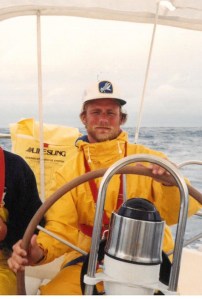 There were trips under sail with my father and brothers. These were tests as well as trips. The ocean makes us foreign to ourselves, our bodies not made to be perpetually wet, and perpetually in motion—shaken and stirred. I have never been anywhere larger than surrounded by sky and ocean, never felt as alive, nor as alone.
 A current meme on Facebook compares what Moms used to say to their kids with what they say now. It is held up as a clarion call to the virtues of yesteryear, when Moms—and their kids—knew what was what. Over and over again, stuff (stuff) like this careens around the internet, in casual banter on news shows, in conversations in my workplaces. Those of us who grew up in the mythical “then” look back with nostalgia, and look at this moment with a jocular disdain. I would like to call “bullshit” on the whole enterprise.
 My mother did what she thought and felt was right. She learned her lessons from her mother and family—and what lessons they were. Some things, she changed. She never leashed us to trees in the front yard. Others were more indelible. I am certain that most of us parent in the same way—sifting through the conscious and unconscious lessons that we received from our parents. What we do, we do almost on a kind of autopilot—in the heat of the moment, dumb memory takes over. Change is hard.
 So much of wit is based on shared experiences. I know I can toss in a “Brian Clements, we love you, get up!” to my friend Brian, and he will smile that wry smile that accompanies a reference to O’Hara. Or proclaim, “Hell, I love everybody!” and he will know what I mean. If I draw my finger across my eye, we have traveled into Bunuel’s fractured mindscape. We share those images and words. I can tell my brother to “Blanket the fucking jib,” and he will know the context. My mother can call me a “Son of a Bitch,” and know the ground upon which she treads. My father would offer a “You have all done very well,” recognizing the provenance of ignorance that surrounded Mr. Grace’s signature line.
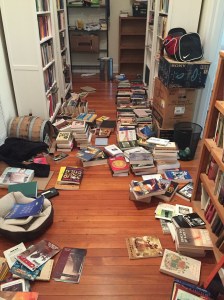 At some point—and it happens fairly quickly—the life of an English teacher becomes more about re-reading than reading. This is a preposterous change from the life of a graduate student, when everything is reading. As a student, there may be a handful of books that one reads a twice, but those are also the books with which one spends an engaged period of time—there is an essay in the offing. If you read them twice, chances are you read them a half dozen or dozen times. By the time you start teaching, the repetition is no longer driven by your desire or directed curiosity, but by a curricular roadmap that more often than not, you have not decided.
 I feel the loss keenly. I am dissatisfied with the too morbid outcomes that serious writers propose, and with the deathly insistence on disconnection and disappointment. And I am dissatisfied with trudging over this same ground over and over again. There must be the possibility of joy, and please, for gods’ sakes, there must be discovery. Which means new works. In “Seymour: An Introduction,” Salinger allows Seymour to give his brother, Bruno, the single best piece of writing advice—and by extension, life advice—I have ever read. It is hopeful. “Imagine the book you most want to read… Now write it.”
 continuoussearch