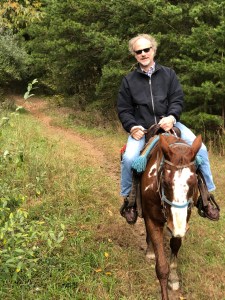
 This past fall, I went horse riding for the first time since I rode at a neighbor’s farm when I was 6 or 7. I rode on a horse named “Old General,” a sleepy footed follower of faster horses, but a step up from a rocking chair. Or so I was told. At one point in the ride, our trail guide asked if we wanted to run. It was actually the second time she had asked us; the first time I had gotten my sense of it. The second time, I was ready. Old General and I dashed, finding speed where it had not been before, and we covered the field ahead of my riding companions. Yes, I am competitive. It was one of the best days I had had in a long time.

The horse made it into the book. Lots of horses made it into the book. I find inspiration where I can, and the museums in Washington DC (the National Gallery of Art and The Smithsonian American Art Museum) include sculptures that snuck into my work. At the very least they gave me ideas that acted as guideposts for the work.
I’m sure that there is some significant invention in this book. I am also certain that I used as much as was provided, whether it was experience or image from the world around me. As far as invention, I recall someone making the claim that all we experience in the first years of life is enough to fill several novels. Perhaps all invention is simply reforging those first few years—shifted through fractured memory.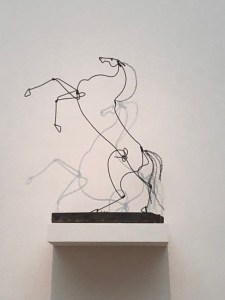
And, perhaps, there are deeper memories, deep from within our genes, stored among things like eye color and height. I know the Celts came from Central Europe and further South in Asia Minor. I wonder what they brought along in their genes, in their deep memories. I wonder if these stories are just what were, once, somewhere. For now, here is the horse, and a ride I will not forget.
“The horses flew through the forests without urging. With no path to follow, they crashed through low hanging limbs of trees, over bushes filled with thorns, and in and out of muddy streams. Their riders crouched low in their saddles, reins held close to the great sweating necks of the stallions. They rode like that, blurs against the dappled light, until the sun had set, and the sliver of the moon had risen, and the lead horse had slowed, finally, to a mere gallop. What pace they had been keeping has no name.
“Behind the other two riders, Thomas rode on the balls of his feet, crouching forward as his companions had done, but lifting himself out of the saddle by inches. The black horse beneath him felt him there, out of the saddle, and remembered a journey made by such a one as this, when she had run eastward toward the sun, when the sun would not rise. Then the rider had guided her to the edge of the world, and with a rope made of salamander skin, impervious to fire, had pulled the sun into the sky, and started the day. After that, it always rose, bright and warm in the east. When Thomas reached down to stroke the neck of the speeding mare, the touch of his hand confirmed the horse’s memory. ‘He has returned.'”
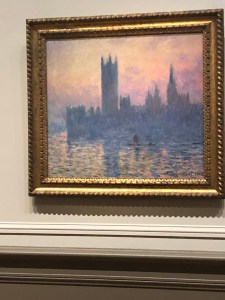 I am looking at a painting made by a French artist of a British building that hangs in an American museum. This seems at once perfectly natural—what else would I be doing? What else would a French artist paint (or an Italian, British, Russian, Afghan, or American)? And where else would a painting be? Of course, this seems only natural because it is what we have become accustomed to, since the time when Ennigaldi-Nanna opened the first museum.

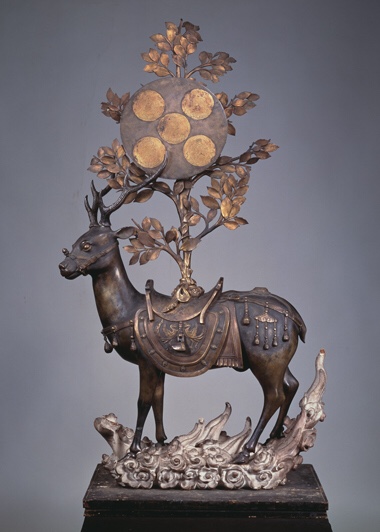 There was a show in the summer of 2019 at the National Gallery of Art, called “The Life of Animals in Japanese Art.” There were several deer, and one of them—not this particular deer—snuck into my work. Whether it stays or not, who knows? For now, here:
 While explaining a quandary I was having as I waded into one of the more difficult portions of my novel, a friend asked, “You’re the writer. Can’t you just make them (your characters) do what you want?” And that, dear reader, is always the rub. Of course, I could, but, even when writing about magical characters (djinn and such), there is no magic wand. Everything must seem real, and if not real, plausible, and if not plausible—if wild and genuinely surprising—then I have to prove it.
 Since the 1987, I have started at least five novels. Some I carried with me for a few months—the story of a wedding, unfolding like the petals of a rose. Others lingered over decades—the story of a woman who stole paintings. None of them lasted beyond seventy or eighty pages, or in the case of the long project, fifteen or twenty starts at initial chapters. I had notebooks full of scenes, outlines, character sketches, dialogue, and thematic connections. All the while I wrote other things. Shorter pieces, poems, prose poems, essays, sermons, children’s stories. Or I wrote nothing at all and suffered in silence. I believe that I was unbearable in those times.
 History is a story of discontinuous events—events that collide like weather systems or galaxies, having barely understood origins, and even less decipherable records. All the witnesses were destroyed in the collision. What they saw, what they thought, and what they felt—even if they recorded their observations on stone, paper, steel, or silicone, have been destroyed along with them. We are living in the age of delusion, in which we believe in the sanctity of our recorded history—either self-scribbled or captured by another.
 Second, in the musical Hamilton (which was also part of this trip to London), the character of George Washington warns Hamilton that we do not control who writes our stories. He’s telling this to a man who believes in his power to literally write his own story—and to use his words to cement his reality. He can’t—and doesn’t. His wife, Eliza, sends his legacy forward—and Lin Manuel Miranda brings us her legacy. But, as Miranda admits in interviews, even this moment for Hamilton—and therefore, for him as well—is provisional and subject to changing tastes and critical opinion.
