“This is the west. When the legend becomes fact, print the legend.”
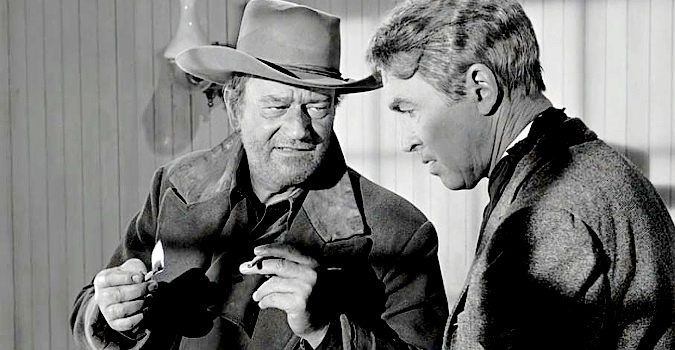
I finally saw John Ford’s The Man Who Shot Liberty Valance. I saw it in a theater, with a fairly full house. I saw it two days after watching Christopher Nolan’s adaptation of The Odyssey, and I was surprised by the similarities in the two movies. Either Ford was making a modern myth, or Nolan was making a mythological Western. I think I’m leaning toward the latter.
Both films center on the personal conflicts of their protagonists: Tom Doniphon and Odysseus. The heroes burn down their homes (literally and figuratively). After what they have done, they can’t go back home. What did they do?
Tom Doniphon lives Shinbone, and life in this frontier outpost is definitely not romantic. Cattle barons hire men to terrorize the townspeople. Tom describes one of these hired guns, Liberty Valance, as “the toughest man south of the Picketwire—next to me.” Except, tough as Tom might be, he does not act to stop Liberty Valance. Only when Ransom Stoddard appears and insists on law (an idea he brings in a satchel full of law books from the somewhere back east), does Tom take action. He kills Valance and lets Ransom take credit, which marks the end of a West governed by rough justice of gunfights, and the beginning of a time of law.
This doesn’t mean that the characters will not pine for that time. The movie begins with Ransom and his wife, Hallie, returning to Shinbone to attend Doniphon’s funeral. Has passed without notice; his body is in a plain pine box and he is remembered by only a handful of the town’s populace. Ransom’s return is news because he has gone onto serve as the unnamed state’s governor and senator, as well as the United States ambassador to Great Britain. When Hallie praises her husband, “It was a wilderness. Now it’s a garden. Aren’t you proud?” She means it. This is an achievement. But she also shows a heavy nostalgia—for Tom and the time that was. I suspect that we feel the same way.
Doniphon’s sacrifice—killing Liberty and giving Ransom the credit—erases him from the movie. He leaves Shinbone, the incipient state, and Hallie (the woman he loves) to Ransom because he knows that Ransom can provide something worth reading and writing about. Except, in the end, what we want to read and write about is heroes like him. His presence looms over all the characters who remember him.Their lives have been diminished by his erasure, even if their lives are better. Tom Doniphon understood the trade.
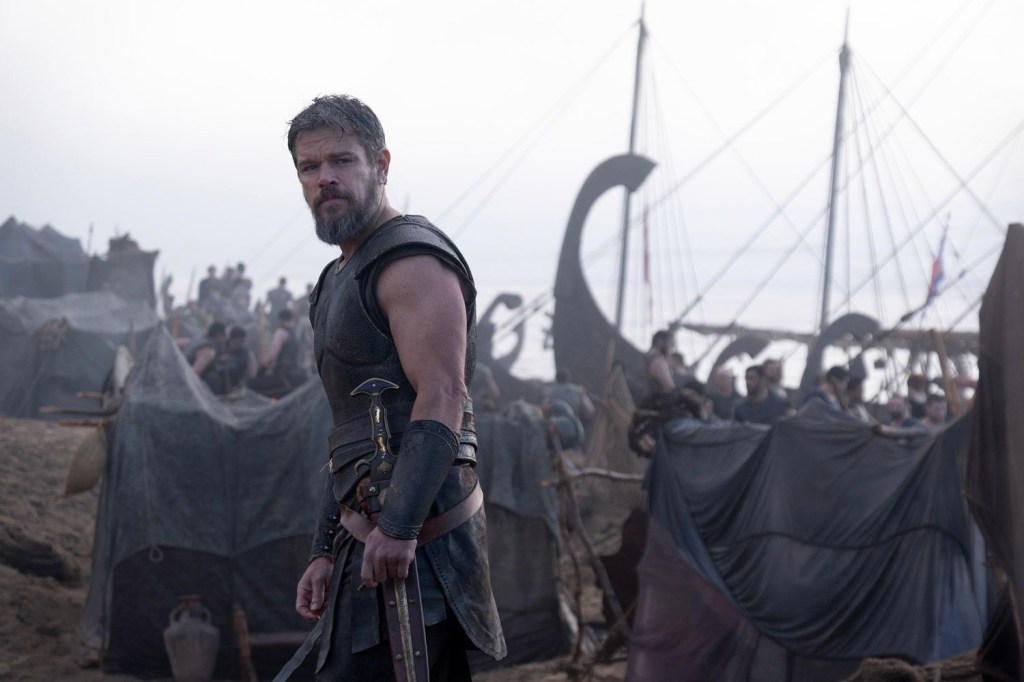
In Nolan’s The Odyssey, a law already exists. Zeus’s law—xenia, the rule of hospitality—declares that “suppliants are sacred” (as Nausicaa reminds her father in the poem). This is an extension of the Homer provides in the poem. “Strangers” and “suppliants” are sacred; Penelope and Telemachus endure the suitors because they are bound by a dictum that all guests be fed. In the poem there are limits. Athena advises Telemachus that if Odysseus returned, “a blood wedding, a quick death would take the lot!” Guests have obligations as well.
Other than Zeus’s law, the gods are mostly absent from the film. Athena appears, but not as the wily trickster-warrior of the poem. Nolan’s film is particularly human-focused, in spite of the presence of the Cyclops, Circe, Charybdis, the sirens, and the armor-clad giant Laestrygonians. These are obstacles mortals must overcome by fight, flight, or sacrifice. Gods do not intercede. Hermes does not provide Odysseus with an herb that protects him from Circe’s potions. Leucothea does not tie her magic scarf around Odysseus’s waist. Athena does not send the salvo of the suitors spears wide of the mark during the slaughter in the hall.
Odysseus and his men are human. They may follow Zeus’s law and they may be aware that Poseidon will punish them for blinding Polyphemus, but they live and suffer in human terms—drowning as they wait inside the horse and needing to forage for food on the way home. On Ithaca rumors of “people from the sea”—not rumors of displeased gods—threaten the peace. And when Tiresias counsels that only the “gods say only you make it home,” Odysseus answers, “Then I defy the gods.”
By limiting the role of the gods, Nolan focuses on human experience. Odysseus bears the costs of war. He questions Agamemnon’s motivation for going to war on Troy, suggesting that is as much for trade as to reclaim the wife (Helen) and honor of Menelaus (Agamemnon’s brother). Calypso drugs Odysseus, first to help heal him, then as a way of keeping him, but also as a kindness. Odysseus’s memories of the sacking of Troy are more of a wound than the physical ones he suffered on the sea.
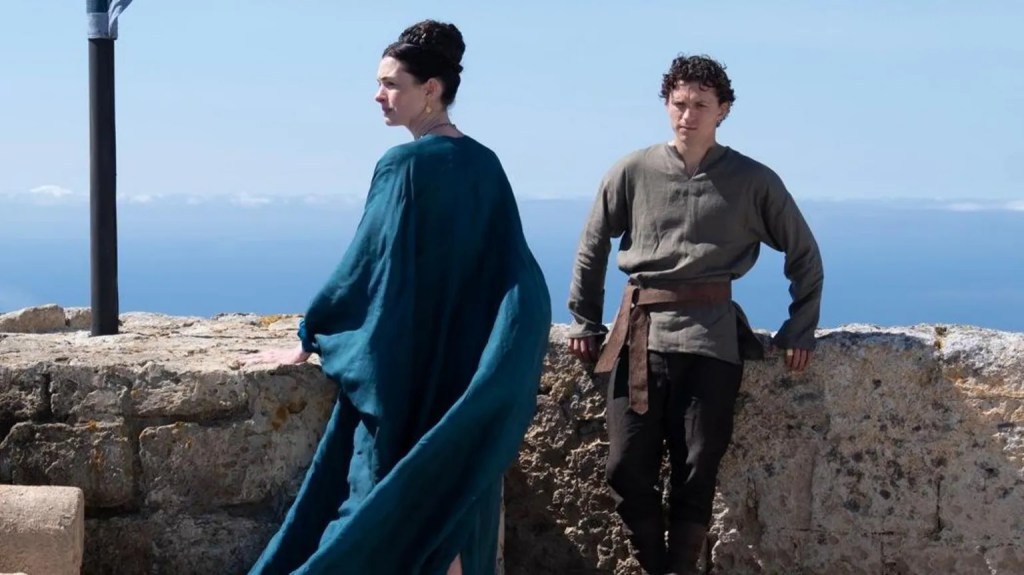
He is much like Tom Doniphon, but unlike Doniphon, he is not preparing the world for a garden. In Nolan’s film Odysseus leaves Ithaca because he feels that he has broken Zeus’s law and not because Telemachus is a better, wiser king. In the poem Odysseus is also charged with an exile/exodus, but this is not a journey toward the west, but inland, to a people who mistake his well-planed oar for a fan to aid in the harvest. Odysseus must make this pilgrimage not to make amends for tricking the Trojans in a way that transgressed Zeus’s law, but because he has failed, repeatedly, to bring the men under his charge back home to Ithaca.
Maybe Telemachus will feel an irrevocable nostalgia for the days when his father could kill the suitors, the same way Hallie, Ransom, and a few others feel nostalgia for Doniphon and the erstwhile wilderness. However, Doniphon and Nolan’s Odysseus both recognize what they have done, and willingly pay the price that their actions demand. Let me note that unlike Ford’s Doniphon, Nolan’s Odysseus is accompanied by Penelope when he leaves his home. Nolan can’t quite make his hero suffer alone.
Comparing these works, Ford’s seems more honest and prescient. We (Americans) still harbor a romanticism about the Wild West, and a predilection for savage displays of strength. He acknowledges the trade Doniphon makes in allowing Ransom to don the mantle of the hero while he leaves the story. In Nolan’s film, Odysseus trades the slaughter of the suitors to give his son a fresh start. However, Telemachus is not ushering in a new law to Ithaca. He is neither visionary nor heroic. Nolan shows him to be a middling fighter at best—well beneath his father’s ability. How will he distinguish himself as king? What has Odysseus’s sacrifice and exile left behind?
Maybe the comparison is unfair, after all these are different films separated by almost 65 years. But they are both movies about legends, law, and sacrifice. Ford shows that after the sacrifices, we can build something new and recognizably better, even if we ache for what was. We have to learn to live with the ache. Nolan’s film shows that there is only loss, that memory is undefeatable. Odysseus and Penelope sail away much as Frodo did at the end of Peter Jackson’s Return of the King, the world saved, but not for him. But what has Odysseus saved in Nolan’s epic? Is there anything worth saving?

