Heeding the Call

Some of my students are aghast at the idea of reading a book a second time, let alone a third or forth, or fifteenth time. The life of a teacher means revisiting books again and again. They become habits. The past dozen years brought steady stops in S.E. Hinton’s The Outsiders and Harper Lee’s To Kill a Mockingbird, Homer’s Odyssey, and maybe Shakespeare’s Macbeth. All became exceedingly familiar territory—terra too cognito—and I welcomed the changes that a change of job and change of curriculum brought this year. I taught half a dozen book I had not read in years. The freshness helped revive my vision.

Of course, repetition is the backbone of study. There isn’t a piece, whether film, book, or painting, that I have not poured over. And over. Some works hold up to repeated visits—this is especially of true of paintings and sculptures. I have sat in front of some paintings for hours, and then gone back a year later to do more. The ability to give concentrated attention to something is a rare quality. And yet, I find myself loosing the fire for return visits and viewings, even for old favorites. How many times can I return to Hamlet, or It’s a Wonderful Life, or Wings of Desire? I know there are things I have not seen, and they call to me.

With spring, my attention is pulled back to baseball, and a group of friends with whom I have played rotisserie baseball for nearly thirty years. I have risen at odd hours when the season began in Japan, as it did again this season. I did not wake to watch early in the morning, but acknowledged the game at arm’s length. I almost did not play our little game this season, almost tired of keeping track of scores and statistics. 162 games and fifteen teams works out to nearly 2500 events to be aware of in some nagging fashion. Enough already.

How much has repetition and routine play a part in life? Too much. At times it seemed that I flew on autopilot, barely aware of the ground beneath me or the time that slipped past, never to return. Sometimes the routine is good—I don’t give more than passing thought to breakfast and lunch when I am busy. I eat the same thing, more or less, day after day. Perhaps my life would be better if I added variations here, but I have had other pressing concerns, like a Stephen Greenblatt essay about Hamlet. There are ways to keep the standards fresh. Still, there must be more.

I changed large parts of my life this past year—there were many reasons, but one was to interrupt the flow that had become too familiar, too easy. I wanted to drive up to a different door—my door. It did not have to be more beautiful—and it wasn’t—it just had to be different. My work as a teacher, although familiar enough, had to take me to different books an different students. And I needed to extricate myself from a years long creative drought. I needed to write to be alive.
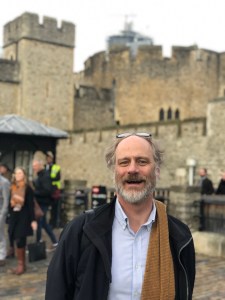
This past December, I traveled to a new place, London, to which I had meant to travel almost thirty years ago. I traveled after I did a series of new things, each one satisfying, but each fueling a desire for more. Almost everything that has been part of the solid ritual of my daily routine tastes bland. I don’t hanker for extremes—a solo sailing venture around the world, or an ascent up some foreboding mountain, or a year in a seraglio—I yearn to encounter something as if for the first time. I wish to be a beginner again, with a clean slate ahead of me.

It will not be. There is much that I cannot jettison (Overboard! Overboard!), and some of which has been central to my life. But to bring my daughter along for the ride. To carry my brave and loving heart into boundless possibility. To write without care for sharp tongued critique. To go, and keep going.

I recognize that when I felt at my best, I was a student, learning, reading, discovering with a vigor that few matched. Right now my writing carries me vigorously to some new place—an undiscovered country that is beyond death—the little death of stagnation and routine, the larger death of a withered soul. I need to find a way to return this more adventurous, more daring, more profound sense of discovery to the rest of my life, to every aspect of my life. To become a masterful student again. Even while I wear the mantle of expert, I am an expert explorer. It is time to honor that. And go.

Perhaps my writing will be enough to answer that call during the long school year. My work feels, for the first time in longer than I care to admit, durable and ecstatic. However, I cannot let anything—or anyone, even myself—keep me from discovery. There must be time for new thoughts, new places, and a new world that will animate my work and revive my old heart. Here—there, and everywhere—I go.
The Books

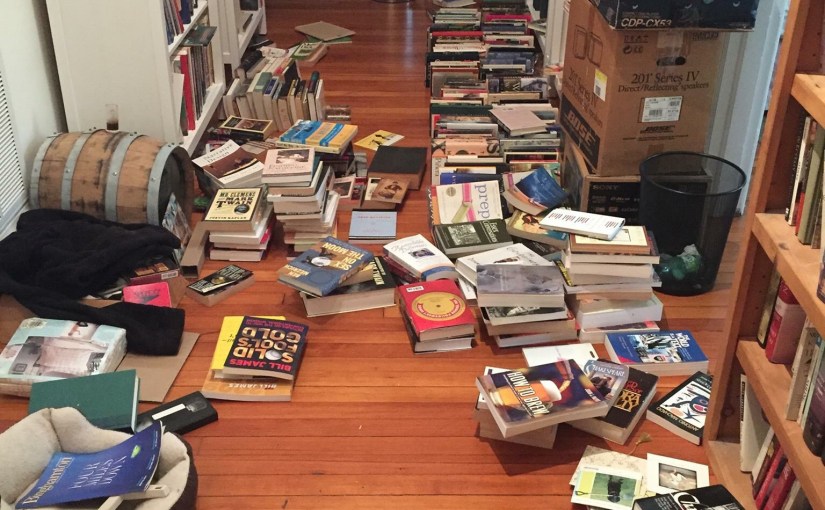
Almost fifteen years ago, I put my books in the attic. They were out, in shelves, but tucked beneath a sloping ceiling and packed behind all manner of family detritus. When my ex-wife and I separated, I moved them into my main living space, where they sang back to me after their—or my—sojourn.  My books matter to me, and I felt their absence. Getting them back onto tall shelves, walking past them every day, reminded me of what I had done, what I had learned, and what I wanted to do with my life and mind.

I have books about writing, books about religion, books about education, history books, philosophy (what we called theory in graduate school), fiction, poetry, books full of art and art history, and even books about sports—mainly baseball. I have a hard cover edition of Dickens published by Chapman and Hall with pages that requires a pocket knife to cut open.  I own a set of Andrew Lang’s color-coded Fairy Tale books.

The books reflect my preoccupations over the past thirty years.  Much of what is on my shelves I first read while I was in graduate school. Some I acquired afterward to keep me in touch with what I spent six years studying. Some comes from undergraduate college—books about gothic art and architecture, an old edition of Joyce’s Portrait of the Artist as a Young Man. There are some newer books that reflect my current interests: a collection of Sumerian mythology, a book about Djinn.

As much as I love my books, as much as they tell a story of my past, as much as they feel like an external manifestation of my mind, I think it may be time to lose them.

How long can one hold onto the past—a past that weighs an actual ton—without moving into the future? Yes, there are some things that I would keep, and this is true of more than my books, but they possess so much gravity. What is the past to me? Of course it is, was, everything. However, the future beckons, and requires a kind of lightness to which things do not lend themselves. Even memorable things.

There are other presences in my life—deep and profound connections. This time last year, I started unraveling the two jobs I had in Norfolk, Virginia. I moved away from those jobs and in the process also moved away from my daughters, who continue to live with their mother in Norfolk. Of course, I separated from and divorced their mother. It may seem inconsequential, but over 30 years ago, I picked a cat off the street, and have had cats ever since. I have never been more than three weeks away from them. This year I considered giving up a long standing fantasy baseball game that I have played for nearly 30 years with friends.

I wonder about what I have given up, but also what I have stayed with over the years. I have been a teacher for over 20 years—including my work as a TA in graduate school, over 25 years. What would it be like to not teach? I wrote for years, and then, if I didn’t stop, I slowed considerably—at what hazard, I cannot guess. I am writing again now, and have been, but can’t help wonder why my work slowed to a trickle.

I wonder would it would be like to be free of obligation and free of the gravity of myself—that ton of books, the closet full of clothes, my job, my family, my cats, even my friends. I wonder what my life would have been like if I had just chased words—the stories that I had declared as my purpose when I went away to and then stayed in graduate school. When I went away to graduate school, I traveled in a single car, with a mattress tied to the roof, and a single cat riding in the passenger seats. What would it be like to travel to what’s next with even less?

I do not regret the life I led, nor the life I lead; regret possesses a gravity greater than all the books own own, and I have no time for that. Not now. Nonetheless, I am aware of another life that exists, not over the horizon, not over the rainbow, but buried deep within me. I don’t know how I have kept it buried for so long, or at what cost—or even at what gain. Still. It is there.

I wonder, and wonder hard, and the wondering stirs something in me, something alive and insistent. What will I carry into the future? What must I carry? And what must I leave?

Writing, Purpose, and Masculinity

I have been struggling with masculinity as of late. Which is to say, struggling with ambition. Or struggling with my career choices. Or struggling with relationship choices. Or, simply struggling. Because I am a man, I am struggling on the somewhat closed field of masculinity. I haven’t always thought of it that way, and yet, there it is. I have avoided masculinity for dozens of reasons.
I have seen more examples of toxicity and hypocrisy among men than anywhere else.  Maybe these are not inherently male traits, but I grew up in a male-dominated environment—which is to say, the world—including four years in an all-male prep school. I have been bullied and been a bully. I have seen puffery masquerade as accomplishment. I have seen might valued over intelligence. I have watched as surface characteristics outshone deeper wells of strength. In To the Lighthouse, when Woolf takes Mr. Ramsay to the cleaners for failing to see the world outside of his carefully constructed “a, b, c…” hierarchy, I knew of what she was writing. But that came later.

After college my father brought me to his company once, to ask his colleagues what career path I should pursue. One of the men counseled, “Don’t go into business.” This was a man my father had often spoken of as one of his few friends at work. This man did not offer an alternate suggestion, just “Don’t.” Then he spoke of a working world in which the soul found no home. That resonated with me. My father was often unhappy after a day of work, and I had seen that unhappiness first hand.

I drew a line between the life of the soul and the world of business and ambition—the world of men.

I spent a number of years in career limbo and ended up managing a restaurant and working 80 hour weeks. Ambition always finds a way, even in limbo, even when one says, “No.” Part of being a man, I suppose, at least this man, was finding my way into positions of authority. During this time, I started writing—the very definition of authority—something I had done in fits and starts in high school then in college. I applied to graduate school in creative writing and was accepted.

So in my late twenties, I became a student of writing and literature. I went all in.  I was never interested in “finding my voice”; I was interested in hitting the metaphorical home run, of, and pardon me for this, catching the big fish.  There was always a bigger fish in the ocean.  Joyce, Woolf, Dickens, Marquez, Dickinson, Whitman, Marquez, and Calvino were among the literary fish that pushed me forward. The critical fish were there too.  Each set out a mark and said, “Meet me here.” And, right or wrong, I chased that mark.

I sought work that broke the hierarchies and offered more possibilities to all. Brilliance the only goal. Brilliance the reward. I reveled. My classmates often complained of this course or that course, or of school altogether. I did not. There was no class—even bibliography—that did not unlock some possibility. My purpose, clear and simple, was to learn and to write.

I was at graduate school at a time when feminism was fully asserting itself, and I allied myself with that movement, in part under the guise of being a creator, which I identified as a feminine act. I was full of it. In the end, I divided the world not between men and women, with all the problematic tangle that came between those energies, but between writers and non-writers. I saw a kinship between Charles Dickens and Jane Gallup. If you know the work, you know what a leap that is. Or, and this is easier, Hélène Cixous and James Joyce. Words held a primal energy for me, an energy that bridged gender and sex. The only ones who could experience jouissance, truly experience it, not simply having it happen, but calling it forth, meeting it, urging it on—if they could—were writers. And so I wrote fervently, seeking a pleasure beyond limits. And I found it.

Now, I realize that I had harnessed a most basic form of male sexual energy, of masculinity. If I had classmates who imagined me in black leather pants, well, there was a reason. I chased something bigger than me, something vital. And chasing is what men do—secretly or not. Part of our deep-seated masculinity drives us to seek—“to bear it out,” as Shakespeare writes, “even to the edge of doom.” What keeps us from doom, from becoming an Ahab (there’s that big fish) is not avoiding the sea and the hunt, just putting up the harpoon and dreaming of what might have been. We must learn to integrate the hunt with the world. We must listen to the world and find an honorable way forth.

I did not. I stopped. I did not stop all at once, but over a series of years. I let more temporary ambitions, often driven by temporary monetary concerns, take precedence. I grew nervous, even cautious. I stepped off the stage. I continued, as I had when I was younger, to find outlets for ambition. They were circumscribed by my career choices, but they persisted. I became principal of a school and, during a crisis at my church, helped hold a congregation together. But I was not doing my life’s work—the thing that brought me joy, even if it did not pay the water bill.

And, as a man, a life without a driving purpose withers. I’m sure this is true for women too. Finally, at 58, I made a change. It was not an easy, nor a secure choice. It is not the final choice I will make along this way. But it is the first step. And I realize that even though I have been writing—fervently, discovering along the way—that I also have things to learn. About me. About the world. And as a man.

London Thoughts

History is a story of discontinuous events—events that collide like weather systems or galaxies, having barely understood origins, and even less decipherable records. All the witnesses were destroyed in the collision. What they saw, what they thought, and what they felt—even if they recorded their observations on stone, paper, steel, or silicone, have been destroyed along with them. We are living in the age of delusion, in which we believe in the sanctity of our recorded history—either self-scribbled or captured by another.

This thought is brought about by two things. First, wandering, quickly—this time—through the British Museum (or Westminster Cathedral, or almost anything else in London), what becomes painfully obvious are the gaps. All these artifacts, so painstakingly arranged create an idea that history is continuous, and has flowed in a linear pattern. And then a closer inspection shows that over and over again, things haven’t come that way. There are sudden breaks in history, when entire empires vanish, or when they change—seemingly overnight—religions, or methods of governance, or technologies, and the old gets swept away, almost as if it was a betrayal of the new.

England as it shifts back and forth between Catholicism and Protestantism bears these marks hard. Or, reading through the story of Ashurbanipal and the claims of glory made by this king reminds me of Shelley’s “Ozymandias.”

Thinking of history reminds me of Stephen Jay Gould’s idea of punctuated equilibrium—evolution proceeding in long quiet periods of little change, and then having sudden outbursts of change. I know, we are taught that slow and steady wins the race, but, we are also taught to believe in the nature of story as an overarching “way things are.” We see things through that frame, and it doesn’t always support the picture inside—or outside—the frame.

Second, in the musical Hamilton (which was also part of this trip to London), the character of George Washington warns Hamilton that we do not control who writes our stories. He’s telling this to a man who believes in his power to literally write his own story—and to use his words to cement his reality. He can’t—and doesn’t. His wife, Eliza, sends his legacy forward—and Lin Manuel Miranda brings us her legacy. But, as Miranda admits in interviews, even this moment for Hamilton—and therefore, for him as well—is provisional and subject to changing tastes and critical opinion.

Does everything disappear? No. There are 2000 year old Roman walls in London. But Rome? Everything can disappear. And we will tell stories that soften the loss.

I wonder, I can’t help but wonder, what I am doing when I write: whose story I am writing? It isn’t my story. Of course it’s my story–as if it could be anything else. Nonetheless, as I write about characters who are 5000 years old–older in some cases–I think about history, because they think about history. How can they not? How can any of us not? It is everywhere–in the streets, and in the faces, here in London.

Mothering and Nostalgia

A current meme on Facebook compares what Moms used to say to their kids with what they say now. It is held up as a clarion call to the virtues of yesteryear, when Moms—and their kids—knew what was what. Over and over again, stuff (stuff) like this careens around the internet, in casual banter on news shows, in conversations in my workplaces. Those of us who grew up in the mythical “then” look back with nostalgia, and look at this moment with a jocular disdain. I would like to call “bullshit” on the whole enterprise.

I don’t now what your mother was like. If she was anything like mine, there were highs and lows. My mother stayed at home with my brothers and me. She bowled in a league. Went shopping. Had bridge parties. Took tennis lessons. She was a den mother for my Cub Scout troop, and took us to the Devault Meat Packing Plant, among other places. Her sons were a handful. She scurried us out at a reasonable time in the morning, set out lunch when it was time, and made dinner for the family. She made us Batman capes for Easter one year; she sewed. I remember her stitching up an injury to one of our cats.

Was she happy? Her happiness was never an issue for us. Nor was our happiness overly attended to. We all were content, which, to my gimlet eye, is a horse of a different color. It was only later, some 13-14 years after I was born that she began to explore art, and then took on the work of a painter, and artist. If she found genuine and durable happiness, it was in that work—and the work of making art is not about easy delight, or even contentment (so says her son, the writer).

My mother did what she thought and felt was right. She learned her lessons from her mother and family—and what lessons they were. Some things, she changed. She never leashed us to trees in the front yard. Others were more indelible. I am certain that most of us parent in the same way—sifting through the conscious and unconscious lessons that we received from our parents. What we do, we do almost on a kind of autopilot—in the heat of the moment, dumb memory takes over. Change is hard.

I cannot and will not say that my childhood was perfect. I can recall exceptional moments on both sides of the ledger. Making a judgment seems beside the point. Here I am now, and I go on. There’s a ton of privilege built into that statement, and I fully recognize exactly how fortunate I am to be where I am, and to have traveled to this point in my life. The choices I can make now—and the way I make those choices—are predicated on the choices of my mother and father. And so on. For ages.

I guess that any time I hear someone pass judgment on another’s parenting—and mothering especially so—in that gross, if semi-benign “Look at the snowflakes” kind of way, I want to yell, “Really? Cast aspersions carefully, oh paragons of perfection!” All those old lessons about the log in your eye and casting the first stone ring out loudly for me. Those are the lessons I remember. Besides, the old joke about walking five miles to school in the snow, uphill, both ways, gives the proper lie to ill-kept nostalgia.

Life, and mothering, are hard. No one needs anyone to chide them for the daily duties. The significant missteps require a different consideration. No more abuse, please. But keep the quibbling to a minimum. Please.

In general, and in a larger sense, I distrust nostalgia. Yes, remember, always remember, but without the haze of candy floss. At heart, I am more focused on where we are going, adapting, and learning—and in passing those lessons on. Have I failed? Indeed. I keep at it. I will fail again. So what? I keep at it. Where I came from is a starting point, but not my destination. Eyes up! Here comes life.

Comedy Tonight

So much of wit is based on shared experiences.  I know I can toss in a “Brian Clements, we love you, get up!” to my friend Brian, and he will smile that wry smile that accompanies a reference to O’Hara. Or proclaim, “Hell, I love everybody!” and he will know what I mean. If I draw my finger across my eye, we have traveled into Bunuel’s fractured mindscape. We share those images and words. I can tell my brother to “Blanket the fucking jib,” and he will know the context. My mother can call me a “Son of a Bitch,” and know the ground upon which she treads. My father would offer a “You have all done very well,” recognizing the provenance of ignorance that surrounded Mr. Grace’s signature line.
My fantasy baseball friends call themselves “lobsters” because 25 years ago, I dubbed us the “League of Blood Sucking Intellectuals,” and one of us couldn’t get “sucking” through the email filter at his job (hard to believe—hehe). So, “Lobsters” we became. One day on the golf course, while following a slow moving group of much older players, I declared that my goal in life was to grow up to become a codger, which elicited chuckles. Maybe because I was already on that road. Or maybe because the bridge to that destination had washed out long ago in my life.

I sit in plays and howl out loud at all the jokes, my laughter more obvious at the jokes no one else gets. I make jokes daily that fall on deaf ears, and that’s because my reference points are in literature and art, and no one knows my plan. If I go for slapstick, there are laughs, or pity (Dr. Brennan, we love you, get up). “Bastard,” or “Rat Bastard” will get broad smiles. Because I am a teacher, I rarely turn my barbs on anyone below me on the food chain—I rather turn myself into shark bait, and perhaps, by example, show the way from chummy ignorance to razor-toothed wisdom. That bridge too stands on uncertain pilings.

I can understand why comics aim for the gut and crotch—there is shared knowledge (fat and thin as it may be) in the bodily functions. And I get it, and laugh at it, up to a point. There is no denying that absurdity of the fleshy slap of desire, or the rumbling gurgle of gluttony. We fuck lustily. We eat heartily. We can dress both up in fantasy, but the actuality is less glorious. And more. The secret is that the middle way is stupid and tiresome. Angels or demons are the way. Humans don’t know enough.

Once upon a time, I read Joyce’s Ulysses, and realized quite quickly, that he was having a ball. My serious classmates scoured the book for meaning, and yet, a big part of the meaning was swaddled in laughter. The great play. Not for them. And so, out went the baby. I do not deny that there is something serious in that book, or that there are books and art and times that are deathly serious—all of them, in fact. But there is play, truly unconscionable and irreverent all the time.

“Dying is easy,” goes the old saw, “Comedy is hard.” Now, we hide the dying, or reverence it out of the sphere of our daily experience. Failure—even for those who practice the dictum, “Fail Harder” (they do so only to achieve a higher form of success)—is fatal, and therefore dirtier than anything else we can imagine—even dirtier than the raunchiest comic’s imagination. And, like death, inevitable. But we do fail, do fall, and do, with mud on our clothes, rise back up, not like zombies—there are plenty of those already manning the parapets—but like humans who have learned that laughter is the key to resilience. It is the joy of the second, third, fourth, and fifth acts.

We may need to banish Jack, but we also need to learn from him. And the Queen will have him back. And even if you don’t know who Jack is, or why he was banished, or which Queen requested the fat man’s return, we know. It may be hard to walk into the room, caked in mud, but given the alternative, here I go, ready to kill it. Again. “Brian Brennan, we love you, get up.”

Echoes and strangers

I went out for bbq at lunch today. The brisket reminded me of my distant friends—eating it, I dine on memories of places as disparate as Taylor, Texas and Owego, New York. Eating in the restaurant with the yellow blazes on the faux wood tables reminded me of the one time I ate here with my daughter, or the meal I ate before chaperoning a dance, and therefore the dance and the evening that followed.

My brain is like that. The past reverberates into the present without effort. There is no stopping it. The pen on my desk reminds me of a dozen trips to office supply stores to buy just that kind of pen. The clipboard brings back the smell of a stationary store in Endicott where I bought narrow ruled yellow legal pads. New things enchant me because they haven’t been imbued with dense and irrevocable histories. For minutes. And then…

This book bag. That smell. The way her voice sounds. Everything.

In many ways, I take solace in being surrounded by memories, and there are some that I purposefully mine. The routine of the same lunch—on most days—reminds me of years of similar lunches from the time I was five—earlier—until just last week—and all the lunches in between. I feel comforted by the way those memories permeate my present so easily.

Others surprise me. They are more angular and disruptive. The sound of a car rushing in the distance—that sharp Doppler shift—triggers an equally effortless, but significantly less welcome memory of a conversation held by the side of a road. Twenty years have passed and yet the resentment stings as it did then. Nothing ages, ripens, or rots.

I have written about the powerful memories associated with places—a rolling set of hills on a road headed north, an intersection with two right turn lanes, a road sign, the curve of a shoreline, a buoy. But, it is everything else as well. All the things. My walls at home are lined with books, and the books speak—not just of what is contained in their pages, but of the times I read them, the places I was, the company that surrounded those moments. And there is more, a gesture, my hand on a doorknob, the sudden turn of my head when I look for something, the way my foot falls on a stair. I am out of myself in a flash, or at least out of this time—even though I know that I am inextricably in it—and another older time surges through me. Even when still, this heartbeat explodes into a thousand, a million other heartbeats, and time collapses.

The only thing that surprises me, seems strange and unconnected from everything else, is my face in the mirror. I almost never recognize myself. Who is this man, and what is he doing in the glass? I wonder. At least there is a scar on my left hand, another on my knee, another on my ankle. These anchor me, but my face is a mystery—and not just because of age. Day by day, for all my life, sitting in a barbershop chair before the mirrored wall, I am a stranger.

And so, beside my own strange face, I also take pleasure in crowds of strange faces, all of whom present unknown avenues, untapped sources of experiences and memories. I know the echoes will come to the strange person I will again be tomorrow.
“I love you”

It’s a common enough occurrence, or at least I hope it is for you. Someone tells you, “I love you.” This seems like a simple enough thing. But I (and I am guessing this is true for some of you as well) did not grow up in a house in which that phrase was bandied about loosely. I do not recall my parents telling each other, “I love you.” Perhaps they did, but they did not in front of us kids.

My father only once told me that he loved my mother, and that was when he chastised me for arguing with her, “She’s my wife, and I love her. She’s always going to be right.” How’s that for a single explicit lesson on love and marriage?

Everything else I figured out on my own—with generous glimpses into the lives of families of my friends and the families of the women I dated over the years. Or movies. We have to learn somewhere.

So, when someone—that someone—tells me “I love you,” I know that there is an appropriate response, something distinctly other than, “That’s nice.” And here, I am distinctly not writing about the first time someone tells me that—I’m writing about months or years of love. Besides, if “That’s nice” is your response, it’s time to move on. You are doing that someone no favors.

First, and this is easy, reply with: “I love you,” or “I love you too.” If possible, touch that person’s hand or arm when you make this response. A simple physical gesture can help punctuate your words.

Maybe this seems too easy. “I want to say more,” you think. How about responding, “Every time you say that, I feel happy”? Imagine telling someone that after ten months or ten years, or, for that matter, ten hundred years. “Every time?” Every time.

Or, you could answer, “I remember the first time you told me that. It thrilled me. It still does.” Perhaps share the particulars of that first time. You remember, don’t you?

If words are not your thing, just stop, and stop them too. No matter where you are, or what you are doing. Take their hand, touch their cheek, kiss them—lightly or deeply as you wish. And then ask them, “Tell me again.”

Confession

I have a confession. I have a terrible time receiving love. I’m sure that this is true of almost everyone, so, I’m reluctant to make any big claim about it.

And yet, that too is a strategy I use to avoid the possibility that you, unknown reader, will not love what I have written. “Oh, god, not another carping complaint. It’s all about him, again. Bastard. Why doesn’t he write about me?”

How quickly I hear disparaging criticism. How even more quickly do I anticipate it. There is virtually no critique that I have not already baked into my work.

“How,” you might imagine, “do you manage to write at all?”

Dear reader, I imagine the same thing.

My creative process is a headlong rush between the giddiness of discovery, and the wrenching feeling of anticipated disdain. When I can hold it in balance, the disdain can provide a critical foil that hones the writing; when it runs wild, my work shrinks to a barely whispered voice. Less. Years have passed.

Harder yet, is when this dynamic creeps into my other parts of my life. Wait, it does not creep. It storms in—jack-booted, kicking down doors, taking the me hostage.

You would think, after 58 years, after a modicum of personal and professional successes, that this would not trouble me. I can be an interminable optimist. The bright red balloon of my heart can soar into possibilities. There is a court jester’s sensibility that makes for easy humor, tinged with sarcasm, but also with an abiding love for the queen (you!) that seeks only to please.

However, I harbor a vision of disconnection and interpersonal doubt that would make Henry David Thoreau or Holden Caulfield seem sunny by comparison. Call it cynicism, or realism (GAH!). When I am at my best, I recognize this darker vision for what it is—a diversion from the bright path that waits. Just. Over. There. And when you are at your best, my heart gladly joins in the song you sing. But when the two of us (or more, and more) sink into dissension and doubt, then I am challenged to rise to my festive best. Then the Hobbesian vision kicks in, and the only reason we find any accord is to put off the never ending war of all against all.

I write, and love, to assert a vision of life that encompasses all the bright possibilities. And that acknowledges the deeper disconnections—not simply disagreements or differences—that drive us apart. I know that there are such divisions, but I believe in the power of writing and love to bind up the old wounds, to forge a new path, and to discover new hope.

Sometimes, all it takes is writing. And that is what I have forgotten too easily over the years. The writing will carry me back to the world of connection, possibility, and yes, love. And so I write, the cloud lifts. The lesson is learned.

Trust

What drives us to claim that someone must “earn” our trust?

Maybe we look at children, and their innocent acceptance of our magical disappearances and reappearances—silly children who haven’t figured out the mystery of object permanence. Or we recall the way dogs will chase the imaginary sticks we have thrown when we hold the actual sticks behind our backs. Dogs are so stupid. Or we remember how Uncle Max had two mistresses—at the same time!—breaking Aunt Sylvia’s heart; how did she not see the signs? Or, or, or…

How many thousand lessons does life provide, proving that if we let our guards down for even a moment, that life will either make fools of us, or render us hapless victims? And earned trust? Surely there are just as many examples when our earned trust was upended like a cheap pine table in an earthquake. We proceed like penurious bankers, giving out loans at interests rates that would humble Rajahs, and still, we are repaid by grief and betrayal. What hope can we have?

How much armor is needed—lead, steel, or titanium—to get us from our bedside to the fringe of the world? Who cares that accident statistics show that SUVs—great exoskeletons that we wear like Gregor Samsa wore his carapace—are more likely to be in a crash than the nimble little roadsters that weave in and out of danger? More armor! More protection!

For what? Wrapped inside a traveling sarcophagus we are pre-entombed—already arrayed for the burial. And trust is just another layer—a shroud that hides a face.

Why not just trust? Why not embrace foolishness, stupidity, Aunt Sylvia’s blissful ignorance (until it finally becomes too much)? How many moments of easy grace do we pass by in the name of incredulity? Protecting our fragile hearts and minds (our bodies are so rarely at risk, and so much easier to protect)? From what?

What price do we pay for the blanket of distrust we wear over our shoulders—leaded, like the dentist’s leaded sheet, to prevent the harmful rays from reaching within? How many more might we more easily trust? What fruits might we more readily sample? What lessons of hope and joy might just as easily fall into our outstretched hands, if we only stretched them out?