The Reader

While I like to write while surrounded by people, once my eyes are on the page, and once my fingers are working, a kind of wall goes up. Writing is solitary. And it is not.

The whole point of writing is for there to be a reader.

Every time I write, I am thinking of you. You could be sitting right behind me at this coffee shop in Gainesville, VA. Or at an internet cafe somewhere in Pakistan. You could be someone I have known for years. Or someone who has stumbled into my work on a whim.

When I write, I imagine myself as that “you.” I am the woman writing about transformation in her blog and that man who took a break from writing about horses and Johnny Cash. I am my daughter, who, perhaps, will look back at this years later when she decides she wants to know something more about her father. And I am you, unknown and unknowable, reading this now. And even you, who I have known, once—maybe for a few glorious months—are still unknown.

These days, I wear reading glasses when I write. The glasses give the letters on the screen crisper definition. When I look up though, the world is blurred. I cannot be focused on the there that is twelve feet away from me and the here that is a ranged configuration of black shapes. Letters. I think of all the alphabets and how arbitrary those shapes are—they stand from left to right or right to left. We see a sequence that shapes the way we read and understand the world as much as the simple shapes try to define that word. Why am I watching those random shapes when other human shapes drift in and out of my blurred vision?

Sometimes, I write for me—not to express my thoughts or feelings, but so that sometime later I can become my own reader. I will remember this person who sat in fairly comfortable, if strange, surroundings, among people who spoke my language and people who spoke other unfamiliar languages. I will remember those who sat with me while I wrote or those who slept in rooms nearby. The strange shapes that I decipher will point me to another time, another me. I will treat whatever is contained in these words as properly strange, belonging to someone who is not me, any more than you are not me.

Plate PlateThere is a plate at the Freer Gallery in Washington DC. Around the rim are an elongated set of letters in Arabic. Even if you knew what those letters meant, would you know about the person who wrote them before the platter was fired in a hundreds of years old kiln? Or what to make of the carved insignias on a Neolithic disc from China? Sometime, 5000 years from now, will these shapes still make sense? Will they point some future reader back to me? Or to anyone else who writes now?

I write to be in the moment. I love the process of getting lost in the words, in trying to connect thoughts and feelings to this electronic scrawl. I loved diving back into the world of the djinn day after day and discovering what he—and all the characters in that book—saw and heard and felt. Writing took me out and away from my self, and gave me a place to visit and revisit.

I  know all too well that the moment does not last. I write ensconced in both the past and the future. Everything I know—59 years of experience—and everything that will open before me—another 59 years?—balances on the self that writes here. Each time, the words bring me back to the self who wrote that fragment, and I keep returning to that self while I work on a particularly long piece of writing. But that self never remains static—returning requires an effort.

The self that writes is almost more like a mask—something and someone stopped in time. I write in and on that mask, but underneath, on my face, in my hands, and in my heart and mind dreams of change and something I have not imagined continue. Last night I dreamed that I was making dinner—a recipe I did not know with someone I did not know. My mind invents and travels and changes. I long to remove the mask, but I accept the part I play. For now.

There will be another mask, just as there will be another dream, just as today’s experiences will shape me. The mask-maker. The writer. The man. And you, also, always. Perhaps you will find your way to here from wherever you are, and you will find your way back to some unknown place. And write.
The Promise of London: A Writer’s Promise

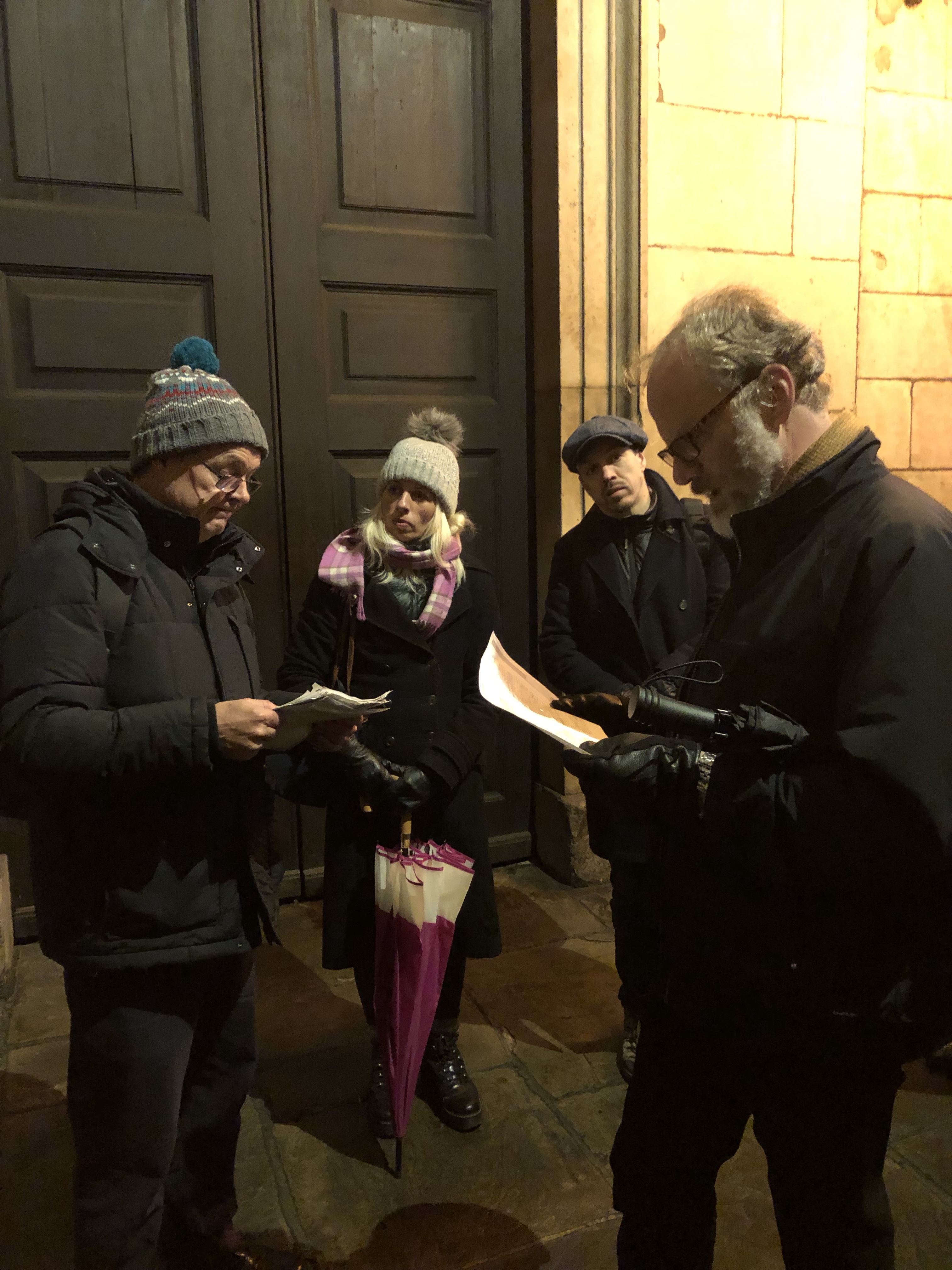
A year ago I was in London. My first night there, it was cold and rainy—the worst weather of my short trip. In spite of that, there was a walk to take—a walking tour of locations connected to Dickens and A Christmas Carol. Only a handful (6? 8 at the most) came out for that walk. At some point in the night, I was recruited to help read from The Pickwick Papers. The walk ended at The George with mulled wine, and guests out of doors in the cold singing.

The memory is happy and sad. I had traveled to London with a woman whom I deeply loved. I had traveled with some amount of trepidation; I knew she had other stars in her eyes, or, at the very least, that she doubted that I was star enough for her eyes. However, London was a promise I had made to myself long ago, and I was fulfilling that promise, or, again, at the very least, making the first steps toward that promise. The trip was a dream and reminded me of why I made that promise years ago.

One part of the promise involved travel. When I was a graduate student, I had been accepted to travel to London to help with a program at my school. I did not go. I had met a woman and thought we were going to be married, so I reneged on my duties and planned a wedding and a life. The marriage did not happen. I stayed in Binghamton for the spring instead of traveling. I promised myself that I would go, and go beyond.

The other part of the promise was to write.

I had gone to Binghamton to be a writer. I began grad school at 28 with only a thin idea of what I wanted to write. To be honest, my idea of myself as a writer was entirely romantic—in that way Shelley’s idea of the poet from In Defense of Poetry is romantic. Such an idea, without a steadily glowing ember of practice, is not sustainable. My writing, though full of hopeful ideas, had not taken proper root. I was a dilettante—determined, but without that obsessive drive that propels most writers. While I was in grad school, I delved into the academic side of my studies—the ideas were thrilling, and it was easier to make headway there.

My first writing workshop focused on short fiction. Although I had written a couple of short stories and read some, especially when I was younger and gobbled up anthologies of supernatural stories, I came to writing because of novels, especially the magical realism of Gabriel Garcia Marquez and Mark Helprin. I wanted big strange things to happen in my work, and for my work to reflect a world in which the impossible was ever-present—if stalwartly and stupidly ignored. I wanted to shine a light on that world. Did I know that then? I do not think that I could have made a clear statement of exactly what I wanted, besides to “be a writer.” That is hardly enough.

I struggled with short work. I wish I could say that I had ten dozen ideas waiting to spring Athena-like from my forehead. I did not. After two years, I somehow cobbled together enough work for a Master’s Thesis, but the work relied too much on retelling stories from my life. I invented nothing. It wasn’t until my third year that I began to find my footing, and then only in the shortest of pieces, prose poems.

While academic writing can flourish jumping from George Chapman to Virginia Woolf to Charles Dickens, from Michel Foucault to Alice Jardine to Judith Butler, creative writing needs a steady—almost boring—focus. You have to sit at the grindstone. You have to want to sit at the grindstone, putting the millstone around your neck the way someone else might blithely doff a silk cravat, tied while running toward a morning meeting, or an afternoon assignation. It’s a damned heavy tie. And there must be something magical and transformative. The words must have the power to change the world.

And here’s the thing—as I have written in some of these posts, obsessive drive was antithetical to my idea of how I wanted to live. I had seen too much obsessive drive and distrusted it. Where some saw vision, I saw blindness. I felt it in myself, especially when I was “in love.” I distrusted the way I experienced romantic love and doubted whether I would be able to love anyone. At 28. I may not have had a clear idea about my writing, but I did have a clear—if wrong-headed—idea about my heart. I had much to learn. Now, I feel called to write every day, and if I do not, I feel the bite of old dogs. If days go by, the dogs grow younger and hungry.

And, I had given up on magic. Are the two things, love and writing, all that separate? Sadly, or happily, for me, they are not.

What happened? Well, this, for one. In January of 2018, I started reflecting on lost bits of my life. I had something to reclaim. It started with reflections on love and what I learned from a selection of movies—some obscure, some well known. Then I started musing on happiness and moving and beginnings and, of course, writing. I had something to reclaim. I explained to a friend that my newfound sense of urgency was the result of losses around me and my own gnawing loss of self. I felt my life slipping away.

What am I to myself

that must be remembered,

insisted upon

so often?

Robert Creeley

One of the early writing lessons was that one had to fight against insistence on anything other than the artistic integrity of the work. Art was all that mattered. Everything else was selfish preoccupation. There is a nascent Buddhism in this practice. Writers must not crave; they must simply let the perfect “be” and then get the hell out of the way. Great writing was, at some level, an act of self-erasure—the presence of absence. Especially when I was a young romantic writer-to-be, this appealed to my innate perfectionism and idealism. In a world full of corrupted motivation and suspect morality, attempting to make something beautiful was honorable. This is part of the elusive call of writing, and of all art. Everyone else must live reined in by the art of the possible: politics and compromise. Writers and artists strive for the unobtainable. Even when we engage the flaws in our work, as often as not we are performing some subtle—or not so subtle—sleight of hand. We are like the carpet weaver adding the imperfection because the perfect is reserved for God alone. Or for Shakespeare.

Which brings me back to London, a city in which Shakespeare’s famous theatre was rebuilt through the efforts of an American actor. When I went to London, I was a month and a half into a novel, and I knew that it would be a novel. I had imagined other work as long as novels before, but this was different. I had never felt drawn into the writing as I had with my book about the djinn. I knew it was going somewhere, and I did not know how it would get there. I was not simply writing about characters who were magical and from the world of enchantment; I was enchanted by the work. I researched djinn as I wrote, and would go back and revise whole sections to suit what I learned while I wrote. I let myself be out of control and let the book go out of my control.

The closest comparisons I can make to this were the feelings I had when I was at the crest of a wave—either on my father’s boat on the Atlantic Ocean or when I was body-surfing off the coast of California. In both cases, I was out of control and exhilarated. I felt the same way in London—that the waves of history, of literature, of streets, of unknown alleyways, and yes, of love could all come crashing down. They could, and some did, and I had to go ahead and throw myself into the waves anyway.

I wonder how this last novel came about so easily, but, really, it did not come easily. It began ages ago and I did not know it. I made a promise. As I gear up for the next, I am surprised that I am finding enchantment. Again. I am also pleasantly surprised that I know, a little, how to uncover enchantment when I need it. I have not needed to travel back to London. And yet, on this day—and if I am honest, every day—I feel the call. I have promises to keep. And miles to go…

What is Enchantment?

At the outset, it is only liking, not understanding, that matters. Gaps in understanding … are not only important, they are perhaps even welcome, like clearings in the woods, the better to allow the heart’s rays to stream out without obstacle. The unlit shadows should remain obscure, which is the very condition of enchantment.

Andre Breton

Enchantment only happens when one is uncertain—when one is drawn to the obscure. Otherwise, there is no spell. Affirmation shines a light on what we already knew. Or, at the very least, what we thought we knew. Enchantment takes us into the shadows.

Yes, some will call confirmation or affirmation by the name of “enchantment.” They mistake the feeling of returning home with walking, almost asleep, into the unknown.

The condition of enchantment requires that we are pulled out of our shoes toward something on which we will walk bare-footed, but cannot see. Will our feet be cut or burnt? Yes. Will the road be rough? Yes. Or will we float, unable to touch the ground, yearning for the familiar in spite of our flight? Yes. We will like the flight, but will not understand how we suddenly sprang out of our shoes. Who untied our laces? Am I still wearing socks? Do I have wings? Look down and behind yourself and be prepared for an answer you did not imagine.

Enchantment calls you out of yourself, possesses you, and makes the world new and strange. And in doing so, makes you new and strange to yourself.

Who would dare enchantment? Who would step out into the unknown, girded only with some semblance of a suddenly out of date idea of oneself? By slips and stumbles one finds something—or is found by something. Either way, because without a self to cling to—why hold fast to the raft when one might grow gills?—the world becomes the self. Enchantment makes me match the call of the world. Be all of this.

And so, I take the obscure way. Enchanted. It waits and welcomes me.

Breaking Up with a Novel, Falling in Love with the Next One

So, your brain works like this when you begin a relationship: a steady stream of oxytocin lasts about two years and gets you through the infatuation stage. During that time, you are giddily in love, and you do the due diligence (or you don’t) that gets you to something more lasting, something, possibly, permanent.

img_0009
Oxytocin

Here’s the trick. If you are still working on a novel after two years, it is time to throw it overboard. No, seriously. Part of what gets a reader to pass into the dream you wrote is a similar flood of hormones. Reading requires infatuation. Yes, you can pack a novel with drama and with exotic wildness, but somehow, somewhere the depth of infatuation a writer feels for his or her work will emanate from the page and enchant the reader. Or it will not–keep in mind that each reader will be enchanted with something different. But we tend to fall in love with willing partners. Enchantment breeds enchantment.

Novelists are oxytocin junkies. We fall in love—or we fall in love enough—to write and write against all expectation of a result, daftly believing in what we are doing in spite of no promise of permanence. And then, when we finish, we move on—or try to. Some novelists visit and revisit characters, unable to move on. There are a number of reasons: security (this stuff was published once, so why not try again?); habit (I already know these characters, this time and place); anxiety (how will I find another novel to write? I’ll just do this again—sort of).

Great novelists work the same material over and over. Think of all the orphans in Dickens, or all of his switched and hidden identities. Or all the women negotiating lives surrounded by powerful if vision-impaired men in Woolf. Faulkner built Yoknapatawpha County and then inhabited and re-inhabited it again and again. Maybe J.K. Rowling knew that she was beginning a 7 volume world at the start, but how could commercial success not have impacted that world? I could go on.

I could just as easily line up novelists who produced one, maybe two books and then stopped. Might I suggest that they were not prepared for the jarring and harrowing experience of finishing a book—of feeling bereft, broken up with? Their lives were intertwined with that book. It had been the one (as it should be, as it must be!). Yet, once the flow of oxytocin stopped, that’s where they were. Done. And done.

Would falling in love with the process be a solution? You get the oxytocin for two years, it doesn’t matter what—or who—you fall in love with. After the infatuation, you have to learn another way to love. Something more indelible. Love your process like that. I have been writing every day for years—fits and starts, fiction and nonfiction. I used it as a base on which I found a more fiery, single love (that book). After finishing it, I crashed hard, but I also had the writing, some kind of writing, to propel me forward.

I will find another, brighter love as I go forward. Another novel beckons. Before I berate myself too much for the difficulty of beginning the next, I must acknowledge that I am still haunted by the ghost of the last. My brain misses the rush of turning to those words, those characters, those places. So to will your brain. Be ready. It’s just the oxytocin. Just.

And so, I revisit places—the Calders at the National Gallery of Art remind me of the value of clean lines, whimsy, and balance (always balance!). In spite of the heartache, there is beauty—beauty made by hands, not simply discovered in nature. Although that beauty too—the changing fall colors, the scent of the season even as I walk on the National Mall—fills my sails with new wind.
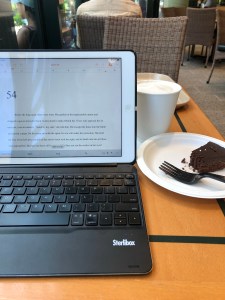
I take my iPad to bed and write as I imagine Proust did, propped up among the pillows. If only the cats would bring me coffee. I have a table in a library on which I arrange my materials, and where I make progress. I wait for the next rush of crust-breaking hormones, chipping away with sad hands until that day arrives—when the glimmer becomes a fire again. I am ready.

500 pages

I graduated from SUNY-Binghamton with a Ph.D. in English Literature/Creative Writing in 1994. Before I went to graduate school, I did not know what I wanted to be. I had written a little earlier in life, and had taken a fiction workshop while I was an undergraduate, but my sense of myself as a writer was hazy at best. Still, I had done some work and I applied to writing programs in the spring of 1988. I was accepted at Binghamton.

While I was in graduate school, I wrote stories, a novel that I shelved, some poetry, and essays. I also wrote a slew of academic papers. Mostly, I read furiously and widely, delving into a world of literature and philosophy that had not existed for me before I began this turn in my life. I still have many of the books that I read in those six years and they are either a bulwark or an anchor. Now, they seem more like part of a wall that divided my life into the time when I did not write, the time I discovered writing, and the time I stopped writing.

That time ended in 2018 when I considered moving away from family and the jobs I held in Norfolk. I had been separated and divorced for four years. Calamity at one of my jobs resonated in my life. I was at sea. I needed to find a ground that was not defined by the needs and desires of other people. I needed, frankly, to be selfish and directed. I do not believe that it is a surprise (to me at least) that my colleagues sent me packing with the book, The Subtle Art of Not Giving a Fuck when I left in August of 2018. Message received.

Because I did give a fuck — too many fucks — not just in my professional work and personal life, but in my writing. Unlike some of my one time classmates, I felt called to writing not so much because I had a need to express myself, but almost in spite of any need to exclaim, “Here I am!” I was obsessed with getting at some ineffable and intractable truth that existed outside my narrow sense of self. I wrote with an evangelical zeal. Can I say that art motivated by such a keening has little easy air to breathe? It does not. My stories, even when they were fantastic, needed to tread more often on the ground.

When I started writing this blog in 2014, I was in China to adopt my daughter. I started to write about simple human truths that were grounded in my simple human experiences. I hoped that my observations would have some resonance with others, but I wrote without too much of a concern for an audience. The work proceeded in fits and starts after that initial push. And then it flared into this—a daily practice of reflection and direction. That fire lit the flame of the novel I finished in August and has carried me into a second.

My writing projects since May of 2018 have produced over 500 pages of words. Some are good. Some are better. My nonfiction has been largely about my writing and writing in general. My fiction has just been a story about a Djinn, almost a retelling of an older—much older—story, with some of my preoccupations thrown in for good measure.

Writing (fiction and nonfiction) has felt revivifying. I have enjoyed the deeper reflection and playful invention. The writing has come more easily and far more consistently than anything else and at any time I have ever written. Ever. I have looked forward to the task and have left it—whether I write for an hour or the better part of a day—feeling replenished. More will—and does—come.

When I shared this insight—500 pages! More is coming!—with a friend, I did so with the proviso: “in spite of the past year.” She corrected me: “Because of it.” Perhaps so. Perhaps I spent the past year and a half knocking myself off my moorings just so that I could get this work done, just so that I could reclaim all that I had feared was lost.

I told another friend that I felt a kind of urgency to write. She worried that I was ill or distressed. Yes, I have been distressed. Old wounds have haunted me and focused my attention. I have allowed them the space to heal. And have used the writing to help me heal.

While the writing has helped me gird myself against that distress, it has also allowed me to wrap myself in joy. I feel that joy more profoundly now than when I was starting out some thirty years ago. The old uncertainties have fallen away. I do not ask, “Is it good enough? Will there be another? Do I have the right?” Instead, I take solace in a more durable method that suits my heart and mind. I go this way.

Why the Djinn?

A friend asked where I got the idea for the Djinn. Here is the long story.

I wrote poems when I was in ninth and tenth grade. They were lengthy works with regular rhythm and rhyme. They told stories. Men turned into dogs. Warriors battled ferociously. Queens and princesses sent boys on impossible quests. When I asked my school to allow me to do an independent study in poetry writing, I was turned down, but one of my teachers suggested working with him to write sonnets and other formal verse. He might have suggested an early round of talk therapy. Stung by early rejection, I refused his offer.

Every night before I fell asleep, I made up stories and told them in my mind. They reflected the source material I grew up with—books of myth and tales that I found in the Schuylkill School Library; comic books that my father doled out on trips to my grandparents; anthologies compiled by Rod Serling that I bought at book fairs.

I did not start reading adult novels until I was in 7th grade and a friend lent me his copy of The Guns of Navarone, after which I read everything that Alastair MacLean wrote. I made a mad dash through Kurt Vonnegut in 8th grade. I read all of Ursula K. LeGuin’s books before 9th grade. All this is a fairly slim bit of literature. My parents were not big readers—we had collections of Reader’s Digest Condensed Novels on our few bookshelves. My mother did read to us, sharing Beowulf and Poe stories. But we were not a bookish family. My brothers and I found what we looked for with relatively little guidance.

I was an able enough reader in high school, but short of Billy Budd, little of what I read stuck with me. On my own, I read all of Neil Simon’s plays, and other plays, and took up with science fiction and fantasy (Asimov, Tolkien, and a little known writer named Zenna Henderson). I read and reread Robin Graham’s account of his trip around the world, Dove. Mostly, I spent long hours listening to progressive rock, watching old movies, swimming, and driving the family car as far and as fast as I could.

In college, I discovered William Blake, James Joyce, Thomas Hardy, Henry James, and Gustave Flaubert. It was also when I read all of John Le Carre’s spy novels, The Joy of Sex, and the only Daniell Steel novel that ever passed my way—The Promise. The main focus of English Literature courses was exposure to more—and I share the story of having a short novel assigned between a Tuesday and Thursday class with my students now. I read widely and gleaned what I could as quickly as I could. I discovered that after reading Portrait of a Lady, my sentences changed. They were better: complicated and analytical.

In my junior year, I switched focus to Art History (same deal: memorize as many works of art—in order and with an understanding of importance—as fast as possible), which, fortunately included a Cinema class that greatly expanded my limited knowledge of film.

I started writing fiction in college, and was accepted into a workshop in my senior year. After graduation, I began an espionage novel that had something to do with Monet’s Haystack paintings in the Hermitage, in St, Petersburg. I fiddled with a story about a baseball player. I wrote a few chapters of something about two friends who decided to go to college and pretended that they were ten years younger than they were.

I had a sense of the novel, and novel length stories, but at this point in my life, I had only read a few hundred novels. I had never heard anyone explain rising action or a three act structure. I grasped scenes and could understand the books in an intuitive and intimate way. I wrote into the unknown without a plan, without having any idea of where to go, or what to do.

When I was 28, I went to graduate school to study writing, and even there the basics were not tended to. What I knew of Freitag’s pyramid, I garnered from John Barth’s “Lost in the Funhouse.” But fiction had never been about plot as much as characters and feelings. Maybe because I had never been drawn to plot. I often knew in a page or two what was going to happen in a novel—not the exact details but I could chart the end of the rainbow from the first curve of the arc.

So, what does any of this have to do with Djinn? I suspect that strains of all this—and of all the events of my life to date—appear in this work. Mainly, there is the myth, the early fascination with and appreciation of the fantastic as a genre, and the long interest in things that were away from here.

I encountered the djinn—as genies—in Sinbad and the Tales of the 1001 Nights. A widow who lived next door to us had those books. This book re-entered my life while I was in graduate school, in large part because of John Barth’s insistence on non-western sources of and for stories. But also because, once I encountered the djinn (or jinn), I was impressed by their wiliness and cruelty. I wondered—right or wrong—whether they had been mis-portrayed by the writer of the 1001 Nights. Why would such power need to be cruel? To refer back to Blake—“…what shoulder & what art,/ Could twist the sinews of thy heart?” I wondered. But I did not pursue the djinn, not yet.

I wrote in other ways. Although I have a set of prose poems set in Philadelphia that delve into the fantastic, I followed the realist tropes of my time. Perhaps this is what kept me from finishing—I was writing away from the story in my heart. Last year, when I dropped everything to take on new responsibilities—to myself and my work—I set aside the piece I had feverishly labored over for over ten years. During that ten years, I had written down a brief thought about a character who was keeping a secret (secrets will be something I grapple with forever). Five years ago, I was waiting for friends in a Mexican restaurant, and dashed out to buy a composition book, wrote a couple of pages before they arrived , and promptly forgot the book at the restaurant.

That story became the story of the Djinn.

I was dating a woman who shared my appreciation for the 1001 Nights—you have a copy too?—and that was enough of a spark to light the fire in this book, because the kindling, and the logs, had been waiting all these many years. Suddenly, I had a character whose secret was so closely held that he did not even know he was keeping it. He had forgotten that he was a Djinn.

There are other connections to other parts of my life and my studies that fueled this fire. Some of those will remain secret. Others are perhaps too obvious for me to mention here. For those of you who wonder how novels—or anything—gets written—by others or by your own hand—the short answer is that we tell the stories that enchant us. The shorter answer is that we sit down and write every day. No matter what. Perhaps because we are enchanted and under some infernal command—I wish that you write a novel, Djinn. So be it.

Routine

Every Sunday, save for one or two while I was traveling, since April, I have wandered through the various art galleries on the National Mall. I carried my notebook with me, and wrote. There was something invigorating about being in the presence of beautifully made things—whether a drinking horn from the 6th century BCE, or a bronze horse from the late 20th century. Bits and pieces of what I saw inspired my writing, which was about an entirely different time and place.

The routine gave me something to anticipate each week while I was in the middle of my project. The two hours—one spent driving in, another on the way back—were worth the result. I found favorite places and favorite works. Monet’s painting of the Houses of Parliament has been a touchstone on these trips. It reminds me of an early interest in his work, of travels I have since taken, and of an approach to work that I have come to appreciate more and more. Partly that approach means honoring the routine, no matter what.

Routine seems like it would be the antithesis of inspiration. Think of the ways we denigrate the grind or the slog of work. Or the way we quote Emerson: “Consistency is the hobgoblin of little minds.” However, I would point out that Emerson nails “A foolish consistency,” not all consistency. I would hazard that there is a wise consistency to be found as well. Like wisdom, it is hard-earned, and requires a kind of flexibility. For instance, when my daughter came to visit, I did not insist on making my weekly sojourn because other plans (a trip to see our family) interrupted my routine. Or last week, when I took a day off (my rough draft was done, and I felt spent), I granted myself some quiet time.

This week, I am back at it though. The sun is once more setting behind the Houses of Parliament, and I have walked about half the distance I will walk the rest of a cloudy day in Washington DC. And I am writing—this now, but the revision continues apace. My routine will be important in the coming months because school has begun again, and without some carefully delineated routines, schoolwork can too easily consume time. Teacher’s always feel as if they could do more—one more brilliantly placed comment on an essay, one more after school event, one more meeting, all while managing the daily preparation. I will get to the gym—the body work supports the brain work. And I will set aside an hour (more as needed) a day to write. I will guard my sleep.

And, I hate to admit this, I will do less of other things. Some were just distractions (Sunday Morning News shows), others (dating) brought joy with the distraction. Like it or not, the wise routine will preclude even delightful entanglements—at least until the process of getting to a final draft (agent, publisher) wraps up. And, of course, the next book is waiting.

I’m not sure what I will find on the way ahead. I know that I will rely on my routines to get me through the uncertain times. And I will seek wisdom, and a wise consistency as I go. Inspiration this way waits.

Resentment

There is always regret when one has not done not just what one has wanted to do, but has dreamed of all of their lives. “If only I had started sooner,” regret whispers. “If only I had not taken that job, moved to that city, loved that person.” Regret is a whispered siren’s song, and it can lead one toward a sadness that is disastrous to the work.

Regret has a companion emotion, and once one figures out exactly what one needs to do, this other emotion can assert itself in awful ways. This emotion is resentment. Anything—everything—that does not help us attain our vision—our purpose—can cause us to feel resentment. For instance: a job that takes our time—our necessary and limited time—even if that job is fulfilling and valuable. Even if that job pays the bills. Our family can cause feelings of resentment. This is a deep dark secret: the people we love can be the people who awaken resentment in us. Because they ask—as they are entitled—for our most precious resources: our imagination, our patience, our time; our essential necessary energy to do the work at hand. And this is terrible. No one wants to resent for their family or loved ones. And yet, we do.

Anything—everything—that takes away from the energy needed to do the creative work that gives our lives meaning cause resentment. One must learn to carve out sufficient time to be fully engaged and to spend the energy at the work required to fulfill one’s purpose. This is true in any circumstance—with or without family, with or without loved ones, and with or without other work. Once one sees what can be done, one must change one’s life to fulfill one’s purpose.

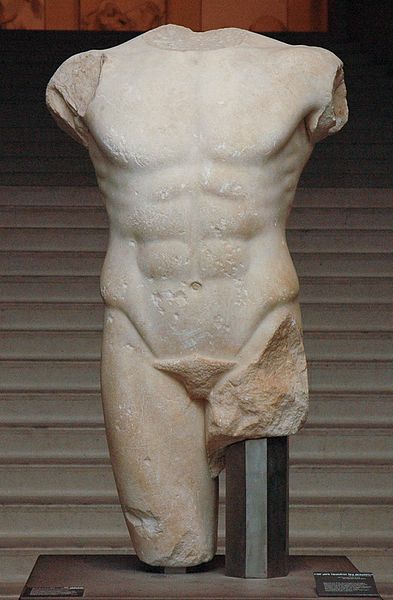
Archaic Torso of Apollo

However, resentment is not located in those other places. Neither my child, nor my job, nor anyone else in my life is the actual wellspring of resentment. It comes from me. Of course there are stupid little human annoyances—the woman who sliced into the left lane ahead of me on I-95 today, then just as abruptly, sliced back through traffic across two lanes to make a sudden right exit. The anger caused by such behaviors only lingers for so long. Resentment comes from an inward driven anger that sharpens regret and turns it back out to the world. The clearest targets are those who are nearest us.

Yes, there may be times when those close to us do ask us to stop our most purposeful work for reasons that are worthy of resentment. They may question your sense of self, and cast aspersions on your work and aspirations. Sometimes people cannot escape the deep-seated injuries and resulting resentments that their injuries caused, and they struggle, not with themselves, but with you. Just as you may struggle with resentment. Just as I have struggled. And one must escape that false judgment, and not validate it in any way. For the most part, we are the main manufacturers of our own grief. We stop ourselves. We foist anger on ourselves and take handfuls of earth and shower ourselves in dirt. We manifest an anger that eats us from within.

I am not suggesting that one should not be angry. Anger can be a source of energy, a goad to action when complacency or sadness or depression has settled too deeply on the creative mind. I let that anger into my work—allowing characters to taste it and spit it where it needs to land. So too with me, I learn, daily, the difference between anger caused by genuine external sources and that which has simply emanated from some ancient sun within me.

When I feel resentment, I check my sources first, and realize that, more likely than not, that I am not doing what I need to do. I am not tending my work and my purpose as I should. I have taken—for reasons at once honorable and misguided—someone else’s charge and anger as my own. I put it down, gently, if I can, and get back to work. The way forward—to fulfillment, to joy—is here.

The Vision before the Travel

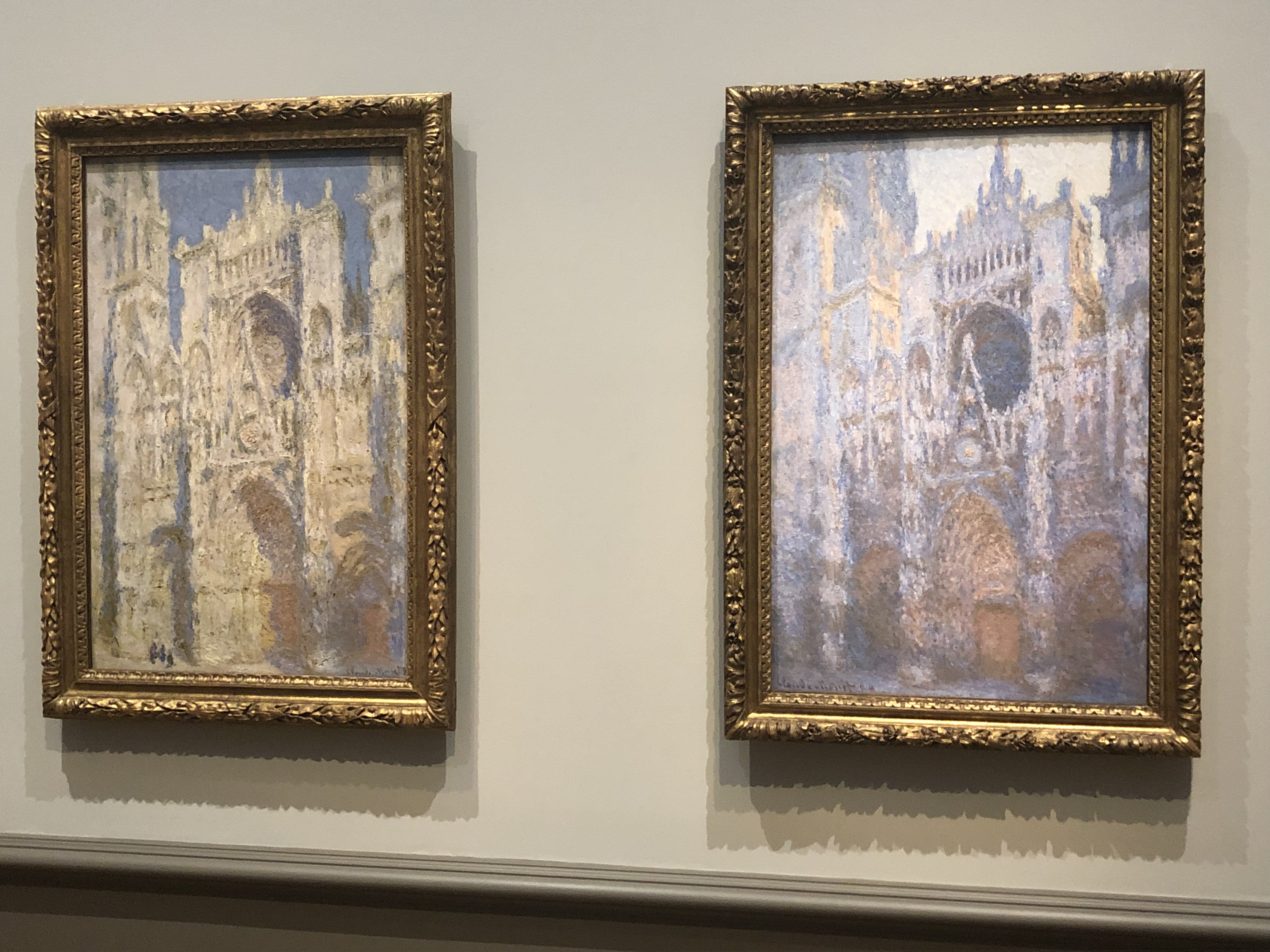
It seems impossible to me that when I finally see the cathedral at Rouen, I will already know the shadows of the late afternoon sun, and the way the morning light illuminates its porticos. How much of the world do I already know through the eyes of artists—the representations and words of painters and writers?

And not just buildings, but people as well. How have Uriah Heep, and Cassius, and Peter Walsh shaped my understanding of certain kinds of men? Or the countless representations of “The Man of Sorrows”?

If I have not traveled, I have imagined, and born witness to hundreds—no, thousands, more—of depictions of the world. I know that I have only traveled through the eyes and thoughts of others, but what others!

And yes, each place I have traveled enters my work, makes it larger, gives me insight to reveal some feeling in each of my characters. However, the travel out into the world is like practice for the travel I must do into the imaginary world I wish to create. I write, again and again, about the gifts that the universe provides, but, in the end, I must make something of them. I must use my imagination to recreate the world.

Which brings me back to the two views of the Rouen Cathedral by Monet at the National Gallery of Art—and all the other renditions I have seen in books and projected onto screens. I see these, and begin to build—in my mind, based on all the cathedrals I have seen in my travels, on all the slants of light, on all the play of clouds—a vision that will become my own. I look forward to seeing the actual building—soon! soon!—but I also know that it exists, somewhere, in my mind already.

Horses: Memory and Inspiration

This past fall, I went horse riding for the first time since I rode at a neighbor’s farm when I was 6 or 7. I rode on a horse named “Old General,” a sleepy footed follower of faster horses, but a step up from a rocking chair. Or so I was told. At one point in the ride, our trail guide asked if we wanted to run. It was actually the second time she had asked us; the first time I had gotten my sense of it. The second time, I was ready. Old General and I dashed, finding speed where it had not been before, and we covered the field ahead of my riding companions. Yes, I am competitive. It was one of the best days I had had in a long time.

Deborah Butterfield, Smithsonian American Art Museum

The horse made it into the book. Lots of horses made it into the book. I find inspiration where I can, and the museums in Washington DC (the National Gallery of Art and The Smithsonian American Art Museum) include sculptures that snuck into my work. At the very least they gave me ideas that acted as guideposts for the work.

I’m sure that there is some significant invention in this book. I am also certain that I used as much as was provided, whether it was experience or image from the world around me. As far as invention, I recall someone making the claim that all we experience in the first years of life is enough to fill several novels. Perhaps all invention is simply reforging those first few years—shifted through fractured memory.Alexander Calder, National Gallery of Art

Alexander Calder, National Gallery of Art

And, perhaps, there are deeper memories, deep from within our genes, stored among things like eye color and height. I know the Celts came from Central Europe and further South in Asia Minor. I wonder what they brought along in their genes, in their deep memories. I wonder if these stories are just what were, once, somewhere. For now, here is the horse, and a ride I will not forget.

“The horses flew through the forests without urging. With no path to follow, they crashed through low hanging limbs of trees, over bushes filled with thorns, and in and out of muddy streams. Their riders crouched low in their saddles, reins held close to the great sweating necks of the stallions. They rode like that, blurs against the dappled light, until the sun had set, and the sliver of the moon had risen, and the lead horse had slowed, finally, to a mere gallop. What pace they had been keeping has no name.

“Behind the other two riders, Thomas rode on the balls of his feet, crouching forward as his companions had done, but lifting himself out of the saddle by inches. The black horse beneath him felt him there, out of the saddle, and remembered a journey made by such a one as this, when she had run eastward toward the sun, when the sun would not rise. Then the rider had guided her to the edge of the world, and with a rope made of salamander skin, impervious to fire, had pulled the sun into the sky, and started the day. After that, it always rose, bright and warm in the east. When Thomas reached down to stroke the neck of the speeding mare, the touch of his hand confirmed the horse’s memory. ‘He has returned.'”