The Weight of Words

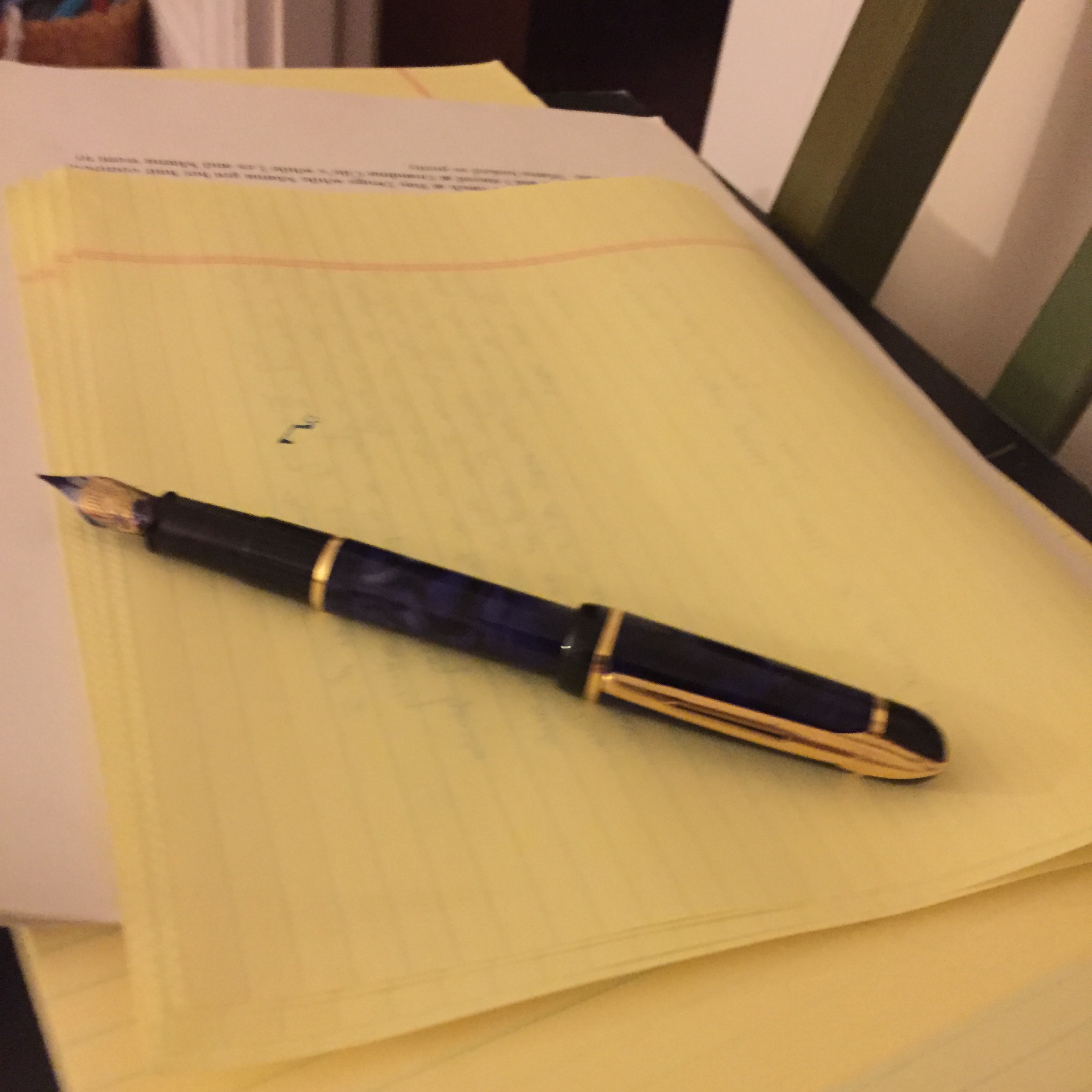
The thing about writing that some people will never understand is that for the writer, it is not cerebral. Writing is physical. I feel exhausted, physically spent, after writing. Not exactly the same as after a work out, or after a night of intimacy, but I will push myself until my body shakes. I stop when I am done, when I have hit a physical limit. I do not believe that people who do not write, seriously write, understand this.

I’m not speaking out of my hat on this. I know about physical limits and I have tested mine. When I was younger, I swam seven hours a day (over three separate workouts). When I was older, I took the helm and held it until for days until storms had passed, even when I was seasick and retching over the stern, even when I had a broken rib. I am aware of myself as a physical being. I know where my limits are, and how to push up to and extend them.

Part of the physicality of writing comes from the sound. When I write, each word resonates. It is like being inside a drum, or suspended in the bell of a trombone. My mind is noisy when I write—not scattered, but genuinely full of noise. And like a conductor, my arms are keeping all the sounds organized, on time, in concert.

Writing calls a world into being. There are no phantoms, no shadows. Each image, every idea, is made real, is pulled from some grey other world into this one. Some ideas and images do not come easily, but must be coaxed, yanked, or held gently—each needs to be evoked and tended in its own particular way—the same way each child needs just this much attention, just this much encouragement. But when they come, what joy.

Sometimes, I have to stop, slow my heart, and wait. I can feel the words begin to come along the inside of my arms, deep in my thighs, in my chest. They shorten my breath and turn my feet unusually cold, almost the only time I feel an actual chill—I am a warm man.

And, well do I know how I become a better writer when I move—when I take long walks, or spend a few thousand yards in the pool, or push my heart rate above 180 beats per minute. Because the writing is physical, and the words have a weight, beyond the blinking cursor on the screen.

Back to the Forge: Learning from Portrait of the Artist as a Young Man

I revisit texts—novels, stories, plays, and poems—with joy. They stand as mileposts, as reminders of the paths I have walked. I have not always enjoyed this journey, but it has been my journey. No one else has walked this path. I have never wanted it to end, even when the trails of my imagination have become untended and overrun with weeds, when it seemed too difficult a task to return to those paths, to follow where they led, to cut new ways into the wilderness.

The mileposts that speak loudest to me are those that recall not simply the distance but the method of travel. How many times have I dipped into Whitman to find a way I thought I had lost? Perhaps not enough. Or the more diminutive Dickinson, who reminds me of the power of possibility? I re-encounter Prospero every few years, not yet ready to cast my books of power into watery graves.

The first time I read Joyce’s Portrait of the Artist as a Young Man, I was 20, a junior in college. I read it in one furious sitting, rushing as was the case in undergraduate school. The book shot through me—the sermons in the third chapter frightened me, and the ending befuddled me.  I had not written since the rhyming verse I attempted in high school. It would be a year before I started to cobble together my own stories.

I encountered it again when I was 28, and in my first year of graduate school. I wrote every day and was just learning to read by making connections—or rather, by freeing my mind to read as expansively as possible. I did not see a mirror in Stephen Dedalus, not yet, but I saw how Joyce was beginning to challenge the reader, and followed his challenge into Ulysses, and peered obliquely at Finnegan’s Wake. Reading Joyce intoxicated me—all the word play, all the allusions, all the swirl of events. This is how my brain worked, and I felt a kindred spirit at play in Joyce. Perhaps this was too great a burden to lift as a young writer—to think like Joyce, to aspire to something like his work, but I saw the path, at least one path. There were others, and I tested many.

The next time I was 41, and in my first high school teaching job. For whatever reason, my writing had slowed. The difficulties I encountered in my work made me doubt every word I wrote—and even every word I read—which made reading more distant and difficult. I could read a novel as a collection of themes and ideas, which made for fine if programmatic teaching, but the hearts of the works did not beat with the same sense of connection. I felt hollow. I read Portrait as a kind of roadmap for one man’s feelings about Ireland, faith, men, and women. I nodded toward his art but felt closed off from that part of Stephen’s story. I knew it was there—I sensed it—which made the experience strangely worse. This is what you should be doing, the book chided.

I spent several years away from my life’s work. I wrote here and there—stories for kids, sermons, and—in fits and starts—this blog. I suffered for it, as, I am sure, did those around me. I am not a man who can be what he is not and put on the trappings of happiness. “Fake it until you make it,” may work for some, but I need connection—not simply interpersonal or romantic connection, but to the universe, to some deep unconscious thrum that turns words into flesh and flesh into a play of bright and dark and dense presence. While I started to craft a life that combined the spiritual threads I would need to reconnect me to that seen and unseen world, it wasn’t until I started writing daily that my words found the old (new) purpose. Over the past year, I have kept a daily writing practice that, with very few exceptions, has brought me back.

Now I am 58. I am not young. I have long past the point where Stephen stepped into his work, but my heart bursts, as if newly forged—reforged by my years long effort. I read the book again, and this time I hear the singing—it is for me, and for my students too. I orchestrate a class that includes Portrait, weaving together strands from universes that while shadowy—more to my students than me—move with playful grace. The book sings to me, calls to me, demands my attention, my thought, and my response. Not simply in class, but in my work.  Not just these words, but other words.

I no longer feel called to write like Joyce, or Dickens, or Marquez, or Woolf, or Calvino (though, wouldn’t that be nice). Or, or, or. All the words—from every page, from the labels of soap, from the scraps of memes, to the shifting exchanges of my students call, all the words—insist “forge.” And so, I will, I must. Old father, old mother, old artificers, all of you, “stand me now and ever in good stead.”

from Portrait of the Artist as a Young Man

You are an artist, are you not, Mr Dedalus?—said the dean, glancing up and blinking his pale eyes.—The object of the artist is the creation of the beautiful. What the beautiful is is another question.—

He rubbed his hands slowly and drily over the difficulty.

—Can you solve that question now?—he asked.

—Aquinas—answered Stephen—says pulcra sunt quæ visa placent.——

—This fire before us—said the dean—will be pleasing to the eye. Will it therefore be beautiful?—

—In so far as it is apprehended by the sight, which I suppose means here esthetic intellection, it will be beautiful. But Aquinas also says Bonum est in quod tendit appetitus. In so far as it satisfies the animal craving for warmth fire is a good. In hell, however, it is an evil.—

—Quite so—said the dean—you have certainly hit the nail on the head.—

The Books

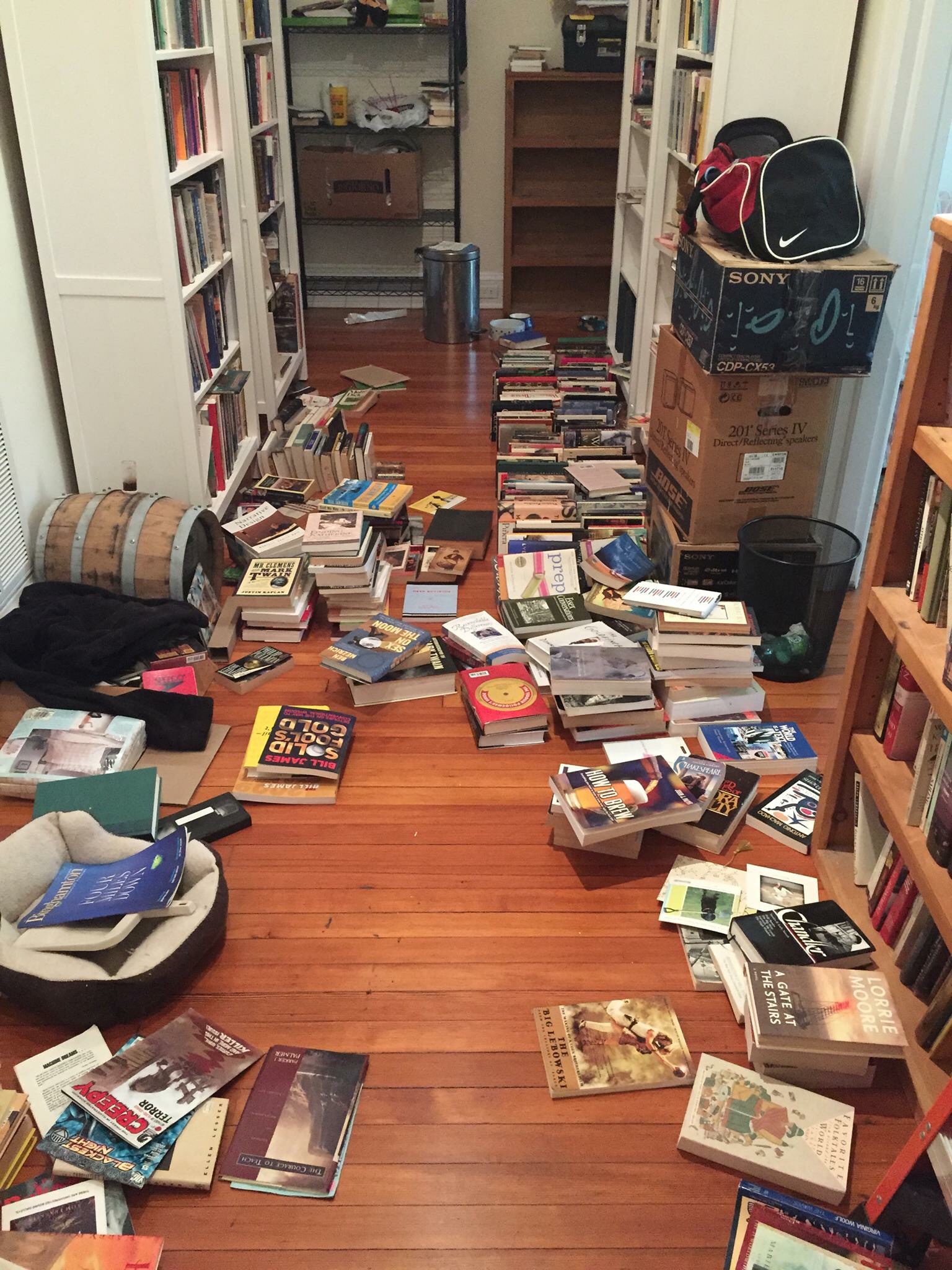
Almost fifteen years ago, I put my books in the attic. They were out, in shelves, but tucked beneath a sloping ceiling and packed behind all manner of family detritus. When my ex-wife and I separated, I moved them into my main living space, where they sang back to me after their—or my—sojourn.  My books matter to me, and I felt their absence. Getting them back onto tall shelves, walking past them every day, reminded me of what I had done, what I had learned, and what I wanted to do with my life and mind.

I have books about writing, books about religion, books about education, history books, philosophy (what we called theory in graduate school), fiction, poetry, books full of art and art history, and even books about sports—mainly baseball. I have a hard cover edition of Dickens published by Chapman and Hall with pages that requires a pocket knife to cut open.  I own a set of Andrew Lang’s color-coded Fairy Tale books.

The books reflect my preoccupations over the past thirty years.  Much of what is on my shelves I first read while I was in graduate school. Some I acquired afterward to keep me in touch with what I spent six years studying. Some comes from undergraduate college—books about gothic art and architecture, an old edition of Joyce’s Portrait of the Artist as a Young Man. There are some newer books that reflect my current interests: a collection of Sumerian mythology, a book about Djinn.

As much as I love my books, as much as they tell a story of my past, as much as they feel like an external manifestation of my mind, I think it may be time to lose them.

How long can one hold onto the past—a past that weighs an actual ton—without moving into the future? Yes, there are some things that I would keep, and this is true of more than my books, but they possess so much gravity. What is the past to me? Of course it is, was, everything. However, the future beckons, and requires a kind of lightness to which things do not lend themselves. Even memorable things.

There are other presences in my life—deep and profound connections. This time last year, I started unraveling the two jobs I had in Norfolk, Virginia. I moved away from those jobs and in the process also moved away from my daughters, who continue to live with their mother in Norfolk. Of course, I separated from and divorced their mother. It may seem inconsequential, but over 30 years ago, I picked a cat off the street, and have had cats ever since. I have never been more than three weeks away from them. This year I considered giving up a long standing fantasy baseball game that I have played for nearly 30 years with friends.

I wonder about what I have given up, but also what I have stayed with over the years. I have been a teacher for over 20 years—including my work as a TA in graduate school, over 25 years. What would it be like to not teach? I wrote for years, and then, if I didn’t stop, I slowed considerably—at what hazard, I cannot guess. I am writing again now, and have been, but can’t help wonder why my work slowed to a trickle.

I wonder would it would be like to be free of obligation and free of the gravity of myself—that ton of books, the closet full of clothes, my job, my family, my cats, even my friends. I wonder what my life would have been like if I had just chased words—the stories that I had declared as my purpose when I went away to and then stayed in graduate school. When I went away to graduate school, I traveled in a single car, with a mattress tied to the roof, and a single cat riding in the passenger seats. What would it be like to travel to what’s next with even less?

I do not regret the life I led, nor the life I lead; regret possesses a gravity greater than all the books own own, and I have no time for that. Not now. Nonetheless, I am aware of another life that exists, not over the horizon, not over the rainbow, but buried deep within me. I don’t know how I have kept it buried for so long, or at what cost—or even at what gain. Still. It is there.

I wonder, and wonder hard, and the wondering stirs something in me, something alive and insistent. What will I carry into the future? What must I carry? And what must I leave?

Writing, Purpose, and Masculinity

I have been struggling with masculinity as of late. Which is to say, struggling with ambition. Or struggling with my career choices. Or struggling with relationship choices. Or, simply struggling. Because I am a man, I am struggling on the somewhat closed field of masculinity. I haven’t always thought of it that way, and yet, there it is. I have avoided masculinity for dozens of reasons.

I have seen more examples of toxicity and hypocrisy among men than anywhere else.  Maybe these are not inherently male traits, but I grew up in a male-dominated environment—which is to say, the world—including four years in an all-male prep school. I have been bullied and been a bully. I have seen puffery masquerade as accomplishment. I have seen might valued over intelligence. I have watched as surface characteristics outshone deeper wells of strength. In To the Lighthouse, when Woolf takes Mr. Ramsay to the cleaners for failing to see the world outside of his carefully constructed “a, b, c…” hierarchy, I knew of what she was writing. But that came later.

After college my father brought me to his company once, to ask his colleagues what career path I should pursue. One of the men counseled, “Don’t go into business.” This was a man my father had often spoken of as one of his few friends at work. This man did not offer an alternate suggestion, just “Don’t.” Then he spoke of a working world in which the soul found no home. That resonated with me. My father was often unhappy after a day of work, and I had seen that unhappiness first hand.

I drew a line between the life of the soul and the world of business and ambition—the world of men.

I spent a number of years in career limbo and ended up managing a restaurant and working 80 hour weeks. Ambition always finds a way, even in limbo, even when one says, “No.” Part of being a man, I suppose, at least this man, was finding my way into positions of authority. During this time, I started writing—the very definition of authority—something I had done in fits and starts in high school then in college. I applied to graduate school in creative writing and was accepted.

So in my late twenties, I became a student of writing and literature. I went all in.  I was never interested in “finding my voice”; I was interested in hitting the metaphorical home run, of, and pardon me for this, catching the big fish.  There was always a bigger fish in the ocean.  Joyce, Woolf, Dickens, Marquez, Dickinson, Whitman, Marquez, and Calvino were among the literary fish that pushed me forward. The critical fish were there too.  Each set out a mark and said, “Meet me here.” And, right or wrong, I chased that mark.

I sought work that broke the hierarchies and offered more possibilities to all. Brilliance the only goal. Brilliance the reward. I reveled. My classmates often complained of this course or that course, or of school altogether. I did not. There was no class—even bibliography—that did not unlock some possibility. My purpose, clear and simple, was to learn and to write.

I was at graduate school at a time when feminism was fully asserting itself, and I allied myself with that movement, in part under the guise of being a creator, which I identified as a feminine act. I was full of it. In the end, I divided the world not between men and women, with all the problematic tangle that came between those energies, but between writers and non-writers. I saw a kinship between Charles Dickens and Jane Gallup. If you know the work, you know what a leap that is. Or, and this is easier, Hélène Cixous and James Joyce. Words held a primal energy for me, an energy that bridged gender and sex. The only ones who could experience jouissance, truly experience it, not simply having it happen, but calling it forth, meeting it, urging it on—if they could—were writers. And so I wrote fervently, seeking a pleasure beyond limits. And I found it.

Now, I realize that I had harnessed a most basic form of male sexual energy, of masculinity. If I had classmates who imagined me in black leather pants, well, there was a reason. I chased something bigger than me, something vital. And chasing is what men do—secretly or not. Part of our deep-seated masculinity drives us to seek—“to bear it out,” as Shakespeare writes, “even to the edge of doom.” What keeps us from doom, from becoming an Ahab (there’s that big fish) is not avoiding the sea and the hunt, just putting up the harpoon and dreaming of what might have been. We must learn to integrate the hunt with the world. We must listen to the world and find an honorable way forth.

I did not. I stopped. I did not stop all at once, but over a series of years. I let more temporary ambitions, often driven by temporary monetary concerns, take precedence. I grew nervous, even cautious. I stepped off the stage. I continued, as I had when I was younger, to find outlets for ambition. They were circumscribed by my career choices, but they persisted. I became principal of a school and, during a crisis at my church, helped hold a congregation together. But I was not doing my life’s work—the thing that brought me joy, even if it did not pay the water bill.

And, as a man, a life without a driving purpose withers. I’m sure this is true for women too. Finally, at 58, I made a change. It was not an easy, nor a secure choice. It is not the final choice I will make along this way. But it is the first step. And I realize that even though I have been writing—fervently, discovering along the way—that I also have things to learn. About me. About the world. And as a man.

London Thoughts

History is a story of discontinuous events—events that collide like weather systems or galaxies, having barely understood origins, and even less decipherable records. All the witnesses were destroyed in the collision. What they saw, what they thought, and what they felt—even if they recorded their observations on stone, paper, steel, or silicone, have been destroyed along with them. We are living in the age of delusion, in which we believe in the sanctity of our recorded history—either self-scribbled or captured by another.

This thought is brought about by two things. First, wandering, quickly—this time—through the British Museum (or Westminster Cathedral, or almost anything else in London), what becomes painfully obvious are the gaps. All these artifacts, so painstakingly arranged create an idea that history is continuous, and has flowed in a linear pattern. And then a closer inspection shows that over and over again, things haven’t come that way. There are sudden breaks in history, when entire empires vanish, or when they change—seemingly overnight—religions, or methods of governance, or technologies, and the old gets swept away, almost as if it was a betrayal of the new.

England as it shifts back and forth between Catholicism and Protestantism bears these marks hard. Or, reading through the story of Ashurbanipal and the claims of glory made by this king reminds me of Shelley’s “Ozymandias.”

Thinking of history reminds me of Stephen Jay Gould’s idea of punctuated equilibrium—evolution proceeding in long quiet periods of little change, and then having sudden outbursts of change. I know, we are taught that slow and steady wins the race, but, we are also taught to believe in the nature of story as an overarching “way things are.” We see things through that frame, and it doesn’t always support the picture inside—or outside—the frame.

Second, in the musical Hamilton (which was also part of this trip to London), the character of George Washington warns Hamilton that we do not control who writes our stories. He’s telling this to a man who believes in his power to literally write his own story—and to use his words to cement his reality. He can’t—and doesn’t. His wife, Eliza, sends his legacy forward—and Lin Manuel Miranda brings us her legacy. But, as Miranda admits in interviews, even this moment for Hamilton—and therefore, for him as well—is provisional and subject to changing tastes and critical opinion.

Does everything disappear? No. There are 2000 year old Roman walls in London. But Rome? Everything can disappear. And we will tell stories that soften the loss.

I wonder, I can’t help but wonder, what I am doing when I write: whose story I am writing? It isn’t my story. Of course it’s my story–as if it could be anything else. Nonetheless, as I write about characters who are 5000 years old–older in some cases–I think about history, because they think about history. How can they not? How can any of us not? It is everywhere–in the streets, and in the faces, here in London.

Confession

I have a confession. I have a terrible time receiving love. I’m sure that this is true of almost everyone, so, I’m reluctant to make any big claim about it.

And yet, that too is a strategy I use to avoid the possibility that you, unknown reader, will not love what I have written. “Oh, god, not another carping complaint. It’s all about him, again. Bastard. Why doesn’t he write about me?”

How quickly I hear disparaging criticism. How even more quickly do I anticipate it. There is virtually no critique that I have not already baked into my work.

“How,” you might imagine, “do you manage to write at all?”

Dear reader, I imagine the same thing.

My creative process is a headlong rush between the giddiness of discovery, and the wrenching feeling of anticipated disdain. When I can hold it in balance, the disdain can provide a critical foil that hones the writing; when it runs wild, my work shrinks to a barely whispered voice. Less. Years have passed.

Harder yet, is when this dynamic creeps into my other parts of my life. Wait, it does not creep. It storms in—jack-booted, kicking down doors, taking the me hostage.

You would think, after 58 years, after a modicum of personal and professional successes, that this would not trouble me. I can be an interminable optimist. The bright red balloon of my heart can soar into possibilities. There is a court jester’s sensibility that makes for easy humor, tinged with sarcasm, but also with an abiding love for the queen (you!) that seeks only to please.

However, I harbor a vision of disconnection and interpersonal doubt that would make Henry David Thoreau or Holden Caulfield seem sunny by comparison. Call it cynicism, or realism (GAH!). When I am at my best, I recognize this darker vision for what it is—a diversion from the bright path that waits. Just. Over. There. And when you are at your best, my heart gladly joins in the song you sing. But when the two of us (or more, and more) sink into dissension and doubt, then I am challenged to rise to my festive best. Then the Hobbesian vision kicks in, and the only reason we find any accord is to put off the never ending war of all against all.

I write, and love, to assert a vision of life that encompasses all the bright possibilities. And that acknowledges the deeper disconnections—not simply disagreements or differences—that drive us apart. I know that there are such divisions, but I believe in the power of writing and love to bind up the old wounds, to forge a new path, and to discover new hope.

Sometimes, all it takes is writing. And that is what I have forgotten too easily over the years. The writing will carry me back to the world of connection, possibility, and yes, love. And so I write, the cloud lifts. The lesson is learned.

Time to Fly

I begin easily enough. Before I know it, a length has passed in the pool—most of it underwater as I dolphin kick on my back until the flags at the far end of the pool pass over my head. Or a new job begins, with all the attendant paperwork and the meetings with people who think they know my job better than I do. They know something better, and I try to learn, as quickly as possible. Or a new romance, which is like falling, and is as easy as falling, the way falling is entirely effortless. What comes next?

The grind of workout #89, when the music on the waterproof MP3 player fails to inspire a quickened pace, and the bottom of the pool is endless. Or the month after the initial set of grades are due, and the fourth set of essays come across my desk. Not again. Not the same mess of misspellings and three page paragraphs. Or when the obligations of work and family eat into the blissful times, and bliss becomes quotidian. Imagine that, quotidian bliss.

In every aspect of my life, the transition from beginning to middle happens almost by accident. Like tripping over a carpet. I get used to the puckered places on the floor—or tug the whole thing up, and set it back down again, flat, until the gremlins shift it around again. And then I tug it up again. And again. One time will not do. One run of the vacuum. One load of laundry. Another set of tests to grade. Another and another and another.

But some things bear repetition, even improve. Like love. While it is hard to make the transition from falling to landing, it is better still to learn to fly, to find the joy. The old joke about, I just flew in from Los Angeles, and boy, are my arms tired. I would live for my arms to be so tired with the effort of flight. And it would be worth the effort, each fluctuation of my unseen wings, soaring in unison with my love.

It is the same with writing. I have used this blog as practice off and on for the past few years. It has been a way to scribble and not to worry about the duration of longer effort. Longer effort—let me call it what it is, a novel—can be daunting. What if, like falling and flying, one mistimes the creative leap and ends up hobbled or broken, with months of work sent to sea like Icarus? I only I can think about something longer as, well, 1000 word spans. 1000 words is nothing. 60 days at that pace, and… But let’s not get ahead.

Is writing something longer romantic? For me, yes. I have fallen out of love with several novels that I have begun. The ideas and characters have soured, or I have not loved them well enough to let them live beyond my narrow conception of them. For me, as much as writing is a commitment of ass to chair (scribble, scribble, Dr. Brennan), it mimics the action of reading—a generous engagement with a book. Seymour Glass’s best piece of writing advice ever— “Imagine the book you most want to read. Now go and write it”—has always resonated with me. And until now, other than some shorter pieces, no longer piece has fully met that criteria. Or, I was not up to the flight.

In the end, really, I don’t write because I have something to say, but still, because I want to discover something. Before I was a writer, I was a reader, and I still love to read. The same way that I love to travel, I love to discover ideas and characters in books. It is flight into unknown places. I love discovering what I do not know. Somewhere along the way the creative process seduces one into intention—I get caught in the web of intention—thinking about what I want to say instead of praising what I see. And letting my words find a way.

I take refuge in Michelangelo’s vision of the sculpture already extant in the stone—we aren’t creators so much as revealers—discoverers if you will. So too, with flight, while there may be a destination, there are also loops and rolls and fields long enough to land, and walk to an untended apple tree, pick a ripe crisp fruit, and eat. Discover this on the journey.

How many other aspects of my life follow this impulse—reveling in discovery more than intentional design? I think too many. Most people still live their lives primarily by design. There is security and satisfaction in the sense of agency that willfulness bestows. My students clamor to know what they need to do to earn an “A,” or a higher score on an exam. How unsatisfyingly do I answer, “Discover more.” That is no way forward, at least no specific way. It is an attitude and not a route.

And frankly, in romance, I have scuttled relationships because I have fought against others’ plans, not happy to simply follow the natural stages of things, and unhappy when a relationship settled into a routine. Of course, life is routine, a series of repeated rituals, a hundred thousand undulations of wings. But that routine, those rituals, can, should, must help one reveal what is hidden in the marble, or what might be found when gloriously in flight.

Perhaps, what I wanted, without knowing it, was someone who was willing to fly with me. And in my writing, something that had the chance of slipping the bonds of my intentions. A goal I could fly toward, that would transport me the same way that love transports and transforms me.

There is a little secret though. I do have at least one intention, and that is for this longer work to last, for it to remain engaging and vital, even when the effort strains my arms. And so, I take small flights. And share these flights, for now, with one who flies with me. I discover something new, one winged trip at a time.
Purpose

“What do I have to say?”

How I wish that more people asked this simple question before adding to the public discourse. Instead of wondering about their particular expertise, or wondering about how their experiences have shaped them, most people weigh in, almost automatically, on nearly any occasion. We have become a nation of opiners, flexing our incredible verbal muscles in a display that rivals any body-building competition.

And for what? What are the effect of our words? What spaces do they carve out in the public square? How do our voices land in the ears of those around us? How does what we say actually represent our thoughts and feelings, and how much is made to simply compete with what we hear—a kind of verbal pyrotechnics meant to outblast, if not outshine, the sound and fury of our neighbors?

It is enough to make one meek. Since everyone expresses opinions at a level of intensity that rivals Jonathan Edwards—dangling our audience over pits of damnation—a quiet measured voice is like a spring zephyr in February—lost in the midst of winter rain and sleet, unless one can open oneself for that fleeting moment that the season will change, and that the one breath of gentler warmth can ease its way into our winter layers. But who has enough patience to be that harbinger? To breathe softer words? To hint?

And who would listen?

I begin with no grand proclamation to shout. My students would laugh to hear me say that. I have shouted, exhorted, acted—overacted—and entertained in classes for years. Inevitably, I will announce “Dr. Brennan’s Rule for Life #7,362: Buy flowers,” and acknowledge that there are as many rules to the north and south of that number. However, my students are a captive audience—they have to at least pretend to listen to me. The same goes for my daughters, or even the members of the congregation I served for nearly a dozen years. Yet, I never take any listening for granted.

Maybe this is true of others as well, and maybe this is part of the reason that there is so much shouting in the square—as if volume could take the place of wisdom. Say something loud enough and someone will pay attention. Get enough people to pay attention, and some number will believe what you are saying. Get enough people to believe and rule the world—or some slice of it.

What if all you want to do is quietly share. I saw this… I heard this… I thought this… I felt this… What if you wanted to just add to the world and not bend it to your will? To inspire some stranger to go and see, or hear, or think, or feel? To suggest, perhaps to persuade, but not to cajole or chastise?

I do not know. I wonder if there is a wisdom or wisdoms that might be shared, if a thought precisely crafted and shared will find purchase. Is there a value in inspired rumination? My students read Walden and bristle at Thoreau’s adamantine vision. Who is he to insist on how we should live? Didn’t he die penniless? Where did he go to school? Why isn’t he as well organized as Emerson? I don’t think about my pants. The same holds true for Whitman’s kosmic voice, and for Dickinson’s route of evanescence. Writers who stake a claim turn readers away. If that selection seems too narrow, Ellison’s blindingly light filled room, Woolf’s roomier postulations, and Marquez’s endless Aurelianos also turn readers into pillars of salt.

But, declare I must, because silence is not a story, and words may find purchase, somewhere, somehow. Time to work.

Paying Attention

When I am out walking with my daughter I have one, simple repeated lesson: pay attention. Crossing a street? Pay attention. Walking past a flower bed? Pay attention. Meeting people? Pay attention. It is the cornerstone. I point out when I fail, as she does: Pay attention, daddy. Did you look? Did you see me? Two eyes seem like slim equipment for the work of days.

As a teacher, the central lesson is a finely tuned attention. The study of literature is a proving grounds for giving attention its fullest due. Words, images, sound. The unpacking of one of Shakespeare’s sonnets, or Joyce Carol Oates’s stories, or a passage from Joyce’s impossible novel relies on the attention one gives and the knowledge one brings. All the knowledge in the world is wasted if one does not look outward and pay attention.

When I write, I also pay attention—it is a balance between inward and outward attention—letting the still, strong voice inside reflect on the outward world. I try to write about what I see, what I learn, what surprises me—almost all outside of me. When I venture within, I hope to turn the same sharp vision within—seeing myself as if on a journey, as if I was foreign and strange—as I must be, even to myself.

But those are only three roles I play in life: father, teacher, writer. I am also a friend, and enjoy paying attention to my friends’ likes and dislikes, their peculiar fascinations and passions. We tend to have similar interests—we are, after all, friends. And I know that my friends pay attention to me—that they appreciate my odd vision.

There is one other role—and it is at once the easiest and most difficult. I love paying attention to the person I love. I love learning the stories that comprise a life, listening to the dreams of possible futures, and discovering the intricacies of another’s heart. All this is so easy—I could listen and learn for a lifetime—I feel like all else is practice for this.

The hard part is having someone pay attention to me. First, allowing someone to see me, all my flaws and strengths. That is, almost, easily assuaged by repeated kindnesses—I have learned to accept being loved.

Harder is accepting when someone misses something. When my daughter stumbles into a crosswalk, head tilted toward phone, there is a quick check—pay attention. When a student misses the meaning of the image: “star to every wandering bark,” I can quickly point out that Shakespeare is punnier and more ribald than serious young students give credit. When I make a mistake in an early draft, I can edit. And I can accept my friends “misses” easily—chalking it up to our simple flawed and generous humanity.

But, with love. Perhaps because it is only then—when I love romantically—that I feel most vulnerable. I sometimes become all but selfless—loving most and desiring least, as if true love could enable a perfect kind of detachment. So much for flawed and generous humanity—I must be perfect. Jeff Tweedy sings, “No loves as random as God’s love”—this random indiscriminate, impossibly generous love. Shakespeare calls it “lascivious grace”—unimaginable to those who walk upon the ground, and yet, the only ideal.

And yet, the hope, beyond hope, that someone is paying attention. One of the great joys of love—and of life—is feeling recognized, not simply on someone else’s terms (This is how you are like me! This is how you complete me!), but on your own terms (You showed me… You taught me… You amazed me… You surprised me… You changed me…). Isn’t this how we feel love, when we are at our best? Isn’t this how we want to be loved?

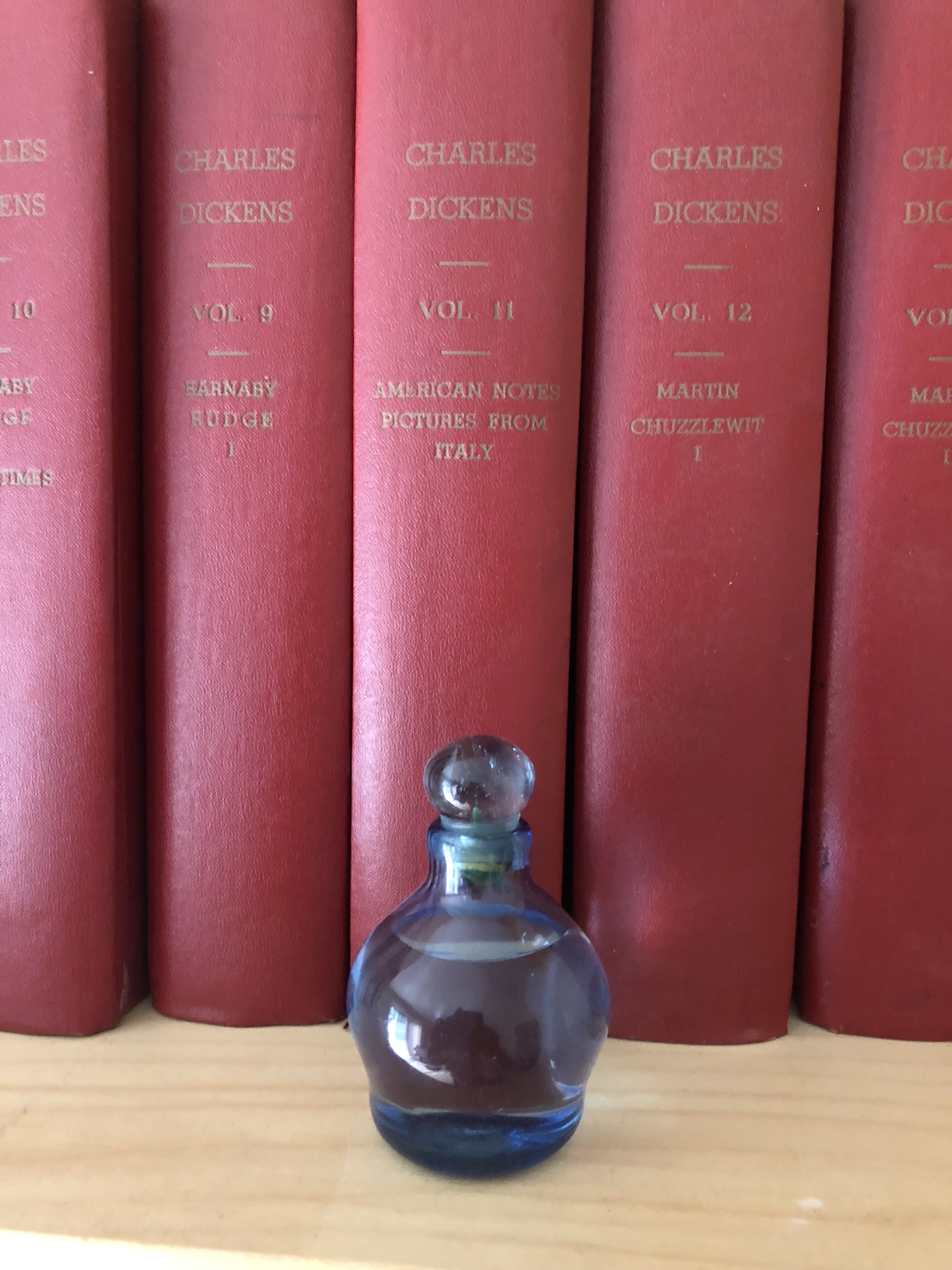
I share little details, bits and pieces, and listen and wait. What is she paying attention to? Through what screen does she see me? I expect hesitantly, trying not to overburden possibility with my hair-shirted set of (non-)expectations. And then, after sharing a story, a glimpse, a piece by Dinesen, some recollection of a journey, she travels away and returns with a small blue jar filled with water from two seas. I know there will be misses, but I also know I have been seen. And this makes all the difference. This is how.