Peripheral Vision and the Dream

I have been writing a novel (#thirdwishnovel) since November—fitting the work in between bouts of schoolwork, and all the other more (and less) joyful events of life. The writing has captivated me, because of the way that the writing has come to me. So often in the past, I felt that what I was working at was always just in my peripheral vision. I would get a brief glimpse, but when I turned my attention to whatever was there—perpendicular to my daily vision—it vanished, or, at the very least, turned into an unintelligible mess. I used shorter forms like prose poetry to capture these bursts of clarity (these blog posts began as another way of harnessing some of those fleeting glimpses), but trying to capture longer work—an extended vision—was like looking at sludge.

And now, out of nowhere, this has changed. Perhaps, because I have written almost every day for over a year, my vision has expanded—I now have eyes in the back of my head (do I?). I do not cagily shift my vision to capture something evanescent. Perhaps, because I removed large chunks of my life, and there is less that clamors for my immediate attention, my vision is not tired when the time to write comes. Perhaps, and this is not easy to admit, because I need the writing, and the need has allowed me to call forth the vision. For now, almost every time I wanted something or was preparing a transition, what I needed appeared directly in front of me. I did not have to look to the side or far ahead, or really ahead at all. Each image, action, or small exchange of dialogue stopped me and held my attention.

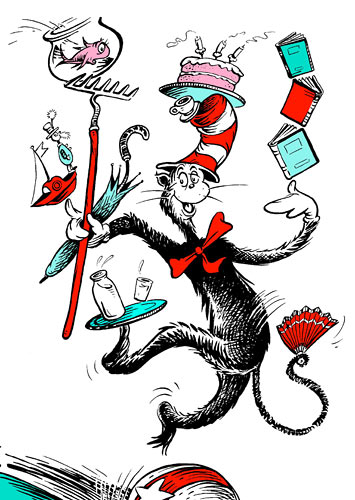
I recall the Cat in the Hat, balancing on a ball with everything balanced for one moment, proclaiming: “Look at me! Look at me! Look at me NOW!” While the Cat is bound to fall—for now—I have not ignored the invitation. I have let the dream—the vivid continuous dream—with all its amazingly balanced parts sweep me up. I am looking.

I am fully aware that I have been inviting myself into the dream—that even though I may have been walking through the streets of London, reading text messages from Kathmandu, attending a Christmas Eve service in a strange church, listening to symphonic renditions of Led Zeppelin songs, or longing for deep personal connection with an elusive lover, the story making part of my brain that has been dormant, distracted, and (really?) depressed for too many years, finally—and for whatever reason—took hold of me and turned my waking life—any and every part of it—into the dream that I was writing. Like a dream, I can barely remember how it began, I can only remember putting my head down on the pillow. And once again— Even though I know where the dream is headed, I have no idea how it ends—isn’t the point that we wake up before the dream fully ends—it begins and ends in medias res, as it were?

The dream (and the vision) is no longer peripheral. No matter how it arrived, it is central and demanding. I enter and reenter the dream at will and discover. The dream provides a seemingly random, but profoundly interconnected tableau. I am enough of an active dreamer that I am aware when I am in a dream, and I can shape parts of what happen in the dream. However, I also know that the surprises that come in the dream world are just as important as the decisions I make in this dark realm. I have enjoyed the surprises that have come—they seem inexhaustible.

And so, as my current work turns toward an ending (gasp), I have to change the way that I approach my writing. No longer can I simply fall back into the dream, letting each image and action reframe what has come before (I have rewritten—redreamed—swaths of the novel to suit new discoveries several times). Now, I must let the end—what I write and what I dream—grow out of all that I have dreamed, and that means gazing backward and forward at the same time—I need the eyes in the back of my head!—and narrowing my vision toward climax and resolution. I must shape the dream consciously—as consciously as one can dream.

Because, and let me be clear, I am not witnessing the Cat any more. I am the damned Cat. I will fall. The rake will get bent. But, I have another thing or two left to do. Here I go. Look at me.

Discovery

So much of this project (#thirdwishnovel) has been centered on twin acts of discovery. First, I have been overjoyed to discover this story, and the way that it has unfolded itself to me in the past several months. Each time I faced a quandary (What should this character do? How will “this”—whatever this is—happen? Why does this world behave the way it does?), the universe opened up and provided some essential part of the story.

I have written about this part of the process in bits and pieces in this blog. I have never been the welcome recipient of so many gifts. There were lions from Assyria, streets in London, a silver tree in Washington DC, heartbreak (yes, even this was a gift), and, of course, love. Each of these, and so many others, found their way into the book.

I cannot tell you, dear reader, how this process of discovery has sustained me. One of my friends asked that since I was the writer, couldn’t I just make up what I wanted? Another chided that since I was a creative writer (with a degree to prove it), couldn’t I just make what I wrote funny (or sad)? Couldn’t I just determine the mood of what I wrote?

The joy of discovery comes in not willing the outcome. I have learned to trust what comes. In addition to the gifts from without, there are also those from within. For instance, I was struggling with some action in the story, a movement that would precipitate a series of events. I found the movement—and an actual movement, an action—through reflection about the characters and reflection about physical exertion. And then, suddenly there was physical labor in the book: two characters moving large stones. Had I moved things? Oh yes. Had I taken some strange joy in physical labor? Oh yes. Were the actions of my characters simple mirrors of myself? No. However, the actions also suited them, and the tenor of what I was writing. They fit.

At the beginning of the school year one of my students interviewed me, and asked about writer’s block. I told her that I did not believe in writer’s block. I do not. I had been writing this blog consistently for almost a year, and felt that the images and ideas that were bubbling up were coming from a (finally) durable source. I talked (a little) with my student about searching for the source. That has been the second discovery.

All my life I have struggled with the twin poles of being in and of the world and also being me. I have had a hard time feeling at home in a world that felt selfish, and that valued self-obsession. Yes, there are some truly altruistic souls, but that drive—or simply drive itself—always seemed suspect to me. It created, more often than naught, a narrowing of vision. And anything that narrowed the world gave me a pain.

Remaining open to connection is a tricky business. It can create a kind of ant-gravity shell around a person, because any ground, any focus, limits the openness to connection. Fortunately, I do not approach my romantic relationships with the same predisposition (or do I? Damn!). But without focus, what will one achieve, except by accident? Accidents do happen—fortunate falls are around most corners. But as a plan, relying on accidents is a hazard best avoided, unless one wants to plan on injury and decides to play in traffic.

But for life—and writing a novel is like life—one needs a more directed plan, more than let’s play in traffic, or let’s dodge life’s slings and arrows. And committing to the living—and to the writing—has made the difference. It took a rearrangement of my life, a reprioritization of what I did, and a willingness to risk. Writing for months on end without the promise of brilliance (let alone publication) is not for those who seek guarantees. The only guarantee is the doing. I have been satisfied with the doing, with the daily writing, in ways that I have never felt satisfied before.

This is because I can no longer wait for the happy accidents. I have asked for them, engineered them, gone where I could be in their presence, and taken a hand in making them happen. While I have been happy to have some advice as I have written, mainly, I have trusted my own ability—and this has been exhilarating.

I have made the turn for home in this current project, and I have no idea how it will end up. Where I do know that I will end up, is with another project, another set of discoveries. Just as this one started almost on a whim—a glimpse—that changed and changed and changed again as I wrote, somehow watching how this has proceeded has helped me discover myself and my purpose. And that purpose is discovery in all its glory.

The deer

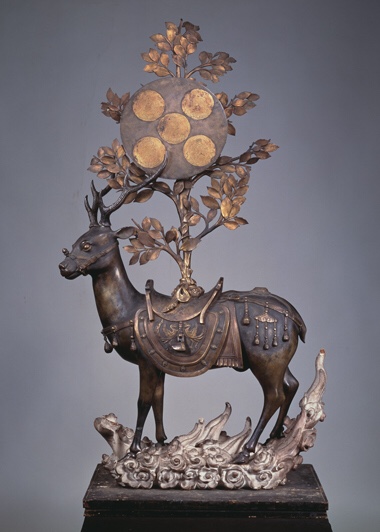
There was a show in the summer of 2019 at the National Gallery of Art, called “The Life of Animals in Japanese Art.” There were several deer, and one of them—not this particular deer—snuck into my work. Whether it stays or not, who knows? For now, here:

As he thought about truth—perhaps the most slippery but indelible of ideas—he became aware of a murmur from among the host of the gathered djinn. He, the dark djinn, and Jabari turned to locate the cause and center of this gentle disruption.

A blue deer walked through the assembled djinn. From its sides and back rose thick shards of white crystal. It could have been quartz or moonstone. Perhaps salt. Its paws pressed deep prints into the earth, revealing the weight of the animal was. As it neared, the gold djinn could tell that it was made of lapis lazuli. And yet it walked. It was tall, almost as large as a horse, and around its legs two cloud colored foxes romped and played. The stone and crystal deer was walking through the crowd and toward them. It was regal.

When it reached them, it lowered its head, and gently—but coldly, since it was stone—nuzzled the dark djinn and gold djinn in turn. It was strangely soft, belying its nature—it was cold stone—but remaining true to its essential nature—it was a deer. The foxes moved around Jabari, who stumbled over them, thrown off by their play. They were like smoke but firm, and this unnerved the ‘Ifrit. They were unnatural.

All the djinn had turned their attention to the scene: the blue and white deer, tame and regal, and the two cloud foxes, playful and disruptive. The three djinn at the center were not aware of the attention given to them, because the animals before them had entranced them. Blue, and white, and silver smoke.

A crack began to form along the deer’s supple neck, and another at its hind quarter. Then a dozen others, opening its body and dividing the crystals ridged along its back. Bits of crystal fell to the ground. Blue stone chipped away from its body. Then it collapsed into rubble, beautiful rubble, but no longer alive. The foxes dissipated.

The djinn were struck silent. The deer had been beautiful and impossible. It had come through them and to them. It was a message and a messenger. Quietly, each member of the throng walked to the pile of stone and crystal and each took a piece of what had been sublime. There was enough for each of the assembled djinn—no more and no less. The remaining wisps of fox-smoke drifted over their heads.

“What was it?” Jabari broke the silence when the taking had finished.

The white haired goddess stood with them. “It was him.”

Remaking the body; remaking the mind

I once had a “fitness trainer” who exhorted me, and those I worked with, to be as hard as the tip of the spear. I had spent years as a serious swimmer, and had a macho enough attitude to gobble this up. There were long sessions among Nautilus machines (the preferred hi-tech option of the early 80’s), blistering runs, and of course, time in the water. I enjoyed the hardness that was belied by my boyish exterior. The baby-faced bloom of youth did not dissipate until I was nearly 30 and grew a beard. I used my appearance to push me: “Do not mistake my youthful exterior for a lack of drive,” I thought. I drove hard.

Then I stopped. I left a life that promised not just physical hardness, but an emotional, intellectual, and spiritual severity. I dropped out and into the lost years of restaurant work, taking solace in uncommitted drift. In spite of the self-enforced sojourn, I kept swimming, which was more languid, even at a brisk pace. Two regular diners, Tom and Janet Flannigan, joked about all the “soft people” they saw in the pool—“You’ll never stay fit doing that,” they jested, lighting up cigarettes, and drinking themselves thin.

And I began writing, even while I worked 80 hour weeks at an Italian dive in Manayunk. The writing echoed the life I left and the ramifications of my decision. It feels as if everything I wrote was rooted in those moments. Of course, I was trying to write my life right.

I have often questioned my decision to become, if not “soft,”then decidedly less “hard” than the path that had been open to me. At least in the first several years after my decision, I think my friends saw aspects of that old self, but as best I could I burned it or buried it. We make choices in life, bending toward the light or dark—unlike phototropic plants that do so automatically. Or so we like to imagine. There are consequences to all our choices, to how we emphasize parts of our personalities or our essential selves. A choice away from or toward ripples into every other dimension of our lives.

This past winter, for the first time in over 30 years, I returned to weights. I bemoaned (and bemoan) the loss of strength—it isn’t innate, and must be tended. Jack, the owner of the gym I attend, says, “You’re in great shape.” I remember when, I think and do not gainsay. For now, I have taken on the task of shifting and strengthening the weight on my body. When I turned 50, I fought hard to get my body weight down to 200 pounds. This year, heading to 59, I flew lower with relative ease—I even have to eat more. I also feel harder, and delight in the body that has reemerged, as if it had been waiting all along (I knew you would be back). Although my strength is not what it was, it waxes again, along with some other aspects of that one time severity.

I court severity carefully. Maybe it took thirty years to give me distance from all that being the tip of the spear meant. Maybe the intervening years have buffered the fatal vision that guided my hand and mind. Or maybe those years changed me enough that I can take that dagger and wield it without the same moral repercussions that haunted me then, and that drove me to chose against it. Choosing against is never the same as choosing for; the choice to avoid a path is not the same as choosing a path. I have begun choosing for again, a bit rusty, but finding my way.

Not to my surprise, this change has come with a reinvigorated call to writing. I am a man whose mind and body work in concert. There was a reason I championed Susan Bordo’s and Richard Rorty’s philosophical repudiations of Descartes’ cogito ergo sum. We are not just minds forged in cold thought but warm bodies that claim a presence in the world. I tried to make my mind and body softer, and there was a deeper cost. I felt that cost more powerfully as I passed through this year’s birthday. I choose this body now, and the mind that goes with it, and feel ready to press on.

Forward.

The grain of sand—intention and writing

While explaining a quandary I was having as I waded into one of the more difficult portions of my novel, a friend asked, “You’re the writer. Can’t you just make them (your characters) do what you want?” And that, dear reader, is always the rub. Of course, I could, but, even when writing about magical characters (djinn and such), there is no magic wand. Everything must seem real, and if not real, plausible, and if not plausible—if wild and genuinely surprising—then I have to prove it.

The writer doesn’t have to avoid those deus ex machina moments, so much as show them in their complete and total glory. You place a grain of sand on the battle field, and then the whole balance is shifted—but you do not, never, ever, forget the grain of sand. You carry it in from some desert or beach (preferably one from which the ocean has retreated and left barren), and you drop it under a horse’s hoof, or into the eye of the hero (or worse, the eye of his lieutenant), and let it have its way.

So much of writing is about discovering the grains of sand. The larger narrative components are there: beginnings, middles, and ends. What holds them together are small moments. Images, lines of dialogue, secondary characters who stumble into a scene. You don’t know that they will be there when you begin, but you find them—or they find you.

And yes, they come from you—unintentionally, more often than not. They sneak in from your childhood, or something you just saw on the news, from a museum display, or from a clutch of conversation overheard while in line at Shake Shack. Your brain files all these away, and then, at the right moment (or the wrong one—but only if you’re lucky) drops them back in on you. “Thought you were done with that, eh?” your writing brain asks, while you have sent a character through a hole in time to receive a secret from his future self, and suddenly you are reliving a kiss, a gesture, from 25 years ago—or last year. Can you even keep track anymore?

No, but once you start writing it, everything floods back, and you are reliving and living and inventing and discovering something you never knew before. But there you are, and everything you write surprises you, and the ending for which you thought you were aiming changes. Because of a grain of sand that you have been carrying with you for 55 years. Here comes the sandstorm.

The Writer’s Character (and work)

I began graduate school in the fall of 1988. Writing was still new to me. I had written in high school then in college, but the daily life of writing was only a shadowy presence. I had begun a novel, and tended it during the free time of my six day weeks managing a small Italian restaurant in the Manayunk neighborhood of Philadelphia. Which is to say, that I had written enough to gain admission to a program, but not enough in any real kind of way.

Graduate school was a relief and a release—it was the thing all my friends and customers were hinting at when they asked, “What are you going to do?”—recognizing long before I did that there was something specific that I was going to do.

I had drifted after college. It was as if I wore an anti-gravity suit that kept me from becoming grounded. There were reasons. I had encountered “purpose” as a rationale for selfishness and intentional moral blindness. The latter I found incredibly troubling. I believed in an inherent goodness—found in man or god—in spite of my experiences in the world. And when I wrote, I explored that possibility.

When I arrived at Binghamton, I poured myself into the work, writing with avaricious fervor, and studying gleefully. I learned quickly that a “B” was an “F,” and after one failing grade on an essay, turned to successful outcomes. I earned a scholarship after my first year, and with it, the right to teach, which I welcomed with the zeal of the recently converted. I was hooked.

One of the hooks at Binghamton was the presence of John Gardner, the author of The Art of Fiction and several novels I had not yet read. I had read Grendel when I was much younger, drawn by the monster after my mother had read us some version of Beowulf as our bedtime entertainment. What attracted us, some of us at least, was the myth of John—driven, irascible, generous, and demanding. As often as not, when describing ourselves as writers, we focused on our characters-not the characters in what we wrote, but out own personal strengths and foibles, and how we matched up against this fabled presence. He had been dead for 6 years, but he hung around the program (his ex-wife became my dissertation director).

One of my teachers, I think it was Liz Rosenberg, introduced me to On Becoming a Novelist, in which Gardner laid out some characteristics of the novelist:

Like other kinds of intelligence, the storyteller’s is partly natural, partly trained. It is composed of several qualities, most of which, in normal people, are signs of either immaturity or incivility: wit (a tendency to make irreverent connections); obstinacy and a tendency towards churlishness (a refusal to believe what all sensible people know is true); childishness (an apparent lack of mental focus and serious life purpose, a fondness for daydreaming and telling pointless lies, a lack of proper respect, mischievousness, an unseemly propensity for crying over nothing); a marked tendency toward oral or anal fixation or both (the oral manifested by excessive eating, drinking, smoking, and chattering; the anal by nervous cleanliness and neatness coupled with a weird fascination with dirty jokes); remarkable powers of eidetic recall, or visual memory (a usual feature of early adolescence and mental retardation); a strange admixture of shameless playfulness and embarrassing earnestness, the latter often heightened by irrationally intense feelings for or against religion; patience like a cat’s; a criminal streak of cunning; psychological instability; recklessness, impulsiveness, and improvidence; and finally an inexplicable and incurable addiction to stories, written or oral, bad or good. Not all writers have exactly the same virtues, of course. Occasionally one finds someone who is not abnormally improvident.

We looked inside ourselves to see whether we met the unholy criteria that John threw down—gauntlet-like—for us to match. It became a weird check list. There were dozens of weird checklists that we tested ourselves against: pre-work habits and rituals, kinds of writing implements, time that we wrote. I think that many of us were hoping to awaken a writing practice that could sustain us, and so looked for that one thing, the one trick that would allow the words to tumble out as effortlessly as possible.

Of course, we focused on how damnably hard writing was—and is. The metaphors we used to describe writing—like Virgilio Pinera’s man who decides to eat a mountain, one rocky mouthful after another—emphasized the difficulty, futility, and irreverent commitment. Perhaps the real solution was a correction to our character—some unbridling of our sinful writer manqué natures, and a resurrection into some more saintly (or demonic) deranger of the senses. If only we could rid ourselves of our flaws, and get to work.

I came to grad school, and to writing, after years of 60+ hour weeks. I rose early enough to get to the pool and down 3000 meters, then head across town to the restaurant. When I arrived in grad school, I found a job, and worked 3-4 nights a week in a high end restaurant. After I started teaching, I took a job in a bookstore ran by the husband of my mentor (he had been a student of Gardner’s as well). I swam, and then started running several days a week (I could listen to music while I ran!). Some of my classmates complained about the workload. I did not. Work was in me. Writing was not.

But it was. I wrote some inspired pieces, and won praise from mentors and classmates for my work. I didn’t know what to do with it—I had some things published, but what do a few stories and prose poems amount to in a world driven by novels? Besides, I confused inspiration with work. Work, that simple, boring, daily activity, with simple, boring, daily and measurable rewards. I was seeking star fire, supernovae, and earth-shaking prose. In order to do that I had to remake myself in the image of whom? John Gardner? Stephen King? Virginia Woolf? Some Norse God?

And what is the measure of good (let alone brilliant) writing? A great sentence doesn’t blaze as distinctly as the time on the clock when you touch the wall after one of ten 200 yard swims (That’s good; keep going). You write without a clear standard, and a novelist bangs out 60,000 to 100,000 words into the blind space of “who knows what will happen to all this?”.

So we focused on character, the one thing we could control or change. This, of course, is poppycock. There are good and bad people who write. Character is no Holy Grail, and no simple gateway or guarantee to writing. Work is. I wish we had simply talked more about work and habit and word count in grad school. How do you sneak in an extra 200 words? Have you done your work for today? Do you need a new pen? God only knows, make it work, let it be work, and demystify the process. It’s just work. It’s not about whether the muse is singing to you, or the dread siren, or anything or anyone. It’s just work, a job, a practice, and all you need to do, is to do it.

In the long run, Gardner’s description of the writer, and, once again, that sense that a purpose that led to blindness to everything other than IT, drove me away. After all, what was the lesson of nearly every novel, short story, or poem we read? Connect. Connect. And for the sake of everything that’s holy, or valuable, or worth saving: connect. The pursuit of art never matched the message. Picasso was a sonofabitch, but Guernica. Dickens philandered. Woolf suffered from limiting snobbery and mental illness. Joyce? Don’t even. Our contemporaries wandered into the forest of “immaturity and incivility” with a stridency that was matched only by ignorant blowhards and professional athletes.

I recognize that now, all of it, as a kind of armor. I know what it allowed, and what costs they incurred for strapping it on with such easy regularity. I saw it for a kind of blindness, and doubted. And in that doubt, returned to the anti-gravity armor that had supported me years before.

I turned, for years, to teaching and a kind of preaching. I tried to reach out, to convert the sensible—and others—to deeper understanding (reading) and brighter thought (writing). These are not fool’s errands, to be sure. But once you have tasted brilliance—and writing done well is brilliance—every other work other than the work that is the most brilliant, makes your tongue recoil. Even your dog would turn away from that feast. Not me. Not for years. And though I still fight with gravity, I feel the pull, and this is what binds us together—separate planets careening into each other with cataclysmic potential. I tried to resist, but, really, why?

So I’m left with these questions: How does one balance the work and the meaning of the work? How does one have purpose and character? Ah, as always, the trick of balance, and not in Gardner’s list of a writer’s characteristics. We will have to figure this out ourselves.

Of course, equanimity (balance) is not Gardner’s list, but the safety net is the work—stupid, dull-witted, and quotidian. Be an angel or a devil, but get to work. It comes back, and, if done well, connects us, once more, to the world, to each other, and to the gravity that holds us all.

Risking it all

It is difficult to explain the existential risk that the writer—at least this writer—undertakes when working. It is tantamount to this:

One time we (my father, two crewmates, and I) sailed out of the Chesapeake Bay and onto the ocean in a gale. A gale is wind at 40 knots. There was already 6-8 foot chop in the bay. One of us (a first-time sailor) slipped into his bunk clutching his life jacket, stricken with an indomitable case of seasickness. We sailed short-handed into stupid weather and bigger seas.

For the next four days, 30-50 knot winds harassed us, and the sea that was more like a protracted set of sand dunes, the water whipped by the wind into twelve-foot peaks that barely seemed to move. They were moving though, faster than we were in our 36-foot sailboat. The ship sailed up and down these wet rolling hills, making ragged progress toward our goal: Bermuda.

Sensible men would have waited, but for all my father’s strengths (long-range planning, and in-the-moment decisiveness among them), he had a stubbornness that did not waver. Once he had a plan, he stuck to it. Later in life, this supported him as he battled g on with Parkinson’s Disease. He suffered with the adaptations the illness forced on him, but refused to be stopped. In the end this led to his death. On this trip, his drive took us into conditions that would test us.

I should also note that when I point to a crewmate who became seasick, I do not cast aspersions. I get seasick, and had each time I had sailed on the ocean before this. It always struck me when I took my first late watch, when the horizon was shrouded in black, and my eyes and inner ear could not properly make sense of the several directions that my body was moving. It is an ugly sickness, driving the guts empty in rebellion until there is nothing left but bile. I never missed my turns at the helm because of it. The nausea would strike, and I would turn my head, and do what I needed. I did not eat or drink while it was on me, and it passed, for me it did, and after 36 hours.

On this trip, in this ocean, I was entirely spared. All my other crewmates, even my father, were struck. In retrospect perhaps the swell of the sea was so distinct and regular, that the three-way (pitch, yaw, and roll) motion did not take grip of me. Or perhaps the danger created a necessary clarity. As with all retrospect, I cannot be sure.

After four days, we finally passed into the fringe of whatever had driven the gale. In a matter of hours, the wind created new swell patterns. Around midnight, the sea that had been a reasonable set of rolling hills, turned, and became more like waves breaking over an invisible reef or sand bar. 18-24 foot waves rose and broke, all headed in one direction. They are called following seas, which means the breakers were rising behind us, and rolling toward us. They were moving faster than we were and lifted our boat to each peak, at which point our boat would slide down the front of the breaker like a sailboard.

That sounds easy enough, but as the boat fell down the surface of each wave, it carved a path driven by gravity and the force of the wave it was riding. Its path down the wave became, temporarily and repeatedly, unmanageable. Pushed by wind, pushed by water, pulled by gravity, the rudder merely suggested a direction. And yet, when at the helm, every suggestion made a difference. Caught at the top of a breaker, the boat could easily go sideways and roll over. Sliding down the side of the breakers, it could turn too sharply and roll over.

A sailboat is not a surfboard.

My father and I took the helm when the sea turned. We held it in half-hour turns, and it was exhausting work that required dense and specific attention. And, we were exhausted after the previous days of sail. Usually, in harsh conditions, one man took the wheel, and the other took refuge propped against the cabin in the leeward side of the cockpit, using the cabin as a wall against the constant water that broke over the windward gunwale. In this case, as we planed down the sides of the swells, the leeward gunwale cut into the water, and the water rushed into the cockpit. This added a new threat. The boat could be capsized, swamped with water if the helmsmen was not attentive. And, because no attention was enough, at the very least, we were soaked, the water pooling in our yellow foul weather gear, which was not designed for repeated submersion.

At 4 in the morning my father looked at me and said, “I can’t do it anymore. I’m going to send another crew member up, but you cannot let him take the helm until the sea settles down. You have to sail until then. The boat is yours.”

I brought a waterproof Walkman on these trips. While I took the helm that night, I listened to an array of the loudest songs I had: Dinosaur Jr’s “I Know You’re Out There,” Medicine’s “One More,” and Sonic Youth’s “Sugar Kane.” Nothing was loud enough. Nothing matched the ocean or my attention. Nothing matched my awareness of what might happen, or when my father relented, what had happened.

I sailed. Every time I turned the wheel, I felt like I was making a decision that could imperil the lives of all of us. We would go down fast, without time to throw the life raft overboard. It would happen in an instant. We were at sea—tempest-tossed as Shakespeare wrote. The end would come quickly. Each time I turned the wheel, each millimeter I moved it to port or starboard, I felt as if I was making a decision for speed and forward motion. It felt, again, as the bard wrote, giddy. Not happy, and not drunk—although I felt as drunk as I could be—drunk with sailing, with water, and with wind—but transported out of my mind, beyond all thought, and into every thought possible. I sailed as I never had before, as I would always want to sail afterward.

Friends ask me if I have been sailing in the years since my father’s death. I have not. But even before he died, I knew that I would not—not because of fear or seasickness (an anti-vertigo drug helped allay that)—but because I had done something then that I would never replicate. Not on the ocean. I have sought it ever since.

I do not know what has ever led me back to safety. I know that what calls me is not simply mastery (I have a Ph.D. in English, I have some level of mastery there), but the exhilaration of being over the edge of control and into the realm of the impossible. To be the captain, which I became that night. Sometimes, too often, I have exercised the caution I faulted my father for lacking. I have stayed controlled, almost too calm. In some measure, this is because I feel a lack of control and a lack of mastery around me. Even the experts profess a quietness or steadfastness, when sometimes what is needed is to go out of one’s mind. To forgo safety. To risk. But also to carry the responsibility for the lives on board. We are, truly, in this together, and must all go out of our minds, together.

I have over-prepared, or tried to know, to tame the ideas in my head, worried that they were unintelligible, or that they were somehow too strange. I feel myself now, at the top of the breaking wave again. And look down into the night sea. This way. Now. Down. For life.

Writing and movement

Once a week I take my tablet and head someplace at least an hour away from home to write. I will find a strange coffeehouse, or a park, or a museum. I will write at a table, on a bench, or sitting on the floor or ground. No matter how far I go, I try to write at least 1000 words, letting wherever I am seep into what I am writing—that café au lait, those trees, this painting.

Two Monets the National Gallery of Art

My students obsess over the idea of writer’s block, and having been away from my writing for years at a time, I can understand why. They see their relationship with their writer as a relationship between themselves and the void—the blank page or blank screen, waiting to be filled. And to be sure, there is a void. Before one writes it, nothing of what the writer sets down exists, not in that exact form. That is, of course, part of the thrill of writing. While there may well be a void, the writer fills it—as much as she or he can.

I disarm the fear in a number of ways. I write every day, whether I feel inspired or not. It is like sailing on the ocean: gale, steady wind, or little or no wind; the sails go up and progress is made. Some days are tedious, at least to begin; fortunately, I find that the act of writing can ignite vision. A friend of mine posted about “Static Writing”—how the grind of daily writing can feel stagnant and stagnating. I get that, and yet, I feel that in the creative endeavor, having a “static” process, one that is not bound by outcomes, but by the power of filling the void (It can never be filled! Keep going!), will lead the writer to their best work.

I also acknowledge that writing is a physical as well as psychic act. Sometimes pushing a pen or pencil over paper can help remind the writer of this, or by the way one pounds out letters on a keyboard (old manual typewriters made this experience easier to understand). Directing the passage of the words from an abstract (thought) into a concrete medium (onto the page/screen) requires physical effort.

In addition, I am aware of my surroundings when I write, and when I write, am aware that the transition into my writing time and space. I often play a specific song to help usher in that time. But I learned not to bind myself to a specific place.

A few weeks ago I attended the DC Authors conference, and someone asked the first book writers (a novelist and a historian), where they wrote, whether they had a special set up for their writing space. I can remember those kind of “what’s your ritual” questions from grad school. Writers would concern themselves with pencil or pen (and what kind of pen), or how much cleaning to do beforehand, or what was in the candy bowl next to where they wrote. I can understand why this is a preoccupation with writers; writing is hard. Writers risk their very sense of self when they make the effort to create a world out of the void. If they fail, not only does the world threaten to spin into unmatched threads, but their hands threaten to unravel as well. Ritual can be a talisman against disaster.

And yet. Writing is movement. While it may be a move toward a center, some still, quiet, and contemplative space (or raucous, ecstatic, unrestrained dance), it is a movement. A writer who can tap into this seems less likely to be caught when his or her ritual is interrupted. “Wanderer, worshiper, lover of leaving,” writes the old poet. We leave this world and enter the void, and make what? Some strange caravan.

So, I go, physically, and in the going drop the pretense of metaphoric movement, embracing actual movement. I allow myself all the charms and dangers of distraction, but I know, all too well, that giving myself this time and this freedom of space will reinvigorate my work, that if some of the threads which I am spinning together have become hackneyed or too full of my will, I can energize and brighten them. A bite of this slice of cake. The sound of that woman exhorting her child in Arabic, the presence of this sculpture of the Buddha.

And so now, cloistered in a room of students taking exams, I can write. Again, and always.

The Unmet Reader—writing novels

Since the 1987, I have started at least five novels. Some I carried with me for a few months—the story of a wedding, unfolding like the petals of a rose. Others lingered over decades—the story of a woman who stole paintings. None of them lasted beyond seventy or eighty pages, or in the case of the long project, fifteen or twenty starts at initial chapters. I had notebooks full of scenes, outlines, character sketches, dialogue, and thematic connections. All the while I wrote other things. Shorter pieces, poems, prose poems, essays, sermons, children’s stories. Or I wrote nothing at all and suffered in silence. I believe that I was unbearable in those times.

What cracks the shell, and let’s the story run out?

I do not know.

I do know that I burned the first one. It had stuck with me for a couple of years, and was the piece I was working on when I went to the MA program at Binghamton. I put the pages on the little hibachi I owned, and watched it burn. I kept the ashes in a brown paper bag on the desk in my office at grad school for as long as I was there. Some of my friends found it morbid. I found it freeing. Move on.

Over the years it has been less easy to move on. I became more anxious. Would this happen? Had I somehow failed? I had other successes as a writer along the way. Why not switch course? Why not give up and go in another direction? There are many ways to write.

Even as a high school English teacher, novels called to me in ways that poems and shorter pieces did not—as exhilarating as a poem or short story can be. There is something satisfying about the duration of a novel. There was also, like it or not, the commercial aspect of novels—they are designed to draw everyday readers. I loved that about them. 300-500 page pop songs.

Perhaps I was too enchanted by the high art novels that I read in my graduate classes, and in the critical approaches we used to pull them and the ideas that surrounded them apart. I forgot about the old thrill of reading for pleasure—which is why novels exist. Art is fine, better than fine. Criticism is a world unto itself. But writing for an audience, for a world of unmet readers, that is everything.

And so, this time, I am following Seymour Glass’s advice to his brother Bruno, and I am writing the book I want to read. I am my own unmet reader. And will hope, against hope, to find many others.

Trusting imagination

I have carved a method out over the several months. I am writing smaller chapters, and it seems to suit the task. Someone may correct this later, make a suggestion to combine and reorder, but for now, my brain jumps from scene to scene, from image to image, from scrap of dialogue, well you get the idea. But I have no plan, no worksheets containing outlines hung on the walls. No maps with pins tracking destinations tacked to a slanted ceiling. No scribbled notes in the margins of a dozen or two books. I have done all of those things over the past twenty years. And not written. I am working without a plan.

This method requires trust. First, and foremost, that I will continue every day, no matter what. I have done plenty of things every day over the past twenty years, but never my work, always someone else’s work, and often done with their idea of what I should be doing. How much does “should” become a cage, and I paced like Rilke’s Panther. I had to change my life.

Second, I have to trust the story as I write it. While I know where it will end up (provisionally), the work opens before me. The writing unlocks images and settings. As I wrote before, surprise is the generative heart of this work. But I have learned that the simple act of writing is like scraping away at the rust and dirt that covers something beautiful. All I need to do is scrape. I find this amazing.

Third, and this is related to the previous one, I have to trust my imagination. This is what I am uncovering. This is what had grown rusty. What I have uncovered isn’t exactly waiting for me, already made, it is the thing that does the making.What I am scraping away at is me, my hands, my mind, my heart, my imagination. Mostly my imagination.

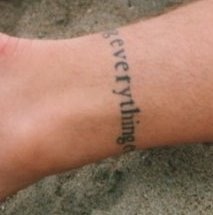
And my imagination includes, as the dictum goes, everything. I went horse riding in the fall, and now there are horses, and one fabulous horse, in the book. I saw the Assyrian Lion Hunt reliefs at the British Museum, and the lions are there. A friend went to Kathmandu and heard an American band playing reggae at a bar called “Purple Haze”; that’s in there too. Patagonia? In the book. Another friend pointed out that what one of my characters was doing was a metaphor for how I felt about making up for lost time. Yes, that’s in there too.

The imagination eats all of the world and transforms it into some odd new thing. I trusted my imagination before, making up shorter pieces. But not like this. And so I scrape away, and find it, as vital as it was when I was a child and fell in love with Sinbad and the genie, which I learned was a story from Scheherazade and the Djinn. It all comes back.

Piece by piece, and like Scheherazade, I know I must keep telling this stories, and trust to make it through another day. The alternative is most unfortunate, but even that will be a surprise.