Playing Fagin

In a frying-pan, which was on the fire, and which was secured to the mantelshelf by a string, some sausages were cooking; and standing over them, with a toasting-fork in his hand, was a very old shrivelled Jew, whose villainous-looking and repulsive face was obscured by a quantity of matted red hair. He was dressed in a greasy flannel gown, with his throat bare; and seemed to be dividing his attention between the frying-pan and the clothes-horse, over which a great number of silk handkerchiefs were hanging.

Oliver Twist, Chapter 8

When Dickens introduces Fagin, he is called “a very old shrivelled Jew.” Dickens names him as “the Jew” over 100 times in the text of Oliver Twist, calling him “Fagin” nearly 300 times. It is an antisemitic portrayal. George Cruikshank’s illustrations make this characterization resoundingly clear. Yes, Dickens savages the officious Beadle, Mr. Bumble, the weedling undertaker, Mr. Sowerberry, and almost everyone else. Only Mr. Brownlow and the almost angelic Oliver avoid the jaundiced teeth with which Dickens bites into the world of workhouses, thieves, prostitutes, official disdain, privileged arrogance and ignorance, and moral corruption. Nonetheless, the portrayal of Fagin stands out.

Plate 23 from Oliver Twist by George Cruikshank

Of course, Fagin is a criminal. He corrupts the orphans he gathers from the streets and turns them into a gang of thieves, prostitutes, and murderers. He takes as much as he can and relinquishes as little as possible to keep the gang assembled. But compare how Oliver is fed at the workhouse (“three meals of thin gruel a day, with an onion twice a week, and half a roll of Sundays”) and how Fagin greets him: sausages. While his love for his “dears” may be tainted with ill-intentions, it is genuine and genuinely creepy. How can he not love the boys and girls who bring him loot?

You may scoff at the idea of Fagin as benefactor and provider, but that is precisely what Dickens is after. If privileged Londoners don’t take generous responsibility, Fagin will father the youth. Dickens does not confuse right and wrong; Fagin is streaked with evil, and the London Constabulary captures and executes him. Dickens may have been a reform-minded writer, but he was no anarchist. But the reformer looms when on the morning of his death, Dickens shows: “A great multitude had already assembled; the windows were filled with people, smoking and playing cards to beguile the time; the crowd were pushing, quarrelling, joking. Everything told of life and animation, but one dark cluster of objects in the centre of all—the black stage, the cross-beam, the rope, and all the hideous apparatus of death.” There is no love for this crowd. No golden justice is meted out by a “hideous apparatus.” This is the bad punishing the bad.

I am thinking about Fagin because I am playing him in the musical, Oliver!. Lionel Bart reframes Fagin almost as comic relief, making him far less dark than in the novel. Fagin is still a thief, still a corrupter, but absolute villainy resides in Bill Sikes alone. One unrepentant, irredeemable “bad ‘un” is enough for a musical. Indeed, Fagin escapes at the end, leaving behind “friends and treasures” and contemplating change. It’s possible.

Alec Guinness as Fagin in Oliver Twist, 1948

Portrayals of Fagin have emphasized his Jewish-ness, and not for the better. A hundred years after George Cruikshank’s illustrations, the Anti-Defamation League protested Alec Guinness’s portrayal in David Lean’s 1948 adaptation of the novel. The film did not open in the United States until over ten minutes of Guinness’s scenes as Fagin was cut. Ron Moody was nominated for an Oscar for his performance in Carol Reed’s 1967 film version, and the portrayal has not aged well. While faithful to the source, the source is problematic. Rowan Atkinson took part in the 2009 London revival, and he plays Rowan Atkinson playing Fagin, which considerably softened the antisemitic aspect of the role.

Ron Moody in Oliver! 1967

Dickens is not flawless, but he grew as a writer. His later characterization of villains focused more firmly on the actual villains of this novel—those who failed to honor their official responsibility. While Dickens always relied on quickly recognizable characters, he expanded beyond stereotypes and countermanded readers’ expectations. In Our Mutual Friend, Riah is Jewish and saintly—in James Mardock’s words an “anti-Shylock” and not just an anti-Fagin.

Rowan Atkinson as Fagin in Oliver! 2009

So, I will approach Fagin as a man who has carved out a niche in a broken society. While he advises Nancy that gin is dangerous to a “pure young girl,” he also knows that life is dangerous for everyone who lives outside the warm glow of privilege. Whether by choice, inclination, calling, or nature, if you live outside expected societal norms, you live at risk. I suspect that Dickens knew that Fagin’s Jewishness marked him as an outsider, and even though the portrayal is antisemitic, there is also sympathy. Dickens almost always stood on the side of the outsider. I will stand with that and see where it takes me.

Process: Swimming and Writing (part one)

Every so often, Facebook reminds me of where I have been. I posted this a dozen years ago. I was still swimming, and this was the template for the 2500 meter swim I did that day. Not the most exciting workout, but after two or three hundred meters of warmup, I held hundreds at 1:15. Pretty fair for a non-competing 49-year-old swimmer. The swimmers out there will recognize that I was breathing bilaterally (on both sides) every five strokes; they will also acknowledge that I was taking 15 strokes each length. Again, pardon me for saying this, but that wasn’t bad for a 49-year-old. I trained myself to breathe bilaterally after I left college because my stroke had a hitch that breathing to each side helped eradicate. My right shoulder was happier.

A few things to note. First, I am virulently attentive to and oriented to process. Swimming was never a “zen” activity for me in which I transcended the effort to reach some peaceful state of mind. Instead, the effort focused me on the effort itself. I paid attention to where my hands entered the water, how they caught the water, how my body moved over my hands, and where my hands exited the water. I was aware of the position of my arms as they flew forward to grab the water again. And again. And again. In this case, I remember thinking, “1, 2, 3, 4, 5 (breathe)”—taking three breaths each length. Focusing on what I was doing helped fend off the building exhaustion.

I grew up swimming when there were no devices to pump music into wet ears to help keep the beat while you worked out. I developed an inner hortator who drummed out a rhythm to keep me on pace. It was similar to the inner voice that kept step following steps when I hiked 500 miles as a 12-year-old, but now more driven and more ecstatic.

“Ecstatic”? You might ask. Through my four years of high school, as I improved from a middling age group swimmer to what I eventually became, it seemed that every swim (in practices and meets) was faster than the last. Every set provided an opportunity for improvement. I may not have gone to the Olympic trials, but I swam faster, following the beat that my cruel inner taskmaster laid down. Swimming fast exhilarated me. The effort I made showed an immediate result. The sweeping second hand of the poolside clock never lied, never expressed an opinion. And I swam in the company of some of the fastest young men on the East Coast. Keeping up meant something. I never again swam without that goad in mind.

Throughout my life, swimming offered the solace of process, repetition, and speed. Tired and overworked? I swam. Heartbroken or happy, I swam. Sick? I swam. No matter the tumble of work and life, swimming was one thing I could control. It was years before I connected the bones of that daily practice with writing, drawing lines from “this” to “that.” While some people had told me that swimming and writing were twinned activities, I felt that writing required another kind of effort. I believed that creativity was antithetical to the dull repetition of physical exertion. Writing required audacious leaps. Even when I began to write, words ran like a flood, flowing from inspirations as varied as my life to what I read. And then, they didn’t.

When I lost the thread for writing, I poured my effort into teaching and, later, churchwork. I wrote everything an English teacher writes—class notes, assignments, student evaluations—and then curricula for Sunday school classes, children’s stories for worship services, and little else. I had a book in mind but no room in my day or brain. Work and family occupied my day—as they should. After years of being too busy to thrash about in the pool, as I approached 50, I answered the old call for 30-45 minutes in the pool. Everywhere else, I felt at someone else’s call.

So, I started swimming, and little by little started writing too. This post, with its repetition, was modeled on a kind of prose poem—a metapoetic “word word word word word punctuation ad infinitum.” I’m not claiming that it was a perfect prose poem. I have changed my mind about the value of writing when inspired. I have sung the praises of word counts in some of my blog posts. An accumulation of words will create its own gravity until it catches fire—almost the way the sun catches fire over and over again. Trust the process and write word after word after word. Don’t wait for inspiration—write yourself there.

My swimming post pointed me in a direction, and eventually, the fire took hold.

The Crooked Path

You can’t do everything.

I look at Hokusai’s screen that encompasses the twelve months and recall a writing task—a prose poem a day—that I imagined and attempted when I was in my early thirties. It was another opportunity to write; I had just finished Baudelaire’s Paris Spleen and felt inspired to follow his example. I wrote a bunch of prose poems centered around Philadelphia, and when I showed them to a teacher, he dismissed them as being too much alike—“in one voice,” he said.

I took the criticism to heart, added some comedic pieces, and stopped. I never felt an urge to get back into it. Or I always felt the urge to get back into it. Writing can be like that. Merwin wrote, “my words are the garment of what I shall never be/Like the tucked sleeve of a one-armed boy.” In a world that values completion, so many stray projects end up feeling unfilled. Here is the life you laid out clothes for last night, and nothing fits in the morning. When you get to work, you notice that everyone else is walking around in well-tailored suits. Your jacket has four arms as if made for a horse or a dog. We won’t talk about your pants.

I attended a graduate writing program that required a full slate of academic courses, which meant that I read Shakespeare and Bussy D’Amboise, Woolf and Dickens, Heidegger and Gallop, Baudelaire and Blake. And I taught. And, oh yes, I wrote. I read work by classmates and writers who my classmates and professors recommended. “You should read—.” There was also a fair amount of “You should write—.” Both “shoulds” implied something about what was good for me and what I would be good for—as if there was a menswear shop that had something in just my style. If only I could figure out my style. With so much swirling around me—and not just “so much” but so much that was exciting and excellent—it was easy to lose track of what I wanted. Other people claimed greater knowledge. Two of my classmates thought I should wear leather pants—that’s how they saw me. Another friend insisted that I put on sweats and play in the Sunday morning touch football game. Later, the same friend castigated me for having a hard time with the “O” word. Obey. Good luck. The only call I had to obey was write. And read. And teach.

Of course, I was disobedient—even to my own calling because I did not know where I wanted to go or what I wanted to write. In the garden of earthly delights, who could choose one pleasure? I was complimented that I could learn from anyone, and this is true. Whether a professor or poet, a work of fiction or philosophy, every teacher had something valuable to add to my world. Even my worst teachers, whose habit ranged into anger and vindictiveness, displayed some small nugget of positive enthusiasm, even if the display was unwitting. In The Marriage of Heaven and Hell, William Blake wrote, “Improvement makes strait roads, but the crooked roads without Improvement, are roads of Genius.” I read that during my first semester of college in 1978. It’s a damnably enticing bit of advice. Who wouldn’t aspire to genius?

But crooked roads don’t conform, and like it or not, conformity is a more guaranteed path. Improve! Improve! In Stumbling on Happiness, Daniel Gilbert wrote that the secret to uncovering happiness is following in others’ footsteps. If you want to know whether or not somewhere or something will make you happy, ask someone who has been there and done that. Obey the wisdom of the crowd—even if the crowd is relatively small and odd, as crowds of writers and artists tend to be. Or choose the Blake way and talk to imaginary friends. In the world of writers, there are iconoclasts—many who have disappeared from view, but a few who still hold our attention.

But. I cautiously add this proviso. Most iconoclasts we acknowledge as geniuses found a reasonably straight path, even if they wrote about the value of the crooked way. They dug trenches that ran long and deep. Many dug at their own peril. Some—a fortunate few—found acknowledgment early in their endeavors. Others—an even smaller few—were favored by enough fortune and privilege to sally forth in strange directions without fear. Many suffered. If you choose the crooked path, prepare for the worst and delight when the better comes.

I have a hard time advising blinders, but unless you have turned distraction to your advantage, avoid it. Figure out your ditch and get digging. I have repeatedly sung the praises of distraction in this blog, but I am also keenly aware of the price I paid for following a crooked path. Maybe you can do both. Maybe work (a job!), a relationship (spouse, partner, kids), and years of peripatetic exploration will not prevent you from piling up words. If you have succeeded, I venture that your work, partner(s), and exploration support your writing. Writing requires support. Virginia Woolf was right when she proclaimed that she—and any woman—needed a room of her own (and three guineas) to mine the creative ore. This is true of either gender. Time, space, and money must be managed. Mr. Micawber put it this way: “Annual income twenty pounds, annual expenditure nineteen pounds nineteen and six, result happiness. Annual income twenty pounds, annual expenditure twenty pounds ought and six, result misery.” If a writer does not build time and space for writing into that calculation: misery.

So, you can’t do everything. But you can write, which, if done well, will connect you to more of the world and to the essential everything you require. If the path is crooked, don’t worry, and take in the view. You are laying up treasures where it counts.

Wonder and Wildness

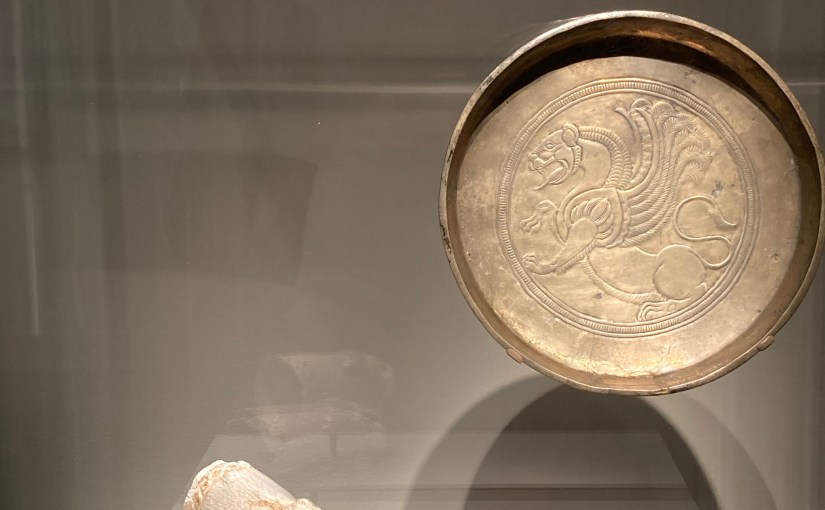
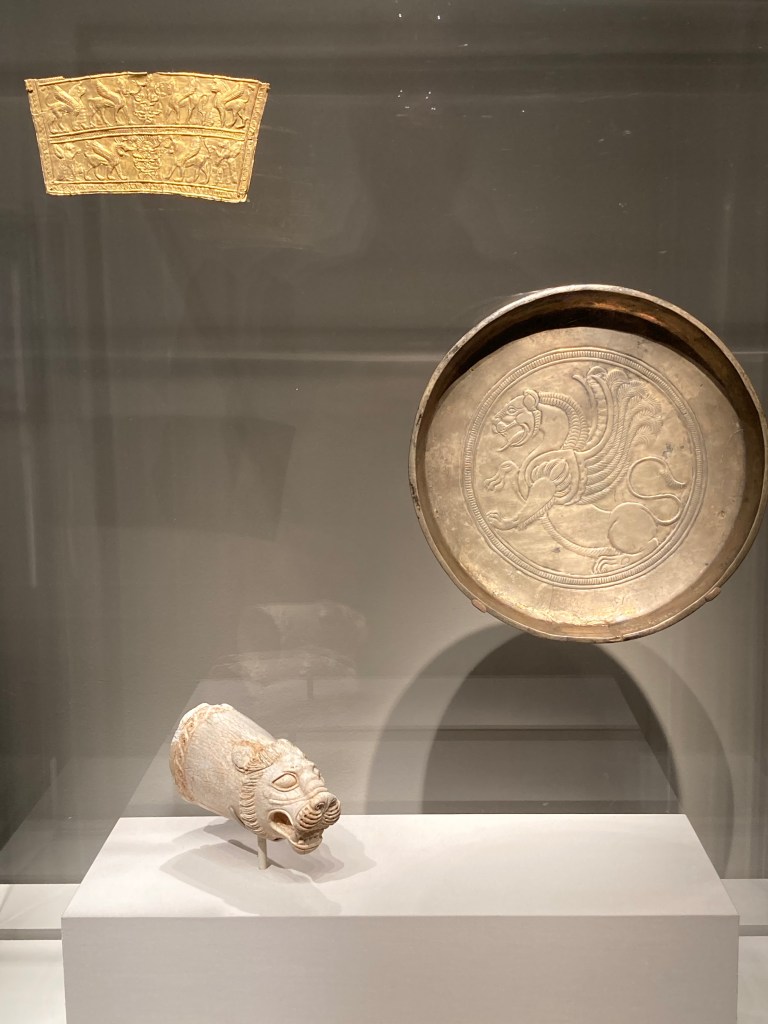
Breastplate Fragment, Northwestern Iran, 8th-7th century BCE; Finial probably Iran or Syria, 8th-7th century BCE; Plate, Iran or Central Asia, 7th century CE

You’ll notice the range here—about 1500 years between the gold breastplate fragment and the bronze plate. Winged guardian spirits persisted in Mesopotamia all the way into earliest Islam. Where did they come from? We don’t know, the same way we don’t know where Jinn originated—or Angels. We only know our domesticated, religion-ified versions. Islam did the Jinn no kindnesses—our vision of them as evil or demonic spirits postdates and is influenced by the Quran, delivered not so long ago. The gold breast piece is twice as old as the Quran.

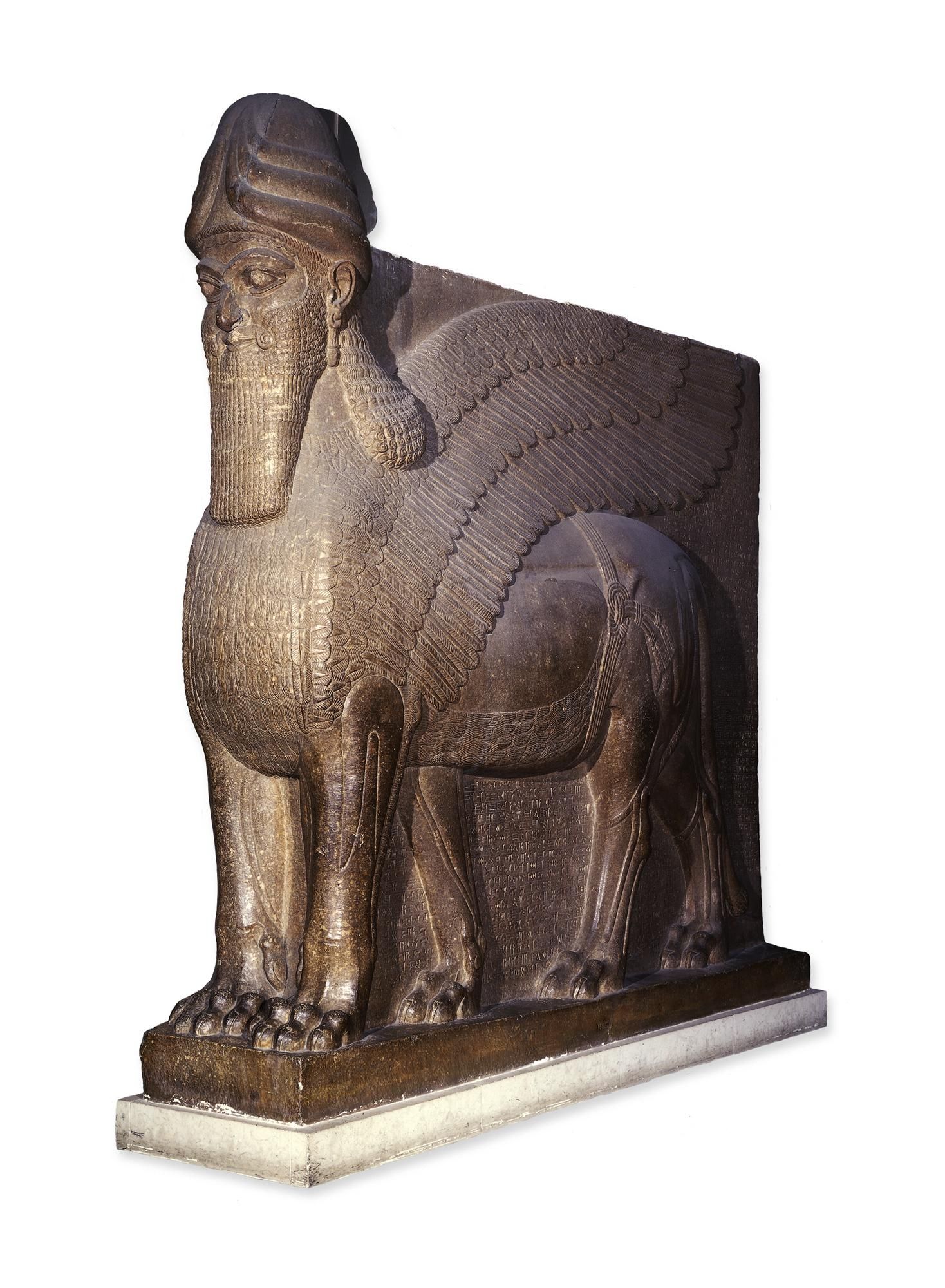
When I write that we don’t know the origins of myths, I don’t mean that they once existed (either the myths or the creatures from the myths) and have disappeared. I only point to our genuine ignorance. Our past is not like science. New devices like those that have allowed the first crude forays into the brain’s working will not uncover why Inanna is the god of love and the god of war (who thought of that combination?) or why winged lions guarded the throne room of Ashurnasirpal II. Lions in Iraq? Winged lions? They persist—becoming a symbol of Mark the Evangelist and the emblem of NATO. How and why the image began is less interesting (if only because it is entirely unanswerable) than how and why they persist and change over our brief human history.

 One of the changes is a distillation of mythological figures into either good or evil characters.  The Jinn suffered this transformation into demonic beings—evil and then even more evil beings (avoid ‘Ifrit and Marid at all costs, even if you are Aladdin, even if they do sound like Robin Williams). In Greek and Roman myth, the gods of love are less complicated than Inanna, as are the gods of war (and, perhaps not surprisingly, the gods of love and war have an affair and are caught in a golden web). Athena, especially the Athena of Homer’s Odyssey, is tricky—the Ur-trickster, if you will—but even she pales compared to the brief glimpses we get of Inanna.

Stone Lion from the throne room of Ashurnasirpal II, Iraq, 9th century BCE

There was a wildness in our early stories and beliefs. We lost much of that wonder and made it make more sense, conforming to ideas of should and could. We read in amazement until the story wraps itself into a moral. Our relationship with God is all but legalistic, and He doesn’t even have to swear on the Stygian marshes to bind him to a promise; we have it in writing. The Torah, the Bible, and the Quran are one part history, one (big) part contract.

And for those who insist that our current beliefs are too unbelievable, it’s not because these neo-heretics are demanding something wilder but seek a more logical and ordered universe. It’s as if we believe that it should be possible to predict the weather right down to the last degree as we leave our homes for another day of work. I remember listening to the automated voice deliver the weather forecast while sailing on the ocean: wind speed, wave height. And then, I got to the business of the waves and wind along my route. The windy, watery world was enduringly unpredictable.

If I was a deist, I would shudder to think that a contract written 1500-5000 years ago had any hold on a being I acknowledged as omnipotent. Like Oliver Twist, I would hold my empty bowl and beseech, “Please, sir, I want some more.” The “more” is more gruel. Somedays, the wild is as unpalatable as gruel, but more often, it is ambrosial in its unpredictability.

We strip the winged lion of its essential weirdness and wildness and turn it into an emblem—an organizational standard bereft of history and wonder. The weirdness and wonder persist too, and they rattle outside the self-imposed cages of our lives. Even when as small and inconsequential as a virus, we logical, rational humans capitulate to what we cannot control. We fail in the face of the wild.

Creative Writing: the Beginning of a Proposal

The commonplace is a story about removing and re-inserting a comma, and I’ve seen it attributed to Flaubert, Wilde, and even Galway Kinnell. It’s a story that circulated in my creative writing program and served to reinforce a notion of meticulous effort. Every word, every punctuation mark, and even every margin mattered. Teachers handed back drafts of stories (I suspect the same for poems, but I was primarily a fiction writer) swathed in red. Students exchanged workshop drafts with equal editorial fervor. I recall a doodle in the margin explaining why “his eyes darted around the room” was wrong (the eyes had sprouted wings and flew).

In retrospect, how did we write anything?

Writing can be a solipsistic venture that verges on the masturbatory. This kills me because the whole point of writing is to write to someone else. We don’t tell stories to the wind—it may feel like that, but the goal is to engage and entertain. Art aspires to enrapture the reader’s heart and mind. I want to hear laughter or tearfall—for my reader to swoon into deep and long-lasting arousal. The worst critique is not “I don’t like it”; it’s “I’m bored.” Spending years with readers who explained exactly what it is they didn’t like did not help me. A simple exclamation of “Yes!” or yawning, “Nope” (politely put) would have helped. We all chase “Yes!” We should be unabashed and single-minded about that pursuit.

I may not know the right way to teach Creative Writing, but I think we got it wrong. The focus on “getting it right” bores down to a molecular level that obscures the grander design. And, too often, it misses the need to simply find a better way to get into it, stay in it, and get back to it. “It,” of course, is writing. While Twain is correct: “The difference between the almost right word and the right word is really a large matter. ‘Tis the difference between the lightning bug and the lightning”; I would argue that unless you learn to write every day, surrounded by bugs and in every sort of weather, lightning will not strike. The friction of the daily grind creates fiction; we live by sparks. The more you grind, the greater the spark—and the chance of producing good writing.

I had acquaintances (primarily students in Binghamton’s Medieval Studies program) who insisted that creative writing could not be taught, and since it couldn’t, shouldn’t be taught in graduate school. I disagree with both assessments; however, I take the point. Some people believe that raw artistic talents are strictly innate, like eye color or height. You can’t teach someone to have green eyes or to be  6’10”. Talent—creative ability— is more fungible. No fairy arrives crib-side to bless some and cast the rest into outer darkness. If she does, gifts are no guarantee of accomplishment. It’s not enough to trust that divine inspiration combined with considerable application of ass to chair will produce work.

To the question of should, I am amazed that those scholars familiar with the scholastic tradition did not appreciate the value of the joint venture. We gather together—even when we are introverts—because, as the monks patiently scribing out holy manuscripts understood, company helps. The world with its incessant demands is not favorable to writers. Lesson one for any writer is that time is the most precious commodity in their day. Money—always money—helps, but money does not put words on the page. And, if you have the drive to be a writer, that drive can be too easily misplaced and reapplied to almost any other worthwhile task. Lesson two for any writer is that drive matters more than talent. Surrounding oneself with people who understand these two immutable truths will help keep the writer on track. One reenters the world, understanding that in both well-meaning and insidious ways, the world will seek to redirect your time and drive is vital.

A note and an aside. Perhaps you like the idea of being a writer more than the actual writing. The world celebrates the idea too, and maybe that is what attracted you in the first place. I have bad news: the reality does not match the idea. Good news! If you are driven to write, the truth, the obstinate durable daily habit of writing, is unmatched. You will begin the day either not knowing or with only the vaguest sense of where you are headed and then discover the Northwest Passage. Or Zanzibar. Or Ur. Or Eden. Writing opens the world.

So, the first things I would start with are how to manage time and how to direct the drive. Writers need to learn that the grind is not their enemy (we live for the struggle!) and that their time is precious. And then I would ask, what is your lightning? What is your spark? And start them working in that direction. And then I would point them to the world that waits.

It does.

Child at Work

There is a scroll of Hokusai’s paintings/drawings. The curator’s note suggests that Jurojin, the aged figure at the left of the scroll, might be a stand-in for Hokusai, who was 80 when he painted this. Jurojin, it should be noted, is a god of longevity. The scroll, like the scroll Jurojin unrolls, may be a teaching tool. Hokusai made many manuals for his students, capturing and encoding the wisdom he accrued over decades.

May I suggest that if Hokusai is taking the part of Jurojin, he is also, at the very least, also acting as the young student sprawled out in front of the deity? Or, he is just the student.

Hokusai declared that “[w]hat [he] painted before the age of seventy does not capture the truth of things.” He kept learning and kept striving for legendary status. Imagine having such a lofty aspiration.

When we are younger and naive, we allow ourselves big dreams. We can foresee heroic possibilities. Time softens those dreams. We take a bite of the realist’s apple and learn to accept humbler goals. We even herald the value of those quieter moments: a well-laid table, an easy transit across town, a perfect fall leaf. All those things matter, yes.

And yet, I think of Monet, late in life, building lily ponds at Giverny, painting them, then draining them and remaking them so that they would match his vision. This was an act that combined impetuousness with determination.

Or, I look at Hokusai and see his determination to keep pushing his art to encapsulate his goal.

Such ambition is, at heart, naive. We let athletes off the hook for greatness when they reach their thirties. What second or third act waits for them? We learn to put away childish things and think and act like adults.

What I love most about Monet is his adult awareness of what he wanted and his adult design to create the very thing he wanted to paint. Wiser critics than I would suggest that Monet’s art was the result of cataracts. But then why build, then drain, and then rebuild those lily ponds? Like a child building with blocks, knocking down, and constructing something similar but better.

We come to creation with hard earned wisdom. Part of that wisdom is the knowledge that creation is a kind of play—play at its most ambitious and visionary. We may start with a pattern, some model from which to work, but then we expand and sharpen. Unlike the baseball player who throws with elegant precision to the strike zone, we toss the ball into the air, seeking a curve and arc that only physics limits. We make our rules and play harder.

As wise as you may grow, we stand astounded before the task ahead. Our propensity for astonishment sets us apart and keeps us in good stead. Here is where we learn, here where we reach for legends.

Gallery Walking

The clay pot from Syria and the stone head from Egypt. “Syria and Egypt are not so far apart,” you think. Shapes, after all, are shapes. I get a sense that Charles Freer would like this thought. He assembled his collection to bridge differences of time and space, to find unities and common threads. And yet, nearly three thousand years separate these objects.

Jackson Pollock, Going West

In the National Gallery, a few steps will take you a hundred years from Raphael to El Greco, and nobody’s confused by the differences between them. Gallery after gallery is organized by time, place, and artist. On one wall, Eakins, on another Whistler, and then two of Sargent. A row of Monet’s, each featuring a reflection in a body of water. We recognize the separate hands. We differentiate—pointedly so—Cassatt from Manet. We recognize that an early Pollock gets tossed upstairs in the glass cases of the Smithsonian American Art Museum, Benton gets a wall in a room, and Lavender Mist has a bench in front of it at the National Gallery so you can sit and think about it.

Jackson Pollock, Number 1, 1950

Walking the galleries can be a jolting experience. It should be a jolting experience. Even in the galleries designated “Arts of the Islamic World,” the shifts from one work to the next makes me question what any of the artists thought, and even more so, what any of the viewers thought. There is no monolith here—or there is, and it constantly fractures and fragments. Yes, of course, Islam, but also them, and me.

Some of my friends comment, “What a nice Sunday ritual you have,” hinting that the museums are peaceful places of reflection. I walk past two sets of angels (Mohammed and Mary, each surrounded by beings of glorious verve and color) listening to The Rolling Stones singing “Can You Hear Me Knocking.” Yeah, peace is my goal. I spend time every Sunday in the company of Monet and Calder—quieter voices after a fashion—at least they aren’t dissonant. The day is dissonant.

Entirely not to scale. The Minaj of the Prophet, by Jami, 1492; Mary, Queen of Heaven, by the Master of the Saint Lucy Legend, 1485/1500.

The vase from Syria and the head from Egypt. 1100 kilometers between them–roughly the distance from Washington DC to Alabama, Illinois, or Maine. So yes, I can see the confusion. Add 3000 years. 3000 years ago, Greece was beginning to lose Mycenaen writing. The New Kingdom in Egypt was collapsing. Babylon was in decline. Celts had started migrating from central Europe—Ireland was still in the future. Turn your head and watch the world change.

Perhaps we think that it changes more slowly now. The leaps from Stone Age to Bronze to Iron seem so slow and so enormous. Now we are cocooned in steel and silicon. Everything is instantaneous and, almost by magic, eternal. Time has stopped. Travel and commerce brought every place within our grasp. Disney helped us imagine a small world, but how quickly it fragmented over my lifetime. Maybe the differences were always there.

from The Wonders of Creation by al-Qazvini

Even walking through the Art of the Islamic World at the Freer, there is an early 15th Century folio from al-Qazvini’s Wonders of Creation. From 100 years earlier, a page of the Shahnameh includes an illustration of Gushtasp slaying a dragon. I don’t know how these stories were received.

It is a commonplace to claim that people have universally enjoyed, even hungered for, stories. I don’t know how each of these audiences spread over 100 years, a thousand years, longer, came to story or to art. I cannot simply state that what I feel, they must have felt. I walk the galleries and try to imagine across time and space how those who came before felt.

Reading like a Dream

Read as if you are reading a dream.

We all dream, and so the experience is not uncommon. We fly, we fuck, we fall. Jungians and archetypalists of all sorts would normalize and defragment the conspicuously bad writing in dreams to give them viable and understandable meaning. Last night—in the morning, really, when I cadged an extra hour of sleep after my alarm gently nudged me—I dreamed about lifting weights. The gym—a fancy place with magnetically attaching plates—did not have—or rather, did not seem to have—bars long enough for bench presses. I had to go outside—in the dark, behind what appeared to be a dock or loading bay—to find the six-foot-long, forty-five-pound bars. Then I put plates on the bar, started lifting, and the weights felt light. I told my friend, Brian (yes, I have a friend who shares my name), who was spotting me, to stop helping me. I was covered in sheets. The word that came to mind was “shroud,” and it was getting in the way. I needed to take it off. Then I woke up.

Yes, this dream is poorly written—a shroud? Really? Concelo ex machina. I remember thinking, “Get this fucking thing off me!” Yes, I curse as much in my dreams as in real life. Obvious, clunky, and weird.

I forgot to mention that the gym was in a hotel in Marseilles. My mind populated the rain-wet streets with a raft of people of different nationalities, all drawn to the port city—a city that is liminal in real life and not just my dreams. I heard them speaking French, Spanish, Arabic, and Farsi and knew that I could not communicate with them even as I heard them. They would not be able to tell me where to go—where the weights were—even if they knew.

There isn’t a book (or website, or Reddit thread) that will provide a definitive interpretation of a dream because there isn’t one. Even our own dreams unravel without narrative coherence or discernible significance. And they are our own dreams! Who better than the dreamer to make sense of the image soup that our brains simmer in the night? Besides, they almost always end with “And then I woke up.” So we rarely encounter a well-orchestrated climax and satisfying denouement.

Imagine, for a moment, treating what we read as if they were dreams. What if, instead of artistic unities, we sought to immerse ourselves the same way we are immersed in dreams. “Why not like life?” you ask. We exert—or attempt to exert—control over life. The homeostatic drive irons out all that is strange or random or, well, dream-like. In dreams, even for the lucid dreamer, there is an element of the unexpected. The joy (jouissance?) of dreams comes in their unpredictability. When else in life do we forsake prediction for sheer experience? 

I struggled to teach my advanced students how to “read like a professor” because they sought to corral meaning. What they read needed to reflect their experiences or interests. But then, I also struggled with my professors and grad school colleagues, who also harnessed what they read to suit their beliefs. Few readers meet the work and let themselves alter when they alteration find. We have a terribly hard time meeting the wild with our own wildness. Besides, surprise, the harbinger of change, runs counter to how our brains process information. Brains—by design—seek to match what happens with deeply rooted predictions. We predict and demand that the world conforms to our predictions. I am drawing on the work of Mark Solms for this.

What if, instead, we read literature like reading a dream?

First, we must know the dreamer better—or, at the very least, recognize that the dream comes from a profoundly intimate and personal space that is entirely subjective and therefore unqualifiable compared to our lived experience. While there may be correspondences with our dreams, relying on what we know of ourselves will lead not so much to a misinterpretation as a “mis-experience” of the dream. While holding up a mirror to ourselves is absolutely enchanting (and even, at times, essential), it becomes a solipsistic activity when left unleavened by a deep understanding of the dreamer.

Second, just as dreams surprise us, we need to be astounded by what we read.  Even if we are reading a novel in a class on post-colonialism, even if the novel makes straightforward claims about the post-colonial world, reading it only as an exemplar will circumscribe the work’s overall effect. It will remove the dreaminess of the work, and in that dream, there may be more (or less) about post-colonialism than we imagined at first. Pardon me while I carry this a step forward; we cannot colonize dreams with reason.

The same way that an out-of-place detail (that shroud!) opens up ways of understanding a dream, it is precisely literature’s ability to flash incongruous elements into being—not only as counterpoint but as mawing gaps in the well-knit Markov blankets of perception. We are lulled into a kind of affirmative satisfaction when pleasantly predictable patterns repeat. The surprises, the mistakes, and the interruptions all unravel the carefully constructed conceptions leaving what? A mad scramble to reweave—midnight (or midmorning) Penelopes trying to stay one step ahead of the rapacious reason-making suitors.

Dreams are strange, and most writing is not. Most writing belies its transactional origins. It keeps accounts, documents ownership, concretizes agreements, or dissolves partnerships. Most writing is officious and tedious. Dreams are not. Granted, we may feel that another person’s accounts of their nighttime rambles are inexplicable and therefore of little interest to us. Still, compared to a bill of sale or divorce decrees, they are candyfloss. The harder bone to chew is that we are primarily transactional beings. Writing reflects our need to organize and regiment experience to a suitable and predictable medium.

Dreams are a rebellion in our brains. While we spend our days demanding sense, dreams help settle a more extraordinary account—that of strangeness and unpredictability. Literature is a semi-intentional settling of accounts. It balances the need for predictable and measurable outcomes with the unsettled and unreliable aspects of existence. And if you make sense of last night’s dream, there is more confusion ahead. Why not court confusion and read to dissent with all common sense?

I go back to Mrs. Dalloway and how Septimus Smith’s death made Clarissa “feel the beauty; made her feel the fun.” Few moments feel as gloriously incongruous as that—as disruptive and necessarily reframing. You cannot read Mrs. Dalloway the same after that moment, and if you are a serious reader, you better start all over again. I will suggest that almost all works of literature have such moments—or several such moments—that just don’t fit. Or completely fit. Each one shatters the pattern and forces the reader to reconsider and reconceive.

There’s a reason that we do not experience reality the same way we experience dreams. It is impossible to have the world perpetually exploded and rearranged out of order. I may seem to critique how we live when I make claims about our essentially transactional natures; I am not. But I see the tension between the drive and indefatigable desire for predictable outcomes and the violently unpredictable nature of complex systems. Reading literature is not a way to practice making sense but of recognizing the failure of making sense. We must need to constantly reassess, and recognize that even in a world that we have (subconsciously) organized (that cleanly appointed gym in a hotel in Marseilles) that there are twists and turns ahead. We need to learn that the world is more unpredictable, more incongruous than we would like. As are we.

Swimming and Time

Every time I touched the wall, I looked up to check my time. The spinning red hand of the clock revealed how long it had taken since I began whatever swim I had started, however many seconds—or minutes—ago. We did two things at practice: we threw yards and meters at our bodies and practiced touching the wall. Whether it was a grueling set of 20×100 yard swims on a 65-second interval to wrap up a workout or the inane 3×1500 meter swims with 30 seconds between each as a warm-up (Imagine doing that at 6 o’clock in the morning on an already warm summer day, in a pool with only thin nylon ropes to separate the lanes), whenever you finished, you jammed into the wall. You lifted your head from the water to see the clock. How fast did I go? How much time until the next swim begins?

I was not a world-class swimmer. When I was little, I tended to sink rather than proceed at pace. I wore a Styrofoam bubble on my back.  There were lessons. My parents took me to Red Cross run classes in a lake near our home in Paoli. I flailed, resisting the head turn required for a proper crawl. Still, I loved the water and turned blue when my parents took us to Jones Beach when we visited their parents. Who would want to leave the churn and rush of waves? We joined local pools and passed our deep-end tests, treading water for an absurd amount of time under the watchful eye of a lifeguard. Once passed, my mother would drop us off while she shopped or played tennis at the Great Valley Country Club. Swim teams only started when I was 11.

In my sophomore year of high school, I was a fair Junior Varsity swimmer. The Hill School had a nationally ranked independent school team, and I was far from fast enough for that. I was only 4 years removed from goggle-less practices in the insidiously warm indoor pool at the Phoenixville Y. I came home bleary-eyed and teary. As far as other sports, I had been an indifferent Little League baseball player—more interested in the planes in the sky than balls hit in my direction. Because I was tall early, my father—a scholarship athlete at Niagara in the 40s—signed me up for basketball. It did not take. I enjoyed gymnastics: the rings and parallel bars carried me a little out of gravity’s grasp. You had to play a sport each afternoon, fall, winter, and spring at my high school. In my first year, I opted for soccer, swimming, and golf.

The 3500 yards that the JV team swam between 3-4 in the afternoon were as many yards as I had ever swum. Fred Borger was the JV coach and threw easily attainable sets at us: ten 100s at 1:45, then 1:30 as we improved. I started off swimming the 500 yard freestyle at meets. My early times were over seven minutes. I ended my first season at 5:55. My 100 breaststroke was north of 1:20, which rarely merited placement in one of the three lanes for meets. During my second year, after spending the fall playing water polo (a ploy to get fall training in for the varsity), my 500 time dropped to 5:20, and my 100 breast hovered at 1:15. I knew if I wanted to improve, I would need to change something.

As a sidebar, I was not happy at my school, an all-boys bastion against, what? a fear of falling? I spent the spring of my sophomore year stoned and looking for a new school for the following year. I crept out after curfew and brought pizza for my dorm mates. I never studied—my memory for most things kept my grades well above water. This was the year that ditched my longstanding boyhood aspiration: to attend the Naval Academy. I wanted a more diverse, less dick-driven environment. After all, how could you read Catcher in the Rye and not feel as if you wanted to turn away?

A friend on the Varsity swim team shared a flier from a swim camp/AAU team in Iowa. Glen Patton was building the program at the University of Iowa and was contacting good young swimmers like my friend as a way of recruitment. I applied to Swimming School and was delighted to be accepted. If I wasn’t going to go anywhere else, at least I could be a better swimmer.

At Iowa, we had three practices a day, totaling as many as seven hours in the pool. I had never swum more than one hour on any day and rarely more than 4000 yards. We swam between 20,000 and 28,000 meters every day. The general philosophy was “Get in. Keep up. Move inward.” Slower swimmers—I was one of them—populated the outside lanes. You shifted from lanes one and ten to two and nine, then three and eight, and so forth. The fastest swimmers—and there were Olympians on that team—swam in the center of the pool: lanes four and five. In the two summers I swam there, I never nosed into the center (not 4 and 5, not even 3 and 6), but I could see them. I chased and swam faster. 

When I swam in Iowa in 1976, we gathered in the evenings to watch the Montreal Olympics. The American men won every event except one (Britain’s David Wilkie took the 200 Breaststroke), and the men set world records in every event except the 100 Butterfly (Mark Spitz’s last record). The East German women had a similar performance, helped, as we know now, by PEDs. The revolution in training (all those miles) caused significant drops in times for those of us who did not use steroids. We were swimming fast, and we all could swim faster. We wore T-shirts emblazoned with the motto: SWIMMING IS MORE FUN WHEN YOU’RE IN SHAPE. And we got in shape by watching our times.

When I returned to my school, I leaped onto the varsity, still not the best, but game. I kept up in practice, By the fall, I was under five minutes in the 500, and my breaststroke time dropped over ten seconds. Raw and brutal repetition rewarded me. The two-hour practices we did at school were intense and competitive. If you weren’t the leader in your lane, you damn well chased the leader, and if you caught them, then you had to lead. Leading was a privilege, but your trailing feet became targets for the hungry swimmers behind you. We each had our strengths, each took the lead on various sets. I had a vicious breaststroke kick, which meniscus surgery 30 years later can attest to. I swam hard, and even later, when I swam just to stay fit, the habits continued. I checked my pulse. I looked at the clock.

 During the 2021 Olympic swimming coverage, I saw the swimmers stare at the clock (digital, not analog) in the distance. I saw the looks of joy and disappointment driven not by winning or losing but by their times.  Was that my best? Did I meet my goal? While the competition may drive many, after a while, the clock becomes the primary combatant. I may have been cognizant of where my teammates were in the pool (chase! chase!), but mostly I looked up and saw that red clock hand sweeping past a black hash mark. Watching the Olympics, if I yelled it once, I yelled it a dozen times, “Show the times!”

The next time you watch swimmers (or runners), notice where they look at the end of their races. If you want to know how they feel, know that they are keenly aware of the inexorable, implacable opponent of the clock. They have looked up thousands of times. And then they have put their heads back down. It is time to go again.

The Necessary Writer

Stop worrying if your vision is new

Let others make that decision

They usually do

You keep moving on

“Move On”–Stephen Sondheim

You already know how to do it.

If you wait for inspiration, the right moment, the formulated phrase, then all you will do is wait.

Writing is like getting on the boat. No matter what the weather is when you leave the marina, you don’t know what you will encounter in three or four days.  And so you get on the boat and sail. Something will happen, maybe something similar to what happened yesterday, or five years ago—an ocean rolled out flat as plate glass that reflects no clouds, only the hot yellow eye of the sun. You will sweat and pray for anything, any change. If you were lucky, you brought a book onboard, and you charge through half of The Pickwick Papers in an afternoon. You will read fast to make up for the blazingly windless day. Or, you will not—you don’t know. You will find out as you go.

You are on the boat, so you dream of dry land and a woman who writes you love letters. The scopolamine patch behind your left ear gives you visions that will haunt you into your sixties: a black-bearded fat man pretending to have a heart attack, but you have discovered his lie, and he winks at you, knowing, somehow, that you will keep his secret, and in doing so, will enter a world of lies. Of course, you didn’t ask for this vision; you didn’t know what was coming. You thought you were sailing to Bermuda—the island of The Tempest—and would find stories of Sycorax and Caliban (you will: she serves breakfast at a restaurant in Hamilton, and he rents mopeds that break down on the winding North Shore Road).

There are no visions if you do not get on the boat. There is no hard, stupid sea, no Bermuda, no gingerbread at a restaurant in Flatts. Your father does not tell you to take the helm and hold it until the mountainous sea subsides. “I can’t do it anymore,” he tells you. “I will send your brother up, but you have to hold the helm. He can’t sail in this.” So you become the necessary sailor.

Writing is not like getting on the boat. Writing is getting on the boat. As much as you prepared, you discover, adapt, and grow. You don’t become a better sailor by reading about sailing—although, of course, reading can help. But remember Antonio Machado’s advice: “Mankind owns for things that are no good at sea: rudder, anchor, oars, and the fear of going down.” What you read is the rudder—an idea of where you should (or could) go. The rest is sailing.

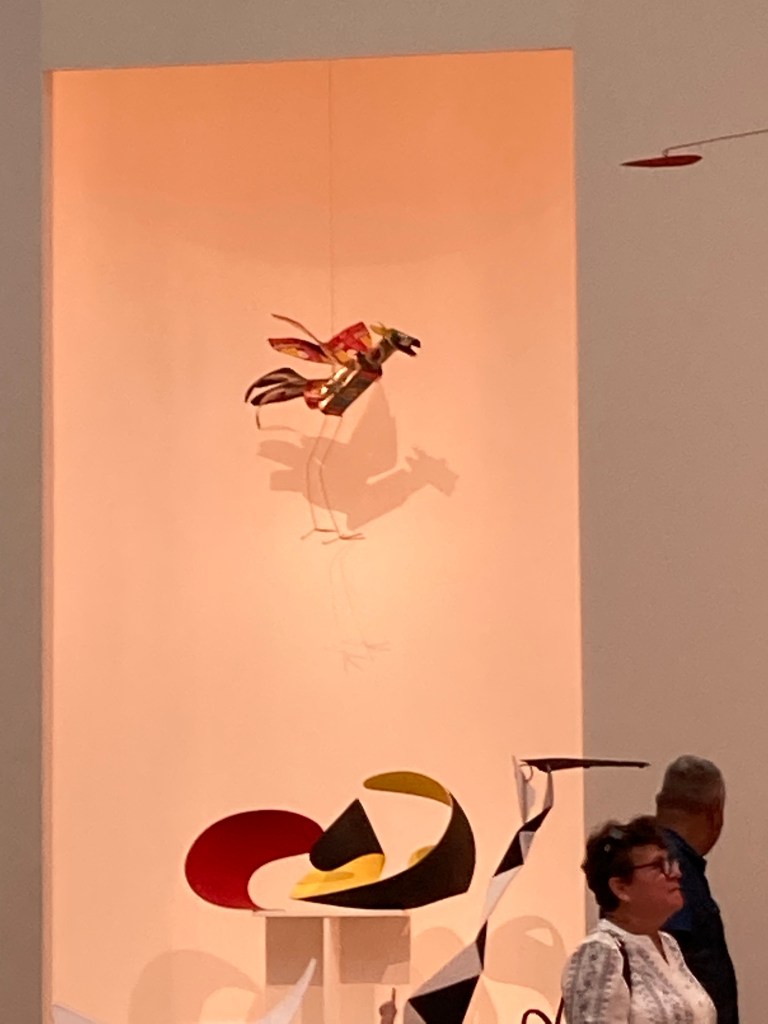
I spend my Sundays wandering through the galleries of Washington DC and writing while I wander. That’s not true. I spend my Sundays writing in the galleries of Washington DC, and when I pause, I wander. I spend 8-10 hours resetting my writing brain for the week and return each week to reset again. The shadows on the walls of the Calder room remind me that there is the thing—the made thing (art, literature, as you will)—and then the accident of the moment—the way the mobile turns above my head and the light casts its silhouette against the wall. I watch as people stand in front of his Birdsong, and the one photographs the sculpture and shadow while his companion kisses him on the cheek. A 10-year-old girl asks the docent, “Are we allowed to take pictures of the sculptures?” She walks around the room with a small camera, recording everything she wants to remember.

Birdsong—Alexander Calder above Black, Yellow, Red—José de Rivera

I sit beneath a wire armature horse and write.

I write in galleries because I am surrounded by finished work. The artists painted or sculpted every day. Monet? There are ten paintings by Monet in Gallery 80. 2500 works have been attributed to Monet. Alongside the Calder sculptures, there is a photograph of his studio. It is work to create works. They were all, always, on the boat.

I love to write surrounded by people in the galleries because of their response to the art. Yes, there are people on their phones. Some walk through the National Gallery and do not see that in Gallery 81, on the wall opposite Constant’s The Favorite of the Emir, the three Renoir paintings (Young Spanish Woman with a Guitar, Odalisque, and Bather Arranging her Hair) reflect the figures in the Constant: musician, dark-haired woman, red-haired woman. Accidents and intentions abound. Unless you go and pay attention, you do not see. Write and pay attention.

But write. Write every day. Find a space that energizes your writing. Annie Dillard claims that she needs a blank wall and no distractions. Who can argue? Know what works for you. But write. Write for hours every day.

When you sail, unless you are in one of the science fiction yachts of the America’s Cup, you cross the ocean at an absurd 5-7 knots. Except you proceed, like the tortoise, every hour of every day. You may read 400 pages of Dickens in an afternoon, but you cannot write 400 pages in an afternoon. Well, maybe Dickens could. Get used to the steady, inexorable pace of the work, knowing that the words and pages will pile up as you write. Don’t be afraid to count the miles, the hours, the days, or the words. If you set out each day, they will accumulate. Get on the boat and go.

You need to become the necessary writer. Do not wait for inspiration or rely on that inner voice that weaves stories and does not write (I know I have a novel in me if only I had time to write). You have the helm—on dreary, monotonous days when the Iron Genoa churns out diesel fumes and artificial speed and for the hours when your mastery balances your life on the crest of swells. You are the only one who can fulfill the wishes you make walking past fountains, rubbing strange lamps. You are the djinn, the captain, the writer. So get on the boat, and don’t look back.