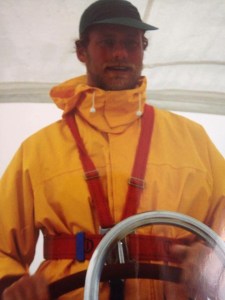
 We gathered a twice a day to listen to the nautical forecast, usually in the cockpit, but when the weather was execrable, in the cabin. For days on the ocean it was the only external information we had, and the computerized voice that intoned the zones and conditions annoyed and entranced us. My father never explained which particular slice of the forecast we should heed. If there was one, it was his secret. We did get a general sense: the information could reveal a significant change from the forecast with which we headed onto the ocean. For the most part, the weather we encountered was weather we could see.
Besides, what did the weather matter? We were going into it one way or the other. If something sudden arose—and in a storm, wind and rain could change direction in a moment—we had one rule: change course. At 3 a.m. on a Monday morning, Saturday afternoon’s destination could wait. That lesson only took one stern delivery.
I think I became an atheist on the ocean, or at least a pragmatist. If there is a god, it answered my prayers for relief with a simple, “You put yourself out here, jackass. You are going to have to get through it on your own.” At the same time I learned to believe in and respect a power much larger than my desire. Only a fool raises a fist against the weather or the ocean and then dares an impossible course. We had our foolish moments. On particularly bad days, my father would simply decree, “This is shitty.” If it was, we sailed through it.
In this way, we learned a sensible passivity on the ocean. Our single dare was the initial impulse: sail. After that we trimmed sails, corrected course, vomited, slept poorly, ran the engine through flat days, cursed the diesel odor, and gloried. We were sailors.
Every so often, the moment called for essential courage: tying down loose sheets at the bow while the boat bucked through night storm. I could hold onto nothing while grabbing the clew of the working jib and the sheet (line) that whipped back and forth, having worked itself loose. “You get that,” my father said, in a tacit admission that his Parkinson’s Disease would prevent him from ever again wandering forward in less than pleasant conditions. “It’s shitty, but we have to get that.” He didn’t even need to add that proviso. I had hooked my tether to the line that ran from bow to stern and was scrambling ahead—cursing, as is one’s right, and scrambling.
One learns not to wish for courageous opportunities. Danger is not a reward, even if it frees the soul from, what? complacency? On the ocean, complacency is death.
I knew about my father’s illness because, on the ocean, every limit will be tested, but it is essential to acknowledge those limits. You do not ask a first time sailor to take the helm in a gale, nor do you ask uncertain hands to tie a bowline. Few are those who ask for something hot to eat and a place at the helm in any weather. And my father’s illness was a limit–he wanted, desperately, to be the one who managed every danger; after all, he was our father. When he could not, we had to know it, and keep him safe.
Even while waiting on the ocean, one never stops being on alert, ready to absorb the next challenge—and boredom (bored in a week? Bah!) must be one of those challenges. But, who gets bored between the sun, the sky, and the endless blue?
Still, I wonder about the lesson—prepare and wait. It is easy to forget that while I waited, I was on board a 36’ sailboat that made steady and infernal forward motion—through all kinds of placid and idiotic weather. Yes, wait, be patient, but for the love of all that’s right, keep going. Even if the pace is a mere 6 knots, keep going. Even if a storm causes a momentary reversal, there is a destination, perhaps on the other side of the world. Keep going. And be prepared for what comes. It is, it will.


 Almost thirty years ago, I was eating dinner at a little restaurant on the edges of Johnson City and Binghamton, New York. My mentor and her husband had invited me along. These were heady occasions, full of discussions about writing and literature, and the program in which we all worked. I was a student, but, still, I worked. On this particular occasion, they started talking about writers manqué—although I heard it as writer manqués. It was a new word for me. Manqué: having failed to become what one might have become; unfulfilled. They started listing writers who had been in the program, writers who had published and stopped, and writers who were currently in the program. It was sharp and cruel, and the sobriquet stood out as one to be avoided at all costs. These may not have been eternal footmen, but there was snickering enough to go around.
 Nonetheless, the fear of being unfulfilled lurks. In a
  Is it any surprise that repetition plays a significant role in my life? I came of age as an athlete knocking out sets of 30 200 yard freestyle swims. They were yardage eaters—a quick and dirty way to lay in 6000 yards of workout and buy time for rest of the yards that the coach had in mind. We finished them at intervals of 2:30, 2:20, and 2:10, which left 50 minutes for the rest of the practice—an easy pace for the two to four thousand yards to come. Pushing off the wall every two minutes and thirty seconds, there was time for conversation between swims. Leaving at every two minutes and ten seconds put a crimp on anything other than brief exchanges: “This sucks,” “Stop hitting my feet,” “I’m hungry.”

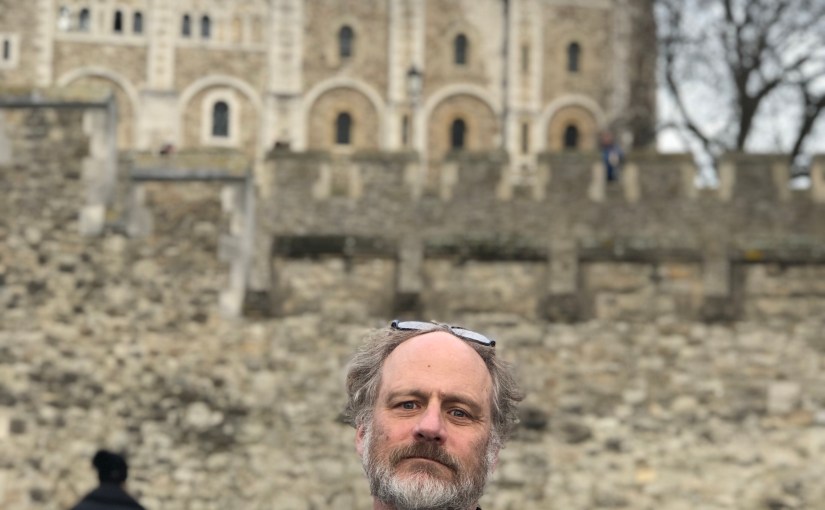
 The charm of London is found in its strange alleyways, endlessly curled streets, and tucked away history. If there is a grid, and in some way, there is, it is bent around the past and the ox bow turns of the Thames, and everything attached to it has been attached in a haphazard fashion. For instance, the coagulation of insurance buildings in central London: the gherkin, the cheese-grater, the scalpel, and the inside-out building; defy any sense of a rational aesthetic plan. Or the juxtaposition of the Tower on one side of the Thames and the glass pineapple of the City Hall just across the river.
 And so London’s history is oddly folded into the cityscape as well. A tour through the city—you cannot tour the whole city, or tour it on a bus; you must walk it—folds two thousand years of history, creased around a Roman occupation, a French conquest in 1066, and a fire that destroyed 80% of the city in 1666. And the city is just the square mile that had been walled and gated, but is now open and underlaced with a rail system that carries you quickly to nearly every point beyond the old wall.
 There is an orderliness to the whole affair. Announcements in the Underground direct people where to walk down hallways and on escalators. Advertisements along the walls of the stations counsel caution with wallets and and advise care with alcohol. “Mind the Gap” is stenciled on the ground where the trains stop, and cheeky announcers corral riders whose fancy Italian made shoes have strayed over the yellow safety line. Cross walks show a green walker when it’s time to cross—around Trafalgar Square the walkers take on a variety of LGBT friendly forms: couples and symbols. Just remember to cross when the green light comes!
 History is a story of discontinuous events—events that collide like weather systems or galaxies, having barely understood origins, and even less decipherable records. All the witnesses were destroyed in the collision. What they saw, what they thought, and what they felt—even if they recorded their observations on stone, paper, steel, or silicone, have been destroyed along with them. We are living in the age of delusion, in which we believe in the sanctity of our recorded history—either self-scribbled or captured by another.
 Second, in the musical Hamilton (which was also part of this trip to London), the character of George Washington warns Hamilton that we do not control who writes our stories. He’s telling this to a man who believes in his power to literally write his own story—and to use his words to cement his reality. He can’t—and doesn’t. His wife, Eliza, sends his legacy forward—and Lin Manuel Miranda brings us her legacy. But, as Miranda admits in interviews, even this moment for Hamilton—and therefore, for him as well—is provisional and subject to changing tastes and critical opinion.
 continuoussearch