Vulnerability (sadness and happiness) and Writing

I have had long stretches of sadness in my life. Not depression, mind you. I dipped an oar in that black river at the end of my annus horribilis; I learned the difference. Sadness is not intractable. It will seem odd to hear this, but I cherish my sadness. I do not revel in it, nor do I valorize it, but when it comes, as it must, I do not turn away from it as from an unwelcome guest. There are good reasons to feel sad. This past year has laid a few at my feet. I have made decisions that would, at some point, along with a bounty of other emotions, cause me sadness.

Sadness passes. So does happiness. I am happy by default. I have a sleep app that prompts me to reflect on how I feel at the end of the day. I almost always designate “happy,” even on days that I also tag as stressful. Even on days when I have felt sad at some point during the day. However, I do not feel happy exclusively, nor do I adamantly cling to that emotion.

When I grew up, my mother warned my brothers and me away from things that would make us feel sad. She policed movies and television shows that grappled with serious and discomforting issues like nuclear war or actual (not fictional) crime. The ugliness never plagued me as much as the shutting off of truth did. Information—truth—drew me with powerful magnetism. Even now after watching the news of the day, I can let anger and sadness pass even as the information remains. There are rare occasions when the cacophony of information drowns out other, happier possibilities. There are times when the information mixes with personal challenges and setbacks. The personal is harder to overcome.

I fortify my day with opportunities for joy. I surround myself with students—people who are younger than I am. They have avoided the cynicism that adults wear too willingly. I go to the gym and lift weights, then charge ahead on the elliptical for 23 hard minutes (530 calories burned!). This summer, I took my place at the table in the school library and worked at my book. I go home, cook dinner (steak, broccoli, and brown rice with avocado), then read. I head to bed at a reasonable hour.

Sometimes, happiness—extreme happiness—is necessary. The first big push for a new writing project requires a kind of ignorant and unabated bliss. There are 100,000 words ahead, and no one may ever read them, but I am going to write them anyway. I began this past book in the bountiful throes of such exuberance. Boundless joy carried me into the first hundred pages of my book. Fortunately, when the cause for that joy left my life, the writing continued. I was writing—at last!—and that became the source of joy for me.

The Doctor on Horseback

Even now, writing this, I feel happy. I look at a photograph from a year ago: the doctor on horseback. I am ecstatic. The novel had not yet begun. As far as the horse carried me, the novel carried me farther—and further. It helps to know the difference.

When I was depressed in 2002, I sought out a counselor, and he advised me that happiness was, if not an illusion, then, at least, a particularly difficult aim. He made this suggestion because I was tangled up in feeling that I was mistaken for not being able to feel happy. My relationship of the past 6 years had ended. I was teaching in a strange place, and my friends were hundreds of miles away. My mother had just gone through a harrowing battle with cancer. My father had just died. Happiness was, at best, elusive. And, perhaps most damning of all, I was not writing.

Writing is difficult—for the reasons I pointed toward above, but also because it requires a kind of vulnerability. One must, at once, care and not care at all about the reader. One must care, and not care at all, about the outcome of the effort. One must learn to love the process above all. This is true of life as well, but writing lays this truth bare in ways that many other kinds of work do not. It is work, and it is, absolutely, not.

No matter what other happiness—even joy—passes from my life, this more vulnerable happiness remains. It was always there, waiting for me to find it, perhaps waiting for me to need it. Finding it, and needing it, I am vulnerable now—open to a more profound sadness—but also open to a deeper joy. I write and proceed.

500 pages

I graduated from SUNY-Binghamton with a Ph.D. in English Literature/Creative Writing in 1994. Before I went to graduate school, I did not know what I wanted to be. I had written a little earlier in life, and had taken a fiction workshop while I was an undergraduate, but my sense of myself as a writer was hazy at best. Still, I had done some work and I applied to writing programs in the spring of 1988. I was accepted at Binghamton.

While I was in graduate school, I wrote stories, a novel that I shelved, some poetry, and essays. I also wrote a slew of academic papers. Mostly, I read furiously and widely, delving into a world of literature and philosophy that had not existed for me before I began this turn in my life. I still have many of the books that I read in those six years and they are either a bulwark or an anchor. Now, they seem more like part of a wall that divided my life into the time when I did not write, the time I discovered writing, and the time I stopped writing.

That time ended in 2018 when I considered moving away from family and the jobs I held in Norfolk. I had been separated and divorced for four years. Calamity at one of my jobs resonated in my life. I was at sea. I needed to find a ground that was not defined by the needs and desires of other people. I needed, frankly, to be selfish and directed. I do not believe that it is a surprise (to me at least) that my colleagues sent me packing with the book, The Subtle Art of Not Giving a Fuck when I left in August of 2018. Message received.

Because I did give a fuck — too many fucks — not just in my professional work and personal life, but in my writing. Unlike some of my one time classmates, I felt called to writing not so much because I had a need to express myself, but almost in spite of any need to exclaim, “Here I am!” I was obsessed with getting at some ineffable and intractable truth that existed outside my narrow sense of self. I wrote with an evangelical zeal. Can I say that art motivated by such a keening has little easy air to breathe? It does not. My stories, even when they were fantastic, needed to tread more often on the ground.

When I started writing this blog in 2014, I was in China to adopt my daughter. I started to write about simple human truths that were grounded in my simple human experiences. I hoped that my observations would have some resonance with others, but I wrote without too much of a concern for an audience. The work proceeded in fits and starts after that initial push. And then it flared into this—a daily practice of reflection and direction. That fire lit the flame of the novel I finished in August and has carried me into a second.

My writing projects since May of 2018 have produced over 500 pages of words. Some are good. Some are better. My nonfiction has been largely about my writing and writing in general. My fiction has just been a story about a Djinn, almost a retelling of an older—much older—story, with some of my preoccupations thrown in for good measure.

Writing (fiction and nonfiction) has felt revivifying. I have enjoyed the deeper reflection and playful invention. The writing has come more easily and far more consistently than anything else and at any time I have ever written. Ever. I have looked forward to the task and have left it—whether I write for an hour or the better part of a day—feeling replenished. More will—and does—come.

When I shared this insight—500 pages! More is coming!—with a friend, I did so with the proviso: “in spite of the past year.” She corrected me: “Because of it.” Perhaps so. Perhaps I spent the past year and a half knocking myself off my moorings just so that I could get this work done, just so that I could reclaim all that I had feared was lost.

I told another friend that I felt a kind of urgency to write. She worried that I was ill or distressed. Yes, I have been distressed. Old wounds have haunted me and focused my attention. I have allowed them the space to heal. And have used the writing to help me heal.

While the writing has helped me gird myself against that distress, it has also allowed me to wrap myself in joy. I feel that joy more profoundly now than when I was starting out some thirty years ago. The old uncertainties have fallen away. I do not ask, “Is it good enough? Will there be another? Do I have the right?” Instead, I take solace in a more durable method that suits my heart and mind. I go this way.

What’s next…

I am in between.

Leaving the world of one book for another—even though I was only in that other world for just over ten months—is a discomforting experience. I feel as if I have broken up with my old book. I have put away the music I listened to while I was at work on that book. No more symphonic Led Zepplin. No more Gorecki’s Symphony of Sorrowful Songs. I wonder about the habits of place and duration that propelled the writing of that novel. Can I still go to my Sunday retreats? My place in the library? I’m not married—a blessing and a curse—but I can see how putting one book down would have seismic effects in my personal life. Fortunately—and unfortunately—those changes were already built into this project.

Hahn/Cock by Katharina Fritsch

I spent an hour or so in front of the blue chicken in the tower display of the National Gallery of Art’s East Building going through songs to build a playlist of new music. I have resorted to familiar places—they are still full of energies that may urge this new project on. But “Monekana” by Deborah Butterfield will not call to me, reminding me what constitutes my magical horse, Bellapari. I will miss Bellapari.

Monekana by Deborah Butterfield

What I take forward is a method—because although Butterfield’s sculpture will no longer sing its mythic song full of infinite purpose, something else will open doors to vision that I have not yet seen. I recall that even the Gorecki that drove two months of writing came only after I heard a snippet of it in an episode of Legion. Gifts come from everywhere. Even my Emira untethered herself from her initial source. All that remained constant was my presence at a keyboard, and my presence will be what carries me.

I messaged a friend as I headed into the last chapters “How did it take so long?” That is a long story, and it feels sadder and more pointless on reflection than it was while I went through it. Maybe the years away will end up having whet the creative blades to such a point that I will cut through the next and the next and the next book with the same—if not ease, then precise and playful resolve.

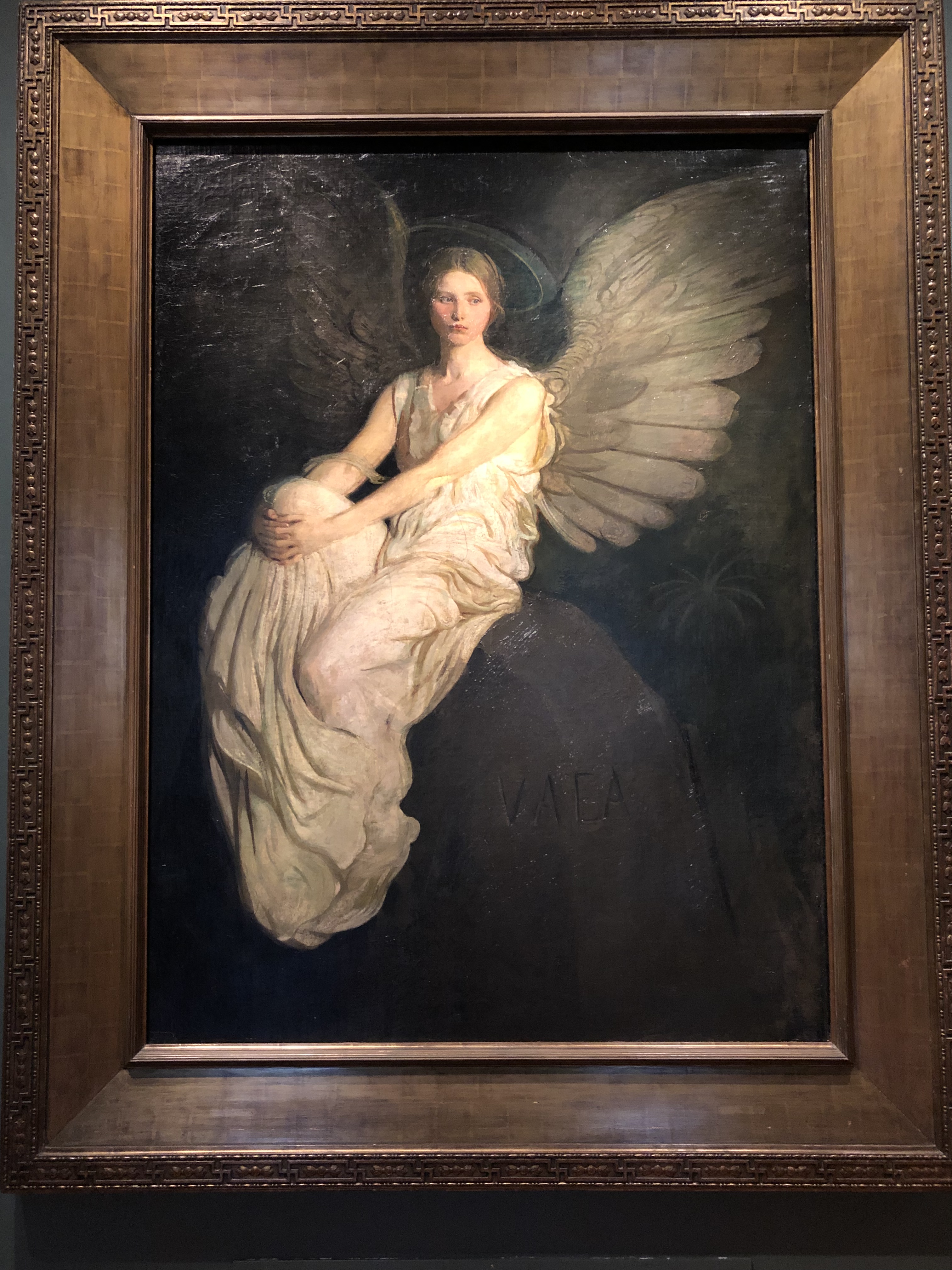
I have loaded the playlist, and gone to visit the angels. Bring on the thieves.

Stevenson Memorial by Abbott Handerson Thayer

Failure, Self-recrimination, and Advice in Much Ado About Nothing (and other places)

One of the joys of reading Shakespeare is finding small moments that are only (only!) tangentially connected to the play—as if Shakespeare was trying to overpack his plays with wisdom. One such moment happens in Much Ado About Nothing, when Leonato’s brother, Antonio, attempts to advise his brother. Antonio knows that his brother is grief-stricken, and wants to assuage that grief with wisdom. He offers this: “If you go on thus, you will kill yourself,/ And ’tis not wisdom thus to second grief/ Against yourself.”

Leonato responds with a diatribe against the advice:

I pray thee, cease thy counsel,

Which falls into mine ears as profitless

As water in a sieve. Give not me counsel,

Nor let no comforter delight mine ear…

Patch grief with proverbs, make misfortune drunk

With candle-wasters, bring him yet to me,

And I of him will gather patience.

But there is no such man. For, brother, men

Can counsel and speak comfort to that grief

Which they themselves not feel, but tasting it,

Their counsel turns to passion, which before

Would give preceptial med’cine to rage,

Fetter strong madness in a silken thread,

Charm ache with air and agony with words.

No, no, ’tis all men’s office to speak patience

To those that wring under the load of sorrow,

But no man’s virtue nor sufficiency

To be so moral when he shall endure

The like himself. Therefore give me no counsel.

My griefs cry louder than advertisement.

Later Antonio will suggest: “Yet bend not all the harm upon yourself./ Make those that do offend you suffer too”; and Leonato agrees to this course—grief will give way to anger and action.

All in all, Leonato hits on the failure of most advice to do anything like good. Can words “[c]harm ache,” or are they just “air”? And what will mend agony?

My father rarely swore. I recall two incidents of “fuck”—once while he was driving, and once when we were getting hammered by a boom made too dangerous by inattentive helmsmanship. Swearing on the ocean was easy for some, but not for him, because he was happier on the his sailboat than anywhere else. Of course there were often far from pleasant days and nights spent under sail. Instead of offering anodyne comment, or suggesting that better days were ahead (we were, after all, headed to Bermuda and at least one evening of perpetual dark n’ stormy’s), we would pronounce, “This is shitty.” That was as far as he would go under duress—save the one time when we were in specific danger—and it summed up the the awfulness of a third day of rain and misbegotten wind as well as anything.

I recognize that we were under sail, and therefore about as far from genuine grief as can be imagined, but soaked, misdirected, and cranky will approximate. We had the advantage, as Leonato said to “endure the like” all together. How often do we experience grief together, and just suffer with each other? How often do we witness those in grief, and feel compelled to offer wisdom—and recoil in shock when our solace is returned with scorn?

Leonato responds in this vein. His grief is exacerbated by his initial response to his daughter, when he excoriates her after Claudio wrongly heaps shame on her. His grief is doubled by the knowledge of his failure of faith in his daughter. Antonio’s final advice points his self-despite toward the men who caused his fault.

And this is a special sort of grief—a pain we lade on ourselves. How many of us can easily confront our failures? Not our foibles—we populate the empty air with “my bad’s.” But genuine failures? Only those who have can offer us solace. Shakespeare offers us this in Leonato’s rejoinder to Antonio.

Why the Djinn?

A friend asked where I got the idea for the Djinn. Here is the long story.

I wrote poems when I was in ninth and tenth grade. They were lengthy works with regular rhythm and rhyme. They told stories. Men turned into dogs. Warriors battled ferociously. Queens and princesses sent boys on impossible quests. When I asked my school to allow me to do an independent study in poetry writing, I was turned down, but one of my teachers suggested working with him to write sonnets and other formal verse. He might have suggested an early round of talk therapy. Stung by early rejection, I refused his offer.

Every night before I fell asleep, I made up stories and told them in my mind. They reflected the source material I grew up with—books of myth and tales that I found in the Schuylkill School Library; comic books that my father doled out on trips to my grandparents; anthologies compiled by Rod Serling that I bought at book fairs.

I did not start reading adult novels until I was in 7th grade and a friend lent me his copy of The Guns of Navarone, after which I read everything that Alastair MacLean wrote. I made a mad dash through Kurt Vonnegut in 8th grade. I read all of Ursula K. LeGuin’s books before 9th grade. All this is a fairly slim bit of literature. My parents were not big readers—we had collections of Reader’s Digest Condensed Novels on our few bookshelves. My mother did read to us, sharing Beowulf and Poe stories. But we were not a bookish family. My brothers and I found what we looked for with relatively little guidance.

I was an able enough reader in high school, but short of Billy Budd, little of what I read stuck with me. On my own, I read all of Neil Simon’s plays, and other plays, and took up with science fiction and fantasy (Asimov, Tolkien, and a little known writer named Zenna Henderson). I read and reread Robin Graham’s account of his trip around the world, Dove. Mostly, I spent long hours listening to progressive rock, watching old movies, swimming, and driving the family car as far and as fast as I could.

In college, I discovered William Blake, James Joyce, Thomas Hardy, Henry James, and Gustave Flaubert. It was also when I read all of John Le Carre’s spy novels, The Joy of Sex, and the only Daniell Steel novel that ever passed my way—The Promise. The main focus of English Literature courses was exposure to more—and I share the story of having a short novel assigned between a Tuesday and Thursday class with my students now. I read widely and gleaned what I could as quickly as I could. I discovered that after reading Portrait of a Lady, my sentences changed. They were better: complicated and analytical.

In my junior year, I switched focus to Art History (same deal: memorize as many works of art—in order and with an understanding of importance—as fast as possible), which, fortunately included a Cinema class that greatly expanded my limited knowledge of film.

I started writing fiction in college, and was accepted into a workshop in my senior year. After graduation, I began an espionage novel that had something to do with Monet’s Haystack paintings in the Hermitage, in St, Petersburg. I fiddled with a story about a baseball player. I wrote a few chapters of something about two friends who decided to go to college and pretended that they were ten years younger than they were.

I had a sense of the novel, and novel length stories, but at this point in my life, I had only read a few hundred novels. I had never heard anyone explain rising action or a three act structure. I grasped scenes and could understand the books in an intuitive and intimate way. I wrote into the unknown without a plan, without having any idea of where to go, or what to do.

When I was 28, I went to graduate school to study writing, and even there the basics were not tended to. What I knew of Freitag’s pyramid, I garnered from John Barth’s “Lost in the Funhouse.” But fiction had never been about plot as much as characters and feelings. Maybe because I had never been drawn to plot. I often knew in a page or two what was going to happen in a novel—not the exact details but I could chart the end of the rainbow from the first curve of the arc.

So, what does any of this have to do with Djinn? I suspect that strains of all this—and of all the events of my life to date—appear in this work. Mainly, there is the myth, the early fascination with and appreciation of the fantastic as a genre, and the long interest in things that were away from here.

I encountered the djinn—as genies—in Sinbad and the Tales of the 1001 Nights. A widow who lived next door to us had those books. This book re-entered my life while I was in graduate school, in large part because of John Barth’s insistence on non-western sources of and for stories. But also because, once I encountered the djinn (or jinn), I was impressed by their wiliness and cruelty. I wondered—right or wrong—whether they had been mis-portrayed by the writer of the 1001 Nights. Why would such power need to be cruel? To refer back to Blake—“…what shoulder & what art,/ Could twist the sinews of thy heart?” I wondered. But I did not pursue the djinn, not yet.

I wrote in other ways. Although I have a set of prose poems set in Philadelphia that delve into the fantastic, I followed the realist tropes of my time. Perhaps this is what kept me from finishing—I was writing away from the story in my heart. Last year, when I dropped everything to take on new responsibilities—to myself and my work—I set aside the piece I had feverishly labored over for over ten years. During that ten years, I had written down a brief thought about a character who was keeping a secret (secrets will be something I grapple with forever). Five years ago, I was waiting for friends in a Mexican restaurant, and dashed out to buy a composition book, wrote a couple of pages before they arrived , and promptly forgot the book at the restaurant.

That story became the story of the Djinn.

I was dating a woman who shared my appreciation for the 1001 Nights—you have a copy too?—and that was enough of a spark to light the fire in this book, because the kindling, and the logs, had been waiting all these many years. Suddenly, I had a character whose secret was so closely held that he did not even know he was keeping it. He had forgotten that he was a Djinn.

There are other connections to other parts of my life and my studies that fueled this fire. Some of those will remain secret. Others are perhaps too obvious for me to mention here. For those of you who wonder how novels—or anything—gets written—by others or by your own hand—the short answer is that we tell the stories that enchant us. The shorter answer is that we sit down and write every day. No matter what. Perhaps because we are enchanted and under some infernal command—I wish that you write a novel, Djinn. So be it.

On the revisionary road

Here is the next step in the process. I have spent the last few weeks reviewing my rough draft, which I have dubbed the “working draft”—and have produced several copies of that working draft. I split time between one draft saved in between Pages (on my iPad), and and another saved in Word (on my laptop PC). I have run the draft through Grammarly several times, and read the document from page one through page 312 (now). By the way, Grammarly does not catch every typo, nor does it allow for “Djinn” to work as both a plural and singular noun. So be it.

I have enjoyed rediscovering how I imagined the book when I began, and to rewrite those old intentions to suit where the whole thing turned. While I was aware of this change as I worked, I resisted the temptation to head back and “correct” the earlier chapters. During the first draft, forward motion was more important than perfection—or rather, something like perfection, because, really, perfection is a chimera. In spite of my decision to emphasize forward motion, there has been much in the working draft that has delighted me, and some, on reflection, that has surprised me.

This draft also contains memories of what I was doing while I wrote. Some of those memories are bittersweet, some are joyful. I began this book with one reader in mind—which was helpful at the start. I felt that there was a whole story ahead of me, but did not know where it would end up. Along the way, I read passages in public, and gauged the work by the reaction of an audience—which was also helpful along the way. I also shared bits and pieces that made me happy with other people, including a colleague, who generously read the 170 pages I had written (and not finished) in June. I found the responses of these readers to be helpful, and heartening, as well.

While writing has taken its right and proper role in my life, I do not write for me, to express some deeply held inner belief or to prove some point. I like to engage a reader, to connect. If there is a bigger point, it would be about the power of connection. I appreciate that a piece of writing can be a kind of conversation between me (the writer) and you (a reader)—and it is not an intellectual conversation.

I think, for years, that I tried to write with my intellect, and that I did not trust my heart with the process. I struggled with the desire to express something perfectly, or at least as well as others had expressed themselves. Those others included anyone and everyone who had written anything and everything. More recently, I was able to hear Sidney’s muse exhort me as well—“Fool, look in thy heart and write.” Turning to my heart—away from not the anxiety of influence as much as the weight of awareness—has allowed me to feel my way through the work. Sharing with others has helped expand that feeling, and to have it be a shared feeling at times.

I have turned back to my intellect as I revise, and this has helped me make connections in the text. I add more than I cut, as I realize that I have not provided all the bridges necessary between scenes. Still, I have rediscovered intuition, and as I make my way through this draft, I am surprised and delighted by what I wrote, almost, it seems, by accident, or, at least, by trusting my poor, fallible, and durable heart.

New Year’s Day

Today is my New Years Day. Today school meetings begin in earnest; students return and classes resume next week. What that means in practical terms is that I was up while the clock had a “6” to start the time, and at work while it showed a “7.”

The time doesn’t really matter. As long as something like 8 hours of sleep happened before I wake, time is just a way to organize the day, so that people can make arrangements. During the school year, the events of the day begin at 8 AM, and I like to be present and pleasantly caffeinated well before then. I plan accordingly.

Nonetheless, it is a new year, with all the attendant joy that comes with beginning. This year, I begin in strangely excellent physical condition. I can swim five miles without stopping (a task I once reserved as a test before heading out on the ocean). I can lift more weight than I have in thirty years. And I weigh as much as I did when I was fit and in college. These are all old markers, but remind me that even though years may pass, I can still fight myself back into shape.

I have also finished a draft of a novel, and have started working on revision. These are new thresholds, and mark a significant change in my daily life. Writing every day has been a revelation. I did not plan far ahead, but trusted—blindly, confidently—that there would be wells along the way. I know that the way ahead is—as it is in my favorite Kafka short story (“My Destination”)—“fortunately, a truly immense journey.” I cannot carry enough water to get me where I am going; there must be wells ahead.

I do not know where that journey will lead. I do not know what the next books will be about, but I can feel the impulse to write, to imagine and . All that matters is the writing and allowing for the discovery—the thrill of the new and of exploration of a subject, characters, places, and ideas. I know that there will be a physical analog to that journey, but that it will be bound to psychological, artistic, and spiritual travel as well. All must happen, and will happen.

Once upon a time I wrote a poem about baseball (and not at all about baseball) that ends: “Each day the day begins again.” And so it does, except I am more aware of my old self, and of carrying him—that old hulk, but also that bright star—into this year. So I go, crafting a way forward, learning, reclaiming, and working.

This is the single greatest attraction beginning a new school year—as it has been since I was much younger. There is something new to learn, some new idea, some new book, some new inner and outer experience on the horizon. Even though I am now a teacher, I plunge ahead, building on what I know, and striving for something I do not know, and prepared to discover. Away we go.

Resentment

There is always regret when one has not done not just what one has wanted to do, but has dreamed of all of their lives. “If only I had started sooner,” regret whispers. “If only I had not taken that job, moved to that city, loved that person.” Regret is a whispered siren’s song, and it can lead one toward a sadness that is disastrous to the work.

Regret has a companion emotion, and once one figures out exactly what one needs to do, this other emotion can assert itself in awful ways. This emotion is resentment. Anything—everything—that does not help us attain our vision—our purpose—can cause us to feel resentment. For instance: a job that takes our time—our necessary and limited time—even if that job is fulfilling and valuable. Even if that job pays the bills. Our family can cause feelings of resentment. This is a deep dark secret: the people we love can be the people who awaken resentment in us. Because they ask—as they are entitled—for our most precious resources: our imagination, our patience, our time; our essential necessary energy to do the work at hand. And this is terrible. No one wants to resent for their family or loved ones. And yet, we do.

Anything—everything—that takes away from the energy needed to do the creative work that gives our lives meaning cause resentment. One must learn to carve out sufficient time to be fully engaged and to spend the energy at the work required to fulfill one’s purpose. This is true in any circumstance—with or without family, with or without loved ones, and with or without other work. Once one sees what can be done, one must change one’s life to fulfill one’s purpose.

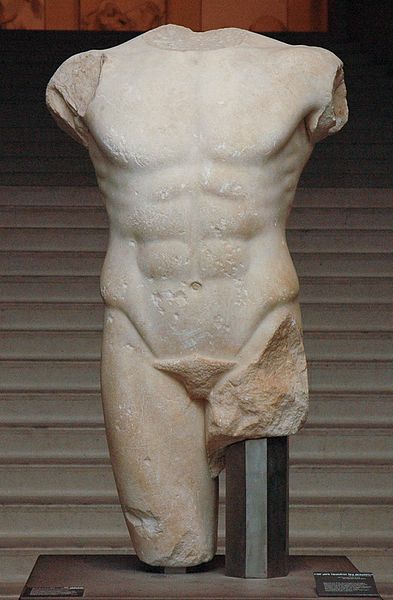
Archaic Torso of Apollo

However, resentment is not located in those other places. Neither my child, nor my job, nor anyone else in my life is the actual wellspring of resentment. It comes from me. Of course there are stupid little human annoyances—the woman who sliced into the left lane ahead of me on I-95 today, then just as abruptly, sliced back through traffic across two lanes to make a sudden right exit. The anger caused by such behaviors only lingers for so long. Resentment comes from an inward driven anger that sharpens regret and turns it back out to the world. The clearest targets are those who are nearest us.

Yes, there may be times when those close to us do ask us to stop our most purposeful work for reasons that are worthy of resentment. They may question your sense of self, and cast aspersions on your work and aspirations. Sometimes people cannot escape the deep-seated injuries and resulting resentments that their injuries caused, and they struggle, not with themselves, but with you. Just as you may struggle with resentment. Just as I have struggled. And one must escape that false judgment, and not validate it in any way. For the most part, we are the main manufacturers of our own grief. We stop ourselves. We foist anger on ourselves and take handfuls of earth and shower ourselves in dirt. We manifest an anger that eats us from within.

I am not suggesting that one should not be angry. Anger can be a source of energy, a goad to action when complacency or sadness or depression has settled too deeply on the creative mind. I let that anger into my work—allowing characters to taste it and spit it where it needs to land. So too with me, I learn, daily, the difference between anger caused by genuine external sources and that which has simply emanated from some ancient sun within me.

When I feel resentment, I check my sources first, and realize that, more likely than not, that I am not doing what I need to do. I am not tending my work and my purpose as I should. I have taken—for reasons at once honorable and misguided—someone else’s charge and anger as my own. I put it down, gently, if I can, and get back to work. The way forward—to fulfillment, to joy—is here.

The Vision before the Travel

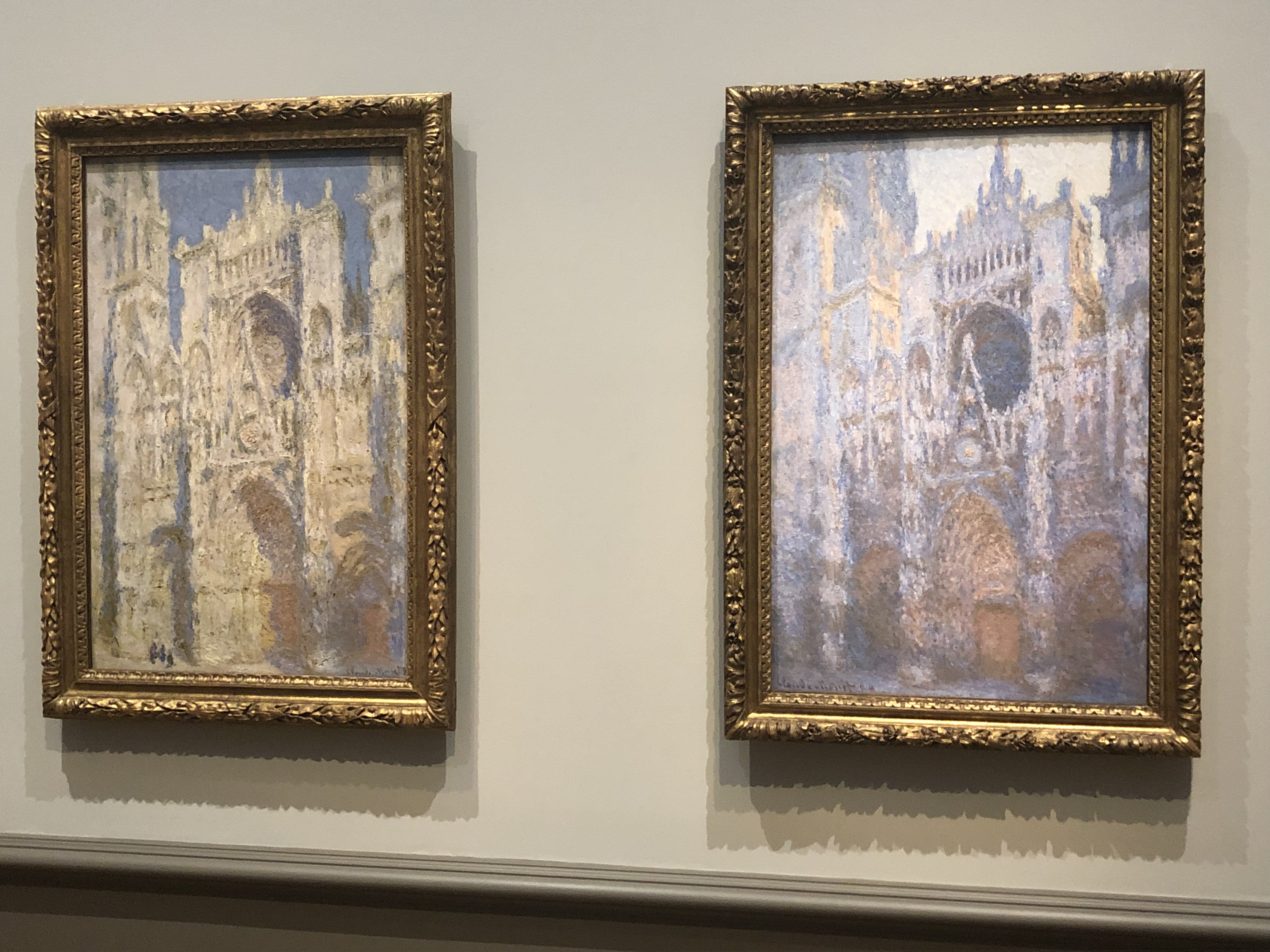
It seems impossible to me that when I finally see the cathedral at Rouen, I will already know the shadows of the late afternoon sun, and the way the morning light illuminates its porticos. How much of the world do I already know through the eyes of artists—the representations and words of painters and writers?
And not just buildings, but people as well. How have Uriah Heep, and Cassius, and Peter Walsh shaped my understanding of certain kinds of men? Or the countless representations of “The Man of Sorrows”?

If I have not traveled, I have imagined, and born witness to hundreds—no, thousands, more—of depictions of the world. I know that I have only traveled through the eyes and thoughts of others, but what others!

And yes, each place I have traveled enters my work, makes it larger, gives me insight to reveal some feeling in each of my characters. However, the travel out into the world is like practice for the travel I must do into the imaginary world I wish to create. I write, again and again, about the gifts that the universe provides, but, in the end, I must make something of them. I must use my imagination to recreate the world.

Which brings me back to the two views of the Rouen Cathedral by Monet at the National Gallery of Art—and all the other renditions I have seen in books and projected onto screens. I see these, and begin to build—in my mind, based on all the cathedrals I have seen in my travels, on all the slants of light, on all the play of clouds—a vision that will become my own. I look forward to seeing the actual building—soon! soon!—but I also know that it exists, somewhere, in my mind already.

Little miracles

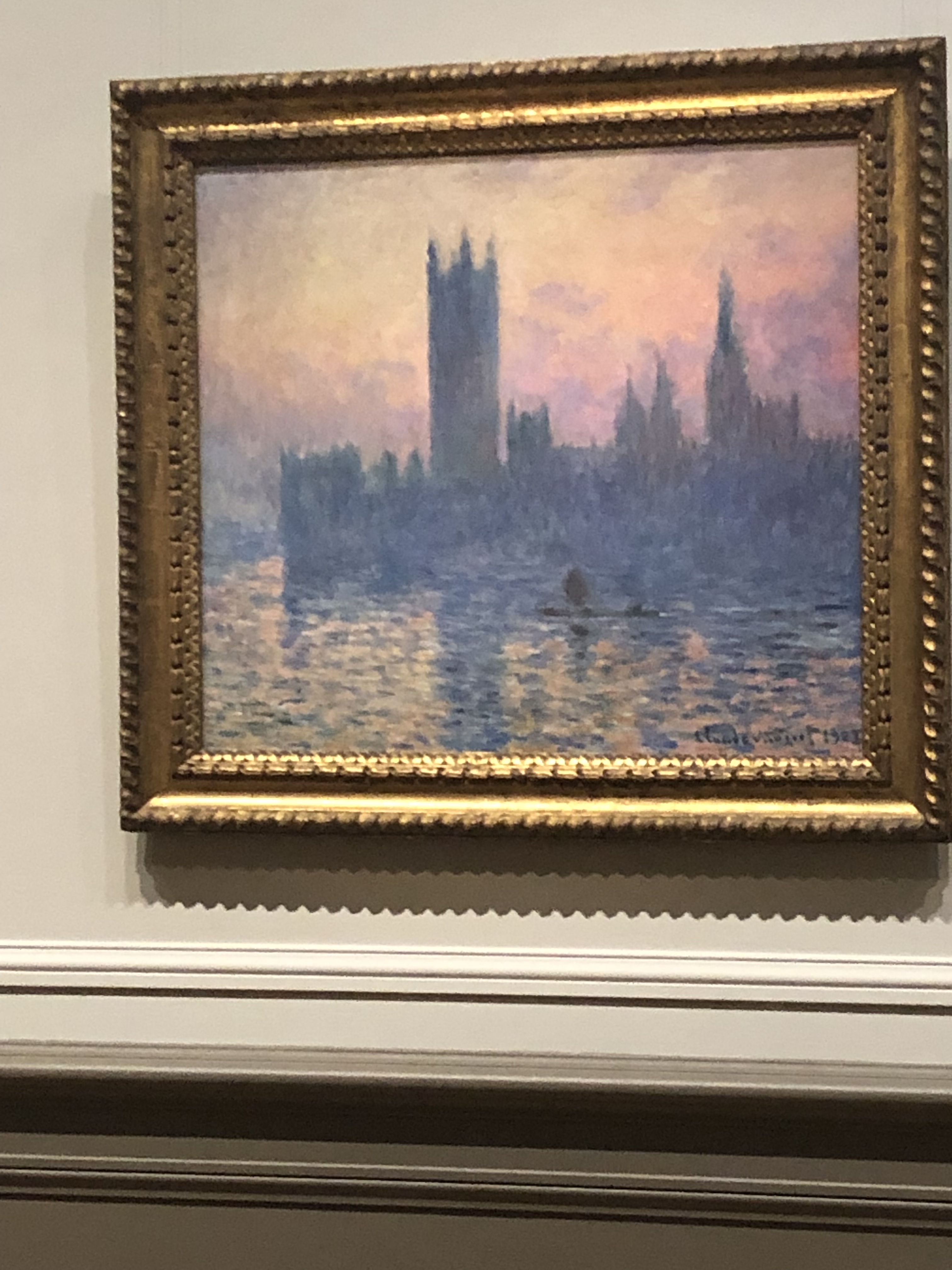
I am looking at a painting made by a French artist of a British building that hangs in an American museum. This seems at once perfectly natural—what else would I be doing? What else would a French artist paint (or an Italian, British, Russian, Afghan, or American)? And where else would a painting be? Of course, this seems only natural because it is what we have become accustomed to, since the time when Ennigaldi-Nanna opened the first museum.

If it is “only natural,” it is also a miracle. That Claude Monet painted? A miracle. That the Houses of Parliament were built along the Thames? A miracle. That the painting somehow came to the National Gallery of Art in Washington DC? A miracle. And that I am here, somehow, seeing this and writing about it? A miracle as well.

We take the commonplace for common, and lose the ability to be a little amazed at what is all around us, and the wild series of coincidences that brings the present moment into bloom. On the flip side, we excuse the awful as “could be worse,” instead of insisting on the more miraculous possibilities that could be. I stand amazed at what is, and demand more. Why not? Why fall back into what is easy, what masquerades as wit, what only keeps us from feeling that we have more to do?

I am looking at a painting made by a French artist of a British building that hangs in an American museum. The gauntlet has been thrown down. This is only the beginning.