Vulnerability (sadness and happiness) and Writing

I have had long stretches of sadness in my life. Not depression, mind you. I dipped an oar in that black river at the end of my annus horribilis; I learned the difference. Sadness is not intractable. It will seem odd to hear this, but I cherish my sadness. I do not revel in it, nor do I valorize it, but when it comes, as it must, I do not turn away from it as from an unwelcome guest. There are good reasons to feel sad. This past year has laid a few at my feet. I have made decisions that would, at some point, along with a bounty of other emotions, cause me sadness.

Sadness passes. So does happiness. I am happy by default. I have a sleep app that prompts me to reflect on how I feel at the end of the day. I almost always designate “happy,” even on days that I also tag as stressful. Even on days when I have felt sad at some point during the day. However, I do not feel happy exclusively, nor do I adamantly cling to that emotion.

When I grew up, my mother warned my brothers and me away from things that would make us feel sad. She policed movies and television shows that grappled with serious and discomforting issues like nuclear war or actual (not fictional) crime. The ugliness never plagued me as much as the shutting off of truth did. Information—truth—drew me with powerful magnetism. Even now after watching the news of the day, I can let anger and sadness pass even as the information remains. There are rare occasions when the cacophony of information drowns out other, happier possibilities. There are times when the information mixes with personal challenges and setbacks. The personal is harder to overcome.

I fortify my day with opportunities for joy. I surround myself with students—people who are younger than I am. They have avoided the cynicism that adults wear too willingly. I go to the gym and lift weights, then charge ahead on the elliptical for 23 hard minutes (530 calories burned!). This summer, I took my place at the table in the school library and worked at my book. I go home, cook dinner (steak, broccoli, and brown rice with avocado), then read. I head to bed at a reasonable hour.

Sometimes, happiness—extreme happiness—is necessary. The first big push for a new writing project requires a kind of ignorant and unabated bliss. There are 100,000 words ahead, and no one may ever read them, but I am going to write them anyway. I began this past book in the bountiful throes of such exuberance. Boundless joy carried me into the first hundred pages of my book. Fortunately, when the cause for that joy left my life, the writing continued. I was writing—at last!—and that became the source of joy for me.

The Doctor on Horseback

Even now, writing this, I feel happy. I look at a photograph from a year ago: the doctor on horseback. I am ecstatic. The novel had not yet begun. As far as the horse carried me, the novel carried me farther—and further. It helps to know the difference.

When I was depressed in 2002, I sought out a counselor, and he advised me that happiness was, if not an illusion, then, at least, a particularly difficult aim. He made this suggestion because I was tangled up in feeling that I was mistaken for not being able to feel happy. My relationship of the past 6 years had ended. I was teaching in a strange place, and my friends were hundreds of miles away. My mother had just gone through a harrowing battle with cancer. My father had just died. Happiness was, at best, elusive. And, perhaps most damning of all, I was not writing.

Writing is difficult—for the reasons I pointed toward above, but also because it requires a kind of vulnerability. One must, at once, care and not care at all about the reader. One must care, and not care at all, about the outcome of the effort. One must learn to love the process above all. This is true of life as well, but writing lays this truth bare in ways that many other kinds of work do not. It is work, and it is, absolutely, not.

No matter what other happiness—even joy—passes from my life, this more vulnerable happiness remains. It was always there, waiting for me to find it, perhaps waiting for me to need it. Finding it, and needing it, I am vulnerable now—open to a more profound sadness—but also open to a deeper joy. I write and proceed.

What’s next…

I am in between.

Leaving the world of one book for another—even though I was only in that other world for just over ten months—is a discomforting experience. I feel as if I have broken up with my old book. I have put away the music I listened to while I was at work on that book. No more symphonic Led Zepplin. No more Gorecki’s Symphony of Sorrowful Songs. I wonder about the habits of place and duration that propelled the writing of that novel. Can I still go to my Sunday retreats? My place in the library? I’m not married—a blessing and a curse—but I can see how putting one book down would have seismic effects in my personal life. Fortunately—and unfortunately—those changes were already built into this project.

Hahn/Cock by Katharina Fritsch

I spent an hour or so in front of the blue chicken in the tower display of the National Gallery of Art’s East Building going through songs to build a playlist of new music. I have resorted to familiar places—they are still full of energies that may urge this new project on. But “Monekana” by Deborah Butterfield will not call to me, reminding me what constitutes my magical horse, Bellapari. I will miss Bellapari.

Monekana by Deborah Butterfield

What I take forward is a method—because although Butterfield’s sculpture will no longer sing its mythic song full of infinite purpose, something else will open doors to vision that I have not yet seen. I recall that even the Gorecki that drove two months of writing came only after I heard a snippet of it in an episode of Legion. Gifts come from everywhere. Even my Emira untethered herself from her initial source. All that remained constant was my presence at a keyboard, and my presence will be what carries me.

I messaged a friend as I headed into the last chapters “How did it take so long?” That is a long story, and it feels sadder and more pointless on reflection than it was while I went through it. Maybe the years away will end up having whet the creative blades to such a point that I will cut through the next and the next and the next book with the same—if not ease, then precise and playful resolve.

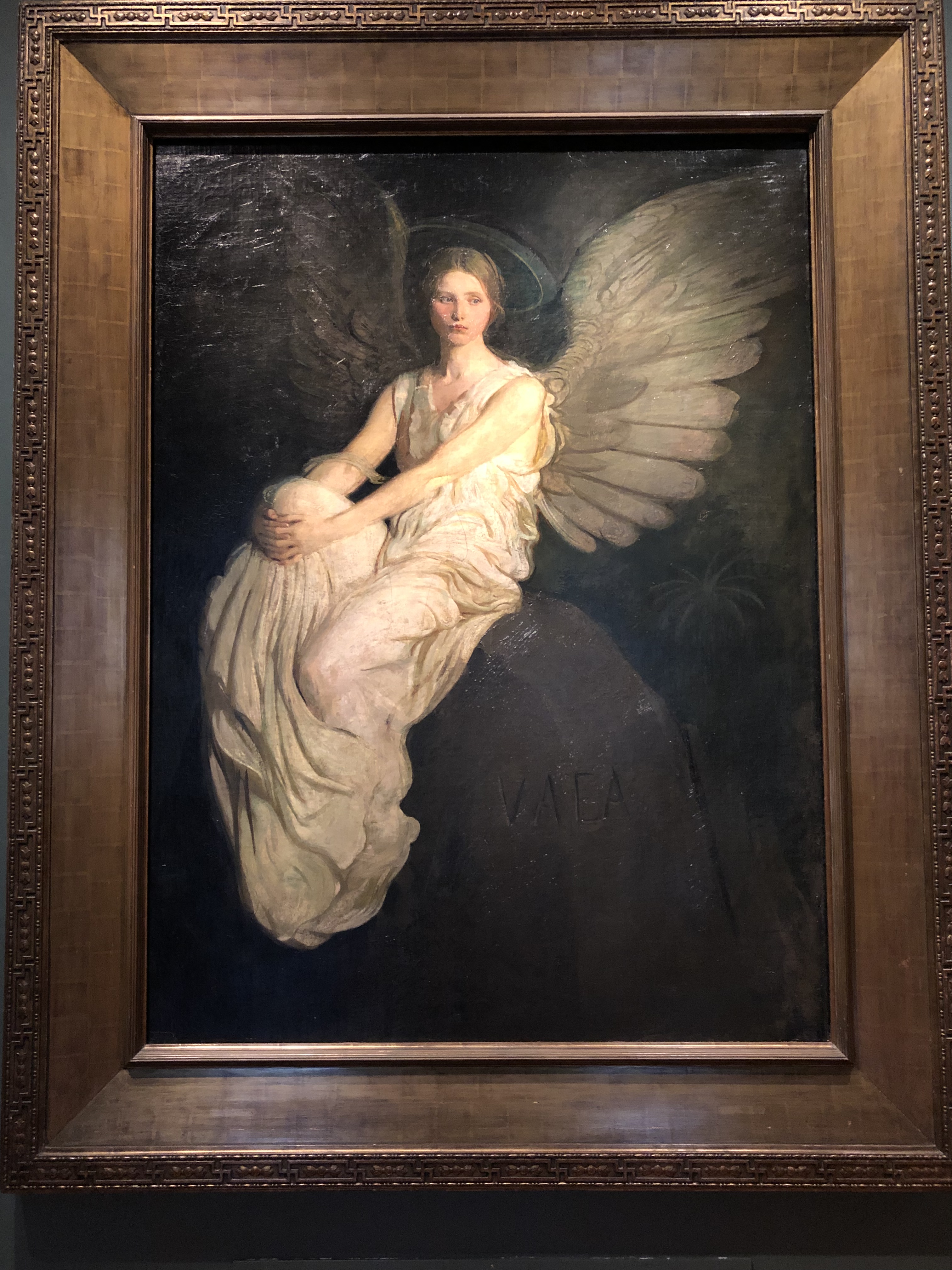
I have loaded the playlist, and gone to visit the angels. Bring on the thieves.

Stevenson Memorial by Abbott Handerson Thayer

Hurt, Pain, and Agony (swimming and writing)

At the end of a day at work, I had a low grade fever on Monday, and so I had a choice to make—go home or go to the gym.

When I was in high school and college, I swam competitively. I was a good swimmer, not a great one, but I had made myself a better one and took pride in the effort. I enjoyed practice, in spite of the fact that practice hurt. The predominant swim coach of my youth was James “Doc” Counsilman. He prescribed—preached, really—the progression of hurt, pain, and agony as the single lane toward improvement. I gobbled up his Science of Swimming, and pushed myself into agony and better results. I never became an elite swimmer. I came to the sport too late and without the technical proficiency needed to excel beyond my willingness to work to the point of physical failure, but I did become a much better swimmer.

I hated to miss practice. I went when I had a fever. I went my my shoulders felt shredded. I went if I had the flu. I pushed my body hard enough to compromise my immune system, and plunged my body into a staph infection that ravaged me for a month. I kept at it.

I briefly considered quitting when I was in college. While Swarthmore was a place to be committed to study, most of the swimmers on the team joined to be fit, or to explore the sport. I was maniacal, and therefore, felt more often than not alone on the team. I missed the hard driven team of my high school. Also, I was not used to being out ahead of everyone else. This is not a boast, just the nature of the circumstance. There were other teams on which I would have not made the cut. I knew that.

I rejoined the team, refocused my effort, and pushed on.

So, I felt under the weather on a Monday. Let me put this into context. Nearly every day at my job, someone calls out sick; I have enough free time in my schedule that I am able to cover other people’s classes. I do not understand being sick and missing work. I know it happens—I have had migraines, back spasms, and bronchitis in the past fifteen years. I had knee surgery fifteen years ago (torn meniscus). I get it. Illness happens. I admit to being stupidly judgmental about this.

For many recent years, I worked seven day weeks. If I got sick, my body, as if on cue, waited until I had a break in the school year. And then, I somehow avoided being ill on Sunday; I worked for a church. It just happened that way. The little stuff—a headache, some intestinal discomfort, a low fever—was just part of the day. Buddha might have said that desire causes suffering, but it seemed to me that a small amount of suffering was simply part of life. Swimming had taught me that.

I claim that swimming taught me that lesson, but I am not so sure, because there were—are—aspects of my life that suffering has upended. While I could fight through a workout, or endure lengthy stretches of difficulty in a relationship or job (perhaps endure too willingly and for too long), when it came to my writing, I backed away from the agony. Agony for writers, I think, is a bit different from agony for swimmers. Muscle pain and, what? brain pain—I hesitate to call it heart pain—are different creatures. Physical pain ends—for most. Certainly the kind of agony I courted in the pool stayed mainly in the pool, at least until my knees needed surgery. Mental pain permeates the day—you can stop writing and still feel the agony of an unsuccessful scene—anything less than glowing prose. And when even the good writing does not find a reader, then the agony feels for naught.

Writing does not quantify the same way swimming does. More writing does not necessarily guarantee better writing (There is a correlation, but it’s more slippery) the way that more (more yards, more effort) swimming leads to faster times. Nor does it compare well with work, where improvement and accomplishment have monetary results. Does a higher salary indicate a job better done—or for that matter a more valuable job? I guess that depends on how you ascribe value.

Maybe because good writing—whatever that means—is dependent on the reader, if one seeks to write well, one either needs a fairly reliable ability to dissociate from the absolute creative process and read one’s own work as a stranger might, or have a reliable enough reader to sort through her—or his—work. But more than that, one has to engage the work almost without a thought for oneself. There is a second dissociation—and this is like swimming: one must be attuned to the pain and the pain cannot matter.

For instance—and this is an insight into my judgmental brain—I described a character whose skin turned browner while he worked for weeks and months outside as “brown as a berry.” This is an old cliche, and one that I first overheard in the British Virgin Islands while sitting at dinner. Some old man—I was 12 or 13, everyone was “old”—described me in his British accent as “brown as a berry.” I did not know then that it was a cliche, and the phrase stuck, because my experience of berries tended to berries of red and blue and possibly black—the blackberries that grew wild on bushes near my home. It felt foreign and I enjoyed that the phrase had some unexplained—for then—British origins. The phrase dropped into my work, and I knew it was hackneyed when I wrote it—a minor disaster, I suck as a writer—and when I revised, I took it out. I knew that I would. But I had to move on while I was writing, I could not spend five minutes, let alone twenty-five, figuring out some turn of phrase. In the end, I let it be simple: “his arms turned brown by the sun.”

Does that sound like agony? Sucking as a writer is agony. The realization that my work would not please everyone—and that I still had to do the work—was not easy to accept; secretly, I believe that the whole point of writing workshops is to learn to ignore critiques as much as to learn from them. How does one know when the work is “not good”? Or, for that matter, “good”? Rickie Nelson sang, “You can’t please everyone, so you’ve got to please yourself” (more hackneyed advice from my childhood). There is agony in those questions.

And so, on Monday, I headed to the gym. I shortened my workout, burning down 500 calories in 23 minutes. It was shorter, not less arduous. I was in various forms of discomfort through the first half of the week—my insides disagreed with something I ate. I kept at the gym anyway. And then—always and then—I read the first chapter of my novel out loud at an open reading on Friday, and sent off the first set of query letters to agents on Saturday. The book, for now, is done. I wrote this. And I started the next book.

I am prepared for the work, even if it hurts, even if I am in agony. I have trained for this all my life.

Why the Djinn?

A friend asked where I got the idea for the Djinn. Here is the long story.

I wrote poems when I was in ninth and tenth grade. They were lengthy works with regular rhythm and rhyme. They told stories. Men turned into dogs. Warriors battled ferociously. Queens and princesses sent boys on impossible quests. When I asked my school to allow me to do an independent study in poetry writing, I was turned down, but one of my teachers suggested working with him to write sonnets and other formal verse. He might have suggested an early round of talk therapy. Stung by early rejection, I refused his offer.

Every night before I fell asleep, I made up stories and told them in my mind. They reflected the source material I grew up with—books of myth and tales that I found in the Schuylkill School Library; comic books that my father doled out on trips to my grandparents; anthologies compiled by Rod Serling that I bought at book fairs.

I did not start reading adult novels until I was in 7th grade and a friend lent me his copy of The Guns of Navarone, after which I read everything that Alastair MacLean wrote. I made a mad dash through Kurt Vonnegut in 8th grade. I read all of Ursula K. LeGuin’s books before 9th grade. All this is a fairly slim bit of literature. My parents were not big readers—we had collections of Reader’s Digest Condensed Novels on our few bookshelves. My mother did read to us, sharing Beowulf and Poe stories. But we were not a bookish family. My brothers and I found what we looked for with relatively little guidance.

I was an able enough reader in high school, but short of Billy Budd, little of what I read stuck with me. On my own, I read all of Neil Simon’s plays, and other plays, and took up with science fiction and fantasy (Asimov, Tolkien, and a little known writer named Zenna Henderson). I read and reread Robin Graham’s account of his trip around the world, Dove. Mostly, I spent long hours listening to progressive rock, watching old movies, swimming, and driving the family car as far and as fast as I could.

In college, I discovered William Blake, James Joyce, Thomas Hardy, Henry James, and Gustave Flaubert. It was also when I read all of John Le Carre’s spy novels, The Joy of Sex, and the only Daniell Steel novel that ever passed my way—The Promise. The main focus of English Literature courses was exposure to more—and I share the story of having a short novel assigned between a Tuesday and Thursday class with my students now. I read widely and gleaned what I could as quickly as I could. I discovered that after reading Portrait of a Lady, my sentences changed. They were better: complicated and analytical.

In my junior year, I switched focus to Art History (same deal: memorize as many works of art—in order and with an understanding of importance—as fast as possible), which, fortunately included a Cinema class that greatly expanded my limited knowledge of film.

I started writing fiction in college, and was accepted into a workshop in my senior year. After graduation, I began an espionage novel that had something to do with Monet’s Haystack paintings in the Hermitage, in St, Petersburg. I fiddled with a story about a baseball player. I wrote a few chapters of something about two friends who decided to go to college and pretended that they were ten years younger than they were.

I had a sense of the novel, and novel length stories, but at this point in my life, I had only read a few hundred novels. I had never heard anyone explain rising action or a three act structure. I grasped scenes and could understand the books in an intuitive and intimate way. I wrote into the unknown without a plan, without having any idea of where to go, or what to do.

When I was 28, I went to graduate school to study writing, and even there the basics were not tended to. What I knew of Freitag’s pyramid, I garnered from John Barth’s “Lost in the Funhouse.” But fiction had never been about plot as much as characters and feelings. Maybe because I had never been drawn to plot. I often knew in a page or two what was going to happen in a novel—not the exact details but I could chart the end of the rainbow from the first curve of the arc.

So, what does any of this have to do with Djinn? I suspect that strains of all this—and of all the events of my life to date—appear in this work. Mainly, there is the myth, the early fascination with and appreciation of the fantastic as a genre, and the long interest in things that were away from here.

I encountered the djinn—as genies—in Sinbad and the Tales of the 1001 Nights. A widow who lived next door to us had those books. This book re-entered my life while I was in graduate school, in large part because of John Barth’s insistence on non-western sources of and for stories. But also because, once I encountered the djinn (or jinn), I was impressed by their wiliness and cruelty. I wondered—right or wrong—whether they had been mis-portrayed by the writer of the 1001 Nights. Why would such power need to be cruel? To refer back to Blake—“…what shoulder & what art,/ Could twist the sinews of thy heart?” I wondered. But I did not pursue the djinn, not yet.

I wrote in other ways. Although I have a set of prose poems set in Philadelphia that delve into the fantastic, I followed the realist tropes of my time. Perhaps this is what kept me from finishing—I was writing away from the story in my heart. Last year, when I dropped everything to take on new responsibilities—to myself and my work—I set aside the piece I had feverishly labored over for over ten years. During that ten years, I had written down a brief thought about a character who was keeping a secret (secrets will be something I grapple with forever). Five years ago, I was waiting for friends in a Mexican restaurant, and dashed out to buy a composition book, wrote a couple of pages before they arrived , and promptly forgot the book at the restaurant.

That story became the story of the Djinn.

I was dating a woman who shared my appreciation for the 1001 Nights—you have a copy too?—and that was enough of a spark to light the fire in this book, because the kindling, and the logs, had been waiting all these many years. Suddenly, I had a character whose secret was so closely held that he did not even know he was keeping it. He had forgotten that he was a Djinn.

There are other connections to other parts of my life and my studies that fueled this fire. Some of those will remain secret. Others are perhaps too obvious for me to mention here. For those of you who wonder how novels—or anything—gets written—by others or by your own hand—the short answer is that we tell the stories that enchant us. The shorter answer is that we sit down and write every day. No matter what. Perhaps because we are enchanted and under some infernal command—I wish that you write a novel, Djinn. So be it.

On the revisionary road

Here is the next step in the process. I have spent the last few weeks reviewing my rough draft, which I have dubbed the “working draft”—and have produced several copies of that working draft. I split time between one draft saved in between Pages (on my iPad), and and another saved in Word (on my laptop PC). I have run the draft through Grammarly several times, and read the document from page one through page 312 (now). By the way, Grammarly does not catch every typo, nor does it allow for “Djinn” to work as both a plural and singular noun. So be it.

I have enjoyed rediscovering how I imagined the book when I began, and to rewrite those old intentions to suit where the whole thing turned. While I was aware of this change as I worked, I resisted the temptation to head back and “correct” the earlier chapters. During the first draft, forward motion was more important than perfection—or rather, something like perfection, because, really, perfection is a chimera. In spite of my decision to emphasize forward motion, there has been much in the working draft that has delighted me, and some, on reflection, that has surprised me.

This draft also contains memories of what I was doing while I wrote. Some of those memories are bittersweet, some are joyful. I began this book with one reader in mind—which was helpful at the start. I felt that there was a whole story ahead of me, but did not know where it would end up. Along the way, I read passages in public, and gauged the work by the reaction of an audience—which was also helpful along the way. I also shared bits and pieces that made me happy with other people, including a colleague, who generously read the 170 pages I had written (and not finished) in June. I found the responses of these readers to be helpful, and heartening, as well.

While writing has taken its right and proper role in my life, I do not write for me, to express some deeply held inner belief or to prove some point. I like to engage a reader, to connect. If there is a bigger point, it would be about the power of connection. I appreciate that a piece of writing can be a kind of conversation between me (the writer) and you (a reader)—and it is not an intellectual conversation.

I think, for years, that I tried to write with my intellect, and that I did not trust my heart with the process. I struggled with the desire to express something perfectly, or at least as well as others had expressed themselves. Those others included anyone and everyone who had written anything and everything. More recently, I was able to hear Sidney’s muse exhort me as well—“Fool, look in thy heart and write.” Turning to my heart—away from not the anxiety of influence as much as the weight of awareness—has allowed me to feel my way through the work. Sharing with others has helped expand that feeling, and to have it be a shared feeling at times.

I have turned back to my intellect as I revise, and this has helped me make connections in the text. I add more than I cut, as I realize that I have not provided all the bridges necessary between scenes. Still, I have rediscovered intuition, and as I make my way through this draft, I am surprised and delighted by what I wrote, almost, it seems, by accident, or, at least, by trusting my poor, fallible, and durable heart.

New Year’s Day

Today is my New Years Day. Today school meetings begin in earnest; students return and classes resume next week. What that means in practical terms is that I was up while the clock had a “6” to start the time, and at work while it showed a “7.”

The time doesn’t really matter. As long as something like 8 hours of sleep happened before I wake, time is just a way to organize the day, so that people can make arrangements. During the school year, the events of the day begin at 8 AM, and I like to be present and pleasantly caffeinated well before then. I plan accordingly.

Nonetheless, it is a new year, with all the attendant joy that comes with beginning. This year, I begin in strangely excellent physical condition. I can swim five miles without stopping (a task I once reserved as a test before heading out on the ocean). I can lift more weight than I have in thirty years. And I weigh as much as I did when I was fit and in college. These are all old markers, but remind me that even though years may pass, I can still fight myself back into shape.

I have also finished a draft of a novel, and have started working on revision. These are new thresholds, and mark a significant change in my daily life. Writing every day has been a revelation. I did not plan far ahead, but trusted—blindly, confidently—that there would be wells along the way. I know that the way ahead is—as it is in my favorite Kafka short story (“My Destination”)—“fortunately, a truly immense journey.” I cannot carry enough water to get me where I am going; there must be wells ahead.

I do not know where that journey will lead. I do not know what the next books will be about, but I can feel the impulse to write, to imagine and . All that matters is the writing and allowing for the discovery—the thrill of the new and of exploration of a subject, characters, places, and ideas. I know that there will be a physical analog to that journey, but that it will be bound to psychological, artistic, and spiritual travel as well. All must happen, and will happen.

Once upon a time I wrote a poem about baseball (and not at all about baseball) that ends: “Each day the day begins again.” And so it does, except I am more aware of my old self, and of carrying him—that old hulk, but also that bright star—into this year. So I go, crafting a way forward, learning, reclaiming, and working.

This is the single greatest attraction beginning a new school year—as it has been since I was much younger. There is something new to learn, some new idea, some new book, some new inner and outer experience on the horizon. Even though I am now a teacher, I plunge ahead, building on what I know, and striving for something I do not know, and prepared to discover. Away we go.

Libraries

I attended an event at the Meridian International Center last week. One of the rooms at the Meridian House is a library. There is a strange surprise about a library in a foundation. The odd assembly of books—all the Russian history (because the foreign service world centered on Russia for decades), a case of biographies of men and women important in the 1940s, 50s, and 60s, and then the random exception, a book by Carly Fiorina (published as she was making a run at the Republican presidential nomination), and then a shelf that jumps from A Woman in Egypt to Lee’s Lieutenants to The Great Influenza. Organization sometimes struggles when books are added.

I notice, besides John Barry’s book about the pandemic of 1920, there is also a copy of Louis Menand’s The Metaphysical Club; both these books are on my shelves at home. I will guess that if I looked more meticulously that I would find other overlaps in our collections. I wonder about the constellation of editions that connect library after library, and how I have felt a kinship with those who share editions with me. This person, this place, is not so strange.

I have written about my books before, both about the joy of having—and unpacking them—them and the burden that they signify. My books are a kind of roadmap, both the orange Home Depot Home Improvement 1-2-3 and Italo Calvino’s Six Memos for the Next Millenium. Some books I have not opened in years, others I revisit with uncanny frequency. They all point to something, somewhere.

Little miracles

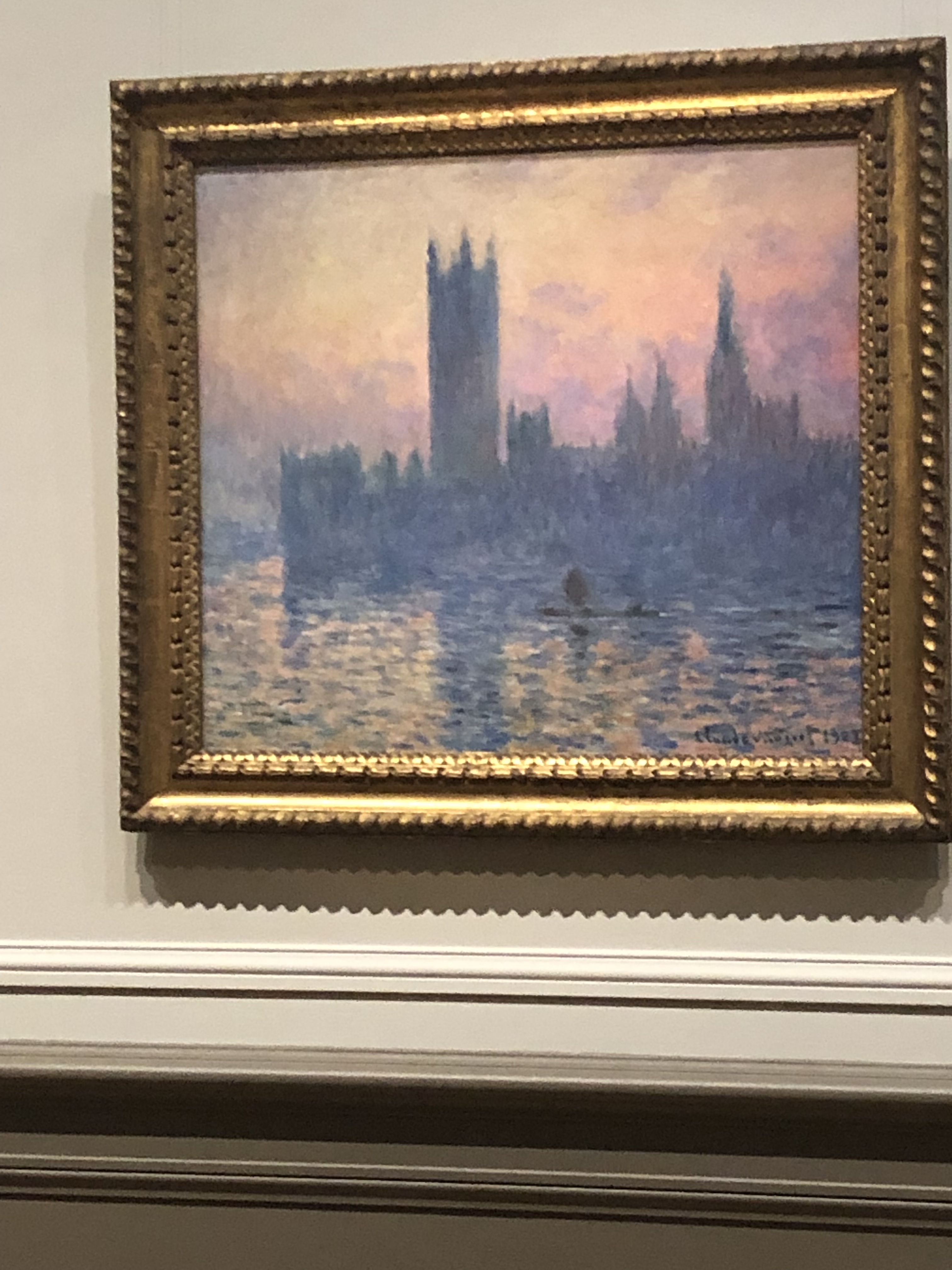
I am looking at a painting made by a French artist of a British building that hangs in an American museum. This seems at once perfectly natural—what else would I be doing? What else would a French artist paint (or an Italian, British, Russian, Afghan, or American)? And where else would a painting be? Of course, this seems only natural because it is what we have become accustomed to, since the time when Ennigaldi-Nanna opened the first museum.
If it is “only natural,” it is also a miracle. That Claude Monet painted? A miracle. That the Houses of Parliament were built along the Thames? A miracle. That the painting somehow came to the National Gallery of Art in Washington DC? A miracle. And that I am here, somehow, seeing this and writing about it? A miracle as well.

We take the commonplace for common, and lose the ability to be a little amazed at what is all around us, and the wild series of coincidences that brings the present moment into bloom. On the flip side, we excuse the awful as “could be worse,” instead of insisting on the more miraculous possibilities that could be. I stand amazed at what is, and demand more. Why not? Why fall back into what is easy, what masquerades as wit, what only keeps us from feeling that we have more to do?

I am looking at a painting made by a French artist of a British building that hangs in an American museum. The gauntlet has been thrown down. This is only the beginning.

Balance

About a year ago, I wrote about the patterns that I had noticed in my life. I have tended to trust the signs that the universe provides for me—much of what I have written about my current book project attests to that. I can admit that there are times that I have misinterpreted the signs, or that the universe has played an awful game of three card Monte with me. And yet, what other choice do I have?

I walk the line between an abundant trust in my muse—or the universe—and a willfulness that is singular and purposeful. This comes with risks. There is a song by Coldplay, in which the singer challenges, “Go on and tear me apart.” It is a brave dare, and echoes a bit of Emerson that was shared with me recently: “People wish to be settled; only as far as they are unsettled is there any hope for them.” What if all I get is torn apart and unsettled? I have lived too long under that flag to feel continued comfort in the “torn apart” life.

As I approach the end of this book, all the patterns (all right, most of the patterns—I am writing about a part of the world that eschews ideas of perfect resolution for a reason) come together. As the revision process takes hold, I rejigger, rip out, and rewrite scenes and conversations so that the whole points, gently and not too obviously (I hope) to the overarching pattern. The book is, finally, about patterns (Is it? Really?).

But life is not a book. Life does not (really) contain messages and patterns that point us toward happiness and success (Are you so sure about that?). Yes, there are patterns, but there are also many, many random occurrences and, perhaps even more challenging, patterns that unsettle us in ways that are distractions, that may even be injurious. At the moment, I simply cannot accept the notion that absolutely everything helps us grow and thrive. Some stuff, as my father pointed out on a particularly egregious day on the ocean, is just shitty. I throw shitty books across the room—the shitty life cannot be so easily flung into some other corner.

So, why feel hopeful? Because I am balancing between an awareness—too keenly felt this past several months—of the capriciousness and, well, shittiness of the universe, and the other more generous and affirming aspects of the exact same universe. Balance is not a passive activity. It may become seemingly involuntary, the way that holding your head—or a glass—level on a churning sea becomes second nature (your muscles are working all the time). I do not veer from happy to sad, celebratory to angry; they are all there, all the time, and for now, that is good enough. Of course, I seek—and will continue to seek—to tilt the balance to the more favorable side of things—and I am (Shut up, Doc!)—and that is because I feel that my purpose is to add to the balance of light.

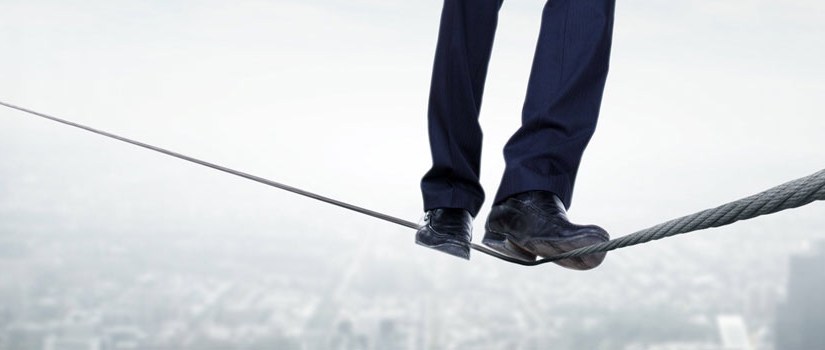
Back to the tightrope.

Peripheral Vision and the Dream

I have been writing a novel (#thirdwishnovel) since November—fitting the work in between bouts of schoolwork, and all the other more (and less) joyful events of life. The writing has captivated me, because of the way that the writing has come to me. So often in the past, I felt that what I was working at was always just in my peripheral vision. I would get a brief glimpse, but when I turned my attention to whatever was there—perpendicular to my daily vision—it vanished, or, at the very least, turned into an unintelligible mess. I used shorter forms like prose poetry to capture these bursts of clarity (these blog posts began as another way of harnessing some of those fleeting glimpses), but trying to capture longer work—an extended vision—was like looking at sludge.

And now, out of nowhere, this has changed. Perhaps, because I have written almost every day for over a year, my vision has expanded—I now have eyes in the back of my head (do I?). I do not cagily shift my vision to capture something evanescent. Perhaps, because I removed large chunks of my life, and there is less that clamors for my immediate attention, my vision is not tired when the time to write comes. Perhaps, and this is not easy to admit, because I need the writing, and the need has allowed me to call forth the vision. For now, almost every time I wanted something or was preparing a transition, what I needed appeared directly in front of me. I did not have to look to the side or far ahead, or really ahead at all. Each image, action, or small exchange of dialogue stopped me and held my attention.

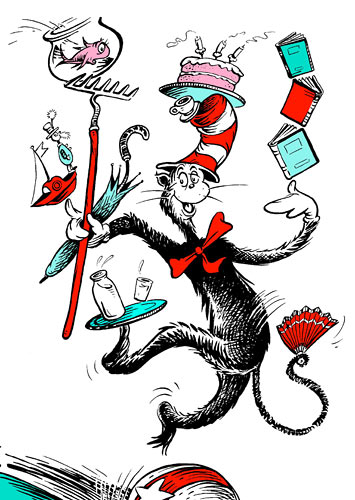
I recall the Cat in the Hat, balancing on a ball with everything balanced for one moment, proclaiming: “Look at me! Look at me! Look at me NOW!” While the Cat is bound to fall—for now—I have not ignored the invitation. I have let the dream—the vivid continuous dream—with all its amazingly balanced parts sweep me up. I am looking.

I am fully aware that I have been inviting myself into the dream—that even though I may have been walking through the streets of London, reading text messages from Kathmandu, attending a Christmas Eve service in a strange church, listening to symphonic renditions of Led Zeppelin songs, or longing for deep personal connection with an elusive lover, the story making part of my brain that has been dormant, distracted, and (really?) depressed for too many years, finally—and for whatever reason—took hold of me and turned my waking life—any and every part of it—into the dream that I was writing. Like a dream, I can barely remember how it began, I can only remember putting my head down on the pillow. And once again— Even though I know where the dream is headed, I have no idea how it ends—isn’t the point that we wake up before the dream fully ends—it begins and ends in medias res, as it were?

The dream (and the vision) is no longer peripheral. No matter how it arrived, it is central and demanding. I enter and reenter the dream at will and discover. The dream provides a seemingly random, but profoundly interconnected tableau. I am enough of an active dreamer that I am aware when I am in a dream, and I can shape parts of what happen in the dream. However, I also know that the surprises that come in the dream world are just as important as the decisions I make in this dark realm. I have enjoyed the surprises that have come—they seem inexhaustible.

And so, as my current work turns toward an ending (gasp), I have to change the way that I approach my writing. No longer can I simply fall back into the dream, letting each image and action reframe what has come before (I have rewritten—redreamed—swaths of the novel to suit new discoveries several times). Now, I must let the end—what I write and what I dream—grow out of all that I have dreamed, and that means gazing backward and forward at the same time—I need the eyes in the back of my head!—and narrowing my vision toward climax and resolution. I must shape the dream consciously—as consciously as one can dream.

Because, and let me be clear, I am not witnessing the Cat any more. I am the damned Cat. I will fall. The rake will get bent. But, I have another thing or two left to do. Here I go. Look at me.