You are going to lose.
At some point, you are going down the tubes, over the edge, off the rails. You may have something to do with the inexorable demolition of your temporary hopes and dreams, or a house may fall on you from out of the sky, while you are in mid-sentence about to say the most profound thing anyone has ever heard. Or not. You may be doing nothing more than mowing the lawn and wondering why it has gotten so dark so suddenly.
What prepared me? Nothing. I led a life of easy glory. Success came without consequence, well other than the third grade geography teacher who told me that my coloring was atrocious, or awful, and I wondered how the other kids filled in the map without the striations of crayons. So what, I won the class spelling bee. I sang in the chorus and joined the math club. Years passed, achievements accumulated.
I sat in my car after the first night I played in our local poker game in Pittsburgh. My heart pounded wildly in my chest, and my hands shook too much to take the wheel. I had lost sixty dollars, which was, at the time, the most I had ever lost at cards. I had played in a casual game in graduate school, and rarely lost, and when I did, it was the cost of a couple of cups of coffee at the local diner. And my winnings were rarely more than a few plates of hotcakes. Sixty dollars hurt. When I returned the next week—it was an amiable bunch of guys, and I sought their company as much as the play of the game—I played to watch and learn. I did.
Over time, I earned back my initial loss, and rarely lost in that group of players. When I sat down to play, I sat down with a plan, and with the hard-honed anger that allowed me to focus on the task. One player’s wife remarked that I had more testosterone than anyone else at the table. It was a back-handed compliment. She was—still is—a feminist, and masculinity, even back in the nineties, was out of favor, especially among academics. Which we were. The game was made up of Ph.D. candidates and recently minted Doctors, along with a few locals (a movie reviewer for a local paper, a former Priest turned pharmacist, a former UPS worker, a purveyor of goods imported from South America and Southeast Asia). We played the gamut of Friday night neighborhood poker games—all sorts of strange and changing wildcards. Maybe that was why I lost the first time I played. Probably not. Later, when Texas Hold ‘Em became de rigueur, the table talk abated. Most games are quieter now. I miss the conversation—it took the edge of the testosterone. But I never forgot that first night.
We don’t learn from losses unless they hurt. A short sharp shock teaches better than a slow accumulation of pain. Maria Konnikova includes an early chapter on loss in her book about poker, The Biggest Bluff. She writes, “After all, losing is what brought me to the table in the first place. It makes sense that learning to lose in a game, to lose constructively and productively, would help me lose at life. Lose and come back. Lose and not see it as a personal failure… When it comes to learning, triumph is the real foe. It’s disaster that’s your teacher. It’s disaster that brings objectivity. It’s disaster that’s the antidote to that greatest of delusions: overconfidence.”
Later in the book, when she begins to recount the disaster that ended one particular tournament to her mentor, Eric Seidel, he tells her, “Stop… Look, every player is going to want to tell you about the time their aces got cracked. Don’t be that player. Bad beats are a really bad mental habit. You don’t want to ever dwell on them.” This may seem contradictory. Learn that losing is part of the game, but don’t talk about them. As long as you made good decisions, the outcome does not matter. Win or lose.
But, you say, don’t we play for an outcome? No. We play because we love the thrill of sustained focus. Making precise, intricate, and meaningful decisions allows us to shine. Define “shine” as you will. I recall Baudelaire’s poem, “Get Drunk”—“With wine, with poetry, with virtue, as you choose!” Choose where you will shine, and focus furiously. I stopped playing poker, saving my focus for what brings me back to the world. I write.
In my classroom, there are a series of posters proclaiming, “Think like a poet,” “Read like a poet,” “Write like a poet.” They were there when I arrived, and I left them up. The joy of writing (and yes, here’s where this comes back to writing), is the simplest of pleasures—making decisions, and learning as you go. You learn the process when you learn to read. (Or not.) You approach the text as a series of branches. “Tomorrow and tomorrow and tomorrow…” Why the tripled “tomorrow’s”? Why the “and’s”? What comes next? (Creeps…). If you learned to read like THAT, then you have practiced how to write.
And losing? What is the bad beat in writing? Rejection? Better writers than I save rejection letters; there are even books full of them. A book of bad beats. Why? Writer’s block caused by what? A lack of simply sitting and scratching out a few words on unproductive days? Hardly. Turn on the music and write about that. Watch the news and write about that. Talk to your friends and write about them. Walk and write about what you saw. Just write.
The bad beat is the loss of faith, in the belief that your vision is enough. I don’t know what caused it for you, or how to restore your loss. Follow me, let me be the Virgil to your Dante. Imagine that—me, Virgil. You will lose—midway on life’s journey, the right road lost. But there is a way. Follow.



 Viruses are the prototype for the “lilies of the field: … they toil not, neither do they spin.” How they may be arrayed is entirely in the eye of the beholder. The virus of current interest wears a crown—or presents something crown-like on its exterior. It’s almost too satisfying to try and picture it, or to quibble over which depiction is more accurate.
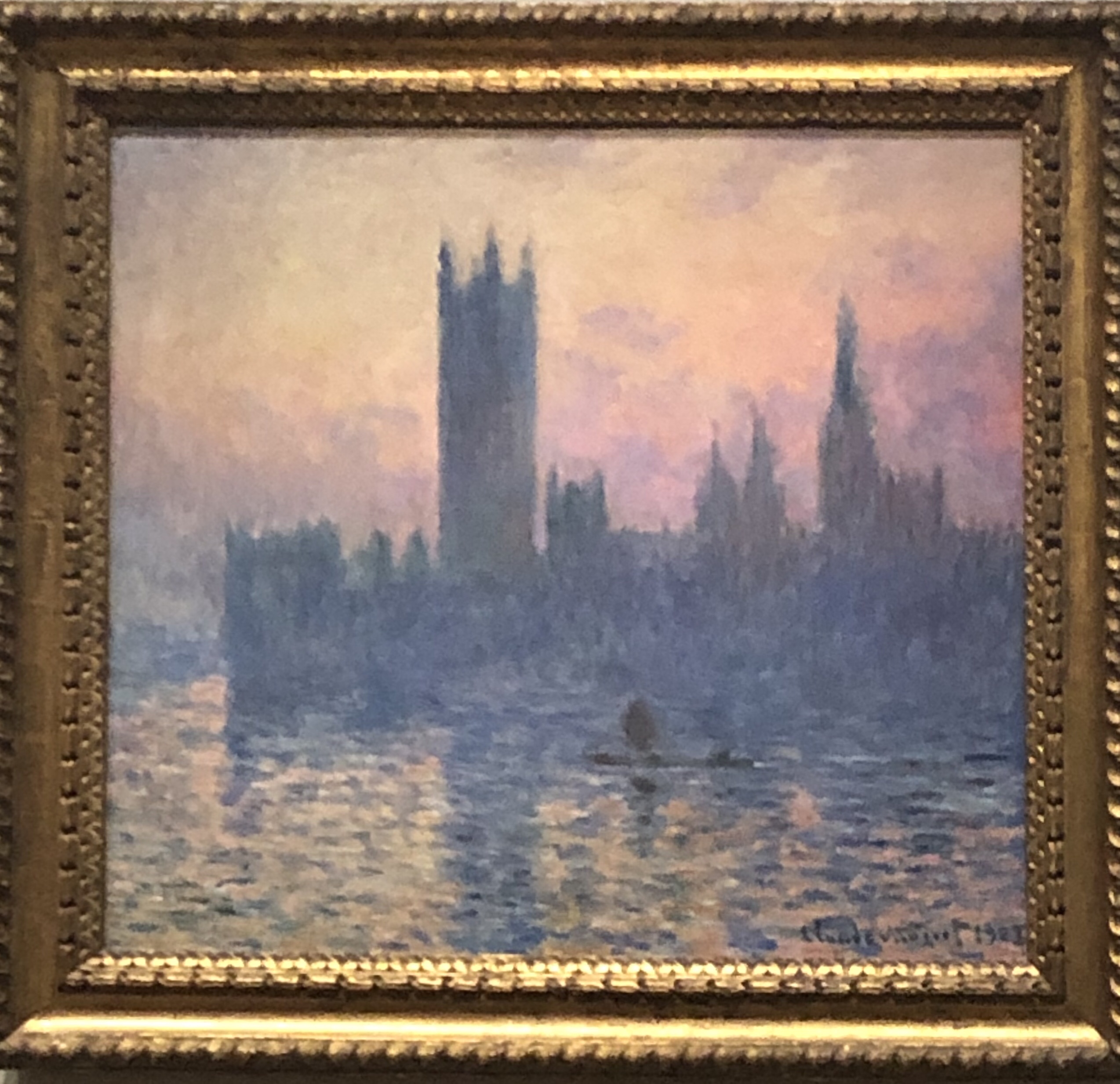 It has been a year and a few months since I was in London. I’m thinking about London while I sit and study Monet’s “Houses of Parliament, Sunset” at the National Gallery of Art. The memory of looking across the Thames at that building, with Big Ben swathed in the latticework of repair, has faded only a little. The memories of walking the streets of the original square mile and beyond remain startlingly vivid. I used them to paint scenes when the characters in my novel walked through London. The memories of the places and the memories of the feelings.
 When I was last in London, I was taking steps into a world where I knew I could live, where I had longed to live. Just like in the dream, writing—flight—was not foreign to me, but something I had traded in for a more certain, more directed existence. While “You are…You should” can feel like shackles, flying—writing—is formless and uncertain. Anywhere is possible. Everywhere is almost a mandate. Just like in the dream, I had written before—had flown—and had lived closer to the limits of my existence. But I had to leave my self-imposed limits. I had to accept that I might fall—and fail—but just as I accepted that in my dream—soaring up the side of a steel and glass edifice, wondering, “What if I forget? What if I fall?—I thought, even as the thrill of fear invigorated me, “You are flying now. Even if you fall, you will remember as you fall, and fly again. Keep flying.”
 Two women look at the Monet—taking seat in the National Gallery beside me. They think it is beautiful, but claim, “It doesn’t look like that.” Of course, the Houses of Parliament look like that, as does the river Thames, as does the sunset. “We didn’t see it,” they claim, “We were tourists, doing touristy things, like thinking about where to have dinner.” I did not think about dinner when I was in London. As much as I love dinner, even food became a secondary thought while I was in London. Even the pubs and ales became little more than way-stations along the bigger task—the journey, the seeing, the walking, and the flying. And the writing.
 In the other corner of the Freer Gallery, an exhibit of Hokusai’s paintings and illustrations includes quotations from the artist about what he intended—not just in the specific works, but as an artist. He wrote about discovering himself as an artist late in life. He was already an artist, but he claims to come into his own in his 50s and thought that he might attain his most complete vision if he lived to 110. He died at 90. His work is sweeping and intimate—monumental nature and quiet personal moments—fantastic and humorous—heroes wrestling demons and uproarious coworkers. Whatever else he meant to last in his work—why that hero wrestled that demon (as if one could easily answer such a question)?—he meant it to last. He aspired to capture a vision that would last long after he died.
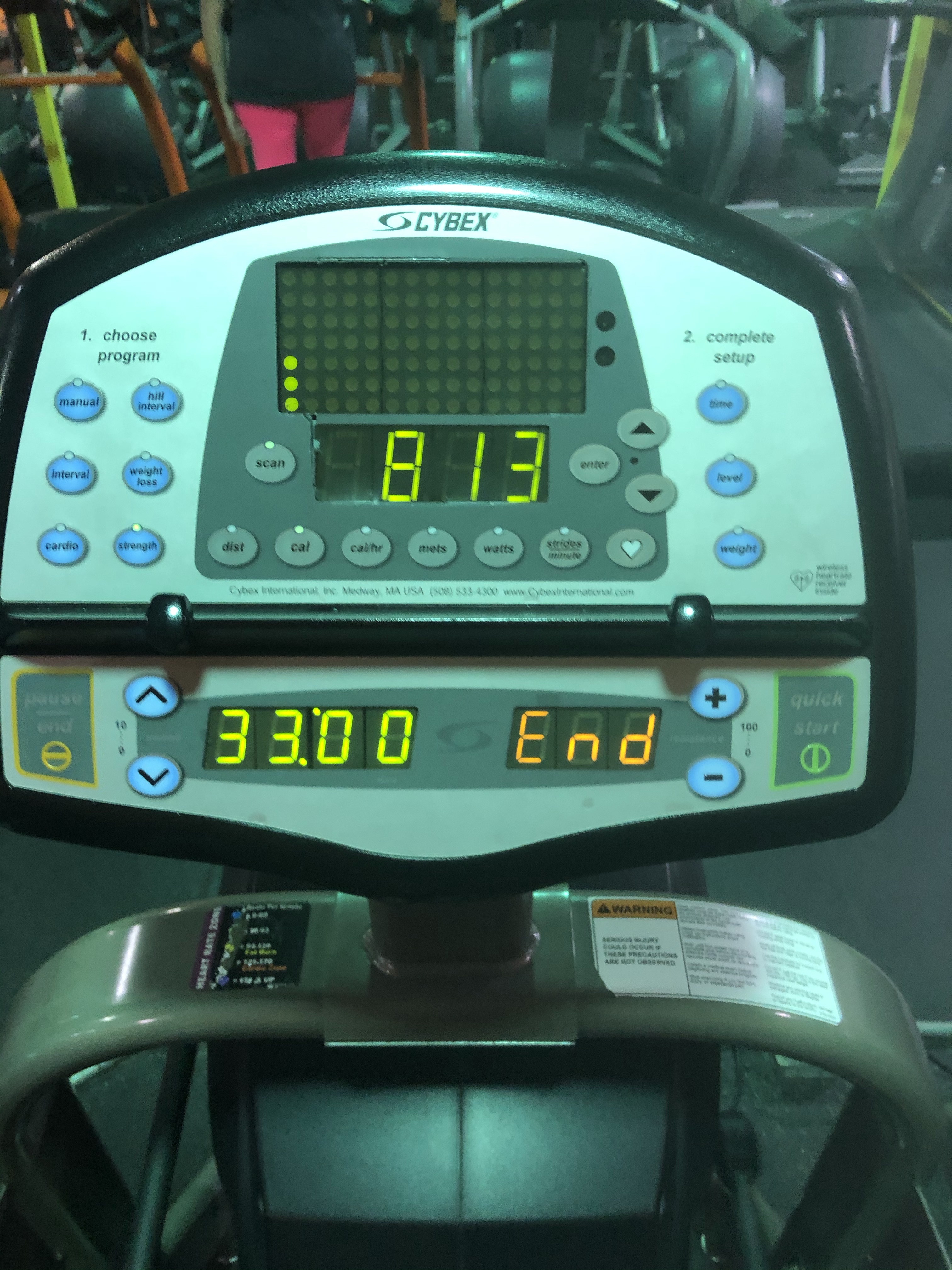 I start paying attention after 17 minutes or so — the meter on the elliptical estimates that I am burning 24.3 calories every minute. I am about halfway through the current “run,” and I will burn through 720 calories in 30 minutes and well over 800 when I include the five minutes of cool-down time that the machine grants me at the end of the workout. I get pissed because the timer starts as soon as I start moving my feet, and the first 15 seconds are “slow.” I make up for it. After a five minute break, I jump on another machine that allows me to take longer strides, and run for 12 minutes, aiming for 7-minute miles. It’s a workout.
 Just over a year ago, I went to the LA Bar in Arlington and did karaoke. It was New Year’s Eve, and I had just come from a fairly routine party, where we had counted down the end of the old year and beginning of the new. It wasn’t enough. And so, away I went with my date, and we signed up to sing the Talking Heads’
  I am sitting in a museum while I write this. I am surrounded by works of Alexander Calder. They are gifts, but he also sold them. There is a fabulous photograph of his workshop in this gallery.
 When I look at any of the works of art at the National Gallery, I do not immediately think of the dates and the events that were taking place in the world at any given time. Art is timeless in a way. And it is not. I am reminded that horror in the world was never limited to acts of overt war, but that it proceeded—and proceeds—in an endless stream of cruelty and misfortune. And yet, in all times, there has been art.
 continuoussearch