It isn’t always easy.
On Sunday at the French Open, Novak Djokovic, the number one tennis player in the world, dropped the first two sets of the championship to a rising star. He had faced the same situation in the fourth round of the tournament, but this was the final, and his opponent, Stefanos Tsitsipas, was poised to win his first major championship.
Djokovic retreated to the locker room after the second set and had a conversation with himself. “There is always two voices inside: one is telling you that you cannot do it, that it is done, it is finished,” he admitted. “That voice was pretty strong after that second set.”
Wait. The best tennis player in the world, a champion who had won 18 major titles (and would win his 19th that day), has a voice that says he cannot succeed?
Sit with that for a moment.
Yes, he has another voice, and he described how he asserted that voice between the second and third set. “I felt that that was a time for me to actually vocalise the other voice and try to suppress the first one that was saying I cannot make it. I told myself I can do it and encouraged myself. I strongly started to repeat that inside of my mind, and tried to live it with my entire being.”
You can see him talk about the two voices here. Jump to about 3:10 in the video.
Success is not about living without doubt. Doubt exists, even in the mind of a champion. Success happens when that “other voice” contends with doubt. Djokovic, who has won 19 major tournaments, has also lost 10, and there was a time when his losses and wins (8 apiece) were equal. Even for the most successful, failure—and failure on a grand stage—still happens. We chose to contend.
I do not have the same record of success as a tennis champion, but, like him, I also have doubt. I have often chided myself for doubt, and this is a mistake. There are two voices: one that says, “Yes”; the other that says, “No.” I have learned—perhaps it took me too long—to listen to that “other voice,” and, when necessary, to give it a push. Vocalize it. Shout it.

Last winter, during the Australian Open, Djokovic was injured, and after leading Taylor Fritz 2-0, he dropped the following two sets. Djokovic has an imposing record after winning the first two sets of matches: 209-1, but injuries are a wildcard in sports. He prevailed, and the victory was especially sweet. “This is definitely one of the most special wins in my life,” Djokovic claimed. “It does not matter what round it is, against who it is. Under these kinds of circumstances, to pull this through is definitely something I will remember forever.”
His immediate response after winning was more revealing. He vocalized. “That’s why I play!”
Play? Novak declares that he loves tennis “with all my heart.” That is what it takes, no matter what, to do something with all my heart—with all your heart. I have no idea what else Novak Djokovic could have been. His parents ran several small businesses. Maybe that’s what he would have done had he not displayed a gift for tennis. Perhaps he would have become the best small business owner in Serbia; I do not know. He chose—as much as anyone chooses—to play.
Writing is play—at least it is a kind of play. We do not play against anyone, only with the reader. We entice and enchant them. Shock and soothe them. We afflict their doubts and shift their worlds. Maybe. And we face our own doubts—quietly and not so quietly. We enlist rituals and habits that either quiell those doubts or quash our urge to write. Which voice do we vocalize most?
Two voices? Like the two wolves from the story. Feeding the wolf? How about giving voice to the wolf? Howl louder. Jettison all the other voices that urge “No.” There will be enough of that—too much—within you. Listen to the voices that encourage, even demand, that you write. And then write more and love the writing with all your heart.
That’s why I play.




 Out of the Past (1947)
 None of this is surprising or unexpected. It’s almost too easy and too obvious. Out of the Past is a movie that continually works between the obvious and the hidden. The main character, Jeff Bailey, is hiding in Bridgeport, a sleepy little California town with a diner owner who knows everyone’s business. Jeff is the wild card, which draws the attention of the town’s beautiful Ann Miller. She is straight out of a fairy tale. We first meet her fishing in secret with Jeff, he declares, “You see that cove over there? Well, I’d like to build a house right there, marry you, live in it, and never go anywhere else.” She answers, “I wish you would.” Ann comes from a world where wishes come true. Jeff does not.
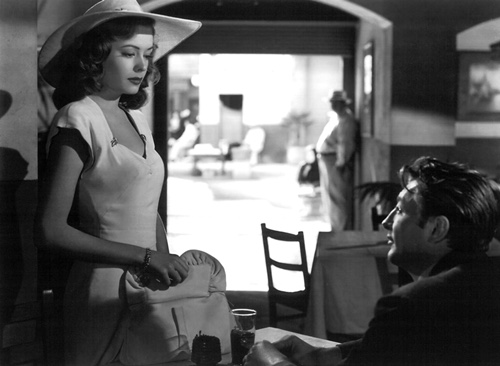 Some critics will let Jeff off the hook—an appropriate metaphor in this film because we are introduced to Ann and Jeff while they are fishing—and claim that the film frames Kathie. After all, Jeff acts nobly at the end of the movie, when the Kid tells Ann, in unspoken accordance with Jeff, that Jeff was leaving with Kathie. This clears the way for Ann to return to her old reliable beau. And Kathie did kill three men.



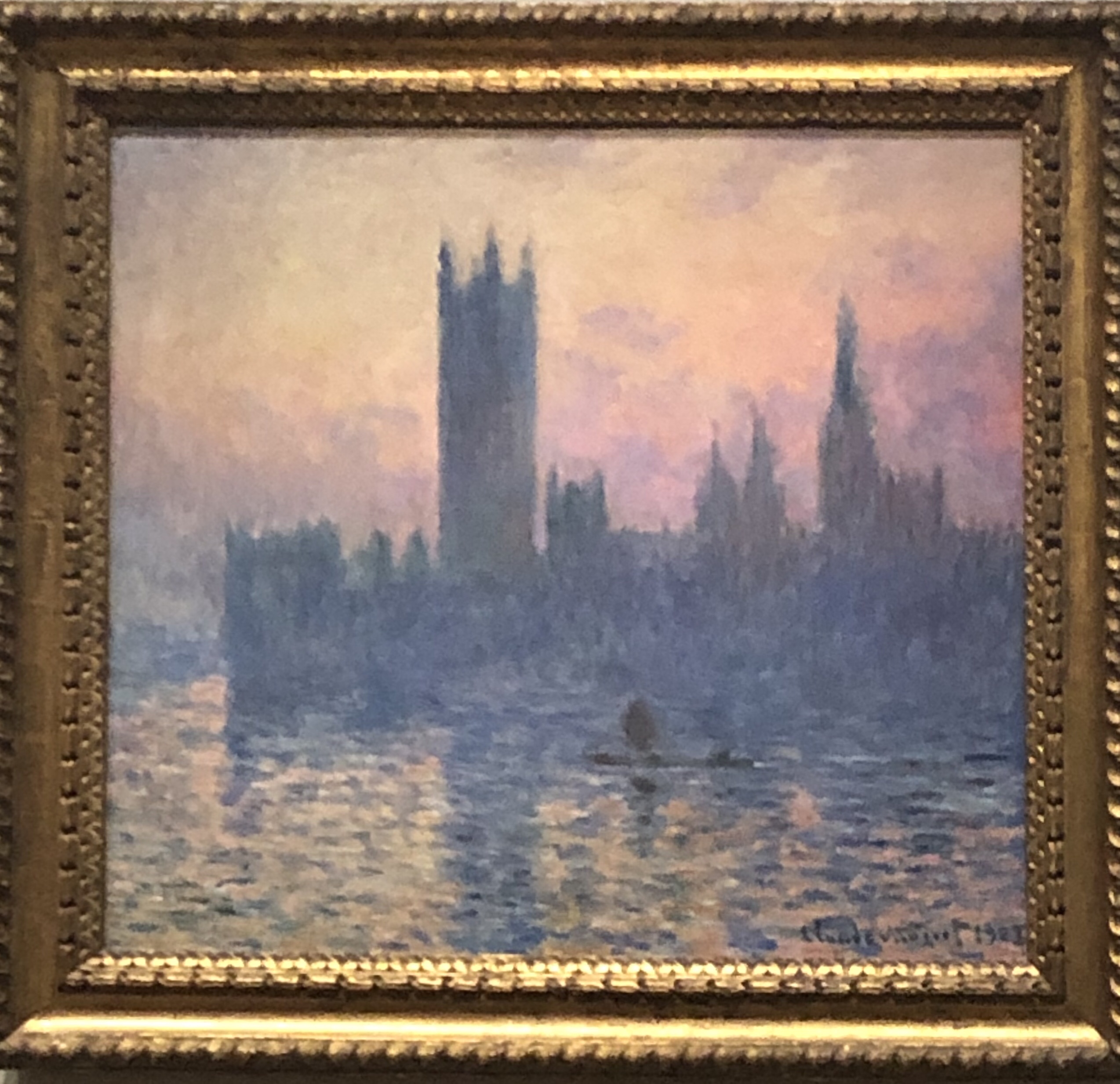 It has been a year and a few months since I was in London. I’m thinking about London while I sit and study Monet’s “Houses of Parliament, Sunset” at the National Gallery of Art. The memory of looking across the Thames at that building, with Big Ben swathed in the latticework of repair, has faded only a little. The memories of walking the streets of the original square mile and beyond remain startlingly vivid. I used them to paint scenes when the characters in my novel walked through London. The memories of the places and the memories of the feelings.
 When I was last in London, I was taking steps into a world where I knew I could live, where I had longed to live. Just like in the dream, writing—flight—was not foreign to me, but something I had traded in for a more certain, more directed existence. While “You are…You should” can feel like shackles, flying—writing—is formless and uncertain. Anywhere is possible. Everywhere is almost a mandate. Just like in the dream, I had written before—had flown—and had lived closer to the limits of my existence. But I had to leave my self-imposed limits. I had to accept that I might fall—and fail—but just as I accepted that in my dream—soaring up the side of a steel and glass edifice, wondering, “What if I forget? What if I fall?—I thought, even as the thrill of fear invigorated me, “You are flying now. Even if you fall, you will remember as you fall, and fly again. Keep flying.”
 Two women look at the Monet—taking seat in the National Gallery beside me. They think it is beautiful, but claim, “It doesn’t look like that.” Of course, the Houses of Parliament look like that, as does the river Thames, as does the sunset. “We didn’t see it,” they claim, “We were tourists, doing touristy things, like thinking about where to have dinner.” I did not think about dinner when I was in London. As much as I love dinner, even food became a secondary thought while I was in London. Even the pubs and ales became little more than way-stations along the bigger task—the journey, the seeing, the walking, and the flying. And the writing.
 continuoussearch