Bi and the Dream

A placard on the wall of Gallery 19 at the Smithsonian Asian Art Museum announces that thousands of bi were found at “elite burial sites” dating from the Liangzhu culture (3300-2300 BCE). They are jade: nephrite colored richly by strains of iron and other ores over millions of years. Craftsmen sliced the discs with string saws.

The bi are displayed face on—almost perfect circles. Suspended in midair, they appear perfect: several circular discs floating behind plexiglass enclosures. This is, in part, a trick of the eye; we see what we expect (or want) to see. Actually, their shapes vary. While definitely circular, many are lumpy or lopsided. A long look from the side shows even more irregularities—thicknesses vary, and some of the bi undulate like warped records.

Some of the bi have barely intelligible marks. The note on one display explains that markings were “extremely rare.” What does that mean? 1 out of 100? 1 out of 1000? The marked bi are neither more nor less perfect than the others.

Nowadays, we mark everything. Like it or not, we even leave a faint digital signature on what we wish to be anonymous. Mostly. At my school, we check drafts of student essays for plagiarism, and when they come back with unnamed and unnecessary sources, it is an embarrassment of unoriginality. 5000 years ago, anonymous discs went to the grave and into eternity. We have them now—disturbed from rest—because of a construction boom at the beginning of the previous century. They could have slept longer.

Not surprisingly—or entirely a surprise—we have few records of the Liangzhu Culture. Evidence of the once-thriving culture ends abruptly. The people who lived in the region around Lake Tai seem to have disappeared. We don’t know why. We know that they thrived primarily because we discovered their funerary deposits: jade bi for the rich and pottery for the others. We build an idea of their lives on what they took to death.

We do not know why they prized their bi. Nor why a few of the bi have marks.

We do not know. Those words can feel intractable, like a dead end. Or like a challenge, a kind of epistemological “try harder.” But how can you know what you cannot know?

●●●

We coined the word “Kafkaesque” to describe the nightmarish world circumscribed by a bureaucracy of the soul. Franz Kafka, who repeatedly depicted such a world in his fiction, also told us how to escape. In his short story “An Imperial Message,” the emperor is dying. Before he dies, he sends a message for you. Sadly, or predictably, his messenger cannot get it to you. This is genuinely Kafkaesque—the emperor is at the center of a thicket of throne rooms, attendants, imperial bureaucrats, and cities within cities. Even though he is the emperor and his messenger bears the imprimatur of the emperor, the message will never arrive. However the story ends, “Du aber sitzt an deinem Fenster und erträumst sie dir, wenn der Abend kommt.” (Roughly, “But you sit at your window and dream it to yourself when evening comes.”).

Of course, the emperor is god—something or someone with absolute power. Except, once enthroned, the emperor’s power is circumscribed, in no small part by the same apparatuses of the power he wields. How often do we mistake the apparatus for the thing, imbuing that which is meant to do little more than act for or transmit with more? How often do we mistake laws for actual authority? We create limits (I can, or I can’t) because we cede control—and the attendant responsibility. Our current idea of self-authorized action is little more than lust and gluttony on steroids; to be the emperor, we must grapple with the full repercussions of having authority (read Shakespeare for a full gloss on the weight of the crown).

But, in Kafka, a dream cuts to the quick. You already know the message. You are the emperor.

In our dreams, we build worlds. A few nights ago, I dreamed of traffic patterns, and police, and cul de sacs. There were merge lanes and scofflaws who drove on the shoulder. I was looking for a purple Jeep. I didn’t make any effort; the world bloomed in my mind—a mind profoundly(and subconsciously) at work. So must it be as we sit by the window (a liminal space) in the evening (another liminal space). Dreams are no time for laziness but a bursting forth of our full power.

If I want to know what I cannot know, then I must dream.

●●●

We have found thousands of bi. Each one cut from a long round piece of jade. I wrote “craftsmen” earlier, but how did this not become domestic work—foisted, as much domestic work is, on women?  Or children? I think of the scene from Parasite when the family folds pizza boxes. Instead of sewing circles, sawing circles. Who did the repetitive work that wore down fingers, hands, and arms for hours at a time? Not a crew of slaves hoisting blocks into pyramids alongside the Nile, but an army of hands slowing sawing through stone.

Does this mean that the Liangzhu people had slaves? I don’t know, but I think about the tech factories outfitted with nets so that the workers do not find relief from their toil. Bone crushing construction or endless hours of grunting agriculture? Slaves, over and over again. Did they sing while they sawed? I try to imagine songs that keep to that frantic beat. Did they race each other to cut their slice first? We compete everywhere. Why not? Imagine a John Henry of the Neolithic Yangtze River delta, whipping a string bereft of crushed quartz through jade as if it was mashed rice paste.

We know that they did not speak Chinese. We know (from genetic analysis of remains) that they shared genes with Austronesian and Tai-Kadai people. But what we don’t know renders what we know into little more than conjecture and guess. Our knowledge is imperfect. In the same way that the bi have imperfect shapes and imperfect history, our understanding is imperfect. The message—the truth—is never coming from the emperor. All we can do is imagine.

More often than we would like to admit, we straddle the worlds of the known and not-known. We lead essentially liminal lives—caught between knowing and not-knowing. Too often, we trade hard-won ignorance (the awareness that as hard as we try—and we must try—our effort will not provide a satisfyingly clear answer) for arrogant correctness. We cannot admit that we do not know. We have a mechanical reflex against unpredictability—whether we read the past, present, or future. We value prediction over genuine discovery. “I was right!” supplants “I found out!”

If we are going to model reading on dreaming, part of the task is to recognize that we are out of control. We will predict—it’s what we do—but surprise will derail our predictions. Surprise is an error message in the infinitely predicting machine of our brains. However, if we substitute rigid certainty for precise and imaginative uncertainty, our interpretations will fail even if they are clear.

●●●

I’m going to make a leap here. Reading is prediction directed to the past; the words are already written. Even though it is past, we still try to fit what we read into models of everything else we have read. When my students assert, “I can relate to X, Y, or Z,” what they are saying is, “This fits with a model that I already know.” And those of us who teach know the living hell of relatability. Anything outside that narrow ravine threatens to stop the students in their tracks—already when they are 16. Earlier.

In the same way, when we encounter new situations, when a circumstance calls on us to genuinely predict, we predict following models we already know. It is nearly impossible to get someone to predict beyond what they expect to happen beyond the known. Happily, most things in our lives adhere to patterns. Until they don’t. Fortunately, most of us are not making predictions that will affect the lives of hundreds of thousands of people, but some are, and they fall prey to the same internal mechanisms. The results are too often catastrophic.

So, how do we avoid the quotidian and useful process of prediction? How do we read the exceptional? How do we incorporate the genuinely new and surprising into our homeostatically driven lives?

When I look at the bi, I can guess (which is not to say that I take incoherent swipes at possibilities) at their significance, but I realize that even my best guesses are circumscribed by the limits of my experience. I know there is something that I do not know, and I realize that ignorance will stymie me over and over. I return to the bi to marvel at them and to marvel at my ignorance. They remind me that despite my reasonably well-trained intelligence, that something as simple and elegant as a jade disc will remain out of bounds. I experience hubris in the face of the unknown. This drives me to consider the undiscovered countries. And consider them I must.

How then do we confront systems that are quantitatively more complex? We try to bridle wild horses (mistaking tigers for horses—they both have four legs!) with prediction and end up eaten. Our imaginations must be more thoroughly engaged.

When Kafka exhorts us to “erträumen,” I do not believe he is suggesting anything passive, or for that matter, lazy. The truth is like a message from the emperor. When we dream that message to ourselves, when we imagine it, our imagination must be fully engaged because it is not as simple as a dream for snack cakes or even a dream of bedding a fantasy partner.  Truth may be a dream, but it is, fortunately, a demanding and difficult dream. But if we do not dream the big dream, our thoughts will be confined to the palace’s myriad chambers and infinite passageways. Our imagination will take us to a place we do not yet know.

Reading like a Dream

Read as if you are reading a dream.

We all dream, and so the experience is not uncommon. We fly, we fuck, we fall. Jungians and archetypalists of all sorts would normalize and defragment the conspicuously bad writing in dreams to give them viable and understandable meaning. Last night—in the morning, really, when I cadged an extra hour of sleep after my alarm gently nudged me—I dreamed about lifting weights. The gym—a fancy place with magnetically attaching plates—did not have—or rather, did not seem to have—bars long enough for bench presses. I had to go outside—in the dark, behind what appeared to be a dock or loading bay—to find the six-foot-long, forty-five-pound bars. Then I put plates on the bar, started lifting, and the weights felt light. I told my friend, Brian (yes, I have a friend who shares my name), who was spotting me, to stop helping me. I was covered in sheets. The word that came to mind was “shroud,” and it was getting in the way. I needed to take it off. Then I woke up.

Yes, this dream is poorly written—a shroud? Really? Concelo ex machina. I remember thinking, “Get this fucking thing off me!” Yes, I curse as much in my dreams as in real life. Obvious, clunky, and weird.

I forgot to mention that the gym was in a hotel in Marseilles. My mind populated the rain-wet streets with a raft of people of different nationalities, all drawn to the port city—a city that is liminal in real life and not just my dreams. I heard them speaking French, Spanish, Arabic, and Farsi and knew that I could not communicate with them even as I heard them. They would not be able to tell me where to go—where the weights were—even if they knew.

There isn’t a book (or website, or Reddit thread) that will provide a definitive interpretation of a dream because there isn’t one. Even our own dreams unravel without narrative coherence or discernible significance. And they are our own dreams! Who better than the dreamer to make sense of the image soup that our brains simmer in the night? Besides, they almost always end with “And then I woke up.” So we rarely encounter a well-orchestrated climax and satisfying denouement.

Imagine, for a moment, treating what we read as if they were dreams. What if, instead of artistic unities, we sought to immerse ourselves the same way we are immersed in dreams. “Why not like life?” you ask. We exert—or attempt to exert—control over life. The homeostatic drive irons out all that is strange or random or, well, dream-like. In dreams, even for the lucid dreamer, there is an element of the unexpected. The joy (jouissance?) of dreams comes in their unpredictability. When else in life do we forsake prediction for sheer experience? 

I struggled to teach my advanced students how to “read like a professor” because they sought to corral meaning. What they read needed to reflect their experiences or interests. But then, I also struggled with my professors and grad school colleagues, who also harnessed what they read to suit their beliefs. Few readers meet the work and let themselves alter when they alteration find. We have a terribly hard time meeting the wild with our own wildness. Besides, surprise, the harbinger of change, runs counter to how our brains process information. Brains—by design—seek to match what happens with deeply rooted predictions. We predict and demand that the world conforms to our predictions. I am drawing on the work of Mark Solms for this.

What if, instead, we read literature like reading a dream?

First, we must know the dreamer better—or, at the very least, recognize that the dream comes from a profoundly intimate and personal space that is entirely subjective and therefore unqualifiable compared to our lived experience. While there may be correspondences with our dreams, relying on what we know of ourselves will lead not so much to a misinterpretation as a “mis-experience” of the dream. While holding up a mirror to ourselves is absolutely enchanting (and even, at times, essential), it becomes a solipsistic activity when left unleavened by a deep understanding of the dreamer.

Second, just as dreams surprise us, we need to be astounded by what we read.  Even if we are reading a novel in a class on post-colonialism, even if the novel makes straightforward claims about the post-colonial world, reading it only as an exemplar will circumscribe the work’s overall effect. It will remove the dreaminess of the work, and in that dream, there may be more (or less) about post-colonialism than we imagined at first. Pardon me while I carry this a step forward; we cannot colonize dreams with reason.

The same way that an out-of-place detail (that shroud!) opens up ways of understanding a dream, it is precisely literature’s ability to flash incongruous elements into being—not only as counterpoint but as mawing gaps in the well-knit Markov blankets of perception. We are lulled into a kind of affirmative satisfaction when pleasantly predictable patterns repeat. The surprises, the mistakes, and the interruptions all unravel the carefully constructed conceptions leaving what? A mad scramble to reweave—midnight (or midmorning) Penelopes trying to stay one step ahead of the rapacious reason-making suitors.

Dreams are strange, and most writing is not. Most writing belies its transactional origins. It keeps accounts, documents ownership, concretizes agreements, or dissolves partnerships. Most writing is officious and tedious. Dreams are not. Granted, we may feel that another person’s accounts of their nighttime rambles are inexplicable and therefore of little interest to us. Still, compared to a bill of sale or divorce decrees, they are candyfloss. The harder bone to chew is that we are primarily transactional beings. Writing reflects our need to organize and regiment experience to a suitable and predictable medium.

Dreams are a rebellion in our brains. While we spend our days demanding sense, dreams help settle a more extraordinary account—that of strangeness and unpredictability. Literature is a semi-intentional settling of accounts. It balances the need for predictable and measurable outcomes with the unsettled and unreliable aspects of existence. And if you make sense of last night’s dream, there is more confusion ahead. Why not court confusion and read to dissent with all common sense?

I go back to Mrs. Dalloway and how Septimus Smith’s death made Clarissa “feel the beauty; made her feel the fun.” Few moments feel as gloriously incongruous as that—as disruptive and necessarily reframing. You cannot read Mrs. Dalloway the same after that moment, and if you are a serious reader, you better start all over again. I will suggest that almost all works of literature have such moments—or several such moments—that just don’t fit. Or completely fit. Each one shatters the pattern and forces the reader to reconsider and reconceive.

There’s a reason that we do not experience reality the same way we experience dreams. It is impossible to have the world perpetually exploded and rearranged out of order. I may seem to critique how we live when I make claims about our essentially transactional natures; I am not. But I see the tension between the drive and indefatigable desire for predictable outcomes and the violently unpredictable nature of complex systems. Reading literature is not a way to practice making sense but of recognizing the failure of making sense. We must need to constantly reassess, and recognize that even in a world that we have (subconsciously) organized (that cleanly appointed gym in a hotel in Marseilles) that there are twists and turns ahead. We need to learn that the world is more unpredictable, more incongruous than we would like. As are we.

Swimming and Time

Every time I touched the wall, I looked up to check my time. The spinning red hand of the clock revealed how long it had taken since I began whatever swim I had started, however many seconds—or minutes—ago. We did two things at practice: we threw yards and meters at our bodies and practiced touching the wall. Whether it was a grueling set of 20×100 yard swims on a 65-second interval to wrap up a workout or the inane 3×1500 meter swims with 30 seconds between each as a warm-up (Imagine doing that at 6 o’clock in the morning on an already warm summer day, in a pool with only thin nylon ropes to separate the lanes), whenever you finished, you jammed into the wall. You lifted your head from the water to see the clock. How fast did I go? How much time until the next swim begins?

I was not a world-class swimmer. When I was little, I tended to sink rather than proceed at pace. I wore a Styrofoam bubble on my back.  There were lessons. My parents took me to Red Cross run classes in a lake near our home in Paoli. I flailed, resisting the head turn required for a proper crawl. Still, I loved the water and turned blue when my parents took us to Jones Beach when we visited their parents. Who would want to leave the churn and rush of waves? We joined local pools and passed our deep-end tests, treading water for an absurd amount of time under the watchful eye of a lifeguard. Once passed, my mother would drop us off while she shopped or played tennis at the Great Valley Country Club. Swim teams only started when I was 11.

In my sophomore year of high school, I was a fair Junior Varsity swimmer. The Hill School had a nationally ranked independent school team, and I was far from fast enough for that. I was only 4 years removed from goggle-less practices in the insidiously warm indoor pool at the Phoenixville Y. I came home bleary-eyed and teary. As far as other sports, I had been an indifferent Little League baseball player—more interested in the planes in the sky than balls hit in my direction. Because I was tall early, my father—a scholarship athlete at Niagara in the 40s—signed me up for basketball. It did not take. I enjoyed gymnastics: the rings and parallel bars carried me a little out of gravity’s grasp. You had to play a sport each afternoon, fall, winter, and spring at my high school. In my first year, I opted for soccer, swimming, and golf.

The 3500 yards that the JV team swam between 3-4 in the afternoon were as many yards as I had ever swum. Fred Borger was the JV coach and threw easily attainable sets at us: ten 100s at 1:45, then 1:30 as we improved. I started off swimming the 500 yard freestyle at meets. My early times were over seven minutes. I ended my first season at 5:55. My 100 breaststroke was north of 1:20, which rarely merited placement in one of the three lanes for meets. During my second year, after spending the fall playing water polo (a ploy to get fall training in for the varsity), my 500 time dropped to 5:20, and my 100 breast hovered at 1:15. I knew if I wanted to improve, I would need to change something.

As a sidebar, I was not happy at my school, an all-boys bastion against, what? a fear of falling? I spent the spring of my sophomore year stoned and looking for a new school for the following year. I crept out after curfew and brought pizza for my dorm mates. I never studied—my memory for most things kept my grades well above water. This was the year that ditched my longstanding boyhood aspiration: to attend the Naval Academy. I wanted a more diverse, less dick-driven environment. After all, how could you read Catcher in the Rye and not feel as if you wanted to turn away?

A friend on the Varsity swim team shared a flier from a swim camp/AAU team in Iowa. Glen Patton was building the program at the University of Iowa and was contacting good young swimmers like my friend as a way of recruitment. I applied to Swimming School and was delighted to be accepted. If I wasn’t going to go anywhere else, at least I could be a better swimmer.

At Iowa, we had three practices a day, totaling as many as seven hours in the pool. I had never swum more than one hour on any day and rarely more than 4000 yards. We swam between 20,000 and 28,000 meters every day. The general philosophy was “Get in. Keep up. Move inward.” Slower swimmers—I was one of them—populated the outside lanes. You shifted from lanes one and ten to two and nine, then three and eight, and so forth. The fastest swimmers—and there were Olympians on that team—swam in the center of the pool: lanes four and five. In the two summers I swam there, I never nosed into the center (not 4 and 5, not even 3 and 6), but I could see them. I chased and swam faster. 

When I swam in Iowa in 1976, we gathered in the evenings to watch the Montreal Olympics. The American men won every event except one (Britain’s David Wilkie took the 200 Breaststroke), and the men set world records in every event except the 100 Butterfly (Mark Spitz’s last record). The East German women had a similar performance, helped, as we know now, by PEDs. The revolution in training (all those miles) caused significant drops in times for those of us who did not use steroids. We were swimming fast, and we all could swim faster. We wore T-shirts emblazoned with the motto: SWIMMING IS MORE FUN WHEN YOU’RE IN SHAPE. And we got in shape by watching our times.

When I returned to my school, I leaped onto the varsity, still not the best, but game. I kept up in practice, By the fall, I was under five minutes in the 500, and my breaststroke time dropped over ten seconds. Raw and brutal repetition rewarded me. The two-hour practices we did at school were intense and competitive. If you weren’t the leader in your lane, you damn well chased the leader, and if you caught them, then you had to lead. Leading was a privilege, but your trailing feet became targets for the hungry swimmers behind you. We each had our strengths, each took the lead on various sets. I had a vicious breaststroke kick, which meniscus surgery 30 years later can attest to. I swam hard, and even later, when I swam just to stay fit, the habits continued. I checked my pulse. I looked at the clock.

 During the 2021 Olympic swimming coverage, I saw the swimmers stare at the clock (digital, not analog) in the distance. I saw the looks of joy and disappointment driven not by winning or losing but by their times.  Was that my best? Did I meet my goal? While the competition may drive many, after a while, the clock becomes the primary combatant. I may have been cognizant of where my teammates were in the pool (chase! chase!), but mostly I looked up and saw that red clock hand sweeping past a black hash mark. Watching the Olympics, if I yelled it once, I yelled it a dozen times, “Show the times!”

The next time you watch swimmers (or runners), notice where they look at the end of their races. If you want to know how they feel, know that they are keenly aware of the inexorable, implacable opponent of the clock. They have looked up thousands of times. And then they have put their heads back down. It is time to go again.

Insistence of Memory

I got chickenpox, mumps, and measles. I had my tonsils out—an operation that required an overnight stay –when I was in 3rd grade because they had been the source of repeated infections. I bounced through cases of flu and other passing illnesses. Years later, I had mononucleosis during the first semester of college. Nothing keeps us from bumping into some microscopic problem. And forget about the web of mysteriously genetic and environmental causes that lead to Parkinson’s Disease or Non-Hodgkins Lymphoma—the two illnesses that plagued my parents—but that was on the distant horizon.

I read Alistair MacLean’s novel The Satan Bug—in which a mutant virus threatens to wipe out humanity—in the 7th grade. In a world that lived under the menace of nuclear war, a biological threat was quieter and almost less tangible, and therefore more insidious. I traced these threats through films and books like The Andromeda Strain, Pursuit, and Rage. Even Close Encounters of the Third Kind used the possibility of a gas or disease outbreak to move the plot along. The insidious unseen nature of these gaseous or microscopic adversaries held my interest.

In my 20s, the HIV-AIDS epidemic galvanized my attention. How could it not? The emergence of a disease that would kill you after sexual intimacy staggered all of us who enjoyed the freedom afforded by birth control and an unshackled moral climate. We felt screwed (and not).

Whether fear or mordant curiosity drove me, I began to study viruses and epidemics with fury. The sudden spread of hemorrhagic fevers that Richard Preston (The Hot Zone) and Laurie Garrett (The Coming Plague) wrote about exacerbated my concern. It was impossible to moralize about what was coming—this wasn’t about sex. Deadly diseases lurked. Diseases have always been half a hair away. In Norfolk, a small park memorializes those who died during an outbreak of Yellow Fever in 1855. I lived a block away.

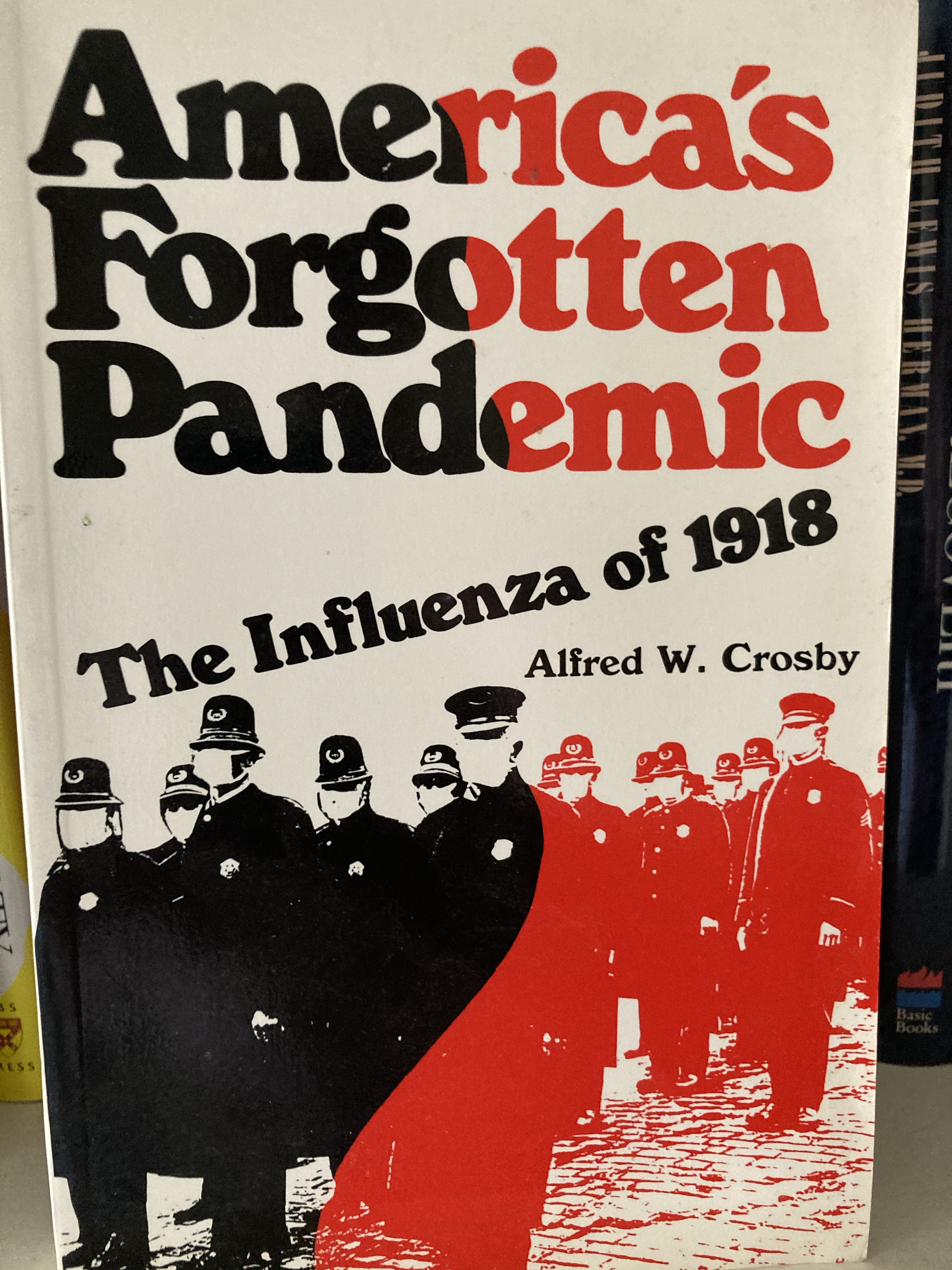
Still, in my 30s, I read Defoe’s Journal of the Plague Year and Garcia Marquez’s Love in the Time of Cholera.  And then, almost by accident, stumbled on reports of the Spanish Flu Pandemic of 1918. I read Alfred W. Crosby’s America’s Forgotten Pandemic at some point in the late ’90s and then John Barry’s The Great Influenza when it came out in 2004. How could it be that we all knew about the Great War, but not the pandemic that occurred at the same time? We know about this now; Barry’s book made it to the bestseller list in 2020, but the memory of the pandemic faded in popular culture. I was surprised this past year when I realized that Mr. Gower’s son dies of influenza in It’s a Wonderful Life; it was the Spanish Flu. Where else was the pandemic?

So when COVID emerged in the winter of 2020, I was not surprised. After all, SARS and MERS had already flourished in their own specific ways. When it became clear that this would be more serious, I bought masks as soon as possible, kept my distance, washed my hands even more assiduously than usual, and settled in for the count. History provided stern warnings; I knew that a count—of cases and deaths—was coming.

We like to predict what will happen, and strangely enough, we tend to think that the future is unwritten. It is, and yet, for a good indication, look to the past. This is true whether you want to know what the weather will be like on May 14th or if there will be traffic on I-95 tomorrow morning. Yes, there are exceptions and random occurrences that will skew the numbers, but the past is all too reliable a guide. Fifty Million people have not died from COVID as died in the last great pandemic, nor have half a billion people contracted the disease. But our imagination does not need to stretch far to encompass those numbers. 675,000 United States citizens died in the influenza pandemic; that number is all too close to where we are headed this year. Yes, the population was smaller in 1918-19, but did anyone expect this to happen?

Over the past year, I gobbled down the numbers. I felt a strange intoxication with having a sense of where things were headed and seeing them move, painfully, sadly in that direction. Anthony Fauci, and most of the medical community, played Cassandra to a population that wished for another outcome. As if wishing could make it so. But what good did it do to know? What effect did my knowing have on anyone other than me? The numbers were a despairing gruel that neither nourished nor encouraged me. I had to wait them out. Eventually, I stopped reloading the numbers every hour and settled on the grim results that appeared each morning in the New York Times.

So what’s the point? Partly this: when you see it coming, get ready: hurricane, pandemic, or whatever is on the horizon of time and place. Get ready before you see it. You have been sick before; people have been sick around you. We should have known better, and our ignorance cost lives. The obvious is always right there. Yes, while knowledge can be overwhelming, there must be a sweet spot: enough information to teach us and lead us into productive discomfort without flooding us into anxious inaction The only way we learn is by exposure.

But there’s something more.

There must be a reason that the pandemic of 1918-19 disappeared from memory. Why and what do we forget? We forget, or remember selectively, and not just about events like pandemics. I’m not aiming at what we don’t retain. As a teacher, I am too aware that students do not retain everything. I wonder why do we forget some things and not others? This is not a reflection just on this pandemic or the last or the run of diseases.  What else have I forgotten? I scramble to instill new habits and new awarenesses or avoid falling down the well of past practices. To borrow from Robert Creely, “[w]hat am I to myself that must be remembered, insisted upon so often”? But more, what have I failed to remember and insist upon?

We resume the remembered rhythms of our lives and return to our old habits and anxieties as if they were never interrupted. Repetition has essential gravity and draws us back. Except sometimes some things should interrupt us. The persistent nudge of discomfort—that we do have something new to learn and some new way to behave—should goad us onto a new course. Except, we stay the course and return to the known, even if it is a life half-lived.

I can (and I suspect that I will) point to the world and shout, “J’accuse! You forgot!” I shout at myself. I must insist that I remember—or that I remember to insist. I write in the face of forgetting, in the face, to borrow once more from Creely, of “the tiredness, the fatuousness, [and] the semi-lust of intentional indifference.” I must return to the hard work of insistence.

The pandemic passes, the lessons must not.

Certainty, News, and the Way Ahead

I grew up reading the news. We did not watch it in my house; my mother felt that the news, which included reporting from Vietnam, was too ugly (her word) for her sons. Keep in mind, this was the same mother who read Edgar Allan Poe to us at bedtime. However, my father brought home the Philadelphia Bulletin every night—back when the Bulletin was Philadelphia’s evening newspaper. He also had Time magazine delivered weekly, and my brothers’ names were often on the subscription. Whether my father was honoring us or getting a new subscriber’s bonus, who knows? I read both.

Later in life, I listened to Philadelphia’s all-news radio station KYW-1060 and grew inured to the rhythm of repeated stories. If they were updated over the course of hours, I noticed. Even later, when I was a night owl, I would slot in my 35 cents for a freshly delivered morning paper. A newspaper and breakfast before bed was near to heaven.

Cable news in its early iteration varied little from the repeated scroll of radio news. That was no matter in Philadelphia, which delayed the spread of cable TV until I was on my way to grad school and other obsessions. Nowadays, whatever used to be journalism has faded out of reportage to be replaced by a carnival barker’s promotion of something like the news. Reporting is more about the changing opinions than the changing facts. The internet does better, providing repeated updates of the day’s events: everything from the stock market to an ambassador arriving in Bahgdad to a 3-2 count on a hitter in the fourth inning of a baseball game in Seattle. Information pours out. At first, it came through the box on my desk, but then it glimmered miraculously from my phone. I pay attention.

I get obsessive. I chase the news with the same intensity that I once chased down sources in the library. And worse. I sit as rapt as I had when I churned through drafts of stories until 7 o’clock in the morning—if I slept at all.

I recognize that I had fallen into the trap that Henry David Thoreau noted back in 1854 when he claimed that “[h]ardly a man takes a half hour’s nap after dinner, but when he wakes he holds up his head and asks, ‘What’s the news?’ as if the rest of mankind had stood his sentinels.” I felt that if I knew, then I could be one of life’s sentinels. On guard, on the post, always. There was no radio, no television, and no internet, and still, he bemoaned the obsession with “news.” Go figure, our national illness.

I tried to know everything. When my family gathered, we were all expected to hold forth on any topic of the day: popular music, politics, foreign affairs, movies, the weather. Our knowledge was expected to be sweeping and insightful. I could not understand people who did not consume—and comment on—news as we did. My father spent hours wringing information from the Wall Street Journal and passed that fervor onto his sons. My mother, despite herself, had some news station, finally settling on NPR, blaring in the background.

It was too much. This past year’s perpetual blast of breaking news—the fires, the politics, the case numbers—drove me to distraction. And I realized that I had been distracted for years. I don’t believe that “ [a]s for Spain, for instance, if you know how to throw in Don Carlos and the Infanta, and Don Pedro and Seville and Granada, from time to time in the right proportions…  it will be true to the letter, and give us as good an idea of the exact state or ruin of things in Spain.” While there are recognizable patterns to history—and history’s first draft—the distinguishable differences are meaningful and worth noticing. And yet, the news can pile up.

Thoreau was on to something, if only that our drive to know masks another deficit: a feeling that life is out of our control. Information is the salve to uncertainty, but it’s snake oil, especially when opinion is disguised as fact.

Writing, for all my appreciation of the uncertainty, is about control. At the very least, and perhaps the very most, I control when I write and that I write. As for the what, well, I take a gentle hand, relying on surprise and a fair amount of chance. Yet, I am aware that no writer, short of a few Dadaists, Postmodernists, or Pornographers, slaps words on the page and waves, “Voila!” I avoid Prufrock’s “hundred visions and revisions”; I don’t have time for such nonsense. The work needs to be done.

During the first draft, I write to discover—just as I listen to the news to find out what is happening in the world. I research my subject the same way I study how the new vaccines work. I have learned (painfully and too slowly) that I must write to the point where I do not know what will happen next; there must be surprises. I go back, organize the words, and develop the surprises, letting them, and not all my preplanned ideas, serve as guides. The writing must be out of control for me to find control. Otherwise, it all falls flat. That was not an easy lesson. No one can stand that—not the reader and not the writer. Not this writer.

This past year, while everything felt out of control: the fires in Australia, the pandemic, my mother, the election, and its aftermath, I charged back into the news. Did knowing all about it help me? Maybe. But knowing got in the way of the creative uncertainty that I needed to engage. I have spent years wielding some kind of authority, and like it or not, that has been the death of my creative life. I do not know how other writers do it. So, for now, I am backing away from the news, cutting the cable, and heading back into the unknown.

Emily Dickinson writes about the “Route of Evanescence”—the road of fleeting possibility. Take her advice. This way can be daunting, especially for someone who likes—no, loves to know. You too write to be in control, except, finally, we are not. But the route Dickinson so briefly and beautifully delineates is one way to uncover the mysteries that wait: “Some mail from Tunis, soon.” So must it be. The unknown and fleeting. Get there.

What I Watched About Evil: Out of the Past

Out of the Past (1947)

Directed by Jacques Tourneur
Starring
Robert Mitchum as Jeff Bailey (Markham)
Jane Greer as Kathie Moffat
Kirk Douglas as Whit Sterling
Virginia Huston as Ann Miller

“Think we ought to go home?

“Do you want to?”

“No.”

Out of the Past begins with a montage of shots of the Sierras. It looks like a series of Anselm Adams’ photographs: stark snow-peaked mountains and high skies cast in rich, sharp grays. The music is sweeping; it befits the landscape. The camera pans down to a small town, Bridgeport, in the shadow of the mountains, and follows a black car as it drives in among the white buildings. The good world, the one we wish for, may be severe in its beauty, but it is beautiful—and natural. Evil, when it comes, comes in human form, wearing a black coat and black gloves.

None of this is surprising or unexpected. It’s almost too easy and too obvious. Out of the Past is a movie that continually works between the obvious and the hidden. The main character, Jeff Bailey, is hiding in Bridgeport, a sleepy little California town with a diner owner who knows everyone’s business. Jeff is the wild card, which draws the attention of the town’s beautiful Ann Miller. She is straight out of a fairy tale. We first meet her fishing in secret with Jeff, he declares, “You see that cove over there? Well, I’d like to build a house right there, marry you, live in it, and never go anywhere else.” She answers, “I wish you would.” Ann comes from a world where wishes come true. Jeff does not.
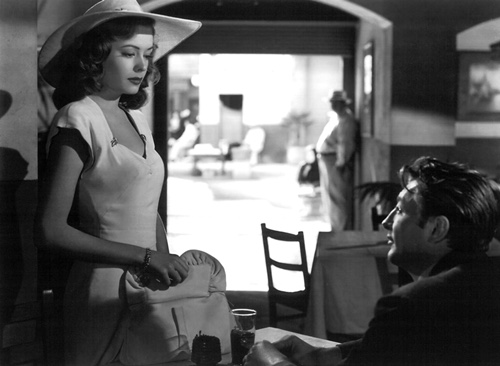
Jeff Bailey is a marked man—his actual name is “Markham”—and we learn the details of his past promptly as the story progresses. The black-gloved driver has come with a summons for Jeff from a gangster named Whit Sterling. The gangster and Jeff share a past: Whit hired Jeff to find a woman, Kathie Moffat, who stole forty thousand dollars and his heart (although the gangster never admits this); Jeff found the woman and fell in love with her. In simplest terms, Whit is evil.

In simpler terms than that, so is Kathie. Essays about film noir identify Kathie Moffat as the femme fatale par excellence. She is bad. After hearing her story, Ann states, “She can’t be all bad. No one is.” Jeff responds, “Well, she comes the closest.” Before the story of the movie begins, Kathie shot Whit—three times with his own gun. She shoots and kills Jeff’s partner (after Jeff pummels him in a fistfight). She finishes off Whit. And finally, she shoots Jeff. She is bad; she is a killer. But so are most of the male characters in the film—even the “innocent” deaf-mute boy who works for Jeff causes the death of Whit’s black-coated muscleman. Kathie acts out of self-interest, and unlike Jeff, who naively believes that his roughed-up partner will not cause further trouble, Kathie understands what men will do. Jeff barely understands himself.

Jeff is repeatedly called “smart” in this film. It reminds me of how often Iago is called “honest” in Othello. Mitchum plays Jeff with languid rakish charm, and it’s an act so good that it convinces nearly everyone, even himself. Jeff is tough enough to claim, “I’m afraid of half the things I ever did,” but toughness and charm simply ease his way into disaster. His actions lead to the deaths of six characters, including his own. He kills none of them. Joe Stefanos, Whit’s muscle, kills a man to frame Jeff. “The Kid”—who works for Jeff—hooks Joe with a well-placed cast and pulls him from a precipice and to his death. Kathie kills three. And the police kill Kathie. But all six deaths begin with Jeff’s admission, “I saw her—coming out of the sun. And I knew why Whit didn’t care about that 40 grand.” “I saw her.”

Some critics will let Jeff off the hook—an appropriate metaphor in this film because we are introduced to Ann and Jeff while they are fishing—and claim that the film frames Kathie. After all, Jeff acts nobly at the end of the movie, when the Kid tells Ann, in unspoken accordance with Jeff, that Jeff was leaving with Kathie. This clears the way for Ann to return to her old reliable beau. And Kathie did kill three men.

Still, Jeff’s naïveté—the kind of naïveté fostered by an over-sentimental macho ethos—never takes into account the consequences of his actions. He’s halfway smart and gets the lion’s share of great lines, but he doesn’t actually know what he’s saying. The lines just sound good. When he chides Whit, “I sell gasoline, I make a small profit. We call it earning a living. You may have heard of it somewhere,” he doesn’t really believe it, no matter what he tells Ann or anyone else.

“You’re no good, and neither am I,” Kathie insists to Jeff. We may have been charmed by Jeff. She may have found him charming, she may even love him, but most of all, she knows him and knows that the good act that he puts on is his weakness. He is evil—as bad as her, worse because he can neither admit it nor make it work to his advantage. It’s a crushing realization.

The realization that the hero—even the louche antihero played so well by Mitchum—is, in fact, the villain, is not easy to accept. We like the cool character, the slow-eyed machismo wins us over, even while he threatens the fairy tale princess at the heart of the story. Maybe we like him for the same reason that we like the stark gray landscape: the Sierras are neither moral nor immoral. The landscape is beyond good and evil. If the mountain stream can be sublime even though it may be dangerous, then why can’t a person be beautiful even if she—or he—is villainous?

Iago claims that “When devils will the blackest sins put on,/ They do suggest at first with heavenly shows” (2.3.371-2), he points out how we may be fooled by evil. There’s something else though, a willingness to set aside our judgment when the “Divinity of Hell” wanders into our midst. We want to understand, to analyze, and to rationalize, thus casting evil into a knowable and, therefore, acceptable quality. We value our ability to sympathize, no matter what. Do we sympathize with Whit? Or his blunt right hand, Joe Stefanos? Or even the femme fatale, Kathie? I suspect that we do not. But Jeff elicits sympathy. Because he is cool, and maybe, because we want a little of that coolness to rub off on us. No matter the cost.

It’s what we wish for.

“Think we ought to go home?” Ann asks Jeff when we meet them. He answers with a question, “Do you want to?” She says, “No.” Home, this country founded on a beautiful idea that there is no evil—or if there is, it is outside whatever we define as home: the four walls, the property lined with a stone wall, the land we call our own. We wish for home and cousin up to the idea that evil exists outside, that it is a black-gloved interloper, that it doesn’t know how to fish, that it doesn’t hire the innocent deaf-mute boy to pump gas and repair tires. And that if evil does exist at home, it comes in the form of nosiness, petty jealousies and provincial attitudes. It doesn’t look or sound like Jeff Bailey.

Macho (Masked) Man

“In that immense crowd which throngs the avenues to power in the United States I found very few men who displayed any of that manly candor and that masculine independence of opinion which frequently distinguished the Americans in former times, and which constitutes the leading feature in distinguished characters, wheresoever they may be found.” from Democracy in America, Alexis de Tocqueville.

At some point, the whole point of “being a man” was to live a life that was, in de Tocqueville’s words, full of “candor” and “independence of opinion.” Sadly, even when he was surveying our country in the first half of the 19th century, de Tocqueville noticed that such characteristics had waned. People were more likely to follow popular opinions and desired little else than to be part of the herd. “The Tyranny of the Majority” was worse than the tyranny of a monarch, in part because it was a refutation of those manly virtues.

I’m inspired to take up this theme again, because Daniel Victor published an article on masculinity and masks in today’s New York Times. Men have made masks a political issue—or rather, they let masks become a marker of their masculinity and let the jeering hoard determine their idea of what it means to be manly.

Set aside the absurdity of going to the mattresses over masks. One might as well complain about wearing shoes (A real man would walk about with bloody mangled feet). But some tide has turned, and real men need to take another stand. No purses. No speed limits. No two-drink minimum. No masks.

What stands out is that men need to gather together in groups to assert this.

I understand that fraternité—brotherhood—has in ineffable and intoxicating power. I delight in the time I spend among my brothers—both of birth and choice.

fraternité

However, part of “being a man”—and whether this is a good or a bad thing I will engage at a later time—is being alone. I relished nights on the ocean when I was at the helm, and my crewmates were either in their bunks or asleep with their backs to the cabin. The years of study and writing I did and do, while they may have their end in a classroom or manuscript, were valuable in and of themselves. I built a kitchen on my own. I pulled the clutch from my VW alone. I made Bastille Day dinner alone. Sure, I looked up the directions, but the bloodied knuckles, thick callouses, and genuine pride belonged to me.

I actually have a more challenging time in company because of the lack of candor that others show—men especially so. Candor: not just honesty, but straightforwardness and a thoroughgoing willingness to shine a light. How many times have I heard someone couch what they were going to say in “This is my opinion…” and then blather on in seriously unexamined directions? How many times each day?

Even this writing results from my natural predilection to push my opinions—and not just about masculinity—and see where they are rooted, and explore their limits and my own. I demand the same from any.

One night on the Chesapeake Bay, my father had charted a course for us to follow. It was the first night of our sail, the ocean and a gale were ahead of us, and my brother Peter and I had the late watch. First, we ran through a set of nets set out just off the channel. They were hoisted between temporary thin posts driven deep enough to hold them and catch fish. But then I noticed that our course, such as it was, would also take us across the land.

My father did not always explain where we were going or share course details. For most of us, that was fine; my father was “the captain,” and we were on his boat—that was enough. This drove me crazy. I wanted to know, to break out a chart, and to mark our progress. I wanted to associate what my eyes told me in the bay—at night with a sky partly lit by stars—with some larger picture.

That night I woke my father—not a dauntless act: besides his distemper at being awakened, he was on medication for Parkinson’s Disease that made his sleep thicker. He groggily looked at the waypoints he had mapped out, looked at the horizon, then handed me a chart zipped into a waterproof plastic jacket. “Get us here,” he grumbled and pointed at a point well to our South and East. Then he returned to his bunk.

The job of a man is to wake his father and tell him when he is wrong. And then get back on course. If you don’t know how to read a chart, learn. If you don’t know how to sail, learn, or stay home.

When de Tocqueville remarked about the flagging “manly candor” and “masculine independence of opinion” in the 1800s, it was because the United States began with strident truth-telling and was born out of a series of acts that took responsibility for the truth. Small groups set out to make a life—a new life—outside the comfortable known world. Those first colonists’ decisions were rooted in hope and vision, and, because they were someplace strange, caution and practicality. To rephrase William Carlos Williams, there were no ideals but in things.  And all those ideals and things needed to be tested and checked for their utility as well as any unnecessary or ornamental value. Think of Puritans and Quakers, both in spare meeting houses—trying, and in some cases failing, to discern the truth. But trying.

What struck de Tocqueville—and strikes me now—is not that truth has become less critical, but the ability to distinguish between the necessity and the ornament of truth has dimmed. This is nothing new. De Tocqueville wrote Democracy In America 150 years ago, and after Thoreau noted that “the mass of men lead lives of quiet desperation.” Maybe its the “quiet desperation” that confounds us and makes us valorize the freedom to breathe and speak without a mask over the responsibility to ensure the safety of those around us. Discomfort outweighs obligation.

And obligation becomes what it has never been before—unmanly. I wonder how that happened, how the more Spartan values of sacrifice and duty have been replaced by a fierce desire to get to the front of the beer line? How did we get so far off course? Yeats wrote, “The best have no conviction. The worst/ are full of passionate intensity.” Why cheer against obligation? This is not why we are here, not what we fought for, not what men do.

Contradiction and Awe

In the Smithsonian American Art Museum, John Singer Sargent’s portrait of Elizabeth Winthrop Chanler hangs in a room on the second floor. The room features paintings of men and women from the Gilded Age—the last great flourishing of robber baron capitalism in the United States. Elizabeth Winthrop Chanler is a descendant of Peter Stuyvestant, a member of the Astor family,and became part of “the 400”—the unofficial roster of New York’s finest families.

Sargent painted her while she was in London for her brother’s wedding. She is 26, the eldest daughter, self-possessed—as she needed to be since both of her parents died by the time she was 11. The description on the museum website points to the juxtaposition between her controlled gaze and the turmoil of “[h]er arms, leg-of-mutton sleeves, and the pillows [as they] seem to wrestle with one another.” That’s fair enough. Her gaze, direct and at the viewer, is strident, almost an affront, “You think you see me?” she asks.

Museums are fabulous places, in no small part because of the juxtapositions of things. Across the mall this is made clear by the exhibit of Charles Lang Freer’s ideas about exhibiting like objects that were made hundreds if not thousands of years apart. Here at SAAM, the exhibitors have put the portrait of Elizabeth Winthrop Chanler in a place where her gaze extends out into and across the hall. Standing across the hall, one can still sense her stridency.

What’s in the room across the hall? Undine, Illusions, Spring Dance, An Eclogue, The White Parasol, and Woman with Red Hair.

None of the women depicted in these works stares fiercely at the viewer. They either stare off to the right or left, or are engaged in a closed unit—with other women, or in the case of “Illusions,” a child or putto. Several are naked, or draped to reveal their sensual forms. Or, as the titles suggest, are to be known for the attributes (hair, parasol). The women her are used as subject matter (“The White Parasol”) or at the service of allegory (“Illusions,” “The Eclogue”).

Spring Dance. Across the hall.

I cannot be certain what Elizabeth Winthrop Chanler felt about art and female representations. That she was part of a world that valued culture (her brother, Robert Wilson Chanler was a painter) is fairly certain. By 1893, sitting for a portrait by Sargent would not have been an inconsiderable achievement. But in this museum—in every museum—are countless works that transform the sitter into something at the service of the artist (who is often working at the service of another). She must have known that.

Sargent captures her singular defiance. She may be beautiful. She may be 26 (and years yet from marriage). She may be wealthy—or wealthy enough, say her rings and her brooch. She is not too young, not too self-aware as to hold our gaze with hers. Sargent said she had “the face of the Madonna and the eyes of a child,” but his painting reveals a fire that exceeds anything childish. She is determined.

“Match me,” she tells us. “I will not go quietly.”

I return to the SAAM—or the hall National Gallery, or the Freer and Sackler Galleries—because getting caught in the web of juxtapositions helps untangle me from whatever I am stuck in from the rest of the week. The juxtapositions reinvigorate me. Roethke writes in “The Waking,” “This shaking keeps me steady.” Do they contradict themselves? I hope so. I count on it.

How are the juxtapositions I find here, in these places and spaces, different from those in the world? There are a web of contradictions waiting around every corner—cocksure hypocrisies and beguiling changes of mind. Why do I need more? What’s the point of contradiction contained in or by art?

There is a difference. I am drawn to a world of things and ideas that acknowledge the diversity, that are not afraid to make contradiction and juxtaposition a large part of the message. Yes, just as there are people who insist on “I know the truth”—and then brook no contradiction—there are works that proclaim their own monolithic messages—“Look on ye mighty and despair.”

And yet like a cathedral, or like a mountain, a canyon, or an act of genuine kindness, they can awaken a sense of awe, and, if you are open to the experience, that sense of awe blasts away preconceptions. And unlike things found in nature—as awe-inspiring as those are—works of art made by human hands, perhaps because they were made by human hands, despite the petty hypocrisies and even the pointed cruelties awaken a human sized sense of awe. I can stand before the human sublime and feel the full terror (Jeder Engel ist schrecklich—Every angel is terrible, Rilke), but the terror is a tearing away of everything else, everything I thought I knew, and an opening to what is suddenly possible. I stand and proclaim, “I do not know!”

I feel rather a bit like Scrooge when he declares: “I don’t know what day of the month it is!… I don’t know how long I’ve been among the Spirits. I don’t know anything. I’m quite a baby. Never mind. I don’t care. I’d rather be a baby…” Imagine that, being 18, 25, 38, or 60 and being like a baby, ready to learn everything as if for the first time. To be wise and to be willing to be surprised.

So, I return, and step between Elizabeth Winthrop Chanler and whatever it was she held in her gaze, and I let myself be cast into the room across the hall, and all the rooms across all the halls, and find, once again, some awe and uncertainty. I can match that.

Into the Dark: What I watched about evil

Two years ago, I rekindled this blog with reflections about what I learned about love from movies I watched in my youth. Love—in all its tangled brilliant forms—is the flame for this moth. Contemplating that light allows me to see through the darkness. Over 40 years ago, my cinema professor, Kaori Kitao, asked us what cinema was—the big question—to which she supplied the final answer after we had all tried our hands. “Cinema,” she said, “is light.”

Of course. What we saw on the screen was light obscured at 24 frames per second—light shaded and shaped into colors (or not) and accompanied by sound (or not). In our Wednesday afternoon classes, we sat and watched—over and over, for 3-6 hours—film projected onto a small white screen. Professor Kitao would speedily rewind reels of film so she could point out—over and over—the traces of light on the screen. There were secrets to be found.

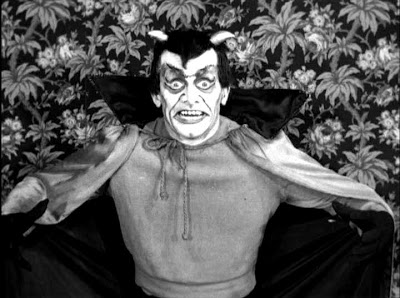
I found love—or at very least, desire. The opening scenes of Bergman’s Persona spelled out what the light could do. I was too shy at 20 to comment on the erect penis that flashed oh so briefly (not that briefly!) on the screen in the opening montage. Love and sex. Desire and death. The devil that dances in that opening sequence reminded me of a childhood dream I had of a green-skinned devil who hopped about in our living room. Cinema is a dream—all dreams—distilled by light. And dreams take place in the dark.

If love is my light, there is also darkness. I struggle with darkness—with seeing it too much. In Peter Chelsom’s underrated Funny Bones, one of the characters remarks that Jack Parker—the comic genius of the film—sees the dark side of comedy too clearly. I saw that movie on my 35th birthday, and it crystallized my thoughts about comedy and tragedy. There are things that some of us see too clearly, that most of us just laugh or cry away. We turn our faces to what suits us best and call what does not please us “the other” in one of its many names.

However, the dark is not merely the absence of light or its easily demonized opposite. It is a vital source of energy. How long did it take me to accept that? I’m still working on it.

I saw the movies that taught me those first lessons about love when I was a teenager—or younger. With a few exceptions, the films that helped me grapple with the dark were part of my twenties—the lost years after I graduated from college and before I began graduate school. With few exceptions, I saw all these in movie theaters (or I have seen them all in theaters). I was fortunate that there was a revival house in Philadelphia (the TLA) that showed old movies. And, while Philadelphia had no cable TV, one of the UHF stations played classic films late at night. I watched. And dreamed.

Unlike the movies that taught me love lessons, these are uniformly great films. There are no April Fools or Hotel here. Maybe that’s because after taking Kaori’s class, I had learned to turn my eyes to more serious work, or maybe that’s because darkness instigates a different kind of art—more obviously profound, more apparent attempts at art. The distinction matters and does not matter. What we see in the dark is a dream. Great or not, these are no more real—or just as real—than the films I wrote about two years ago, the same way that my dreams are neither better nor worse than when I was a boy. Out of the light and into the dark.

Evil. What is evil in these films? Inhumanity. Failure. Fatal inevitability. Some incredible compunction on the part of the characters to launch headfirst into harm, and to take large swaths of their world with them. I saw these at a time when I became more starkly aware of the evil that was at once accepted and codified in the world around me. Sure, I had warnings along the way, and sure, these films are not life—any more than the movies that taught me about love ever substituted for the harder lessons that life delivered. Still, they offer up the contradiction: darkness painted with light. And each one provided a lesson that stuck, even if I disagreed with its premise.

I’ve been wrong before. I will be wrong again.

The Films

Out of the Past

The Draughtsman’s Contract

Brazil

Ran

House of Games

Lawrence of Arabia

Dr. Strangelove

At War with the Virus

Say, you live in Maine, far from the coast, in the softly rolling hills in the part of the state known as “The County.” In Winter, the days are short and bitter with cold. You are not at war with the dark, and the winter wind is not your enemy. You may decide to move someplace warmer, where the sun rises earlier and warms the world even in January, but no matter where you go, The County will be cold in January.

Say, you live in Florida, and for four months each year, you pay special attention to the weather forecast in the morning. You have sheets of plywood stowed away in your garage, just in case. In Winter, the streets fill with license plates from places up North. Hurricanes and snowbirds are the limits of your life, but you aren’t ready to chuck it all and move to Tempe. You aren’t at war with hurricanes—what a futile battle that would be. They pass through, soaking the earth and knocking down trees. At least they aren’t earthquakes—unpredictable and worse than ornery.

My father planned his trips to Bermuda in late May and early June—when the weather was usually warm enough and before hurricane season roared into full flower. Only once did a tropical depression explode into hurricane force. We were still inside the reef, making our way from Hamilton to the customs house in St. George. One of the ferries veered off its routine course to check on us as we were about to depart Hamilton Harbor. My father’s stubbornness was as unrelenting as the weather. It took us a day to power around the island’s northern passage—a trip that usually took scant happy hours. I held the helm as we motored inch by inch into idiot winds. I slept well in an uneasy anchorage that night. By morning, most of the cell had crawled on, slowly dissipating in the pan of the chilly Atlantic.

A sailor, a Floridian, or a Down Easter all understand that weather comes and keeps on coming. Some cycles are reasonably predictable, but day by day, if you are planning a day sail, a picnic, or a ski trip, you better check ahead.

There’s a lesson here, and it’s full of holes. Not everything is like the weather. When we describe people as walking hurricanes or icicles, we make metaphors to explain their character. We know that their behavior did not originate as the result of cold air spinning over warm water, or that they are actually frozen. We alert ourselves to the difficulty of such people because we know that grappling with rain and wind or freezing cold is a fool’s errand.

The coronavirus is more like weather than some “invisible enemy.” We will not “contain it,” or “defeat it,” as much as adapt to it—the way that we put on a heavy coat in the Winter, or attach plywood outside our windows when the storm heads toward us. Yes, the virus can kill us, but it’s not a willful assailant. It did not attack us or declare war on us. It has no strategy learned at war college. The virus just is.

We think of the world in terms of stories. Even the way I began this—weather—is just a story based on my experiences, although I have never sealed a window behind plywood or hunkered out to check fields in the brief sun of Winter. I can imagine such things because I have seen them depicted in the news or heard these stories from people who have done them. Or because my life has brushed close enough to these places and that weather. Besides, these are common enough stories.

But war? A friend reminded me—over and over—how poorly the military was depicted in film and television. The military and war are described to conform to our sense of what they are—to fit the stories we already have. I recall Henry in The Red Badge of Courage, marching off to war with heroic accounts of the Greeks dancing in his mind. And then the battle happens.

There was a singular absence of heroic poses. The men bending and surging in their haste and rage were in every impossible attitude. The steel ramrods clanked and clanged with incessant din as the men pounded them furiously into the hot rifle barrels. The flaps of the cartridge boxes were all unfastened, and bobbed idiotically with each movement. The rifles, once loaded, were jerked to the shoulder and fired without apparent aim into the smoke or at one of the blurred and shifting forms which upon the field before the regiment had been growing larger and larger like puppets under a magician’s hand. (Crane, The Red Badge of Courage)

Of course, this is a little too poetic. Crane gets at the chaos and absence. The overall effect of his novel is the persistent shift from order to chaos and back again. He did not experience war but learned by listening to veterans as he prepared to write. We can learn new stories.

We fall back on stories that we already know. The gravity of the familiar is too powerful for most to escape. We repeat and replicate the stories from our lives with tidal regularity. We do it automatically and insensibly. And that is fine and sensible when what we already know helps guide us back to familiar places. However, when faced with the exceptional, we must learn, quickly, to adapt and revise those familiar stories into something that will suit the present moment. “Must”? Why “must”? We do well enough with the old ways.

Metaphors, which are all that stories are, helpful tools that can open and expand our understanding. In Range, David Epstein writes how Kepler used metaphors to help him discern the motion of the planets. However, metaphors come imbued with values and can ensconce our judgment with moral values that impede clear vision. In Illness of a Metaphor, Susan Sontag points how “[i]llnesses have always been used to enliven charges that a society was corrupt or unjust.”

So, if we are at war with the virus, it must be a foe with corrupt and evil origins. We demonize the virus to create a familiar story of us vs them. We go to war with the virus to stir a sense of urgency; war is the epitome of urgency. The evil enemy must be defeated. Leave out the chaos and unpredictability. The slip of genetic information becomes an “invisible enemy,” the President takes on the mantle of “War President.” Except this enemy does not stand on a field and fight, does not snipe at us from a jungle blind, does not line up or plan or have a General in charge of strategy. There is no Rommel, no Lee, no Hannibal directing the forces. No more than some angry, vengeful force directs the cold wind to gnaw off the fingers of your left hand, or tears trees up by their roots and smashes them down through your roof.

The man who attacks the wind is worse than a fool and doomed to fail. Even if the wind abates, and the serene sun returns like a balm, he did not defeat the wind, and he did not bring the sun.

Still, we feel the need to play the useful if futile part. We must do something. During the pandemic, many will do—and should do— much, as we slowly find out a way to live with this next new virus. There have been other illnesses, and there will be others. We can be sure of that. We will learn this lesson, or forget it and retreat to the familiar old story. The story was there before and will wait for us, as it always has.