On the revisionary road

Here is the next step in the process. I have spent the last few weeks reviewing my rough draft, which I have dubbed the “working draft”—and have produced several copies of that working draft. I split time between one draft saved in between Pages (on my iPad), and and another saved in Word (on my laptop PC). I have run the draft through Grammarly several times, and read the document from page one through page 312 (now). By the way, Grammarly does not catch every typo, nor does it allow for “Djinn” to work as both a plural and singular noun. So be it.

I have enjoyed rediscovering how I imagined the book when I began, and to rewrite those old intentions to suit where the whole thing turned. While I was aware of this change as I worked, I resisted the temptation to head back and “correct” the earlier chapters. During the first draft, forward motion was more important than perfection—or rather, something like perfection, because, really, perfection is a chimera. In spite of my decision to emphasize forward motion, there has been much in the working draft that has delighted me, and some, on reflection, that has surprised me.

This draft also contains memories of what I was doing while I wrote. Some of those memories are bittersweet, some are joyful. I began this book with one reader in mind—which was helpful at the start. I felt that there was a whole story ahead of me, but did not know where it would end up. Along the way, I read passages in public, and gauged the work by the reaction of an audience—which was also helpful along the way. I also shared bits and pieces that made me happy with other people, including a colleague, who generously read the 170 pages I had written (and not finished) in June. I found the responses of these readers to be helpful, and heartening, as well.

While writing has taken its right and proper role in my life, I do not write for me, to express some deeply held inner belief or to prove some point. I like to engage a reader, to connect. If there is a bigger point, it would be about the power of connection. I appreciate that a piece of writing can be a kind of conversation between me (the writer) and you (a reader)—and it is not an intellectual conversation.

I think, for years, that I tried to write with my intellect, and that I did not trust my heart with the process. I struggled with the desire to express something perfectly, or at least as well as others had expressed themselves. Those others included anyone and everyone who had written anything and everything. More recently, I was able to hear Sidney’s muse exhort me as well—“Fool, look in thy heart and write.” Turning to my heart—away from not the anxiety of influence as much as the weight of awareness—has allowed me to feel my way through the work. Sharing with others has helped expand that feeling, and to have it be a shared feeling at times.

I have turned back to my intellect as I revise, and this has helped me make connections in the text. I add more than I cut, as I realize that I have not provided all the bridges necessary between scenes. Still, I have rediscovered intuition, and as I make my way through this draft, I am surprised and delighted by what I wrote, almost, it seems, by accident, or, at least, by trusting my poor, fallible, and durable heart.
Routine

Every Sunday, save for one or two while I was traveling, since April, I have wandered through the various art galleries on the National Mall. I carried my notebook with me, and wrote. There was something invigorating about being in the presence of beautifully made things—whether a drinking horn from the 6th century BCE, or a bronze horse from the late 20th century. Bits and pieces of what I saw inspired my writing, which was about an entirely different time and place.

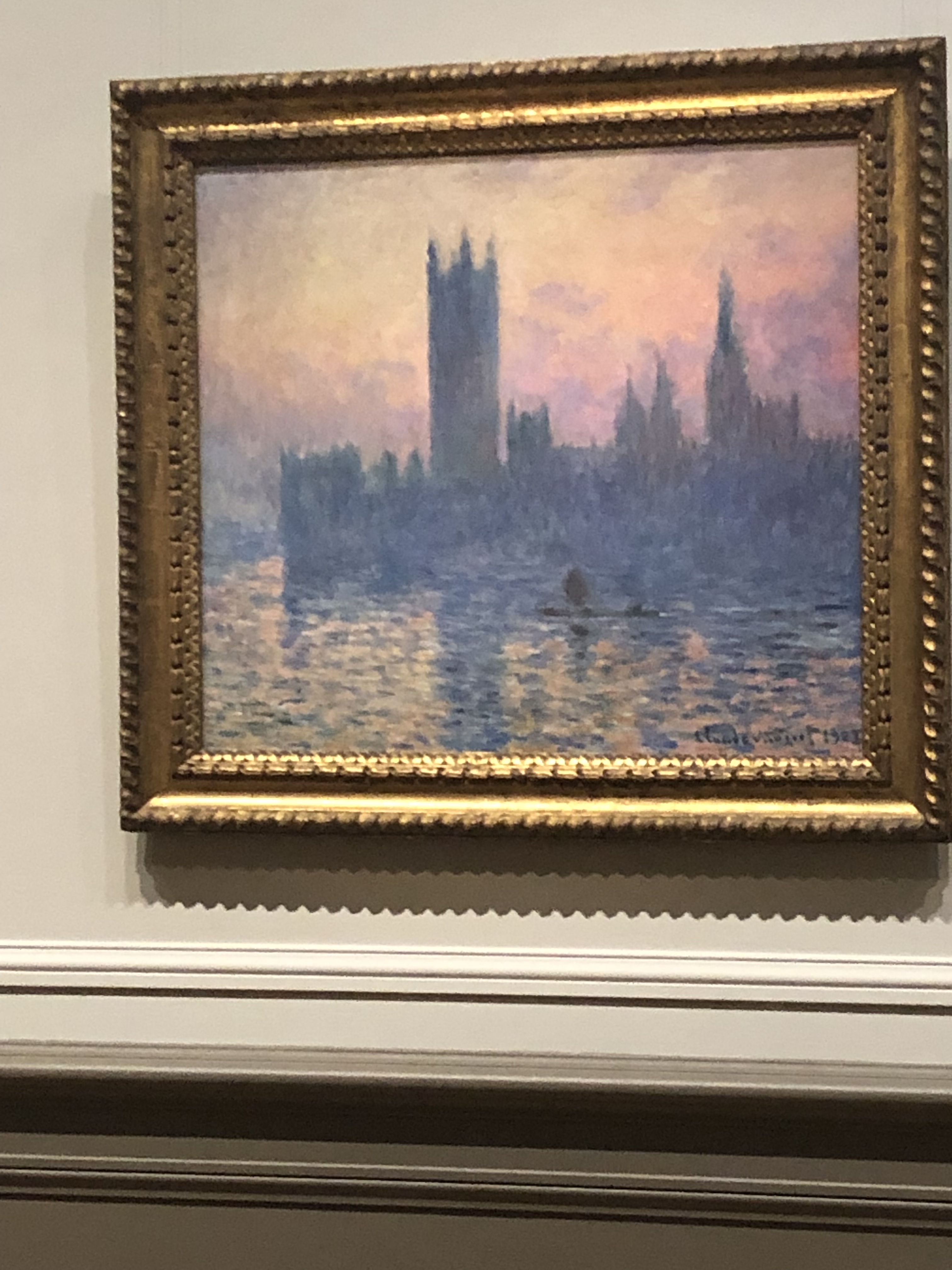
The routine gave me something to anticipate each week while I was in the middle of my project. The two hours—one spent driving in, another on the way back—were worth the result. I found favorite places and favorite works. Monet’s painting of the Houses of Parliament has been a touchstone on these trips. It reminds me of an early interest in his work, of travels I have since taken, and of an approach to work that I have come to appreciate more and more. Partly that approach means honoring the routine, no matter what.

Routine seems like it would be the antithesis of inspiration. Think of the ways we denigrate the grind or the slog of work. Or the way we quote Emerson: “Consistency is the hobgoblin of little minds.” However, I would point out that Emerson nails “A foolish consistency,” not all consistency. I would hazard that there is a wise consistency to be found as well. Like wisdom, it is hard-earned, and requires a kind of flexibility. For instance, when my daughter came to visit, I did not insist on making my weekly sojourn because other plans (a trip to see our family) interrupted my routine. Or last week, when I took a day off (my rough draft was done, and I felt spent), I granted myself some quiet time.

This week, I am back at it though. The sun is once more setting behind the Houses of Parliament, and I have walked about half the distance I will walk the rest of a cloudy day in Washington DC. And I am writing—this now, but the revision continues apace. My routine will be important in the coming months because school has begun again, and without some carefully delineated routines, schoolwork can too easily consume time. Teacher’s always feel as if they could do more—one more brilliantly placed comment on an essay, one more after school event, one more meeting, all while managing the daily preparation. I will get to the gym—the body work supports the brain work. And I will set aside an hour (more as needed) a day to write. I will guard my sleep.

And, I hate to admit this, I will do less of other things. Some were just distractions (Sunday Morning News shows), others (dating) brought joy with the distraction. Like it or not, the wise routine will preclude even delightful entanglements—at least until the process of getting to a final draft (agent, publisher) wraps up. And, of course, the next book is waiting.

I’m not sure what I will find on the way ahead. I know that I will rely on my routines to get me through the uncertain times. And I will seek wisdom, and a wise consistency as I go. Inspiration this way waits.

New Year’s Day

Today is my New Years Day. Today school meetings begin in earnest; students return and classes resume next week. What that means in practical terms is that I was up while the clock had a “6” to start the time, and at work while it showed a “7.”

The time doesn’t really matter. As long as something like 8 hours of sleep happened before I wake, time is just a way to organize the day, so that people can make arrangements. During the school year, the events of the day begin at 8 AM, and I like to be present and pleasantly caffeinated well before then. I plan accordingly.

Nonetheless, it is a new year, with all the attendant joy that comes with beginning. This year, I begin in strangely excellent physical condition. I can swim five miles without stopping (a task I once reserved as a test before heading out on the ocean). I can lift more weight than I have in thirty years. And I weigh as much as I did when I was fit and in college. These are all old markers, but remind me that even though years may pass, I can still fight myself back into shape.

I have also finished a draft of a novel, and have started working on revision. These are new thresholds, and mark a significant change in my daily life. Writing every day has been a revelation. I did not plan far ahead, but trusted—blindly, confidently—that there would be wells along the way. I know that the way ahead is—as it is in my favorite Kafka short story (“My Destination”)—“fortunately, a truly immense journey.” I cannot carry enough water to get me where I am going; there must be wells ahead.

I do not know where that journey will lead. I do not know what the next books will be about, but I can feel the impulse to write, to imagine and . All that matters is the writing and allowing for the discovery—the thrill of the new and of exploration of a subject, characters, places, and ideas. I know that there will be a physical analog to that journey, but that it will be bound to psychological, artistic, and spiritual travel as well. All must happen, and will happen.

Once upon a time I wrote a poem about baseball (and not at all about baseball) that ends: “Each day the day begins again.” And so it does, except I am more aware of my old self, and of carrying him—that old hulk, but also that bright star—into this year. So I go, crafting a way forward, learning, reclaiming, and working.

This is the single greatest attraction beginning a new school year—as it has been since I was much younger. There is something new to learn, some new idea, some new book, some new inner and outer experience on the horizon. Even though I am now a teacher, I plunge ahead, building on what I know, and striving for something I do not know, and prepared to discover. Away we go.

Running in the Rain

A fragment #thirdwishnovel

As they walked, it began to rain. Small creeks formed where the land dipped, and the water flowed south, away from the mountains in the north. Tammuz took a long stride across one of the sudden streams, and turned to help Shalti across. She had already leapt, dry rise to dry rise, and laughed as he turned to make his chivalrous gesture.

“I’m over here!” she shouted in the rain, and ran ahead across familiar ground.

He watched his steps, and watched the woman move across the landscape ahead of him. She barely let her feet touch the ground before she stepped again, moving as if suspended by wings or wires. He stopped as he watched her, letting the rain soak him. She wore black boots and danced from one dry spot to the next. He had no idea where she was going, and she did not look back. If he stood there too long, he was sure that she would disappear.

He started to run too. Unlike her, his footfalls found water, and he splashed ahead straight after her, mud splattering up his pant legs. He did not care. He did not catch her, but she did not outpace him either. They ran in clumsy unison a hundred yards, more or less, apart. The rain kept falling, and they ran away from the shelter of her home to where? He did not know. Perhaps she did. He was not sure how quickly she ran, but felt no strain in his legs or lungs as he followed her. The pace came naturally, easily to him, in spite of the way he charged through the water and the mud.

A stone structure appeared as first she, then he crested a small hill. It looked as if it were made a simple monolithic slabs of rock, lifted and deposited to form a rough hovel. She ran there and waited for him under the thick roof of stone.

“You are soaked,” she declared, when he arrived. “It feels good to run, doesn’t it?”

“You have a strange idea of fun,” he answered. “Why aren’t you wet?”

“I know not to run into the raindrops, or the streams.” She pointed to his pants, which were coated with wet earth.

“I do not know the land or the sky as well as you, not here,” he said.

“Don’t make me laugh, strange man. You would get wet wherever you were. I can tell that about you.” She laughed at him, and he joined in with her. “You can run a little though, so perhaps,” she paused and poked him in the chest with the outstretched fingers of her right hand, “Perhaps there is hope for you.”

Resentment

There is always regret when one has not done not just what one has wanted to do, but has dreamed of all of their lives. “If only I had started sooner,” regret whispers. “If only I had not taken that job, moved to that city, loved that person.” Regret is a whispered siren’s song, and it can lead one toward a sadness that is disastrous to the work.

Regret has a companion emotion, and once one figures out exactly what one needs to do, this other emotion can assert itself in awful ways. This emotion is resentment. Anything—everything—that does not help us attain our vision—our purpose—can cause us to feel resentment. For instance: a job that takes our time—our necessary and limited time—even if that job is fulfilling and valuable. Even if that job pays the bills. Our family can cause feelings of resentment. This is a deep dark secret: the people we love can be the people who awaken resentment in us. Because they ask—as they are entitled—for our most precious resources: our imagination, our patience, our time; our essential necessary energy to do the work at hand. And this is terrible. No one wants to resent for their family or loved ones. And yet, we do.

Anything—everything—that takes away from the energy needed to do the creative work that gives our lives meaning cause resentment. One must learn to carve out sufficient time to be fully engaged and to spend the energy at the work required to fulfill one’s purpose. This is true in any circumstance—with or without family, with or without loved ones, and with or without other work. Once one sees what can be done, one must change one’s life to fulfill one’s purpose.

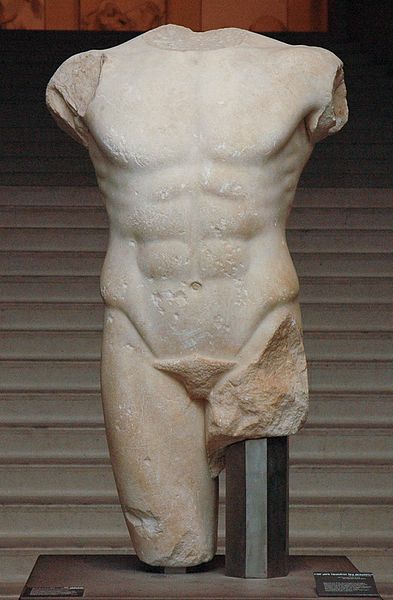
Archaic Torso of Apollo

However, resentment is not located in those other places. Neither my child, nor my job, nor anyone else in my life is the actual wellspring of resentment. It comes from me. Of course there are stupid little human annoyances—the woman who sliced into the left lane ahead of me on I-95 today, then just as abruptly, sliced back through traffic across two lanes to make a sudden right exit. The anger caused by such behaviors only lingers for so long. Resentment comes from an inward driven anger that sharpens regret and turns it back out to the world. The clearest targets are those who are nearest us.

Yes, there may be times when those close to us do ask us to stop our most purposeful work for reasons that are worthy of resentment. They may question your sense of self, and cast aspersions on your work and aspirations. Sometimes people cannot escape the deep-seated injuries and resulting resentments that their injuries caused, and they struggle, not with themselves, but with you. Just as you may struggle with resentment. Just as I have struggled. And one must escape that false judgment, and not validate it in any way. For the most part, we are the main manufacturers of our own grief. We stop ourselves. We foist anger on ourselves and take handfuls of earth and shower ourselves in dirt. We manifest an anger that eats us from within.

I am not suggesting that one should not be angry. Anger can be a source of energy, a goad to action when complacency or sadness or depression has settled too deeply on the creative mind. I let that anger into my work—allowing characters to taste it and spit it where it needs to land. So too with me, I learn, daily, the difference between anger caused by genuine external sources and that which has simply emanated from some ancient sun within me.

When I feel resentment, I check my sources first, and realize that, more likely than not, that I am not doing what I need to do. I am not tending my work and my purpose as I should. I have taken—for reasons at once honorable and misguided—someone else’s charge and anger as my own. I put it down, gently, if I can, and get back to work. The way forward—to fulfillment, to joy—is here.

The Vision before the Travel

It seems impossible to me that when I finally see the cathedral at Rouen, I will already know the shadows of the late afternoon sun, and the way the morning light illuminates its porticos. How much of the world do I already know through the eyes of artists—the representations and words of painters and writers?

And not just buildings, but people as well. How have Uriah Heep, and Cassius, and Peter Walsh shaped my understanding of certain kinds of men? Or the countless representations of “The Man of Sorrows”?

If I have not traveled, I have imagined, and born witness to hundreds—no, thousands, more—of depictions of the world. I know that I have only traveled through the eyes and thoughts of others, but what others!

And yes, each place I have traveled enters my work, makes it larger, gives me insight to reveal some feeling in each of my characters. However, the travel out into the world is like practice for the travel I must do into the imaginary world I wish to create. I write, again and again, about the gifts that the universe provides, but, in the end, I must make something of them. I must use my imagination to recreate the world.

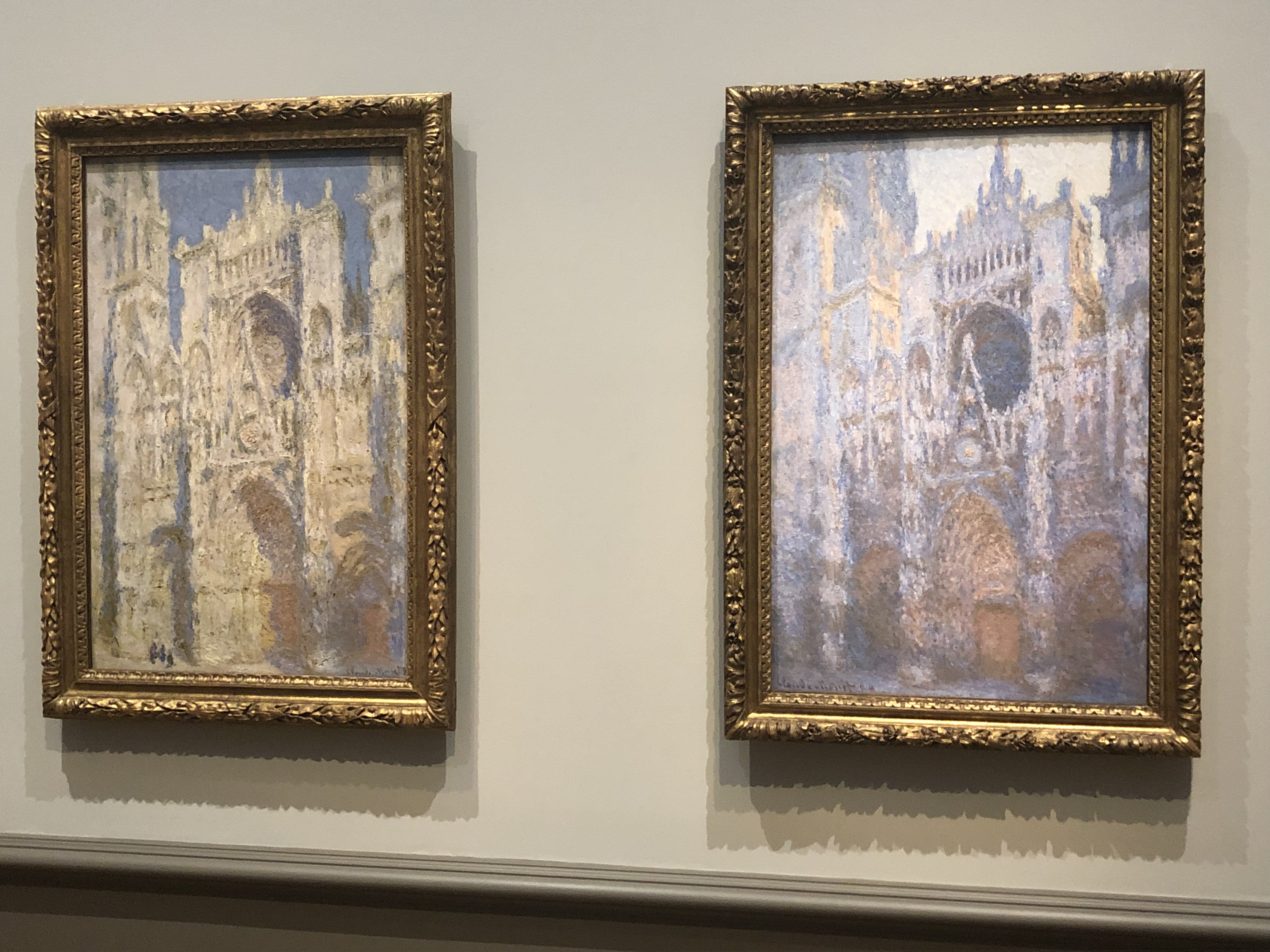
Which brings me back to the two views of the Rouen Cathedral by Monet at the National Gallery of Art—and all the other renditions I have seen in books and projected onto screens. I see these, and begin to build—in my mind, based on all the cathedrals I have seen in my travels, on all the slants of light, on all the play of clouds—a vision that will become my own. I look forward to seeing the actual building—soon! soon!—but I also know that it exists, somewhere, in my mind already.

Horses: Memory and Inspiration

This past fall, I went horse riding for the first time since I rode at a neighbor’s farm when I was 6 or 7. I rode on a horse named “Old General,” a sleepy footed follower of faster horses, but a step up from a rocking chair. Or so I was told. At one point in the ride, our trail guide asked if we wanted to run. It was actually the second time she had asked us; the first time I had gotten my sense of it. The second time, I was ready. Old General and I dashed, finding speed where it had not been before, and we covered the field ahead of my riding companions. Yes, I am competitive. It was one of the best days I had had in a long time.

Deborah Butterfield, Smithsonian American Art Museum

The horse made it into the book. Lots of horses made it into the book. I find inspiration where I can, and the museums in Washington DC (the National Gallery of Art and The Smithsonian American Art Museum) include sculptures that snuck into my work. At the very least they gave me ideas that acted as guideposts for the work.

I’m sure that there is some significant invention in this book. I am also certain that I used as much as was provided, whether it was experience or image from the world around me. As far as invention, I recall someone making the claim that all we experience in the first years of life is enough to fill several novels. Perhaps all invention is simply reforging those first few years—shifted through fractured memory.Alexander Calder, National Gallery of Art

Alexander Calder, National Gallery of Art

And, perhaps, there are deeper memories, deep from within our genes, stored among things like eye color and height. I know the Celts came from Central Europe and further South in Asia Minor. I wonder what they brought along in their genes, in their deep memories. I wonder if these stories are just what were, once, somewhere. For now, here is the horse, and a ride I will not forget.

“The horses flew through the forests without urging. With no path to follow, they crashed through low hanging limbs of trees, over bushes filled with thorns, and in and out of muddy streams. Their riders crouched low in their saddles, reins held close to the great sweating necks of the stallions. They rode like that, blurs against the dappled light, until the sun had set, and the sliver of the moon had risen, and the lead horse had slowed, finally, to a mere gallop. What pace they had been keeping has no name.

“Behind the other two riders, Thomas rode on the balls of his feet, crouching forward as his companions had done, but lifting himself out of the saddle by inches. The black horse beneath him felt him there, out of the saddle, and remembered a journey made by such a one as this, when she had run eastward toward the sun, when the sun would not rise. Then the rider had guided her to the edge of the world, and with a rope made of salamander skin, impervious to fire, had pulled the sun into the sky, and started the day. After that, it always rose, bright and warm in the east. When Thomas reached down to stroke the neck of the speeding mare, the touch of his hand confirmed the horse’s memory. ‘He has returned.'”

Little miracles

I am looking at a painting made by a French artist of a British building that hangs in an American museum. This seems at once perfectly natural—what else would I be doing? What else would a French artist paint (or an Italian, British, Russian, Afghan, or American)? And where else would a painting be? Of course, this seems only natural because it is what we have become accustomed to, since the time when Ennigaldi-Nanna opened the first museum.

If it is “only natural,” it is also a miracle. That Claude Monet painted? A miracle. That the Houses of Parliament were built along the Thames? A miracle. That the painting somehow came to the National Gallery of Art in Washington DC? A miracle. And that I am here, somehow, seeing this and writing about it? A miracle as well.

We take the commonplace for common, and lose the ability to be a little amazed at what is all around us, and the wild series of coincidences that brings the present moment into bloom. On the flip side, we excuse the awful as “could be worse,” instead of insisting on the more miraculous possibilities that could be. I stand amazed at what is, and demand more. Why not? Why fall back into what is easy, what masquerades as wit, what only keeps us from feeling that we have more to do?

I am looking at a painting made by a French artist of a British building that hangs in an American museum. The gauntlet has been thrown down. This is only the beginning.

Balance

About a year ago, I wrote about the patterns that I had noticed in my life. I have tended to trust the signs that the universe provides for me—much of what I have written about my current book project attests to that. I can admit that there are times that I have misinterpreted the signs, or that the universe has played an awful game of three card Monte with me. And yet, what other choice do I have?

I walk the line between an abundant trust in my muse—or the universe—and a willfulness that is singular and purposeful. This comes with risks. There is a song by Coldplay, in which the singer challenges, “Go on and tear me apart.” It is a brave dare, and echoes a bit of Emerson that was shared with me recently: “People wish to be settled; only as far as they are unsettled is there any hope for them.” What if all I get is torn apart and unsettled? I have lived too long under that flag to feel continued comfort in the “torn apart” life.

As I approach the end of this book, all the patterns (all right, most of the patterns—I am writing about a part of the world that eschews ideas of perfect resolution for a reason) come together. As the revision process takes hold, I rejigger, rip out, and rewrite scenes and conversations so that the whole points, gently and not too obviously (I hope) to the overarching pattern. The book is, finally, about patterns (Is it? Really?).

But life is not a book. Life does not (really) contain messages and patterns that point us toward happiness and success (Are you so sure about that?). Yes, there are patterns, but there are also many, many random occurrences and, perhaps even more challenging, patterns that unsettle us in ways that are distractions, that may even be injurious. At the moment, I simply cannot accept the notion that absolutely everything helps us grow and thrive. Some stuff, as my father pointed out on a particularly egregious day on the ocean, is just shitty. I throw shitty books across the room—the shitty life cannot be so easily flung into some other corner.

So, why feel hopeful? Because I am balancing between an awareness—too keenly felt this past several months—of the capriciousness and, well, shittiness of the universe, and the other more generous and affirming aspects of the exact same universe. Balance is not a passive activity. It may become seemingly involuntary, the way that holding your head—or a glass—level on a churning sea becomes second nature (your muscles are working all the time). I do not veer from happy to sad, celebratory to angry; they are all there, all the time, and for now, that is good enough. Of course, I seek—and will continue to seek—to tilt the balance to the more favorable side of things—and I am (Shut up, Doc!)—and that is because I feel that my purpose is to add to the balance of light.

Back to the tightrope.

Writing: Sludge and Frustration

I spent the past 24 hours writing in what I described as “sludge”–not exactly “ten million pounds of sludge from New York and New Jersey,” but close. It happens. I admitted this to a friend, who asked, “You’re not feeling frustrated?” I answered, “Frustration is part of writing. One cannot write without it.” Let me explain.

First, as you will recognize from previous posts, I used to sail on the ocean, heading back and forth from the Chesapeake Bay to Bermuda with my father. Setting aside the variability of the weather (from windless and flat to howling and mountainous), I was sick nearly every time I took the trip: 24-36 hours of plain and pronounced discomfort. I eventually discovered that a vertigo medicine helped settle the sea for me, but up to then I kept at it, and accepted the retching as payment for the joy. So, I have that experience to draw on.

Second, I was a swimmer, and while I was not an Olympian, I practiced hard. Improvement came with pain, and I learned to adapt to the persistent ache in my shoulders, arms, and legs. During practices, the immediate feedback for how fast I was going came through either the proximity I had to faster swimmers, or, when I was one of the faster swimmers, from how much pain I felt. Pain—of a certain kind—equaled speed. There are, of course, other kinds of pain, such that denote injury and not improvement, and I was fortunate to avoid these until later in life.

Some days writing is just going to be like a bad day on the ocean, or a crap day in the pool. Some days my brain just does not connect to anything brilliant, or worse I think it’s brilliant, but I have done none of the necessary work of getting my characters in and out of rooms. I have left out simple gestures, and replaced action with explication.

Sometimes when sludge is all there is, I scrap large chunks. Sometimes it just takes connective tissue—so that the ideas get bound to motion. Sometimes, it is a signal that I am not being wild enough. Once I was told that a character was boring. Tough criticism, but, a sludge encrusted character needs to be set free—or buried.

So, frustration will happen. So will boredom, says the man who puts in 26-32 minutes on the elliptical six days a week. Raucous music keeps the heart rate over 160 bpm, and sometimes works for writing. And metaphoric raucous music too—add a crazy scene as needed. Even Dickens used spontaneous combustion to advance the plot.

But the frustration also comes when we get close to the sludge, and the sludge covers what we don’t want to engage. Sometimes we need to treat ourselves roughly when we write, and work what makes us, not just uncomfortable, but downright upset. The sludge can be like a makeshift bandage, covering some old hurt. Hey, you don’t have to own the hurt, but see it, and work it. Pain can clarify and properly unsettle the writer—and enliven the writing.

So, here’s to frustration. And writing through it.