Figuring things out

My room of my own

I started writing poetry in the 10th grade, stopped, then started writing fiction in my final year of college. I got into a writing workshop on the strength of a story about a mine disaster based on fact (there were/are/will be mine collapses) and was inspired by the immediacy and detail of a scene in Conrad’s Lord Jim (a boiler explodes). After college, I tried to write a mystery/thriller novel with Monet’s Haystack paintings as its centerpiece. It didn’t get far. Then I started another about a pair of young men who masqueraded as even younger men so they could be freshmen again and restart the process. No. Then, another about a young man with no memory who happened to be an all-star pitcher. This one also died a quick and quiet death, but the idea of someone without a memory persisted, and 40 years later (after several odd turns) became the spine of the novel I finished.

I will leave out the other fits and starts and hazard to mention that I attended a Ph.D. program in Creative Writing for six years and have published a few stories and poems. My writing life has centered more on frustrating periods of silence than flourishing runs of production. I have written other things along the way—articles, curricula, and this blog—but the impetus (novel, novel, novel) that started me writing was not fully engaged until I set aside other obligations. I am no longer the manager of an Italian dive restaurant in Philadelphia. I am no longer a director of religious education or the principal of a small boys’ school. I am no longer a full-time teacher. I continue to teach part-time but spend the better part of my workday in a well-lit corner of the library chasing pages.

When I was younger, I thought I had plenty of time to figure out my writing and that I would somehow perfect the creative process to get properly tuned into the muse. Many of my teachers focused on quality, brandishing red pens, and working as gatekeepers, and I ate that up. Only one teacher wrote an encouraging “Keep Writing!” at the bottom of every story I delivered to workshop, no matter what other positive or adverse comments he made. Maybe my teachers took for granted that the most significant driver of creativity is not perfection in all its glory but a desire to spend hours every day at the task. And—and this is the hard pill to swallow—the world is not just set against providing anyone with the hours required to do the work; it will also sponge up and divert the emotional and intellectual attention that writing requires.

I acknowledge that some writers get by on an hour borrowed here and there, getting in a solid jag on their off days. Some. I had one—and only one—teacher who advised against attempting to balance writing with a full-time teaching job. He suggested that driving a soda delivery truck would be a better option. And he taught. He recognized how easy it was to get wrapped up in the briar patch of teaching. Even when it is a bed of roses. However, writers, novel writers at least (okay, this particular novel writer; I really can’t speak for anyone else), revel in the unceasing details of life. Even driving a truck full of soda bottles can provide grist for the attention mill. Writing is more about limiting the scope of one’s vision, on not-seeing. One either ignores everything that doesn’t advance the progress of the current project, or the attention-seeking device in the writer’s mind will fly with a preternatural attentiveness to every corner of the room, out the window, and down the street to a vast and varied countryside. Again, yes, some novels venture into the encyclopedic (including some novels I love), but once you lash yourself to the mast of a story, you must learn to pass through the siren songs of everything—anything—else.

As previous posts note, I value distraction. I welcome something (anything?) that nudges ajar the closed doors of perception and lets in the light of inspiration. Except.  The distractions I choose are just that: my choice. The inexorable enforced distractions that modern life promulgates, especially those that are delightful, noble, or profitable, will not contribute to the necessary accumulation of pages that a novel requires. Virginia Woolf recommended a room and three guineas as the basis for a creative life; something like that still holds.

In the end, I have become significantly less concerned about the origin arrival of the next idea and whether it is good than with securing time, place, and inspirational distractions. The mind will generate ideas as surely as it produces dreams night after night without prodding or worry. Back to work!

The Right Way

I’m sure it’s happened to you. Someone has told you the right way to do something. It could be something as simple as folding towels and then hanging them up on a towel rack in your bathroom, folding a t-shirt and putting it in a drawer, or wrapping a birthday present. Maybe you offer such advice, although it’s not really advice. It’s a dictum: THE RIGHT WAY. I wonder where people get these ideas, and I suppose, as often as not, they come from parents who explained how to wash a fork or how to tie shoelaces. Someone once watched as I tied my laces and corrected me. “That’s not the right way.”

My parents never offered such advice. After my mother taught me the wrong way to tie my shoes, I became a free-range kid—long before there were such things as free-range kids. My brothers and I roamed through our exurban neighborhood, sent on our way for hours every day with only a momentary return for a PB&J at lunch. When I was eleven, I read the instructions on a box of Chef Boy-Ar-Dee pizza and made pizza dough from scratch on Saturday afternoons. I asked for and received a pizza tin for a birthday. My father set out the chess pieces, and after explaining how the pieces could move, I was on my own. Did I find a book in the school library that offered suggestions? Yes, I did, and then, eventually, beat my father. I learned to tie a bowline knot in Boy Scouts (the rabbit runs around the tree method), and my father didn’t care how I tied it when we sailed on the ocean together, so long as I could do it when the ship was bucking over chop.

I can’t tell you how many things I learned on my own, occasionally seeking guidance. While I took swim lessons, first in the pool of a local family, then at a Red Cross class at a nearby pond, later when I wanted to ascend from the junior varsity to varsity team at my very competitive high school, I turned to Doc Counsilman’s Science of Swimming to work on my breaststroke. My first car was a Volkswagen Beetle, and I owned a copy of John Muir’s How to Keep Your Volkswagen Alive and used it to guide me through replacing the clutch; it was more complicated than I imagined. Replacing the McPherson struts was beyond my ken, mainly because I didn’t own something to compress the springs in the suspension. Even with expert advice, I knew when to turn to a professional.

I learned to cook by deciphering recipe instructions in my mother’s worn copy of The Joy of Cooking—the only cookbook she suffered to own. I watched cooking shows on PBS when I was a teenager, and in my early twenties read James Beard’s Theory and Practice of Good Cooking for fun. When I worked there as a waiter at La Fourchette in Wayne, I asked the head chef how to make a beurre blanc, which I needed to know to make scallops stuffed with pesto in a beurre blanc. I asked about the pesto, too; there was no internet. I learned about pastries from the pastry chef. For one Bastille Day dinner, I replicated his white chocolate mousse recipe, straining raspberry coulis through a well-cleaned lint screen from the dryer in my apartment’s basement. Not the right way, but one of many possible ways.

My early school teachers remain a blur. I remember one who told me my world map looked messy—my crayon blue oceans were too streaky. But there was Mr. Hecht, who asked me to join the math club, and Mrs. Vandergriff, who had us do a lesson in prejudice by segregating the blue-eyed blond students to a single table. We weren’t allowed to use our hall’s water fountains or restrooms. My seventh grade history teacher (Mr. Moore) taught us how to take notes, and I can still organize any lecture into a fairly plastic but organized outline. I made deeper connections with my teachers in high school, in no small part because we ate three meals a day with them; I attended a boarding school. But besides dates and processes (which I loved), I don’t recall learning how-tos. Ryck Walbridge did not walk us through how to work an autoclave; we had one, but how it worked was a lesson beyond us all. Buzz Gardner read Catcher in the Rye from start to finish aloud in class. Neither Dick Broad, Buzz Gardner, Arthur Jackson, nor Alexander Revell taught me how to read more effectively—or “Read Like a Professor,” as Thomas Foster advises. I came to reading on my own.

I was not an early reader. Sure, my mother dropped us off at the Paoli Library while she shopped. My brother and I wandered through the small dark corners, pulling books from shelves, settling on Dr. Seuss’s preposterous rhymes and Richard Scarry’s encyclopedic illustrations. We had few books at home: a multi-volume photographic history of World War II, another multi-volume medical dictionary acquired volume by volume by shopping at the Acme grocery store, and a few Reader’s Digest compilations of abridged novels. I must be misremembering a little because, at some point, the shelves in my 11-year-old bedroom began accumulating books, among them E.B. White’s Stuart Little and the anthology Rod Serling’s Triple W: Witches, Warlocks, and Werewolves, and a hard cover dictionary. In seventh grade, I met a boy who was reading Alistair MacLean’s Where Eagles Dare,and when he was finished, he loaned it to me. Thus began a reading bender that has not ended. I tore through those adventure novels, some early Michael Crichton, all of Vonnegut in paperback (Player Piano through Slaughterhouse Five).

Somewhere in that jungle of pleasure reading, I started to pull books apart. While reading MacLean’s The Way to Dusty Death, finding the title phrase buried in a description deep in the novel delighted me. I was 11 or 12 and began to dig through books looking for interconnected words as if the repetitions would unlock the book. I read books like puzzles. Of course, I never considered that MacLean alluded to Macbeth (I had, at the time, neither read nor watched a play by Shakespeare). Later, my magpie mind would make that connection and a thousand more.

I guess my point is that no one said, “Brian, look for repetitions” as a method for unpacking a novel (or, for that matter, the world). I learned to read, moving from Dick and Jane to The Story of Ferdinand the Bull to “Who Am I This Time?” to Leviathan to The Waves without anyone saying, “This is the right way to read.” Did I stumble along the way? Yes. Even in graduate school, one of my professors marveled at my compendious collection of interlinked parts of Donald Barthleme’s The Dead Father but suggested that I hadn’t stumbled on a reason for that compendium. “This lacks a thesis,” she wrote—as if connection wasn’t the thesis. Sometimes I think that what I believe to be so obvious that it beggars definition. It’s not. I have to be painfully clear.

So, I want to tell you there is no right way; there is only your way.

But.

You will only find your way by working at it. You will need to test your method in several unrelated fields. “But I don’t like math,” you will complain. Or, or, or I don’t like “fill in the blank.” Look, even if you don’t like math, or Latin, or chemistry, you can’t say, “I don’t like trying.” You may be at a loss for knowing what you want to spend the rest of your life trying. The whole point of school is not to teach you some balance of everything. School is here to give you a reasonable amount of exposure to things you would not necessarily consider as avenues for something like success. And—and this will frustrate you—school teaches you that effort—genuine slog through the mud, sweat in the field, freeze on the mountainside effort—has lasting value. You may not remember the Krebs cycle or the quadratic formula, but you will remember the effort.

Let’s suppose you are that rarest of rare birds, “the natural.” What you are a natural at is not baking, auto repair, baseball, drawing, or writing. Naturals have the ability to expend genuinely unfathomable effort in some—usually one—direction over and over again without giving in to the fear of failure. They begin every day and try. The rest of us, the regulars, must learn how to try. “The right way” is just a shortcut—and when replacing a clutch, I’m happy to have that shortcut. Imagine winging a clutch. Good luck.

Even if there is a right way, there is no right way to try. That you have to figure out for yourself. Figure it out. Try. And you will find your way.

Soloing in the Red Canoe

I pulled the paddle into my lap and raised my gaze from the bow of the canoe to the sky. Insects thrummed from both banks of the river. Over my head, the telltale wings of raptors drifted. The smaller sets of wings belonged to hawks, the larger to the few eagles that patrolled the river. One began to circle—head down, eyes scanning the water, wings in a sturdy glide—one loop then another, as it made its way upriver, as slowly as my canoe drifted downriver. “Does it see me?” I wondered. “Does it care?”

I hadn’t looked up much. I paddled alone; that’s not true. I paddled in a group of sixteen students and five adults. A momentary miscalculation and late invitation made our group oddly numbered, which does not suit traveling in canoes. Yes, of course, one canoe could have set off with three. Still, three in a canoe with a river running low after a summer of less rain (I opened an umbrella once or twice and almost always—and only—during summer afternoon downpours) leads to too much scraping through what would have been more boisterous water. As our party assembled, I suggested that I would paddle solo. There was one slightly smaller canoe. Advice was offered. Off we went.

A very long time ago—almost fifty years now—I was required to solo to pass a course. I remember being in some quiet part of Pickering Creek and rocking the canoe from side to side to watch the ripples cascade against the shore. The instructor chastised me and threatened to withhold certification. What fourteen-year-old boy does not revel in the movement of water, whether caused by throwing rocks as heavy as he could muster from whatever height was possible or watching a leaf float down a dreary current in August? YMCA instructors advocate safety and not exuberance. I passed.

So as I took my seat—the molded plastic bow seat now used as a midstern soloists bench—I began simple “J” strokes, gauging how much my pull would shift the canoe on either side. One of the joys of canoeing with a partner is that you can take full strokes. While it’s not like lifting weights, catching the water and pulling the canoe forward with the strength of one’s arms, shoulders, back, and hips is gratifying. Exertion that has an immediate result is a pleasure. With a partner in the canoe, finding a rhythm and effort that matches and propels the boat forward in a resolutely straight line is like singing in an improvised harmony. Get it right, and it’s beautiful and swift.

I realized quickly that I was slower than the other canoes in the flotilla; I paddled with half the horsepower of the other boats. If the day before my partner and I had led us at a crisp, easy pace, today I would be challenged to keep up with eighteen-year-olds who were quick to fire. If the young like ripples, speed—whether running, swimming, paddling, or (prepare for this) driving—is an intoxication. Fortunately, after the first flurry, effort abates. I played the part of the tortoise and kept at it.

However, when soloing, each stroke contains a moment of counterpoise. Paddle too strongly, and the canoe will veer hard to the right or left, depending on which side of the boat you paddle. Fast in the wrong direction will not do. And so each stroke ends with a curl—the bottom of the “J”—that corrects direction but slows the boat. You are constantly foiling your effort to proceed forward. Think of it as “Yippee! Damn! Yippee! Damn!” I learned quickly that my right-armed strokes were too strong; they needed more “J” and, therefore, more slowing than my left-armed strokes. I am, after all, right-handed—naturally unbalanced.

The whole reason we were on the river was to forge bonds going into senior year. My school gathers the seniors for an overnight trip during which they hike and canoe together. Paddling alone ran counter to the purpose of our journey. Yet, there I was as they pushed ahead. I caught them when they rested, proceeded onward while they snacked, and then greeted them again as they passed me. Again. And again.

I scanned the water ahead and planned and planned and planned, reading and, almost as often, misreading the lay of the river. Paddling alone, I stayed focused on the water because the water was low, and I needed to find a way forward. Too often, I lacked the speed to catch the right course through the rocks that rested just below the surface and scraped to a halt, losing all the advantage of the river’s brief flurry of forward momentum.

The Hound and Hunter, Winlsow Homer

However, keeping my eyes at river level meant that I witnessed turtles sunning themselves on rocks, a family of brown feathered ducks tucked in against the river bank, and once, when I was well ahead, a doe and fawn swimming across the river. At first, it looked like one small brown lump—I thought some small river mammal. I had never seen a deer in the water; the closest thing was a painting by Winslow Homer, The Hound and the Hunter. The deer I saw transforming from a brown lump to a full-bodied animal had no horns. She slowly emerged, an entire brown body of deer, picking its way across the rocks and onto the ledge at the river’s edge. Then the second body, still adorned with a fawn’s spotted coat, followed its mother. They stood by the water, then proceeded through the weeds covering the bank—eschewing a man-made stairway that led from a shed to the water—and into the woods. I was aware that they were aware and that if I had been surrounded by my group, their passage would have been quicker, affording a glimpse at best. Alone, I had moments with them.

Later, when I joined the crowd for lunch, one of the grown-ups recounted all the raptors they had seen along the way. I left the lunchers for a final three miles and put my paddle down, this time looking up. I had not looked up, my attention so much on the water and the passage.

On the final stretch, the wind picked up, and because canoes are keel-less, it pulled arrow-like into the wind, pulling me off the straight line of the river. However, if I paddled on my left side, I discovered that I could lay into my strokes more aggressively. The wind corrected my course without the impediment of the “J.” I began, over otherwise flat water, to make speed. I watch the blade of my paddle cut whirlpools that trailed deep. I watched my arm and hand as they worked lightly with effort. I may be sixty-two, and my knees ache, but movement delights me. I was delighted. Then the wind slackened, and my course went cattywampus. Everything is adjustment.

I arrived at our pick-up spot minutes before the students and teachers arrived. I pulled my canoe onto shore, tipped it over to expel the little water that had trickled into it while I shifted my paddle from side to side, and waited. Not long. One of my fellow grown-ups said, “You’ll sleep well tonight.” Little did he know that what would blanket me wasn’t lingering exhaustion but abundant happiness.

As I write, I realize that I have so much out; brief conversations as students and colleagues paddled around, then by me; a turtle that fell from a branch of a fallen tree; the angle of the sun. More. There is always more. And I acknowledge that there are several metaphors and lessons just below the water, and for once, I will ask you to avoid them as best you can. You won’t miss them all, just as I did not miss all the rock ledges that cut along the bottom of the south fork of the Shenandoah River. This is just about canoeing solo and together and the three and a half hours it took to go from Point A to Point B. Of course, it’s not, but put the paddle in and see where you go.

The “Hypos”–on the writer venturing into the dark

I began the day in a foul mood. That’s not true. I shook the snooze on my phone enough times to drift back in and out of a dream I was having, gathered the cats’ feeding mice (they retrieve their food from a set of “mice” that I secret throughout my apartment twice a day), and poured a small cup of coffee. Traffic was inordinately painless. Then there was a line outside my first Sunday stop, a French bakery off Logan Circle in DC. People bundled in the late March chill. Flurries on the 27th? So be it.

Then the first blow, no almond croissants. Routine is terrible; I accept the necessity and know that I must make adjustments—perpetually. I arrive by ten to ensure my weekly extravagance of three almond croissants, which I portion out across the awful early days of the workweek. So be it. The friendly counter assistant offered almond croissants with chocolate, but I prefer not to mix my pleasures. “I’ll have three pistachio croissants.” There were, fortunately, plenty. “I’ll suffer,” I told her as the owner of the bakery looked on, noting my disappointment and smiling nonetheless.

And then the descent. As I left the shop, a young man burst through the open door and into the crowded shop. A wiry blonde fellow carrying a blue paperback textbook. Physics or economics—it hardly matters. He charged in without acknowledging his rudeness—one other person was waiting to exit. Unlike Ishmael, my first impulse was not to knock his hat off; he wore no hat. I wanted to deck him. “There’s more room out there,” slipped from my mouth, and then, “Dumb ass.”

In his 2005 commencement speech at Kenyon College, David Foster Wallace warned against such flares of anger. He suggests “that the Hummer that just cut me off is maybe being driven by a father whose little child is hurt or sick in the seat next to him, and he’s trying to get this kid to the hospital, and he’s in a bigger, more legitimate hurry than I am: it is actually I who am in HIS way.” I get it. That young man might have had some life-saving advice to give to the people he was meeting at the bakery. Or he may have been on the spectrum and not in control of his social cues. I have many more moments when I can find the deeper solidarity of human experience, but I am keenly aware of my disdain for what? the failure of something like social grace.

The next twenty minutes of my morning descended in a spiral of disgust and disdain. Bad drivers multiplied like fleas and ticks on a lost dog. The sensor in my car alerted me that the air pressure in a reasonably new tire was low. The news and Joe Biden’s slip of passion—too much like my own. The world.

Except there are always bad drivers and people who back up without looking on crowded sidewalks or couples who stand conversing in entryways as if no one else wants to enter or exit. There are also kind shop owners, docents who recognize you and wave at you over the heads of a crowd, women who pet dogs, and dog owners who say, “Yes, she loves people.” Part of my Sunday ritual casts me pointedly and intentionally into the sea of museum-goers. The way people gaze at art—their comments and commiserations—delight me. We are at a concert, dancing and singing along with the masters of the world.

No wonder I write surrounded by all this—and all of them.

So, why such hypos today?

I just killed one of the characters in my novel. Yes, of course, someone else in the book killed him; I didn’t do it. But I did it. I knew I would do it and try as I may—and did—to distract myself from this inevitable passing, it had to happen. And today’s writing would carry me into the aftermath of that realization. I would have to begin the slow work of grief with the characters who remain. Writing has consequences, and no number of almond, or pistachio, croissants will salve the emotions that the work stirs. Yes, other characters have died in other works, but this was the first time a central character died because of another character’s cruelty. He will haunt the rest of the novel and haunt the characters who loved him.

I used to tell students in my college classes that they could miss a week of classes and needed to provide no excuses. “You’re adults,” I told them, “Life happens.” I also said, “Do not invent excuses. Do not claim sickness or death that did not happen—no, ‘I had to attend my great aunt’s funeral.’ Words have consequences. They are magic and can change the world.” I still believe this.

So today, on a perfectly ordinary day in a perfectly ordinary world, my brain hunkered down in advance of the pages that waited. Huzzah for belated self-awareness. I haven’t broken anything yet. Lesson: writing will shape your world, even if you aren’t aware of the shaping, even if it doesn’t change the rest of the world. Get to work at your own risk. Risk it all.

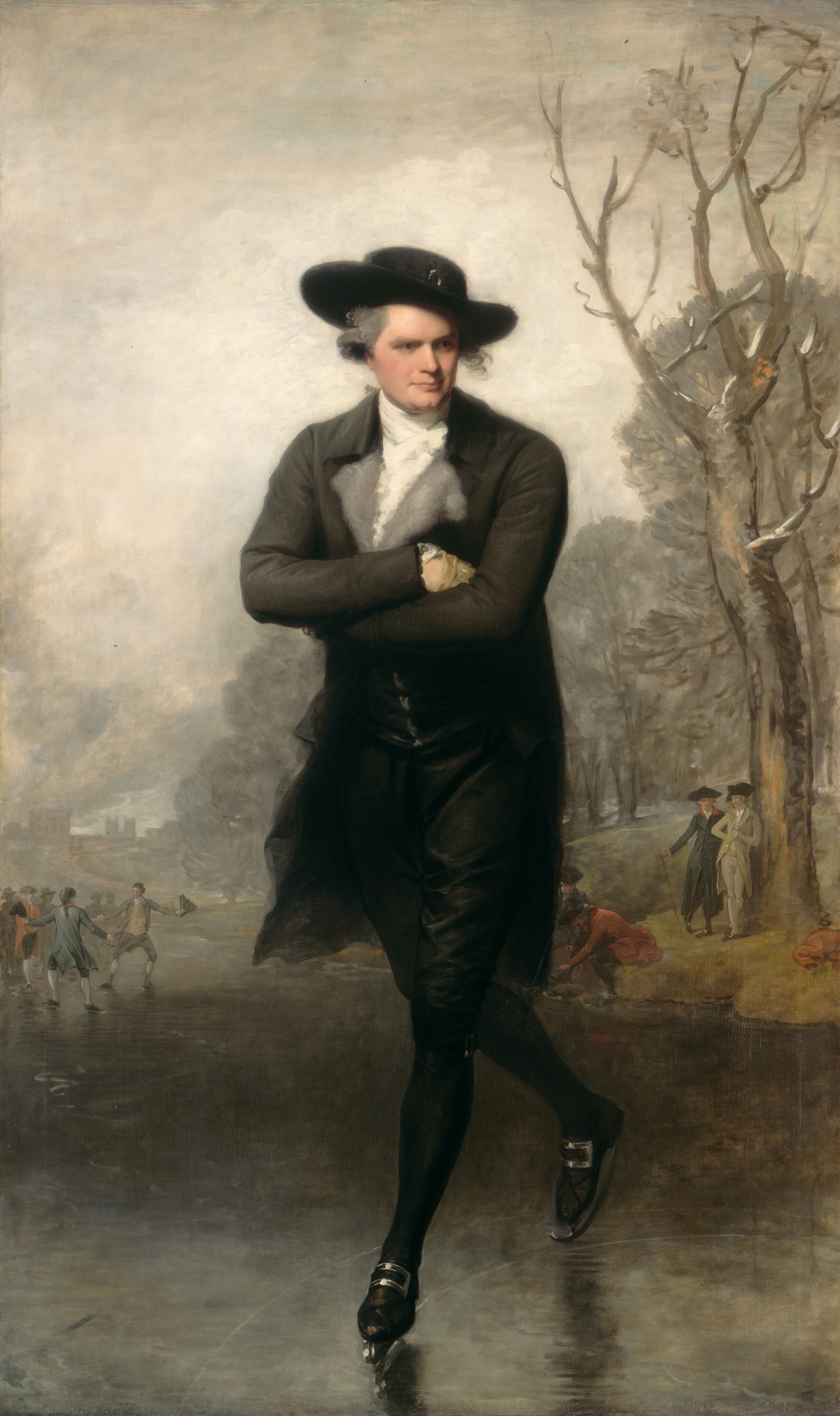
As a coda, there is a painting by Gilbert Stuart—he of the famous portrait of Washington—of a skater (called, The Skater). The man is utterly self-possessed. Unflappable. And yet, he is inscribing perfect circles on the ice. He has a nice hat. I don’t want to knock it off. I see him and think, “abstemious” (Either that or he just came from a long ocean voyage). Just as Prospero advised Miranda and Ferdinand, “Be more abstemious.” Advice well given. Back to work.

Writer at play

I was in my classroom one morning in April of 2021, but later in the month, so no fooling. and Mike Hughes, the director of my school’s theater program, stopped by. “I have an idea,” he said and asked whether I had been on the stage or sang. “We’re putting on Oliver! next spring, and I think you would be a good fit for Fagin.”

Here’s the skinny: I had a small part in a school play in the 6th grade and again in the 8th grade (King Ferdinand in a historical pageant). My mother made my costume—a cape—by ironing brown stripes onto a cheap yellow beach towel. In high school, I sang in the choir—we sang four days a week, and I could read the music for about a year. There was a play in Philadelphia—an avant-garde piece about the French Revolution; I was recruited by regular customers at my restaurant in Manayunk for this strange one-night venture. The congregation I served might remember me singing “Jingle Bells” during a holiday service and when a minister asked me to mime a juggler while she read Robert Fulghum’s “The Juggler.” Another holiday performance. That’s my resume.

Maybe you’ll argue that teachers are always on stage, and up to a point, that’s true. But one of the reasons we teach is to have our own meager fiefdom to direct what we will. Whether you do it, either as a sage on the stage or facilitator par excellence, your class is your own. Every class reflects its teacher, and even Bibliographic Methods could have been a lively and engaging experience (it wasn’t). Putting yourself in the hands of a director and in service to someone else’s vision—all those words, all that music—requires an entirely different discipline.

The closest I ever came was reading my work in front of a live audience. I recall the first time at a Friday night graduate school event. I was anxious, and the poet Ruth Stone told me that anxiety was an appropriate emotion any time you do something meaningful. Later, when I read for a panel of judges, I admitted my nerves—I am always too honest about such things—and was counseled by them to treat them like my students. I was a young teacher at the time but already a classroom performer. I once swam across a run of tables to demonstrate the difference between simile and metaphor. Either one does, or one does not do—there is no “like.”

The short of it—I have virtually no experience on the stage. Did I tell Mike Hughes that? Yes. I visited him in his office to confirm that the only time I sang in front of people and actually made an effort was when I sang “Angel from Montgomery” with two students at an open mic event. His colleague, who had heard me, commented that I could good relative pitch. As if I knew what that was.

However, a teacher’s job is to get out of the way and let our students succeed or fail on their own terms. When I mentioned that I had been “recruited” to take part in the school musical, someone I had just met suggested that I should let a student take the part. Even if I had been invited, even if I knew that my school was currently short on depth, was I extinguishing a nascent flame? Nonetheless, I asked my colleagues, and they trusted that the request came from a place of need and respect.

But, what was I thinking? How much I can possibly suck crosses my mind at every rehearsal. If I haven’t performed, I have watched my share of excellent and delightful performances. And star turns that should have been eclipsed. We all have. This is not simply “imposter syndrome” run wild. I have done nothing like this before.

Daring and humility are uncommon psychic partners, and I am often genuinely ambivalent. People who almost know me make the mistake of either seeing my geysers of chutzpah or my lakes of self-doubt. In “The Waking,” Roethke writes, “This shaking keeps me steady”; my two minds do that dance. If only there were just two. In the second of his thirteen ways, Wallace Stevens offers this:

I was of three minds

Like a tree

In which there are three blackbirds.

A writer must learn to inhabit at least two minds—the writer’s mind and the reader’s mind. A fiction writer is even more fractured. We are, as often as possible, out of our minds. I was going to write, “Perhaps I embraced this too late in life, but better late than, well, you know.” I spent years in the maelstrom of one, then the other, then the other. And then, and then, and then. I have learned how to push the storm forward or in some direction. I won’t get stuck swirling on one spot, a dervish without purpose.

What does this have to do with playing Fagin? Taking a risk and facing doubt expands the mind. And learning to do something new—working at it and, possibly, finding success—opens the world. I could claim that I took on the part of Fagin—leader of a band of thieves—because he has something to do with the characters I am writing about (thieves). While this is true, doing something I had never done before—committing to a process and seeing it through to its end—drove my choice.

A writer must explore possibilities—this is the heart of Socrates’s dictum about the unexamined life. Too often, people quote “the unexamined life is not worth living” to justify the attitude that life is like a buffet and every morsel must be piled onto one’s plate. “I tried it” is not the same as “I examined it.”

And so, I played. I will continue to play. As should you, dear reader—and dear writer. There are worlds to examine and lives to live.

Audience (part two)

So, I posted my workout on Facebook, and one of my friends replied, “sounds like a good swimming workout to me!” Another responded, “Or something rather naughty.” A few weeks later, the woman I was married to threw a log onto whatever fire we were in the middle of and said she was ashamed by what I had posted. Her response did not rise to the level of high dudgeon: “How could you!” Instead, “You’re an embarrassing idiot.” Later in life, one of my blog posts earned a chilly, “Why are you sharing your emotions? It’s just like Taylor Swift.” I should be so lucky to have Taylor Swift’s “readership.” I lay myself bare here—joys and struggles—to let my tiny audience know that they are not alone. I have been in the hole, and I found a way out.

Some of this I learned from other writers. Over two thousand years ago, Aristotle wrote that effective speakers (and writers should think of themselves as speakers) needed to be aware of their own character, the demands of the audience, and, finally, the logic or quality of their arguments. I will not investigate or interrogate your character, and, honestly, character seems less and less an issue these days. Or, just as troublesome, the only issue. I have read excellent work by writers of execrable demeanor, and awful work written by saints. I don’t need my favorite writers to join me for dinner or win my vote in the next election. One hopes for excellence on the page, in public, and in private, but it doesn’t always work that way. Writers, like readers, are human.

As far as the quality of your work, if you have read any of what I have written before, you know that I believe the more you write, the more likely you are to improve. Grit out an hour, two, or six a day and fill the buckets. Murky water will become clear, and with a bit of luck and a ton of persistence, it will transform into decent ale, wine, or smoky whiskey. Are there savants who miraculously produce exceptional work as if their quills were wetted in holy ink? Maybe. While I am sure that lightning strikes, most writers have written gobs before their first miraculous effort arrives on the page. Dickens, Twain, and Marquez wrote for newspapers under deadlines. Virginia Woolf kept dense journals.

But audience…

And here’s the second (the first was process) thing: when you write, you don’t write for yourself. Of course, you write for yourself, to answer some deep-seated god-only-knows-why-I’m-doing-this compunction, but the whole point is to tell. Your words seek another’s ear. Yes, yes, delight yourself and unburden yourself (or profoundly burden yourself) by what you do, but never forget that your words seek an audience. The reclusive Emily Dickinson wrote for God—at once the most daunting and forgiving audience. Joyce wrote the nearly impossible Finnegan’s Wake for a tiny audience—one that was brazen enough, curious enough, playful enough, and willing enough—but the effort was not solipsistic. His claim that if it took seventeen years to write, it should take seventeen years to read is as ponderous a gauntlet to throw down to the reader as any writer should manage. Easy messages (those that surprise but stay within narrower, almost expected bounds) get bigger audiences, but even Dubliners’ original print run was for only 1250 copies. It did better, but he fought hard for that initial print run. You will fight too.

So, write with an audience in mind, and know your audience. Your audience is not everyone (even if it could be anyone), and it is certainly not someone who willfully (and vindictively) misconstrues your meaning. Some people are beyond convincing It could be because of something their parent said, or where they were born, or the weather in Tasmania. If you chase that rabid white rabbit, you will get bitten. You have no control over how the reader feels when they read. With any luck, you will cheer those in need and charm those ready to be diverted and enchanted. Every reader carries baggage to your work, and not all of it will get in the way. Some readers are packed for whatever journey you take them on. Be ready for them. Seriously, they will expect your best work—meet their expectations.

Besides, writers come with our own freightload of luggage; it’s okay. The best you can do is enter into an unspoken contract with your readers to provide something clear and engaging (and in the broadest and most profound sense, entertaining) to read; they will enter into a similar contract to read as generously as they are able.

Not all readers will. Not all readers can. Some are just curmudgeons. Some will comment and criticize for their own delight. I once had a classmate add an illustration of eyes in flight to the margins of one of my fledgling efforts. He said he wanted to remind me that “eyes cannot fly around a room.” The eyes were artfully crafted but perhaps beside the point. Maybe you like that kind of attention. There is something enthralling about gobs of feedback, even down to the level of “Use curly, not straight quotation marks.” Or the other way around. A writer can become mesmerized by confirmation that readers have given their fullest attention even if the attention is toxic.

Let me remind you that some readers refuse to read anything out of their comfort zones, refusing to read a book about football, or only wanting to read books about football. They remind me of my daughter, who always wanted mac n’ cheese no matter where we ate. Some people don’t want a salad with goat cheese, a veggie burger, pasta primavera, or grilled fish. Some people turn their noses up at pecan pie. They aren’t wrong; they just aren’t right for you.

And there is a side to people we must admit. Let me share stories that will put this in sharper relief. On a zoom meeting with fellow faculty (weather kept us home), a number of us displayed our pets. One faculty member chimed in, “I can feel my allergies getting ready to kick in.” Delight, delight, delight, and fuck you. Or, while I sang the praises of hot and sour soup with duck from a Chinese restaurant, one person volunteers, “I don’t like spicy food.” It could have been “I don’t like duck.” Leaving a movie with friends, I shared that I was going home to enjoy a small glass of Lagavulin 16 year old Scotch. “If you like drinking a campfire,” one acquaintance replied. Witty, but really? Humans have a predilection for negativity, and on the other side, we drag negative comments behind us like a chain of money boxes. Oh, the humanity. This negative penchant can be fatal for writers struggling to break the shell between themselves and the world made of words—the world they can and should make.

You are going to need a thick skin. More importantly, you will need a clear vision of the star you hitched your wagon to (some readers will complain about what I just did).

In Salinger’s Seymour: An Introduction, Seymour advises his brother Buddy about writing: “[Y]ou’ve been a reader long before you were ever a writer… ask yourself, as a reader, what piece of writing in all the world [you] would most want to read… The next step is terrible, but so simple… You just sit down shamelessly and write the thing yourself.” Remember what delighted you, what amazed you, what made you turn page after page, or read and reread over and over again. What book do you thrust at friends and strangers, exclaiming, “You’ve got to read this!”? Of course, some will complain that they cannot keep all the Aurelianos straight in One Hundred Years of Solitude—you don’t have to be friends with them anymore; it’s okay to make that judgment. I jest. No, I don’t. Yes, I do.

No, I don’t.

Yes, you are the writer, but you are also your first audience. Have you written something that delights, amazes, frightens, shocks, excites, encourages, and engages you? If you have, it stands a chance to do the same for someone else. You might wonder if anyone will publish—or buy—what you write? Keep this in mind: shelves (actual and virtual) are full of product (yes, product) with a range of quality. Write well and let the market settle its own problems.

Be ready. Your audience will want you to guide them, to tickle them, and torment (for the right reasons) them. They will adjust their schedules and expectations when you surprise them. Surprise them!Write for that audience, delight and amaze them. And disregard all others. I think I may have drifted too far into a warning about that other audience, so let me insist that some people will cheer you on—as you work and for your finished work. One of my teachers would always comment “Keep writing!” on my stories whether he liked what I wrote or not. He wouldn’t invite me into the weeds of precisely what he thought I should fix or revise, even if his overall comment was “No,” he still cheered, “Keep writing!”

And so, keep writing. Find your audience. Be more patient with yourself and them. They will come around. So will you.

Creative Writing: the Beginning of a Proposal

The commonplace is a story about removing and re-inserting a comma, and I’ve seen it attributed to Flaubert, Wilde, and even Galway Kinnell. It’s a story that circulated in my creative writing program and served to reinforce a notion of meticulous effort. Every word, every punctuation mark, and even every margin mattered. Teachers handed back drafts of stories (I suspect the same for poems, but I was primarily a fiction writer) swathed in red. Students exchanged workshop drafts with equal editorial fervor. I recall a doodle in the margin explaining why “his eyes darted around the room” was wrong (the eyes had sprouted wings and flew).

In retrospect, how did we write anything?

Writing can be a solipsistic venture that verges on the masturbatory. This kills me because the whole point of writing is to write to someone else. We don’t tell stories to the wind—it may feel like that, but the goal is to engage and entertain. Art aspires to enrapture the reader’s heart and mind. I want to hear laughter or tearfall—for my reader to swoon into deep and long-lasting arousal. The worst critique is not “I don’t like it”; it’s “I’m bored.” Spending years with readers who explained exactly what it is they didn’t like did not help me. A simple exclamation of “Yes!” or yawning, “Nope” (politely put) would have helped. We all chase “Yes!” We should be unabashed and single-minded about that pursuit.

I may not know the right way to teach Creative Writing, but I think we got it wrong. The focus on “getting it right” bores down to a molecular level that obscures the grander design. And, too often, it misses the need to simply find a better way to get into it, stay in it, and get back to it. “It,” of course, is writing. While Twain is correct: “The difference between the almost right word and the right word is really a large matter. ‘Tis the difference between the lightning bug and the lightning”; I would argue that unless you learn to write every day, surrounded by bugs and in every sort of weather, lightning will not strike. The friction of the daily grind creates fiction; we live by sparks. The more you grind, the greater the spark—and the chance of producing good writing.

I had acquaintances (primarily students in Binghamton’s Medieval Studies program) who insisted that creative writing could not be taught, and since it couldn’t, shouldn’t be taught in graduate school. I disagree with both assessments; however, I take the point. Some people believe that raw artistic talents are strictly innate, like eye color or height. You can’t teach someone to have green eyes or to be  6’10”. Talent—creative ability— is more fungible. No fairy arrives crib-side to bless some and cast the rest into outer darkness. If she does, gifts are no guarantee of accomplishment. It’s not enough to trust that divine inspiration combined with considerable application of ass to chair will produce work.

To the question of should, I am amazed that those scholars familiar with the scholastic tradition did not appreciate the value of the joint venture. We gather together—even when we are introverts—because, as the monks patiently scribing out holy manuscripts understood, company helps. The world with its incessant demands is not favorable to writers. Lesson one for any writer is that time is the most precious commodity in their day. Money—always money—helps, but money does not put words on the page. And, if you have the drive to be a writer, that drive can be too easily misplaced and reapplied to almost any other worthwhile task. Lesson two for any writer is that drive matters more than talent. Surrounding oneself with people who understand these two immutable truths will help keep the writer on track. One reenters the world, understanding that in both well-meaning and insidious ways, the world will seek to redirect your time and drive is vital.

A note and an aside. Perhaps you like the idea of being a writer more than the actual writing. The world celebrates the idea too, and maybe that is what attracted you in the first place. I have bad news: the reality does not match the idea. Good news! If you are driven to write, the truth, the obstinate durable daily habit of writing, is unmatched. You will begin the day either not knowing or with only the vaguest sense of where you are headed and then discover the Northwest Passage. Or Zanzibar. Or Ur. Or Eden. Writing opens the world.

So, the first things I would start with are how to manage time and how to direct the drive. Writers need to learn that the grind is not their enemy (we live for the struggle!) and that their time is precious. And then I would ask, what is your lightning? What is your spark? And start them working in that direction. And then I would point them to the world that waits.

It does.

Write a note, but write

A quick note can save the day. You’re writing, and you start worrying, “Do I have the scene right?” You get bogged down, derailed, and despondent.

In the middle of a chapter, unsure of where it was headed, I inserted this line: “Out to dinner with [the usual crowd—check and add].” That not sat on the page (it didn’t sit long). The music changed, a few paragraphs later, I got up and walked to a different room, and then the note became two pages of unstructured dialogue (see at the end). Will it all stay? I don’t know. The Gatsby-driven exchange may come out.

What I do know, none of it was there when I wrote the note “the usual crowd—check and add.” I kept writing. Advice: If you can’t find what you are looking for, drop in a note to yourself, and move on.

First, writing begets writing. Write something—anything—but write. Put down sentence after sentence. The connections will come. But start. Write holding pattern sentences as a warm-up, the same way you begin a workout with 3-5 minutes of easy exercise before grinding into the “real” work. It’s all real—and all necessary.

Second, never forget that everything can (will) be revised and rewritten. First drafts are first drafts are first drafts. Write it (even if it is temporary, even if you think you have finished), and let it go. It could stick around until the end (maybe there is something Gatsby-esque that will hold that part of the exchange), but don’t get obsessed, attached, or disgusted. Keep going.

A note to yourself can save your day. Just keep writing.

“You have a job?” Valerie was incredulous. “Did Richard find it for you?”

“No!” I answered too forcibly. While they had been my entrée, with this crowd, I felt too much in their shadow.

“The tooth brushing didn’t work out?” Jason asked.

“He told me about that. You’re as scandal, Aletheia. No wonder you never found a real job.”

“She told Jason that she was doing porn—brushing her teeth naked for old men.”

“Or a boyfriend.”

“Better than brushing naked old men’s teeth.”

“No, seriously, how did you get the job?”

“An old man hooked me up.”

“Connections.”

“Gumections.”

“Get it?”

“I get it, Wolfsheim.”

“Ha!”

“She’s pregnant.”

“No! Valerie!”

“You’re having wine?”

“Just a glass. I gave up cigarettes.”

“You mean, I gave up cigarettes.”

“Well, I’m carrying the package. It’s the least you could do.”

“I’ll have another.”

“Do you have morning sickness?”

“I have nicotine withdrawal. The poor thing will grow up with a pre-baked craving.”

“An itch it can’t scratch.”

“Have you picked out a name?”

“Jason’s great grandmother was named ‘Esmeralda.’ We can call her ‘Esme.’”

“Is it a girl?”

“Who knows, we just found out.”

“Just?” Looks shot back and forth across the table.

“Well, not just.” Jason placed his hand on Valerie’s. “Just enough. It might be a boy, but Val’s convinced.”

“She’s never wrong.”

“A baby and a job!”

“We’re getting old.”

“Speak for yourself.”

“Speak for yourself. I’ve always been old.”

“I hope I die.”

“You are old.”

“Here’s to getting old!”

Child at Work

There is a scroll of Hokusai’s paintings/drawings. The curator’s note suggests that Jurojin, the aged figure at the left of the scroll, might be a stand-in for Hokusai, who was 80 when he painted this. Jurojin, it should be noted, is a god of longevity. The scroll, like the scroll Jurojin unrolls, may be a teaching tool. Hokusai made many manuals for his students, capturing and encoding the wisdom he accrued over decades.

May I suggest that if Hokusai is taking the part of Jurojin, he is also, at the very least, also acting as the young student sprawled out in front of the deity? Or, he is just the student.

Hokusai declared that “[w]hat [he] painted before the age of seventy does not capture the truth of things.” He kept learning and kept striving for legendary status. Imagine having such a lofty aspiration.

When we are younger and naive, we allow ourselves big dreams. We can foresee heroic possibilities. Time softens those dreams. We take a bite of the realist’s apple and learn to accept humbler goals. We even herald the value of those quieter moments: a well-laid table, an easy transit across town, a perfect fall leaf. All those things matter, yes.

And yet, I think of Monet, late in life, building lily ponds at Giverny, painting them, then draining them and remaking them so that they would match his vision. This was an act that combined impetuousness with determination.

Or, I look at Hokusai and see his determination to keep pushing his art to encapsulate his goal.

Such ambition is, at heart, naive. We let athletes off the hook for greatness when they reach their thirties. What second or third act waits for them? We learn to put away childish things and think and act like adults.

What I love most about Monet is his adult awareness of what he wanted and his adult design to create the very thing he wanted to paint. Wiser critics than I would suggest that Monet’s art was the result of cataracts. But then why build, then drain, and then rebuild those lily ponds? Like a child building with blocks, knocking down, and constructing something similar but better.

We come to creation with hard earned wisdom. Part of that wisdom is the knowledge that creation is a kind of play—play at its most ambitious and visionary. We may start with a pattern, some model from which to work, but then we expand and sharpen. Unlike the baseball player who throws with elegant precision to the strike zone, we toss the ball into the air, seeking a curve and arc that only physics limits. We make our rules and play harder.

As wise as you may grow, we stand astounded before the task ahead. Our propensity for astonishment sets us apart and keeps us in good stead. Here is where we learn, here where we reach for legends.

Noise and the Weight of Silence

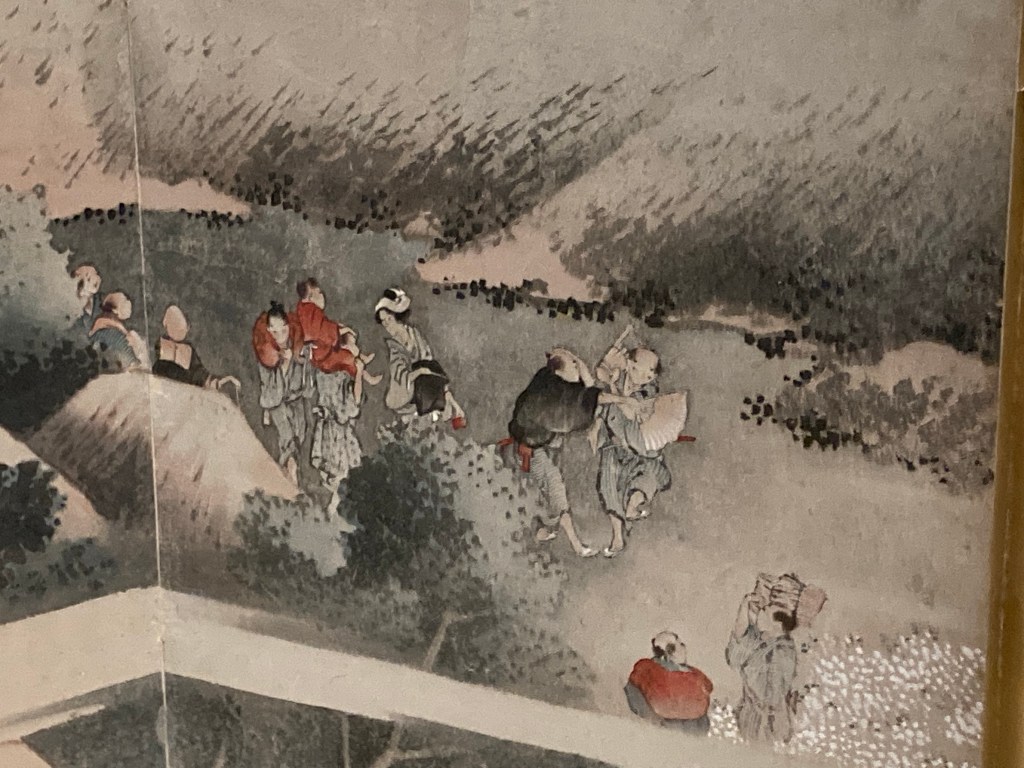
In a matched pair of screens, Hokusai depicts two groups who are out enjoying an afternoon. I imagine that it is afternoon—it could be morning or early evening. One group of people—larger, closer to us—turns to notice the other group. They are in the distance, smaller, but whatever noise they are making is enough to draw their attention.

Some of the quiet group seem curious about their noisy almost neighbors, and some are clearly annoyed, aggrieved, really. The woman playing the shamisen looks over her shoulder. “What is that ruckus.”

Across the way, two men dance—or fight—with fans. A child rides on his parent’s shoulders. They seem of a lower class than those spread out on a red blanket on the hill above them. They seem unaware of their neighbors or the disturbance they have created. So small, so far away, and yet, so loud. And so fun.

Some of the quiet group seem to look with a kind of longing. “We could be having that fun if we were over there.” The annoyance comes at once from the disturbance and the awareness that a woman in the quiet group (it is a man in Hokusai’s painting that is particularly aggrieved) might want to be with someone else who offers more fun. Pardon me while I engage the metaphorical: beauty wants a little riot.

The museums are, generally, quiet spaces. Most people use the most indoor of indoor voices, except for tour guides and children. In the sculpture garden this morning, one youngster offered a delighted “Wow” when he turned the corner on a Calder. Kids played on the walkway between the East and West buildings of the National Gallery (which is a work of art), amazed by the softness of the walkway and the glistening lights above their heads. A woman gives an impromptu explication of The Feast of the Gods, explaining the cast of characters in Bellini and Titian’s painting.

There are other less quiet conversations. Sometimes about lunch. Sometimes about a musical composition and performance. Phone conversations are always louder than imagined. In a museum? Always. I eavesdrop, and sometimes I ask questions.

Besides all that, the paintings are noisy. Wait, what? No, of course, they aren’t. And then you hear the visceral click-click of Keith Sonnier’s Go Between, but let’s be honest, stone and paint are silent. Except, who cannot hear the snigger behind the kerchief in Bartolomé Esteban Murillo’s Two Women at a Window? Or the bawdy laughter in Quentin Massys’s The Ill-Matched Lovers? Or who thinks that the animals gathered for Circe’s lesson in Circe and her Lovers in a Landscape attend her in silence? Or that she is silent? Or the squeezebox playing angel in Mary, Queen of Heaven? Even the idyllic scenes contain the rush of wind over a field.

from Mary, Queen of Heaven

Still lives and portraits test this, but once again, if you cannot hear the voice of Cardinal Pietro Bembo, it’s your fault and not Titian’s.

Then there is abstract art, which seems to want to put a cork in art’s ample mouth. It’s hard to hear Rothko or Louis or Andre; there may be a note or a chord playing in your mind’s ear yet, these pieces wrestle elsewhere. They are either loud or static-filled or, like Oldenburg’s Clarinet Bridge, just out and out messing with you.

Claes Oldenburg, Clarinet Bridge

I spend my Sundays surrounded by noise—the art and the people—and it rejuvenates me. I reflect on a time in my life when I was surrounded by people who preferred silence during their slice of Sunday. I wish I did not think about this. I do not enjoy thinking about people who complained about the noises children made in church or griped how a fellow congregant beat a tambourine during hymns. While I write this, a child shrieks in a Smithsonian American Art Museum gallery in a full gale. Life happens.

Of course there is a value to spending time in the field or forest, the mountain or ocean, but none of these are silent at all. There is a generous cacophony in nature. But silence has come to dominate spirituality. People gather and decide to subdue noise for ostensibly spiritual reasons. I wonder at how fragile one’s spiritual life must be to suffer from human noise. I watched Barak Obama’s Eulogy for Reverend Pinckney with my Speech students, and it was a noisy event. People chipped in with “yes,” “that’s right,” and dozen other verbal nods; they would have earned hard stares at my church.

The valorization of silence imposes a purity narrative on the spiritual. Like all purity narratives, this only serves to control an otherwise uncontrollable experience. And it places the blame for distraction someplace else—the same way that some faiths require the covering of women to prevent men from being distracted. We all are so easily distracted.

Perhaps we wrestle with distraction because it is a piece of our evolutionary puzzle: we had to be easily distracted to avoid danger. Our senses are always on alert. But maybe the problem isn’t so much about distraction as focus. For instance, when I attended Quaker Meeting, we all sat silently. But we listened—not for our thoughts or ideas, but for the spirit. Silence was a way of severing us from not just the world but from ourselves, so that we could listen—attend—more closely.

I’m not sure that we are listening the right way anymore. We try to “hear ourselves think,” and then replicate that strain of thought everywhere around us. We listen to confirm our biases, and it is almost impossible to do anything else. Our brains strive for homeostasis—not just of temperature, but attitude. The more we listen to the “still strong voice,” the less we hear the clarinet blast—or the tone of the angelic pipe organ squeezebox—that calls us to what we, fortunately,  do not know.