I am looking at a painting made by a French artist of a British building that hangs in an American museum. This seems at once perfectly natural—what else would I be doing? What else would a French artist paint (or an Italian, British, Russian, Afghan, or American)? And where else would a painting be? Of course, this seems only natural because it is what we have become accustomed to, since the time when Ennigaldi-Nanna opened the first museum.
If it is “only natural,” it is also a miracle. That Claude Monet painted? A miracle. That the Houses of Parliament were built along the Thames? A miracle. That the painting somehow came to the National Gallery of Art in Washington DC? A miracle. And that I am here, somehow, seeing this and writing about it? A miracle as well.
We take the commonplace for common, and lose the ability to be a little amazed at what is all around us, and the wild series of coincidences that brings the present moment into bloom. On the flip side, we excuse the awful as “could be worse,” instead of insisting on the more miraculous possibilities that could be. I stand amazed at what is, and demand more. Why not? Why fall back into what is easy, what masquerades as wit, what only keeps us from feeling that we have more to do?
I am looking at a painting made by a French artist of a British building that hangs in an American museum. The gauntlet has been thrown down. This is only the beginning.
About a year ago, I wrote about the patterns that I had noticed in my life. I have tended to trust the signs that the universe provides for me—much of what I have written about my current book project attests to that. I can admit that there are times that I have misinterpreted the signs, or that the universe has played an awful game of three card Monte with me. And yet, what other choice do I have?
I walk the line between an abundant trust in my muse—or the universe—and a willfulness that is singular and purposeful. This comes with risks. There is a song by Coldplay, in which the singer challenges, “Go on and tear me apart.” It is a brave dare, and echoes a bit of Emerson that was shared with me recently: “People wish to be settled; only as far as they are unsettled is there any hope for them.” What if all I get is torn apart and unsettled? I have lived too long under that flag to feel continued comfort in the “torn apart” life.
As I approach the end of this book, all the patterns (all right, most of the patterns—I am writing about a part of the world that eschews ideas of perfect resolution for a reason) come together. As the revision process takes hold, I rejigger, rip out, and rewrite scenes and conversations so that the whole points, gently and not too obviously (I hope) to the overarching pattern. The book is, finally, about patterns (Is it? Really?).
But life is not a book. Life does not (really) contain messages and patterns that point us toward happiness and success (Are you so sure about that?). Yes, there are patterns, but there are also many, many random occurrences and, perhaps even more challenging, patterns that unsettle us in ways that are distractions, that may even be injurious. At the moment, I simply cannot accept the notion that absolutely everything helps us grow and thrive. Some stuff, as my father pointed out on a particularly egregious day on the ocean, is just shitty. I throw shitty books across the room—the shitty life cannot be so easily flung into some other corner.
So, why feel hopeful? Because I am balancing between an awareness—too keenly felt this past several months—of the capriciousness and, well, shittiness of the universe, and the other more generous and affirming aspects of the exact same universe. Balance is not a passive activity. It may become seemingly involuntary, the way that holding your head—or a glass—level on a churning sea becomes second nature (your muscles are working all the time). I do not veer from happy to sad, celebratory to angry; they are all there, all the time, and for now, that is good enough. Of course, I seek—and will continue to seek—to tilt the balance to the more favorable side of things—and I am (Shut up, Doc!)—and that is because I feel that my purpose is to add to the balance of light.
I spent the past 24 hours writing in what I described as “sludge”–not exactly “ten million pounds of sludge from New York and New Jersey,” but close. It happens. I admitted this to a friend, who asked, “You’re not feeling frustrated?” I answered, “Frustration is part of writing. One cannot write without it.” Let me explain.
First, as you will recognize from previous posts, I used to sail on the ocean, heading back and forth from the Chesapeake Bay to Bermuda with my father. Setting aside the variability of the weather (from windless and flat to howling and mountainous), I was sick nearly every time I took the trip: 24-36 hours of plain and pronounced discomfort. I eventually discovered that a vertigo medicine helped settle the sea for me, but up to then I kept at it, and accepted the retching as payment for the joy. So, I have that experience to draw on.
Second, I was a swimmer, and while I was not an Olympian, I practiced hard. Improvement came with pain, and I learned to adapt to the persistent ache in my shoulders, arms, and legs. During practices, the immediate feedback for how fast I was going came through either the proximity I had to faster swimmers, or, when I was one of the faster swimmers, from how much pain I felt. Pain—of a certain kind—equaled speed. There are, of course, other kinds of pain, such that denote injury and not improvement, and I was fortunate to avoid these until later in life.
Some days writing is just going to be like a bad day on the ocean, or a crap day in the pool. Some days my brain just does not connect to anything brilliant, or worse I think it’s brilliant, but I have done none of the necessary work of getting my characters in and out of rooms. I have left out simple gestures, and replaced action with explication.
Sometimes when sludge is all there is, I scrap large chunks. Sometimes it just takes connective tissue—so that the ideas get bound to motion. Sometimes, it is a signal that I am not being wild enough. Once I was told that a character was boring. Tough criticism, but, a sludge encrusted character needs to be set free—or buried.
So, frustration will happen. So will boredom, says the man who puts in 26-32 minutes on the elliptical six days a week. Raucous music keeps the heart rate over 160 bpm, and sometimes works for writing. And metaphoric raucous music too—add a crazy scene as needed. Even Dickens used spontaneous combustion to advance the plot.
But the frustration also comes when we get close to the sludge, and the sludge covers what we don’t want to engage. Sometimes we need to treat ourselves roughly when we write, and work what makes us, not just uncomfortable, but downright upset. The sludge can be like a makeshift bandage, covering some old hurt. Hey, you don’t have to own the hurt, but see it, and work it. Pain can clarify and properly unsettle the writer—and enliven the writing.
So, here’s to frustration. And writing through it.
There was a show in the summer of 2019 at the National Gallery of Art, called “The Life of Animals in Japanese Art.” There were several deer, and one of them—not this particular deer—snuck into my work. Whether it stays or not, who knows? For now, here:
As he thought about truth—perhaps the most slippery but indelible of ideas—he became aware of a murmur from among the host of the gathered djinn. He, the dark djinn, and Jabari turned to locate the cause and center of this gentle disruption.
A blue deer walked through the assembled djinn. From its sides and back rose thick shards of white crystal. It could have been quartz or moonstone. Perhaps salt. Its paws pressed deep prints into the earth, revealing the weight of the animal was. As it neared, the gold djinn could tell that it was made of lapis lazuli. And yet it walked. It was tall, almost as large as a horse, and around its legs two cloud colored foxes romped and played. The stone and crystal deer was walking through the crowd and toward them. It was regal.
When it reached them, it lowered its head, and gently—but coldly, since it was stone—nuzzled the dark djinn and gold djinn in turn. It was strangely soft, belying its nature—it was cold stone—but remaining true to its essential nature—it was a deer. The foxes moved around Jabari, who stumbled over them, thrown off by their play. They were like smoke but firm, and this unnerved the ‘Ifrit. They were unnatural.
All the djinn had turned their attention to the scene: the blue and white deer, tame and regal, and the two cloud foxes, playful and disruptive. The three djinn at the center were not aware of the attention given to them, because the animals before them had entranced them. Blue, and white, and silver smoke.
A crack began to form along the deer’s supple neck, and another at its hind quarter. Then a dozen others, opening its body and dividing the crystals ridged along its back. Bits of crystal fell to the ground. Blue stone chipped away from its body. Then it collapsed into rubble, beautiful rubble, but no longer alive. The foxes dissipated.
The djinn were struck silent. The deer had been beautiful and impossible. It had come through them and to them. It was a message and a messenger. Quietly, each member of the throng walked to the pile of stone and crystal and each took a piece of what had been sublime. There was enough for each of the assembled djinn—no more and no less. The remaining wisps of fox-smoke drifted over their heads.
“What was it?” Jabari broke the silence when the taking had finished.
The white haired goddess stood with them. “It was him.”
While explaining a quandary I was having as I waded into one of the more difficult portions of my novel, a friend asked, “You’re the writer. Can’t you just make them (your characters) do what you want?” And that, dear reader, is always the rub. Of course, I could, but, even when writing about magical characters (djinn and such), there is no magic wand. Everything must seem real, and if not real, plausible, and if not plausible—if wild and genuinely surprising—then I have to prove it.
The writer doesn’t have to avoid those deus ex machina moments, so much as show them in their complete and total glory. You place a grain of sand on the battle field, and then the whole balance is shifted—but you do not, never, ever, forget the grain of sand. You carry it in from some desert or beach (preferably one from which the ocean has retreated and left barren), and you drop it under a horse’s hoof, or into the eye of the hero (or worse, the eye of his lieutenant), and let it have its way.
So much of writing is about discovering the grains of sand. The larger narrative components are there: beginnings, middles, and ends. What holds them together are small moments. Images, lines of dialogue, secondary characters who stumble into a scene. You don’t know that they will be there when you begin, but you find them—or they find you.
And yes, they come from you—unintentionally, more often than not. They sneak in from your childhood, or something you just saw on the news, from a museum display, or from a clutch of conversation overheard while in line at Shake Shack. Your brain files all these away, and then, at the right moment (or the wrong one—but only if you’re lucky) drops them back in on you. “Thought you were done with that, eh?” your writing brain asks, while you have sent a character through a hole in time to receive a secret from his future self, and suddenly you are reliving a kiss, a gesture, from 25 years ago—or last year. Can you even keep track anymore?
No, but once you start writing it, everything floods back, and you are reliving and living and inventing and discovering something you never knew before. But there you are, and everything you write surprises you, and the ending for which you thought you were aiming changes. Because of a grain of sand that you have been carrying with you for 55 years. Here comes the sandstorm.
Once a week I take my tablet and head someplace at least an hour away from home to write. I will find a strange coffeehouse, or a park, or a museum. I will write at a table, on a bench, or sitting on the floor or ground. No matter how far I go, I try to write at least 1000 words, letting wherever I am seep into what I am writing—that café au lait, those trees, this painting.
Two Monets the National Gallery of Art
My students obsess over the idea of writer’s block, and having been away from my writing for years at a time, I can understand why. They see their relationship with their writer as a relationship between themselves and the void—the blank page or blank screen, waiting to be filled. And to be sure, there is a void. Before one writes it, nothing of what the writer sets down exists, not in that exact form. That is, of course, part of the thrill of writing. While there may well be a void, the writer fills it—as much as she or he can.
I disarm the fear in a number of ways. I write every day, whether I feel inspired or not. It is like sailing on the ocean: gale, steady wind, or little or no wind; the sails go up and progress is made. Some days are tedious, at least to begin; fortunately, I find that the act of writing can ignite vision. A friend of mine posted about “Static Writing”—how the grind of daily writing can feel stagnant and stagnating. I get that, and yet, I feel that in the creative endeavor, having a “static” process, one that is not bound by outcomes, but by the power of filling the void (It can never be filled! Keep going!), will lead the writer to their best work.
I also acknowledge that writing is a physical as well as psychic act. Sometimes pushing a pen or pencil over paper can help remind the writer of this, or by the way one pounds out letters on a keyboard (old manual typewriters made this experience easier to understand). Directing the passage of the words from an abstract (thought) into a concrete medium (onto the page/screen) requires physical effort.
In addition, I am aware of my surroundings when I write, and when I write, am aware that the transition into my writing time and space. I often play a specific song to help usher in that time. But I learned not to bind myself to a specific place.
A few weeks ago I attended the DC Authors conference, and someone asked the first book writers (a novelist and a historian), where they wrote, whether they had a special set up for their writing space. I can remember those kind of “what’s your ritual” questions from grad school. Writers would concern themselves with pencil or pen (and what kind of pen), or how much cleaning to do beforehand, or what was in the candy bowl next to where they wrote. I can understand why this is a preoccupation with writers; writing is hard. Writers risk their very sense of self when they make the effort to create a world out of the void. If they fail, not only does the world threaten to spin into unmatched threads, but their hands threaten to unravel as well. Ritual can be a talisman against disaster.
And yet. Writing is movement. While it may be a move toward a center, some still, quiet, and contemplative space (or raucous, ecstatic, unrestrained dance), it is a movement. A writer who can tap into this seems less likely to be caught when his or her ritual is interrupted. “Wanderer, worshiper, lover of leaving,” writes the old poet. We leave this world and enter the void, and make what? Some strange caravan.
So, I go, physically, and in the going drop the pretense of metaphoric movement, embracing actual movement. I allow myself all the charms and dangers of distraction, but I know, all too well, that giving myself this time and this freedom of space will reinvigorate my work, that if some of the threads which I am spinning together have become hackneyed or too full of my will, I can energize and brighten them. A bite of this slice of cake. The sound of that woman exhorting her child in Arabic, the presence of this sculpture of the Buddha.
And so now, cloistered in a room of students taking exams, I can write. Again, and always.
Since the 1987, I have started at least five novels. Some I carried with me for a few months—the story of a wedding, unfolding like the petals of a rose. Others lingered over decades—the story of a woman who stole paintings. None of them lasted beyond seventy or eighty pages, or in the case of the long project, fifteen or twenty starts at initial chapters. I had notebooks full of scenes, outlines, character sketches, dialogue, and thematic connections. All the while I wrote other things. Shorter pieces, poems, prose poems, essays, sermons, children’s stories. Or I wrote nothing at all and suffered in silence. I believe that I was unbearable in those times.
What cracks the shell, and let’s the story run out?
I do not know.
I do know that I burned the first one. It had stuck with me for a couple of years, and was the piece I was working on when I went to the MA program at Binghamton. I put the pages on the little hibachi I owned, and watched it burn. I kept the ashes in a brown paper bag on the desk in my office at grad school for as long as I was there. Some of my friends found it morbid. I found it freeing. Move on.
Over the years it has been less easy to move on. I became more anxious. Would this happen? Had I somehow failed? I had other successes as a writer along the way. Why not switch course? Why not give up and go in another direction? There are many ways to write.
Even as a high school English teacher, novels called to me in ways that poems and shorter pieces did not—as exhilarating as a poem or short story can be. There is something satisfying about the duration of a novel. There was also, like it or not, the commercial aspect of novels—they are designed to draw everyday readers. I loved that about them. 300-500 page pop songs.
Perhaps I was too enchanted by the high art novels that I read in my graduate classes, and in the critical approaches we used to pull them and the ideas that surrounded them apart. I forgot about the old thrill of reading for pleasure—which is why novels exist. Art is fine, better than fine. Criticism is a world unto itself. But writing for an audience, for a world of unmet readers, that is everything.
And so, this time, I am following Seymour Glass’s advice to his brother Bruno, and I am writing the book I want to read. I am my own unmet reader. And will hope, against hope, to find many others.
—You are an artist, are you not, Mr Dedalus?—said the dean, glancing up and blinking his pale eyes.—The object of the artist is the creation of the beautiful. What the beautiful is is another question.—
He rubbed his hands slowly and drily over the difficulty.
—Can you solve that question now?—he asked.
—Aquinas—answered Stephen—sayspulcra sunt quæ visa placent.——
—This fire before us—said the dean—will be pleasing to the eye. Will it therefore be beautiful?—
—In so far as it is apprehended by the sight, which I suppose means here esthetic intellection, it will be beautiful. But Aquinas also saysBonum est in quod tendit appetitus. In so far as it satisfies the animal craving for warmth fire is a good. In hell, however, it is an evil.—
—Quite so—said the dean—you have certainly hit the nail on the head.—
History is a story of discontinuous events—events that collide like weather systems or galaxies, having barely understood origins, and even less decipherable records. All the witnesses were destroyed in the collision. What they saw, what they thought, and what they felt—even if they recorded their observations on stone, paper, steel, or silicone, have been destroyed along with them. We are living in the age of delusion, in which we believe in the sanctity of our recorded history—either self-scribbled or captured by another.
This thought is brought about by two things. First, wandering, quickly—this time—through the British Museum (or Westminster Cathedral, or almost anything else in London), what becomes painfully obvious are the gaps. All these artifacts, so painstakingly arranged create an idea that history is continuous, and has flowed in a linear pattern. And then a closer inspection shows that over and over again, things haven’t come that way. There are sudden breaks in history, when entire empires vanish, or when they change—seemingly overnight—religions, or methods of governance, or technologies, and the old gets swept away, almost as if it was a betrayal of the new.
England as it shifts back and forth between Catholicism and Protestantism bears these marks hard. Or, reading through the story of Ashurbanipal and the claims of glory made by this king reminds me of Shelley’s “Ozymandias.”
Thinking of history reminds me of Stephen Jay Gould’s idea of punctuated equilibrium—evolution proceeding in long quiet periods of little change, and then having sudden outbursts of change. I know, we are taught that slow and steady wins the race, but, we are also taught to believe in the nature of story as an overarching “way things are.” We see things through that frame, and it doesn’t always support the picture inside—or outside—the frame.
Second, in the musical Hamilton (which was also part of this trip to London), the character of George Washington warns Hamilton that we do not control who writes our stories. He’s telling this to a man who believes in his power to literally write his own story—and to use his words to cement his reality. He can’t—and doesn’t. His wife, Eliza, sends his legacy forward—and Lin Manuel Miranda brings us her legacy. But, as Miranda admits in interviews, even this moment for Hamilton—and therefore, for him as well—is provisional and subject to changing tastes and critical opinion.
Does everything disappear? No. There are 2000 year old Roman walls in London. But Rome? Everything can disappear. And we will tell stories that soften the loss.
I wonder, I can’t help but wonder, what I am doing when I write: whose story I am writing? It isn’t my story. Of course it’s my story–as if it could be anything else. Nonetheless, as I write about characters who are 5000 years old–older in some cases–I think about history, because they think about history. How can they not? How can any of us not? It is everywhere–in the streets, and in the faces, here in London.
A current meme on Facebook compares what Moms used to say to their kids with what they say now. It is held up as a clarion call to the virtues of yesteryear, when Moms—and their kids—knew what was what. Over and over again, stuff (stuff) like this careens around the internet, in casual banter on news shows, in conversations in my workplaces. Those of us who grew up in the mythical “then” look back with nostalgia, and look at this moment with a jocular disdain. I would like to call “bullshit” on the whole enterprise.
I don’t now what your mother was like. If she was anything like mine, there were highs and lows. My mother stayed at home with my brothers and me. She bowled in a league. Went shopping. Had bridge parties. Took tennis lessons. She was a den mother for my Cub Scout troop, and took us to the Devault Meat Packing Plant, among other places. Her sons were a handful. She scurried us out at a reasonable time in the morning, set out lunch when it was time, and made dinner for the family. She made us Batman capes for Easter one year; she sewed. I remember her stitching up an injury to one of our cats.
Was she happy? Her happiness was never an issue for us. Nor was our happiness overly attended to. We all were content, which, to my gimlet eye, is a horse of a different color. It was only later, some 13-14 years after I was born that she began to explore art, and then took on the work of a painter, and artist. If she found genuine and durable happiness, it was in that work—and the work of making art is not about easy delight, or even contentment (so says her son, the writer).
My mother did what she thought and felt was right. She learned her lessons from her mother and family—and what lessons they were. Some things, she changed. She never leashed us to trees in the front yard. Others were more indelible. I am certain that most of us parent in the same way—sifting through the conscious and unconscious lessons that we received from our parents. What we do, we do almost on a kind of autopilot—in the heat of the moment, dumb memory takes over. Change is hard.
I cannot and will not say that my childhood was perfect. I can recall exceptional moments on both sides of the ledger. Making a judgment seems beside the point. Here I am now, and I go on. There’s a ton of privilege built into that statement, and I fully recognize exactly how fortunate I am to be where I am, and to have traveled to this point in my life. The choices I can make now—and the way I make those choices—are predicated on the choices of my mother and father. And so on. For ages.
I guess that any time I hear someone pass judgment on another’s parenting—and mothering especially so—in that gross, if semi-benign “Look at the snowflakes” kind of way, I want to yell, “Really? Cast aspersions carefully, oh paragons of perfection!” All those old lessons about the log in your eye and casting the first stone ring out loudly for me. Those are the lessons I remember. Besides, the old joke about walking five miles to school in the snow, uphill, both ways, gives the proper lie to ill-kept nostalgia.
Life, and mothering, are hard. No one needs anyone to chide them for the daily duties. The significant missteps require a different consideration. No more abuse, please. But keep the quibbling to a minimum. Please.
In general, and in a larger sense, I distrust nostalgia. Yes, remember, always remember, but without the haze of candy floss. At heart, I am more focused on where we are going, adapting, and learning—and in passing those lessons on. Have I failed? Indeed. I keep at it. I will fail again. So what? I keep at it. Where I came from is a starting point, but not my destination. Eyes up! Here comes life.
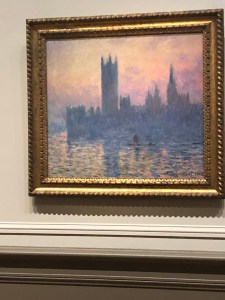 I am looking at a painting made by a French artist of a British building that hangs in an American museum. This seems at once perfectly natural—what else would I be doing? What else would a French artist paint (or an Italian, British, Russian, Afghan, or American)? And where else would a painting be? Of course, this seems only natural because it is what we have become accustomed to, since the time when Ennigaldi-Nanna opened the first museum.

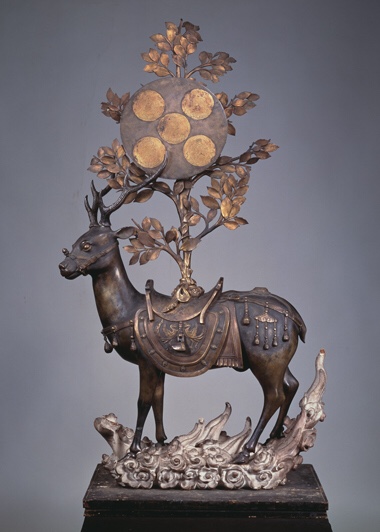 There was a show in the summer of 2019 at the National Gallery of Art, called “The Life of Animals in Japanese Art.” There were several deer, and one of them—not this particular deer—snuck into my work. Whether it stays or not, who knows? For now, here:
 While explaining a quandary I was having as I waded into one of the more difficult portions of my novel, a friend asked, “You’re the writer. Can’t you just make them (your characters) do what you want?” And that, dear reader, is always the rub. Of course, I could, but, even when writing about magical characters (djinn and such), there is no magic wand. Everything must seem real, and if not real, plausible, and if not plausible—if wild and genuinely surprising—then I have to prove it.
 Since the 1987, I have started at least five novels. Some I carried with me for a few months—the story of a wedding, unfolding like the petals of a rose. Others lingered over decades—the story of a woman who stole paintings. None of them lasted beyond seventy or eighty pages, or in the case of the long project, fifteen or twenty starts at initial chapters. I had notebooks full of scenes, outlines, character sketches, dialogue, and thematic connections. All the while I wrote other things. Shorter pieces, poems, prose poems, essays, sermons, children’s stories. Or I wrote nothing at all and suffered in silence. I believe that I was unbearable in those times.
 History is a story of discontinuous events—events that collide like weather systems or galaxies, having barely understood origins, and even less decipherable records. All the witnesses were destroyed in the collision. What they saw, what they thought, and what they felt—even if they recorded their observations on stone, paper, steel, or silicone, have been destroyed along with them. We are living in the age of delusion, in which we believe in the sanctity of our recorded history—either self-scribbled or captured by another.
 Second, in the musical Hamilton (which was also part of this trip to London), the character of George Washington warns Hamilton that we do not control who writes our stories. He’s telling this to a man who believes in his power to literally write his own story—and to use his words to cement his reality. He can’t—and doesn’t. His wife, Eliza, sends his legacy forward—and Lin Manuel Miranda brings us her legacy. But, as Miranda admits in interviews, even this moment for Hamilton—and therefore, for him as well—is provisional and subject to changing tastes and critical opinion.
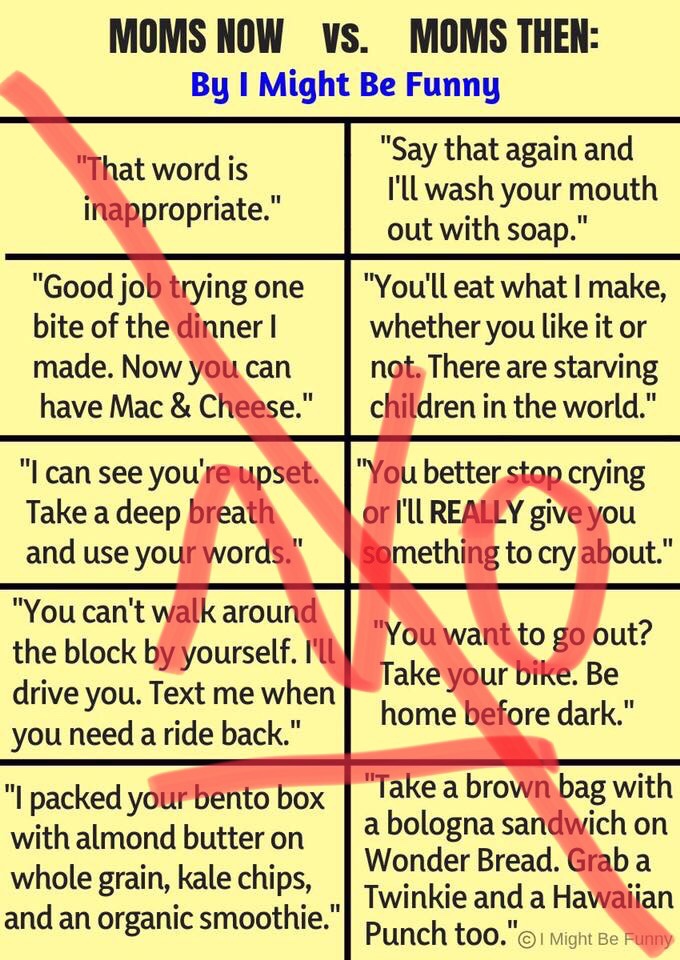 A current meme on Facebook compares what Moms used to say to their kids with what they say now. It is held up as a clarion call to the virtues of yesteryear, when Moms—and their kids—knew what was what. Over and over again, stuff (stuff) like this careens around the internet, in casual banter on news shows, in conversations in my workplaces. Those of us who grew up in the mythical “then” look back with nostalgia, and look at this moment with a jocular disdain. I would like to call “bullshit” on the whole enterprise.
 My mother did what she thought and felt was right. She learned her lessons from her mother and family—and what lessons they were. Some things, she changed. She never leashed us to trees in the front yard. Others were more indelible. I am certain that most of us parent in the same way—sifting through the conscious and unconscious lessons that we received from our parents. What we do, we do almost on a kind of autopilot—in the heat of the moment, dumb memory takes over. Change is hard.
 continuoussearch