Writing the Dream

It is different for each of us, but being a fiction writer means living a large part of one’s life in the realm of make-believe. Wait, that’s not quite right. It means that we build something new—over and over again—in the land of make-believe. Fiction writers are artists of the possible. Sometimes the possible looks an awful lot like the everyday, and sometimes it does not. Sometimes the possible is just as sad or happy as the everyday, and sometimes it is happier or sadder. We decide what it will look like and how it will feel, and then use our prose to create a circumstance in which those visions and feelings come to life. In the most prosaic terms, we make the hammer that the protagonist drops on his bare foot, breaking his toe, and sending him into howls of hurt and anger. The hammer, the hurt, the anger, the foot—and the rest of the protagonist—come from the writer.

One of the joyful challenges of writing is not simply making a world that does what I want, but in making a world in which what I want makes sense. There is a difference. I am certain that all writers struggle with the switch from a world in which they create everything—and in which most of it works—to the world in which they do not—in which the deft use of language has absolutely no impact on reality, or worse, in which their singular ability to shape the world is denigrated, or produces an opposite effect than intended.

John Gardner said the goal of fiction is a “vivid continuous dream.” That’s a damn good metaphor for how fiction should work. The whole piece needs to bind together with the logical and artistic consistency of a dream—nothing that wakes the reader from that dream can be included. But a dream—with all its truth and disjunction—is hard to create intentionally. We’ve all seen—or read—dream sequences that were stupidly obvious. A great dream draws us in, surprises us, and finally wakes us from slumber wondering, “What the hell was that?”—and maybe, if we are lucky, driving us back into sleep for the chance to retrace our steps back to that magical lost garden. There is a reason that we pour over books of dream interpretation to discover the real meaning of the nightly synchronized swimming show our brains orchestrates for our (dis)pleasure.

The odd thing is that the real world sometimes feels more like a poorly written dream than my fiction does. People behave in random—seemingly so—ways. We are subject to momentary desires, and desires that have little to do with our present circumstances. No amount of professional therapy will ever translate a deep understanding of our pasts into a reasonable pattern of behavior in our present. Knowing why we are who we are does not give us the sudden ability to act other than we have been. If characters in fiction acted the way people do in life, we would all throw the books out the nearest windows.

When we write the dream, we must select and we must focus. The genuinely random bits of life must be jettisoned for a kind of “unity of effect” (that’s a term that Poe uses in the “Philosophy of Composition”) Hence writers fall back on routine while they write—trying to evoke this unity by listening to the same music (if they do) while they write, or writing in the same space, at the same time of day, using the same pen or pencil or computer, and the same kind of paper—or typing in the same font. The tricks are endless. The goal is the vivid continuous dream.

And yet, we are like the actors in Shakespeare’s time: we get our roles—just our lines—and little else. We must pull our parts together based on the parts we have already played—young lover, perfidious King, lascivious barmaid, starry-eyed daughter. Or so I imagine. Somehow, perhaps, we craft a starry-eyed King, or perfidious daughter. Shakespeare did.

When I was a child, we had a favorite book in the house. It had split pages and you could make new animals by combining the top of this animal, the middle of some other, and the bottom of that one. Some of the combinations were absurd—and that was the point. So, we experiment and put our stories together.

As for what to do with real life, I do not have an easy, or a happy answer. It will not be shaped. I write this even though I work as a teacher, a so-called shaper of young minds. Too much has happened in my life that has defied shaping. Like a fairly conscious dreamer, I have learned to act on the stage of the unconscious—which happens in the waking life just as much as the sleeping—and to fly into the tornado that devastates the landscape. I avoid destruction. I cannot stop the tornado though.

And here’s the secret: when I write, I pray for the tornado. Everything else is wind too calm. I need a wind wild enough to carry me. And it does.

On the revisionary road

Here is the next step in the process. I have spent the last few weeks reviewing my rough draft, which I have dubbed the “working draft”—and have produced several copies of that working draft. I split time between one draft saved in between Pages (on my iPad), and and another saved in Word (on my laptop PC). I have run the draft through Grammarly several times, and read the document from page one through page 312 (now). By the way, Grammarly does not catch every typo, nor does it allow for “Djinn” to work as both a plural and singular noun. So be it.

I have enjoyed rediscovering how I imagined the book when I began, and to rewrite those old intentions to suit where the whole thing turned. While I was aware of this change as I worked, I resisted the temptation to head back and “correct” the earlier chapters. During the first draft, forward motion was more important than perfection—or rather, something like perfection, because, really, perfection is a chimera. In spite of my decision to emphasize forward motion, there has been much in the working draft that has delighted me, and some, on reflection, that has surprised me.

This draft also contains memories of what I was doing while I wrote. Some of those memories are bittersweet, some are joyful. I began this book with one reader in mind—which was helpful at the start. I felt that there was a whole story ahead of me, but did not know where it would end up. Along the way, I read passages in public, and gauged the work by the reaction of an audience—which was also helpful along the way. I also shared bits and pieces that made me happy with other people, including a colleague, who generously read the 170 pages I had written (and not finished) in June. I found the responses of these readers to be helpful, and heartening, as well.

While writing has taken its right and proper role in my life, I do not write for me, to express some deeply held inner belief or to prove some point. I like to engage a reader, to connect. If there is a bigger point, it would be about the power of connection. I appreciate that a piece of writing can be a kind of conversation between me (the writer) and you (a reader)—and it is not an intellectual conversation.

I think, for years, that I tried to write with my intellect, and that I did not trust my heart with the process. I struggled with the desire to express something perfectly, or at least as well as others had expressed themselves. Those others included anyone and everyone who had written anything and everything. More recently, I was able to hear Sidney’s muse exhort me as well—“Fool, look in thy heart and write.” Turning to my heart—away from not the anxiety of influence as much as the weight of awareness—has allowed me to feel my way through the work. Sharing with others has helped expand that feeling, and to have it be a shared feeling at times.

I have turned back to my intellect as I revise, and this has helped me make connections in the text. I add more than I cut, as I realize that I have not provided all the bridges necessary between scenes. Still, I have rediscovered intuition, and as I make my way through this draft, I am surprised and delighted by what I wrote, almost, it seems, by accident, or, at least, by trusting my poor, fallible, and durable heart.

Routine

Every Sunday, save for one or two while I was traveling, since April, I have wandered through the various art galleries on the National Mall. I carried my notebook with me, and wrote. There was something invigorating about being in the presence of beautifully made things—whether a drinking horn from the 6th century BCE, or a bronze horse from the late 20th century. Bits and pieces of what I saw inspired my writing, which was about an entirely different time and place.

The routine gave me something to anticipate each week while I was in the middle of my project. The two hours—one spent driving in, another on the way back—were worth the result. I found favorite places and favorite works. Monet’s painting of the Houses of Parliament has been a touchstone on these trips. It reminds me of an early interest in his work, of travels I have since taken, and of an approach to work that I have come to appreciate more and more. Partly that approach means honoring the routine, no matter what.

Routine seems like it would be the antithesis of inspiration. Think of the ways we denigrate the grind or the slog of work. Or the way we quote Emerson: “Consistency is the hobgoblin of little minds.” However, I would point out that Emerson nails “A foolish consistency,” not all consistency. I would hazard that there is a wise consistency to be found as well. Like wisdom, it is hard-earned, and requires a kind of flexibility. For instance, when my daughter came to visit, I did not insist on making my weekly sojourn because other plans (a trip to see our family) interrupted my routine. Or last week, when I took a day off (my rough draft was done, and I felt spent), I granted myself some quiet time.

This week, I am back at it though. The sun is once more setting behind the Houses of Parliament, and I have walked about half the distance I will walk the rest of a cloudy day in Washington DC. And I am writing—this now, but the revision continues apace. My routine will be important in the coming months because school has begun again, and without some carefully delineated routines, schoolwork can too easily consume time. Teacher’s always feel as if they could do more—one more brilliantly placed comment on an essay, one more after school event, one more meeting, all while managing the daily preparation. I will get to the gym—the body work supports the brain work. And I will set aside an hour (more as needed) a day to write. I will guard my sleep.

And, I hate to admit this, I will do less of other things. Some were just distractions (Sunday Morning News shows), others (dating) brought joy with the distraction. Like it or not, the wise routine will preclude even delightful entanglements—at least until the process of getting to a final draft (agent, publisher) wraps up. And, of course, the next book is waiting.

I’m not sure what I will find on the way ahead. I know that I will rely on my routines to get me through the uncertain times. And I will seek wisdom, and a wise consistency as I go. Inspiration this way waits.

Resentment

There is always regret when one has not done not just what one has wanted to do, but has dreamed of all of their lives. “If only I had started sooner,” regret whispers. “If only I had not taken that job, moved to that city, loved that person.” Regret is a whispered siren’s song, and it can lead one toward a sadness that is disastrous to the work.

Regret has a companion emotion, and once one figures out exactly what one needs to do, this other emotion can assert itself in awful ways. This emotion is resentment. Anything—everything—that does not help us attain our vision—our purpose—can cause us to feel resentment. For instance: a job that takes our time—our necessary and limited time—even if that job is fulfilling and valuable. Even if that job pays the bills. Our family can cause feelings of resentment. This is a deep dark secret: the people we love can be the people who awaken resentment in us. Because they ask—as they are entitled—for our most precious resources: our imagination, our patience, our time; our essential necessary energy to do the work at hand. And this is terrible. No one wants to resent for their family or loved ones. And yet, we do.

Anything—everything—that takes away from the energy needed to do the creative work that gives our lives meaning cause resentment. One must learn to carve out sufficient time to be fully engaged and to spend the energy at the work required to fulfill one’s purpose. This is true in any circumstance—with or without family, with or without loved ones, and with or without other work. Once one sees what can be done, one must change one’s life to fulfill one’s purpose.

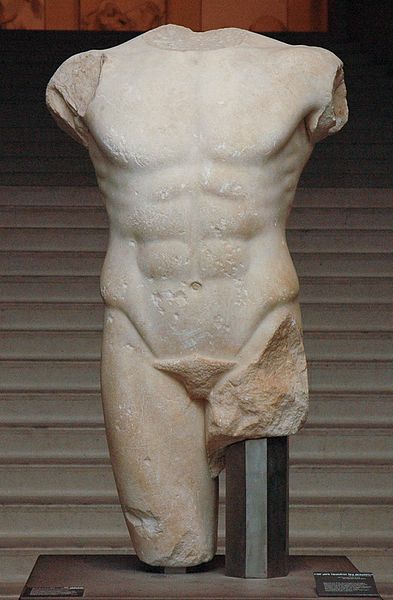
Archaic Torso of Apollo

However, resentment is not located in those other places. Neither my child, nor my job, nor anyone else in my life is the actual wellspring of resentment. It comes from me. Of course there are stupid little human annoyances—the woman who sliced into the left lane ahead of me on I-95 today, then just as abruptly, sliced back through traffic across two lanes to make a sudden right exit. The anger caused by such behaviors only lingers for so long. Resentment comes from an inward driven anger that sharpens regret and turns it back out to the world. The clearest targets are those who are nearest us.

Yes, there may be times when those close to us do ask us to stop our most purposeful work for reasons that are worthy of resentment. They may question your sense of self, and cast aspersions on your work and aspirations. Sometimes people cannot escape the deep-seated injuries and resulting resentments that their injuries caused, and they struggle, not with themselves, but with you. Just as you may struggle with resentment. Just as I have struggled. And one must escape that false judgment, and not validate it in any way. For the most part, we are the main manufacturers of our own grief. We stop ourselves. We foist anger on ourselves and take handfuls of earth and shower ourselves in dirt. We manifest an anger that eats us from within.

I am not suggesting that one should not be angry. Anger can be a source of energy, a goad to action when complacency or sadness or depression has settled too deeply on the creative mind. I let that anger into my work—allowing characters to taste it and spit it where it needs to land. So too with me, I learn, daily, the difference between anger caused by genuine external sources and that which has simply emanated from some ancient sun within me.

When I feel resentment, I check my sources first, and realize that, more likely than not, that I am not doing what I need to do. I am not tending my work and my purpose as I should. I have taken—for reasons at once honorable and misguided—someone else’s charge and anger as my own. I put it down, gently, if I can, and get back to work. The way forward—to fulfillment, to joy—is here.

Balance

About a year ago, I wrote about the patterns that I had noticed in my life. I have tended to trust the signs that the universe provides for me—much of what I have written about my current book project attests to that. I can admit that there are times that I have misinterpreted the signs, or that the universe has played an awful game of three card Monte with me. And yet, what other choice do I have?

I walk the line between an abundant trust in my muse—or the universe—and a willfulness that is singular and purposeful. This comes with risks. There is a song by Coldplay, in which the singer challenges, “Go on and tear me apart.” It is a brave dare, and echoes a bit of Emerson that was shared with me recently: “People wish to be settled; only as far as they are unsettled is there any hope for them.” What if all I get is torn apart and unsettled? I have lived too long under that flag to feel continued comfort in the “torn apart” life.

As I approach the end of this book, all the patterns (all right, most of the patterns—I am writing about a part of the world that eschews ideas of perfect resolution for a reason) come together. As the revision process takes hold, I rejigger, rip out, and rewrite scenes and conversations so that the whole points, gently and not too obviously (I hope) to the overarching pattern. The book is, finally, about patterns (Is it? Really?).

But life is not a book. Life does not (really) contain messages and patterns that point us toward happiness and success (Are you so sure about that?). Yes, there are patterns, but there are also many, many random occurrences and, perhaps even more challenging, patterns that unsettle us in ways that are distractions, that may even be injurious. At the moment, I simply cannot accept the notion that absolutely everything helps us grow and thrive. Some stuff, as my father pointed out on a particularly egregious day on the ocean, is just shitty. I throw shitty books across the room—the shitty life cannot be so easily flung into some other corner.

So, why feel hopeful? Because I am balancing between an awareness—too keenly felt this past several months—of the capriciousness and, well, shittiness of the universe, and the other more generous and affirming aspects of the exact same universe. Balance is not a passive activity. It may become seemingly involuntary, the way that holding your head—or a glass—level on a churning sea becomes second nature (your muscles are working all the time). I do not veer from happy to sad, celebratory to angry; they are all there, all the time, and for now, that is good enough. Of course, I seek—and will continue to seek—to tilt the balance to the more favorable side of things—and I am (Shut up, Doc!)—and that is because I feel that my purpose is to add to the balance of light.

Back to the tightrope.

Writing: Sludge and Frustration

I spent the past 24 hours writing in what I described as “sludge”–not exactly “ten million pounds of sludge from New York and New Jersey,” but close. It happens. I admitted this to a friend, who asked, “You’re not feeling frustrated?” I answered, “Frustration is part of writing. One cannot write without it.” Let me explain.

First, as you will recognize from previous posts, I used to sail on the ocean, heading back and forth from the Chesapeake Bay to Bermuda with my father. Setting aside the variability of the weather (from windless and flat to howling and mountainous), I was sick nearly every time I took the trip: 24-36 hours of plain and pronounced discomfort. I eventually discovered that a vertigo medicine helped settle the sea for me, but up to then I kept at it, and accepted the retching as payment for the joy. So, I have that experience to draw on.

Second, I was a swimmer, and while I was not an Olympian, I practiced hard. Improvement came with pain, and I learned to adapt to the persistent ache in my shoulders, arms, and legs. During practices, the immediate feedback for how fast I was going came through either the proximity I had to faster swimmers, or, when I was one of the faster swimmers, from how much pain I felt. Pain—of a certain kind—equaled speed. There are, of course, other kinds of pain, such that denote injury and not improvement, and I was fortunate to avoid these until later in life.

Some days writing is just going to be like a bad day on the ocean, or a crap day in the pool. Some days my brain just does not connect to anything brilliant, or worse I think it’s brilliant, but I have done none of the necessary work of getting my characters in and out of rooms. I have left out simple gestures, and replaced action with explication.

Sometimes when sludge is all there is, I scrap large chunks. Sometimes it just takes connective tissue—so that the ideas get bound to motion. Sometimes, it is a signal that I am not being wild enough. Once I was told that a character was boring. Tough criticism, but, a sludge encrusted character needs to be set free—or buried.

So, frustration will happen. So will boredom, says the man who puts in 26-32 minutes on the elliptical six days a week. Raucous music keeps the heart rate over 160 bpm, and sometimes works for writing. And metaphoric raucous music too—add a crazy scene as needed. Even Dickens used spontaneous combustion to advance the plot.

But the frustration also comes when we get close to the sludge, and the sludge covers what we don’t want to engage. Sometimes we need to treat ourselves roughly when we write, and work what makes us, not just uncomfortable, but downright upset. The sludge can be like a makeshift bandage, covering some old hurt. Hey, you don’t have to own the hurt, but see it, and work it. Pain can clarify and properly unsettle the writer—and enliven the writing.

So, here’s to frustration. And writing through it.

The Writer’s Character (and work)

I began graduate school in the fall of 1988. Writing was still new to me. I had written in high school then in college, but the daily life of writing was only a shadowy presence. I had begun a novel, and tended it during the free time of my six day weeks managing a small Italian restaurant in the Manayunk neighborhood of Philadelphia. Which is to say, that I had written enough to gain admission to a program, but not enough in any real kind of way.

Graduate school was a relief and a release—it was the thing all my friends and customers were hinting at when they asked, “What are you going to do?”—recognizing long before I did that there was something specific that I was going to do.

I had drifted after college. It was as if I wore an anti-gravity suit that kept me from becoming grounded. There were reasons. I had encountered “purpose” as a rationale for selfishness and intentional moral blindness. The latter I found incredibly troubling. I believed in an inherent goodness—found in man or god—in spite of my experiences in the world. And when I wrote, I explored that possibility.

When I arrived at Binghamton, I poured myself into the work, writing with avaricious fervor, and studying gleefully. I learned quickly that a “B” was an “F,” and after one failing grade on an essay, turned to successful outcomes. I earned a scholarship after my first year, and with it, the right to teach, which I welcomed with the zeal of the recently converted. I was hooked.

One of the hooks at Binghamton was the presence of John Gardner, the author of The Art of Fiction and several novels I had not yet read. I had read Grendel when I was much younger, drawn by the monster after my mother had read us some version of Beowulf as our bedtime entertainment. What attracted us, some of us at least, was the myth of John—driven, irascible, generous, and demanding. As often as not, when describing ourselves as writers, we focused on our characters-not the characters in what we wrote, but out own personal strengths and foibles, and how we matched up against this fabled presence. He had been dead for 6 years, but he hung around the program (his ex-wife became my dissertation director).

One of my teachers, I think it was Liz Rosenberg, introduced me to On Becoming a Novelist, in which Gardner laid out some characteristics of the novelist:

Like other kinds of intelligence, the storyteller’s is partly natural, partly trained. It is composed of several qualities, most of which, in normal people, are signs of either immaturity or incivility: wit (a tendency to make irreverent connections); obstinacy and a tendency towards churlishness (a refusal to believe what all sensible people know is true); childishness (an apparent lack of mental focus and serious life purpose, a fondness for daydreaming and telling pointless lies, a lack of proper respect, mischievousness, an unseemly propensity for crying over nothing); a marked tendency toward oral or anal fixation or both (the oral manifested by excessive eating, drinking, smoking, and chattering; the anal by nervous cleanliness and neatness coupled with a weird fascination with dirty jokes); remarkable powers of eidetic recall, or visual memory (a usual feature of early adolescence and mental retardation); a strange admixture of shameless playfulness and embarrassing earnestness, the latter often heightened by irrationally intense feelings for or against religion; patience like a cat’s; a criminal streak of cunning; psychological instability; recklessness, impulsiveness, and improvidence; and finally an inexplicable and incurable addiction to stories, written or oral, bad or good. Not all writers have exactly the same virtues, of course. Occasionally one finds someone who is not abnormally improvident.

We looked inside ourselves to see whether we met the unholy criteria that John threw down—gauntlet-like—for us to match. It became a weird check list. There were dozens of weird checklists that we tested ourselves against: pre-work habits and rituals, kinds of writing implements, time that we wrote. I think that many of us were hoping to awaken a writing practice that could sustain us, and so looked for that one thing, the one trick that would allow the words to tumble out as effortlessly as possible.

Of course, we focused on how damnably hard writing was—and is. The metaphors we used to describe writing—like Virgilio Pinera’s man who decides to eat a mountain, one rocky mouthful after another—emphasized the difficulty, futility, and irreverent commitment. Perhaps the real solution was a correction to our character—some unbridling of our sinful writer manqué natures, and a resurrection into some more saintly (or demonic) deranger of the senses. If only we could rid ourselves of our flaws, and get to work.

I came to grad school, and to writing, after years of 60+ hour weeks. I rose early enough to get to the pool and down 3000 meters, then head across town to the restaurant. When I arrived in grad school, I found a job, and worked 3-4 nights a week in a high end restaurant. After I started teaching, I took a job in a bookstore ran by the husband of my mentor (he had been a student of Gardner’s as well). I swam, and then started running several days a week (I could listen to music while I ran!). Some of my classmates complained about the workload. I did not. Work was in me. Writing was not.

But it was. I wrote some inspired pieces, and won praise from mentors and classmates for my work. I didn’t know what to do with it—I had some things published, but what do a few stories and prose poems amount to in a world driven by novels? Besides, I confused inspiration with work. Work, that simple, boring, daily activity, with simple, boring, daily and measurable rewards. I was seeking star fire, supernovae, and earth-shaking prose. In order to do that I had to remake myself in the image of whom? John Gardner? Stephen King? Virginia Woolf? Some Norse God?

And what is the measure of good (let alone brilliant) writing? A great sentence doesn’t blaze as distinctly as the time on the clock when you touch the wall after one of ten 200 yard swims (That’s good; keep going). You write without a clear standard, and a novelist bangs out 60,000 to 100,000 words into the blind space of “who knows what will happen to all this?”.

So we focused on character, the one thing we could control or change. This, of course, is poppycock. There are good and bad people who write. Character is no Holy Grail, and no simple gateway or guarantee to writing. Work is. I wish we had simply talked more about work and habit and word count in grad school. How do you sneak in an extra 200 words? Have you done your work for today? Do you need a new pen? God only knows, make it work, let it be work, and demystify the process. It’s just work. It’s not about whether the muse is singing to you, or the dread siren, or anything or anyone. It’s just work, a job, a practice, and all you need to do, is to do it.

In the long run, Gardner’s description of the writer, and, once again, that sense that a purpose that led to blindness to everything other than IT, drove me away. After all, what was the lesson of nearly every novel, short story, or poem we read? Connect. Connect. And for the sake of everything that’s holy, or valuable, or worth saving: connect. The pursuit of art never matched the message. Picasso was a sonofabitch, but Guernica. Dickens philandered. Woolf suffered from limiting snobbery and mental illness. Joyce? Don’t even. Our contemporaries wandered into the forest of “immaturity and incivility” with a stridency that was matched only by ignorant blowhards and professional athletes.

I recognize that now, all of it, as a kind of armor. I know what it allowed, and what costs they incurred for strapping it on with such easy regularity. I saw it for a kind of blindness, and doubted. And in that doubt, returned to the anti-gravity armor that had supported me years before.

I turned, for years, to teaching and a kind of preaching. I tried to reach out, to convert the sensible—and others—to deeper understanding (reading) and brighter thought (writing). These are not fool’s errands, to be sure. But once you have tasted brilliance—and writing done well is brilliance—every other work other than the work that is the most brilliant, makes your tongue recoil. Even your dog would turn away from that feast. Not me. Not for years. And though I still fight with gravity, I feel the pull, and this is what binds us together—separate planets careening into each other with cataclysmic potential. I tried to resist, but, really, why?

So I’m left with these questions: How does one balance the work and the meaning of the work? How does one have purpose and character? Ah, as always, the trick of balance, and not in Gardner’s list of a writer’s characteristics. We will have to figure this out ourselves.

Of course, equanimity (balance) is not Gardner’s list, but the safety net is the work—stupid, dull-witted, and quotidian. Be an angel or a devil, but get to work. It comes back, and, if done well, connects us, once more, to the world, to each other, and to the gravity that holds us all.

Lessons from Sailing: Patience and Course

We gathered a twice a day to listen to the nautical forecast, usually in the cockpit, but when the weather was execrable, in the cabin. For days on the ocean it was the only external information we had, and the computerized voice that intoned the zones and conditions annoyed and entranced us. My father never explained which particular slice of the forecast we should heed. If there was one, it was his secret. We did get a general sense: the information could reveal a significant change from the forecast with which we headed onto the ocean. For the most part, the weather we encountered was weather we could see.

Besides, what did the weather matter? We were going into it one way or the other. If something sudden arose—and in a storm, wind and rain could change direction in a moment—we had one rule: change course. At 3 a.m. on a Monday morning, Saturday afternoon’s destination could wait. That lesson only took one stern delivery.

I think I became an atheist on the ocean, or at least a pragmatist. If there is a god, it answered my prayers for relief with a simple, “You put yourself out here, jackass. You are going to have to get through it on your own.” At the same time I learned to believe in and respect a power much larger than my desire. Only a fool raises a fist against the weather or the ocean and then dares an impossible course. We had our foolish moments. On particularly bad days, my father would simply decree, “This is shitty.” If it was, we sailed through it.

In this way, we learned a sensible passivity on the ocean. Our single dare was the initial impulse: sail. After that we trimmed sails, corrected course, vomited, slept poorly, ran the engine through flat days, cursed the diesel odor, and gloried. We were sailors.

Every so often, the moment called for essential courage: tying down loose sheets at the bow while the boat bucked through night storm. I could hold onto nothing while grabbing the clew of the working jib and the sheet (line) that whipped back and forth, having worked itself loose. “You get that,” my father said, in a tacit admission that his Parkinson’s Disease would prevent him from ever again wandering forward in less than pleasant conditions. “It’s shitty, but we have to get that.” He didn’t even need to add that proviso. I had hooked my tether to the line that ran from bow to stern and was scrambling ahead—cursing, as is one’s right, and scrambling.

One learns not to wish for courageous opportunities. Danger is not a reward, even if it frees the soul from, what? complacency? On the ocean, complacency is death.

I knew about my father’s illness because, on the ocean, every limit will be tested, but it is essential to acknowledge those limits. You do not ask a first time sailor to take the helm in a gale, nor do you ask uncertain hands to tie a bowline. Few are those who ask for something hot to eat and a place at the helm in any weather. And my father’s illness was a limit–he wanted, desperately, to be the one who managed every danger; after all, he was our father. When he could not, we had to know it, and keep him safe.

Even while waiting on the ocean, one never stops being on alert, ready to absorb the next challenge—and boredom (bored in a week? Bah!) must be one of those challenges. But, who gets bored between the sun, the sky, and the endless blue?

Still, I wonder about the lesson—prepare and wait. It is easy to forget that while I waited, I was on board a 36’ sailboat that made steady and infernal forward motion—through all kinds of placid and idiotic weather. Yes, wait, be patient, but for the love of all that’s right, keep going. Even if the pace is a mere 6 knots, keep going. Even if a storm causes a momentary reversal, there is a destination, perhaps on the other side of the world. Keep going. And be prepared for what comes. It is, it will.

Risking it all

It is difficult to explain the existential risk that the writer—at least this writer—undertakes when working. It is tantamount to this:
One time we (my father, two crewmates, and I) sailed out of the Chesapeake Bay and onto the ocean in a gale. A gale is wind at 40 knots. There was already 6-8 foot chop in the bay. One of us (a first-time sailor) slipped into his bunk clutching his life jacket, stricken with an indomitable case of seasickness. We sailed short-handed into stupid weather and bigger seas.

For the next four days, 30-50 knot winds harassed us, and the sea that was more like a protracted set of sand dunes, the water whipped by the wind into twelve-foot peaks that barely seemed to move. They were moving though, faster than we were in our 36-foot sailboat. The ship sailed up and down these wet rolling hills, making ragged progress toward our goal: Bermuda.

Sensible men would have waited, but for all my father’s strengths (long-range planning, and in-the-moment decisiveness among them), he had a stubbornness that did not waver. Once he had a plan, he stuck to it. Later in life, this supported him as he battled g on with Parkinson’s Disease. He suffered with the adaptations the illness forced on him, but refused to be stopped. In the end this led to his death. On this trip, his drive took us into conditions that would test us.

I should also note that when I point to a crewmate who became seasick, I do not cast aspersions. I get seasick, and had each time I had sailed on the ocean before this. It always struck me when I took my first late watch, when the horizon was shrouded in black, and my eyes and inner ear could not properly make sense of the several directions that my body was moving. It is an ugly sickness, driving the guts empty in rebellion until there is nothing left but bile. I never missed my turns at the helm because of it. The nausea would strike, and I would turn my head, and do what I needed. I did not eat or drink while it was on me, and it passed, for me it did, and after 36 hours.

On this trip, in this ocean, I was entirely spared. All my other crewmates, even my father, were struck. In retrospect perhaps the swell of the sea was so distinct and regular, that the three-way (pitch, yaw, and roll) motion did not take grip of me. Or perhaps the danger created a necessary clarity. As with all retrospect, I cannot be sure.

After four days, we finally passed into the fringe of whatever had driven the gale. In a matter of hours, the wind created new swell patterns. Around midnight, the sea that had been a reasonable set of rolling hills, turned, and became more like waves breaking over an invisible reef or sand bar. 18-24 foot waves rose and broke, all headed in one direction. They are called following seas, which means the breakers were rising behind us, and rolling toward us. They were moving faster than we were and lifted our boat to each peak, at which point our boat would slide down the front of the breaker like a sailboard.

That sounds easy enough, but as the boat fell down the surface of each wave, it carved a path driven by gravity and the force of the wave it was riding. Its path down the wave became, temporarily and repeatedly, unmanageable. Pushed by wind, pushed by water, pulled by gravity, the rudder merely suggested a direction. And yet, when at the helm, every suggestion made a difference. Caught at the top of a breaker, the boat could easily go sideways and roll over. Sliding down the side of the breakers, it could turn too sharply and roll over.

A sailboat is not a surfboard.

My father and I took the helm when the sea turned. We held it in half-hour turns, and it was exhausting work that required dense and specific attention. And, we were exhausted after the previous days of sail. Usually, in harsh conditions, one man took the wheel, and the other took refuge propped against the cabin in the leeward side of the cockpit, using the cabin as a wall against the constant water that broke over the windward gunwale. In this case, as we planed down the sides of the swells, the leeward gunwale cut into the water, and the water rushed into the cockpit. This added a new threat. The boat could be capsized, swamped with water if the helmsmen was not attentive. And, because no attention was enough, at the very least, we were soaked, the water pooling in our yellow foul weather gear, which was not designed for repeated submersion.

At 4 in the morning my father looked at me and said, “I can’t do it anymore. I’m going to send another crew member up, but you cannot let him take the helm until the sea settles down. You have to sail until then. The boat is yours.”

I brought a waterproof Walkman on these trips. While I took the helm that night, I listened to an array of the loudest songs I had: Dinosaur Jr’s “I Know You’re Out There,” Medicine’s “One More,” and Sonic Youth’s “Sugar Kane.” Nothing was loud enough. Nothing matched the ocean or my attention. Nothing matched my awareness of what might happen, or when my father relented, what had happened.

I sailed. Every time I turned the wheel, I felt like I was making a decision that could imperil the lives of all of us. We would go down fast, without time to throw the life raft overboard. It would happen in an instant. We were at sea—tempest-tossed as Shakespeare wrote. The end would come quickly. Each time I turned the wheel, each millimeter I moved it to port or starboard, I felt as if I was making a decision for speed and forward motion. It felt, again, as the bard wrote, giddy. Not happy, and not drunk—although I felt as drunk as I could be—drunk with sailing, with water, and with wind—but transported out of my mind, beyond all thought, and into every thought possible. I sailed as I never had before, as I would always want to sail afterward.

Friends ask me if I have been sailing in the years since my father’s death. I have not. But even before he died, I knew that I would not—not because of fear or seasickness (an anti-vertigo drug helped allay that)—but because I had done something then that I would never replicate. Not on the ocean. I have sought it ever since.

I do not know what has ever led me back to safety. I know that what calls me is not simply mastery (I have a Ph.D. in English, I have some level of mastery there), but the exhilaration of being over the edge of control and into the realm of the impossible. To be the captain, which I became that night. Sometimes, too often, I have exercised the caution I faulted my father for lacking. I have stayed controlled, almost too calm. In some measure, this is because I feel a lack of control and a lack of mastery around me. Even the experts profess a quietness or steadfastness, when sometimes what is needed is to go out of one’s mind. To forgo safety. To risk. But also to carry the responsibility for the lives on board. We are, truly, in this together, and must all go out of our minds, together.

I have over-prepared, or tried to know, to tame the ideas in my head, worried that they were unintelligible, or that they were somehow too strange. I feel myself now, at the top of the breaking wave again. And look down into the night sea. This way. Now. Down. For life.

Keep writing.

The impulse is to judge, and then to correct. Don’t do that, do this. Or at the very least, Don’t do that.

Keep writing.

There is the (I hope it is apocryphal and, sadly, know better) story of Galway Kinnell working all morning to take a comma out of a poem, then returning the next, working again all morning, and putting it back in—a sort of “for want of a nail, the war was lost” mentality. While I see the value in such a granular vision—yes, yes, as Twain. wrote, “Th difference between the almost right word and the right word is really a large matter–’tis the difference between the lightning-bug and the lightning”—does every comma need to be examined, interrogated, and tried?

Keep writing.

As a teacher, I struggle with two impulses: fix everything, and encourage my students to keep writing. I teach younger students, and while, yes, their writing has flaws, mainly they are flaws of omission (not enough detail, not enough focus, not enough development, not enough). More is a welcome problem. So, I suggest, add details, organize, and:

Keep writing.

As a younger writer I had an early teacher who would simply read my stories, and if I was not hitting the mark suggested:

Keep writing.

When I hit the mark, he cheered:

Keep writing.

As I developed, I had a teacher who jotted “No’s” into the margins, and exercised comments in red pen. Fortunately, I was driven and obsessed. I revised and redrafted furiously. At least to start, but as time passed, I began to think that there was no way forward without to web of red ink. Red means stop.

Keep writing.

This creeps into our daily lives as well—the impulse to correct, to impulse toward perfection. We hold up ideals and ignore the working or workable drafts. Or complain when the dishwasher is full, but not packed the way we like it. Or demand, “Turn here!” There are a thousand roads to Mecca. The first steps to Avalon are through impenetrable fog and mist. To find the end of the world, get lost. And yet, afraid of missing something, a voice within us insists: The right way, the right way!

Keep writing.

In the song, “Move On” from Sunday in the Park with George, a vision of Dot sings to George, who is struggling with his work:

Stop worrying it your vision

Is new

Let others make that decision-

They usually do

You keep moving on

Keep writing.

Yes, you know this already. Whether a word, a paragraph, or 2000 words, all that matters is the writing. Fix it later.

Keep writing.