 It has been a year and a few months since I was in London. I’m thinking about London while I sit and study Monet’s “Houses of Parliament, Sunset” at the National Gallery of Art. The memory of looking across the Thames at that building, with Big Ben swathed in the latticework of repair, has faded only a little. The memories of walking the streets of the original square mile and beyond remain startlingly vivid. I used them to paint scenes when the characters in my novel walked through London. The memories of the places and the memories of the feelings.
When I was there, I had just begun what would become my first completed novel. I had changed my life, but was only taking the first steps out of the extended shadow under which I had lived my life for much too long. I had been grounded—too grounded.
This morning I woke from a dream of flight. I had to deliver a package, and the way to the place I had to deliver it to was blocked. The streets were closed—barricades blocked alleys and police redirected traffic. I picked up the box—a box of books, perhaps? In a previous job, I often carried boxes of books and was required, on occasion, to pick up from warehouses and deliver them. I carried the box through city streets, all the while receiving instructions about exactly where I was and exactly where I should go. Except, I knew where I was, and knew where I had to go. The instructions were extraneous, the kind of litany of “You are… You should…” that have too long tethered me. And so I did the only thing left to me. I flew. I flew in between the buildings in the city, sometimes following the spaces above the streets, sometimes flying over the buildings—skyscrapers. I flew past a circus parade, as performers prepared to enter their theater. I flew and wondered where I should ply my flying trade—the circus came to mind, naturally, but so did the military (I was a secret weapon). I scooped up a bully who was tormenting a younger child and instructed, “Superheroes live, and we are watching,” before setting him back on the ground, edified.
 When I was last in London, I was taking steps into a world where I knew I could live, where I had longed to live. Just like in the dream, writing—flight—was not foreign to me, but something I had traded in for a more certain, more directed existence. While “You are…You should” can feel like shackles, flying—writing—is formless and uncertain. Anywhere is possible. Everywhere is almost a mandate. Just like in the dream, I had written before—had flown—and had lived closer to the limits of my existence. But I had to leave my self-imposed limits. I had to accept that I might fall—and fail—but just as I accepted that in my dream—soaring up the side of a steel and glass edifice, wondering, “What if I forget? What if I fall?—I thought, even as the thrill of fear invigorated me, “You are flying now. Even if you fall, you will remember as you fall, and fly again. Keep flying.”
 Two women look at the Monet—taking seat in the National Gallery beside me. They think it is beautiful, but claim, “It doesn’t look like that.” Of course, the Houses of Parliament look like that, as does the river Thames, as does the sunset. “We didn’t see it,” they claim, “We were tourists, doing touristy things, like thinking about where to have dinner.” I did not think about dinner when I was in London. As much as I love dinner, even food became a secondary thought while I was in London. Even the pubs and ales became little more than way-stations along the bigger task—the journey, the seeing, the walking, and the flying. And the writing.
At some point, you leave behind what holds you back, and you push off the ground and make your first tentative moves into the air. At first, it feels more like swimming than flying. Wait. That will change. Once you have flown, you do not lose the gift of flight. You may set it aside, for whatever reason (You are…You should), but when you—finally—return to it, the inspiration, the ecstasy, and the certainty will return as well. You will accept the fear and even turned it to your use—flying and writing into places that scare you, outpacing your fear and using it as a goad—higher, faster, stranger, more beautiful, and then more.
I want to say that you do not have to wait until you are 58 years old to rediscover flight. But even at 58, then 59, you can recapture that rapturous joy of flight—and writing. While, in the dream, I was younger than I am now, and yet I could remember all of my current life. Maybe that was what I carried in my box: life. My life.
When I made my way to the circus—because, of course, the circus calls for a flier—an older man (I recognized him as the father of a former girlfriend, although I never met him in real life) warned me against the life I desired, not merely the circus, but flight in general. He did not say, “You are, you should,” but as his daughter had inveighed, he advised, “You are not… You should not.” He was an old musician, and soured by his work in the circus band. Another older man joined us and said, “Let him fly.” But he was dotty, had tufts of white hair on his fingers, and was probably drunk. Looking at these two, I thought, perhaps, that the circus is not for me. There are other places to fly—not into the dark above the audience’s —but into the light. I thought that while I dreamt.
I think about all this while I dream. And when I walk. And when I see. And when I write. And when I wake up.
I write this to you now because you may be 59. Or 29. However, you stopped flying—or writing. You stopped something. Or maybe you never started. I wrote in 9th and 10th grades. Again as a senior in college. Then I started working on a novel when I was 21. Again when I was 24. Again when I was 26. In grad school, I wrote 20 stories, a short book of prose poems, and two starts at novels. Then nothing that endured for years. A few poems, some prose (sermons and stories and articles), the start and start and start and start of a novel. Whatever I was doing felt like silence. You may be facing a silence of your own. I write to you.
Barricades may block the road ahead of you. You may need to get out of your dream car and carry that box (what is in your box?) through the city on foot. You know the way. Plus—and this is your secret—you know how to fly.
There is another world. It doesn’t feel like there is. I remember that feeling, and the horrible weight of “should and should not,” “are and are not.” Part of the way back to this world is the repeated practice of returning to it—fingers to keyboard, pen to paper. Revel in the count of words, in the hours in the air. Try to think of the inches, then yards, then miles you have traveled, and enjoy the journey.
Plenty of people will remind you of what you lack, will cast blank aspersions on the life you have lived, will denigrate what you have done to get where you are, and will sow doubt in the field where you play. They are not your friends, and you can do without them. Do not try to solve the problems they foist on you, or—worse—take them on as your own. The work, even when you fly, is hard enough without taking on unnecessary freight. There is weight enough in this work.
And there is lightness ahead. And light. You can soar as you wish. I wait, standing on the ground, or suspended in the air among clouds and antennae, and wait to cheer you. Fly! Wake up and fly again.

 In the other corner of the Freer Gallery, an exhibit of Hokusai’s paintings and illustrations includes quotations from the artist about what he intended—not just in the specific works, but as an artist. He wrote about discovering himself as an artist late in life. He was already an artist, but he claims to come into his own in his 50s and thought that he might attain his most complete vision if he lived to 110. He died at 90. His work is sweeping and intimate—monumental nature and quiet personal moments—fantastic and humorous—heroes wrestling demons and uproarious coworkers. Whatever else he meant to last in his work—why that hero wrestled that demon (as if one could easily answer such a question)?—he meant it to last. He aspired to capture a vision that would last long after he died.
 I start paying attention after 17 minutes or so — the meter on the elliptical estimates that I am burning 24.3 calories every minute. I am about halfway through the current “run,” and I will burn through 720 calories in 30 minutes and well over 800 when I include the five minutes of cool-down time that the machine grants me at the end of the workout. I get pissed because the timer starts as soon as I start moving my feet, and the first 15 seconds are “slow.” I make up for it. After a five minute break, I jump on another machine that allows me to take longer strides, and run for 12 minutes, aiming for 7-minute miles. It’s a workout.
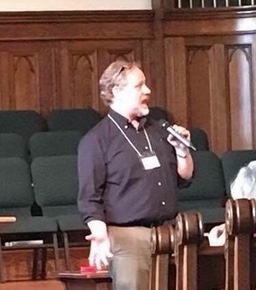 Just over a year ago, I went to the LA Bar in Arlington and did karaoke. It was New Year’s Eve, and I had just come from a fairly routine party, where we had counted down the end of the old year and beginning of the new. It wasn’t enough. And so, away I went with my date, and we signed up to sing the Talking Heads’
  I am sitting in a museum while I write this. I am surrounded by works of Alexander Calder. They are gifts, but he also sold them. There is a fabulous photograph of his workshop in this gallery.
 When I look at any of the works of art at the National Gallery, I do not immediately think of the dates and the events that were taking place in the world at any given time. Art is timeless in a way. And it is not. I am reminded that horror in the world was never limited to acts of overt war, but that it proceeded—and proceeds—in an endless stream of cruelty and misfortune. And yet, in all times, there has been art.
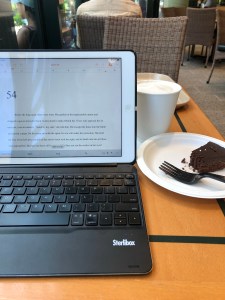 While I like to write while surrounded by people, once my eyes are on the page, and once my fingers are working, a kind of wall goes up. Writing is solitary. And it is not.
 There is a plate at the Freer Gallery in Washington DC. Around the rim are an elongated set of letters in Arabic. Even if you knew what those letters meant, would you know about the person who wrote them before the platter was fired in a hundreds of years old kiln? Or what to make of the carved insignias on a Neolithic disc from China? Sometime, 5000 years from now, will these shapes still make sense? Will they point some future reader back to me? Or to anyone else who writes now?

 Disenchantment is not simply the end of magic; it is the end of hope. “I have lost hope,” is the death sentence of enchantment. Hope and enchantment live in an unknown future. I have cursed myself—or is it a blessing? I hope it is a blessing—by wedding myself to enchantment, by casting my lot with the unknown. Nothing else will do. The known—the comfortable, the predictable, the routine—feels like an iron chain. Disenchantment is the foundry in which that chain is forged, and when I am at my worst, I discover that I hold the hammer and the tongs. I shape the links that will bind me and sink me beneath an ocean of worthless ink. How did I become the master smithy of my discontent?
 continuoussearch