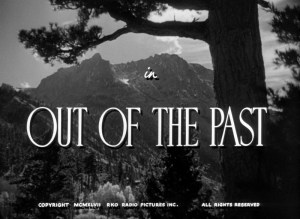
 Out of the Past (1947)
Directed by Jacques Tourneur
Starring
Robert Mitchum as Jeff Bailey (Markham)
Jane Greer as Kathie Moffat
Kirk Douglas as Whit Sterling
Virginia Huston as Ann Miller
“Think we ought to go home?
“Do you want to?”
“No.”
Out of the Past begins with a montage of shots of the Sierras. It looks like a series of Anselm Adams’ photographs: stark snow-peaked mountains and high skies cast in rich, sharp grays. The music is sweeping; it befits the landscape. The camera pans down to a small town, Bridgeport, in the shadow of the mountains, and follows a black car as it drives in among the white buildings. The good world, the one we wish for, may be severe in its beauty, but it is beautiful—and natural. Evil, when it comes, comes in human form, wearing a black coat and black gloves.
 None of this is surprising or unexpected. It’s almost too easy and too obvious. Out of the Past is a movie that continually works between the obvious and the hidden. The main character, Jeff Bailey, is hiding in Bridgeport, a sleepy little California town with a diner owner who knows everyone’s business. Jeff is the wild card, which draws the attention of the town’s beautiful Ann Miller. She is straight out of a fairy tale. We first meet her fishing in secret with Jeff, he declares, “You see that cove over there? Well, I’d like to build a house right there, marry you, live in it, and never go anywhere else.” She answers, “I wish you would.” Ann comes from a world where wishes come true. Jeff does not.
Jeff Bailey is a marked man—his actual name is “Markham”—and we learn the details of his past promptly as the story progresses. The black-gloved driver has come with a summons for Jeff from a gangster named Whit Sterling. The gangster and Jeff share a past: Whit hired Jeff to find a woman, Kathie Moffat, who stole forty thousand dollars and his heart (although the gangster never admits this); Jeff found the woman and fell in love with her. In simplest terms, Whit is evil.
In simpler terms than that, so is Kathie. Essays about film noir identify Kathie Moffat as the femme fatale par excellence. She is bad. After hearing her story, Ann states, “She can’t be all bad. No one is.” Jeff responds, “Well, she comes the closest.” Before the story of the movie begins, Kathie shot Whit—three times with his own gun. She shoots and kills Jeff’s partner (after Jeff pummels him in a fistfight). She finishes off Whit. And finally, she shoots Jeff. She is bad; she is a killer. But so are most of the male characters in the film—even the “innocent” deaf-mute boy who works for Jeff causes the death of Whit’s black-coated muscleman. Kathie acts out of self-interest, and unlike Jeff, who naively believes that his roughed-up partner will not cause further trouble, Kathie understands what men will do. Jeff barely understands himself.
Jeff is repeatedly called “smart” in this film. It reminds me of how often Iago is called “honest” in Othello. Mitchum plays Jeff with languid rakish charm, and it’s an act so good that it convinces nearly everyone, even himself. Jeff is tough enough to claim, “I’m afraid of half the things I ever did,” but toughness and charm simply ease his way into disaster. His actions lead to the deaths of six characters, including his own. He kills none of them. Joe Stefanos, Whit’s muscle, kills a man to frame Jeff. “The Kid”—who works for Jeff—hooks Joe with a well-placed cast and pulls him from a precipice and to his death. Kathie kills three. And the police kill Kathie. But all six deaths begin with Jeff’s admission, “I saw her—coming out of the sun. And I knew why Whit didn’t care about that 40 grand.” “I saw her.”
 Some critics will let Jeff off the hook—an appropriate metaphor in this film because we are introduced to Ann and Jeff while they are fishing—and claim that the film frames Kathie. After all, Jeff acts nobly at the end of the movie, when the Kid tells Ann, in unspoken accordance with Jeff, that Jeff was leaving with Kathie. This clears the way for Ann to return to her old reliable beau. And Kathie did kill three men.
Still, Jeff’s naïveté—the kind of naïveté fostered by an over-sentimental macho ethos—never takes into account the consequences of his actions. He’s halfway smart and gets the lion’s share of great lines, but he doesn’t actually know what he’s saying. The lines just sound good. When he chides Whit, “I sell gasoline, I make a small profit. We call it earning a living. You may have heard of it somewhere,” he doesn’t really believe it, no matter what he tells Ann or anyone else.
“You’re no good, and neither am I,” Kathie insists to Jeff. We may have been charmed by Jeff. She may have found him charming, she may even love him, but most of all, she knows him and knows that the good act that he puts on is his weakness. He is evil—as bad as her, worse because he can neither admit it nor make it work to his advantage. It’s a crushing realization.
The realization that the hero—even the louche antihero played so well by Mitchum—is, in fact, the villain, is not easy to accept. We like the cool character, the slow-eyed machismo wins us over, even while he threatens the fairy tale princess at the heart of the story. Maybe we like him for the same reason that we like the stark gray landscape: the Sierras are neither moral nor immoral. The landscape is beyond good and evil. If the mountain stream can be sublime even though it may be dangerous, then why can’t a person be beautiful even if she—or he—is villainous?
Iago claims that “When devils will the blackest sins put on,/ They do suggest at first with heavenly shows” (2.3.371-2), he points out how we may be fooled by evil. There’s something else though, a willingness to set aside our judgment when the “Divinity of Hell” wanders into our midst. We want to understand, to analyze, and to rationalize, thus casting evil into a knowable and, therefore, acceptable quality. We value our ability to sympathize, no matter what. Do we sympathize with Whit? Or his blunt right hand, Joe Stefanos? Or even the femme fatale, Kathie? I suspect that we do not. But Jeff elicits sympathy. Because he is cool, and maybe, because we want a little of that coolness to rub off on us. No matter the cost.
It’s what we wish for.
“Think we ought to go home?” Ann asks Jeff when we meet them. He answers with a question, “Do you want to?” She says, “No.” Home, this country founded on a beautiful idea that there is no evil—or if there is, it is outside whatever we define as home: the four walls, the property lined with a stone wall, the land we call our own. We wish for home and cousin up to the idea that evil exists outside, that it is a black-gloved interloper, that it doesn’t know how to fish, that it doesn’t hire the innocent deaf-mute boy to pump gas and repair tires. And that if evil does exist at home, it comes in the form of nosiness, petty jealousies and provincial attitudes. It doesn’t look or sound like Jeff Bailey.




 Viruses are the prototype for the “lilies of the field: … they toil not, neither do they spin.” How they may be arrayed is entirely in the eye of the beholder. The virus of current interest wears a crown—or presents something crown-like on its exterior. It’s almost too satisfying to try and picture it, or to quibble over which depiction is more accurate.
 It has been a year and a few months since I was in London. I’m thinking about London while I sit and study Monet’s “Houses of Parliament, Sunset” at the National Gallery of Art. The memory of looking across the Thames at that building, with Big Ben swathed in the latticework of repair, has faded only a little. The memories of walking the streets of the original square mile and beyond remain startlingly vivid. I used them to paint scenes when the characters in my novel walked through London. The memories of the places and the memories of the feelings.
 When I was last in London, I was taking steps into a world where I knew I could live, where I had longed to live. Just like in the dream, writing—flight—was not foreign to me, but something I had traded in for a more certain, more directed existence. While “You are…You should” can feel like shackles, flying—writing—is formless and uncertain. Anywhere is possible. Everywhere is almost a mandate. Just like in the dream, I had written before—had flown—and had lived closer to the limits of my existence. But I had to leave my self-imposed limits. I had to accept that I might fall—and fail—but just as I accepted that in my dream—soaring up the side of a steel and glass edifice, wondering, “What if I forget? What if I fall?—I thought, even as the thrill of fear invigorated me, “You are flying now. Even if you fall, you will remember as you fall, and fly again. Keep flying.”
 Two women look at the Monet—taking seat in the National Gallery beside me. They think it is beautiful, but claim, “It doesn’t look like that.” Of course, the Houses of Parliament look like that, as does the river Thames, as does the sunset. “We didn’t see it,” they claim, “We were tourists, doing touristy things, like thinking about where to have dinner.” I did not think about dinner when I was in London. As much as I love dinner, even food became a secondary thought while I was in London. Even the pubs and ales became little more than way-stations along the bigger task—the journey, the seeing, the walking, and the flying. And the writing.
 In the other corner of the Freer Gallery, an exhibit of Hokusai’s paintings and illustrations includes quotations from the artist about what he intended—not just in the specific works, but as an artist. He wrote about discovering himself as an artist late in life. He was already an artist, but he claims to come into his own in his 50s and thought that he might attain his most complete vision if he lived to 110. He died at 90. His work is sweeping and intimate—monumental nature and quiet personal moments—fantastic and humorous—heroes wrestling demons and uproarious coworkers. Whatever else he meant to last in his work—why that hero wrestled that demon (as if one could easily answer such a question)?—he meant it to last. He aspired to capture a vision that would last long after he died.
 I start paying attention after 17 minutes or so — the meter on the elliptical estimates that I am burning 24.3 calories every minute. I am about halfway through the current “run,” and I will burn through 720 calories in 30 minutes and well over 800 when I include the five minutes of cool-down time that the machine grants me at the end of the workout. I get pissed because the timer starts as soon as I start moving my feet, and the first 15 seconds are “slow.” I make up for it. After a five minute break, I jump on another machine that allows me to take longer strides, and run for 12 minutes, aiming for 7-minute miles. It’s a workout.
 continuoussearch