Keep writing.

The impulse is to judge, and then to correct. Don’t do that, do this. Or at the very least, Don’t do that.

Keep writing.

There is the (I hope it is apocryphal and, sadly, know better) story of Galway Kinnell working all morning to take a comma out of a poem, then returning the next, working again all morning, and putting it back in—a sort of “for want of a nail, the war was lost” mentality. While I see the value in such a granular vision—yes, yes, as Twain. wrote, “Th difference between the almost right word and the right word is really a large matter–’tis the difference between the lightning-bug and the lightning”—does every comma need to be examined, interrogated, and tried?

Keep writing.

As a teacher, I struggle with two impulses: fix everything, and encourage my students to keep writing. I teach younger students, and while, yes, their writing has flaws, mainly they are flaws of omission (not enough detail, not enough focus, not enough development, not enough). More is a welcome problem. So, I suggest, add details, organize, and:

Keep writing.

As a younger writer I had an early teacher who would simply read my stories, and if I was not hitting the mark suggested:

Keep writing.

When I hit the mark, he cheered:

Keep writing.

As I developed, I had a teacher who jotted “No’s” into the margins, and exercised comments in red pen. Fortunately, I was driven and obsessed. I revised and redrafted furiously. At least to start, but as time passed, I began to think that there was no way forward without to web of red ink. Red means stop.

Keep writing.

This creeps into our daily lives as well—the impulse to correct, to impulse toward perfection. We hold up ideals and ignore the working or workable drafts. Or complain when the dishwasher is full, but not packed the way we like it. Or demand, “Turn here!” There are a thousand roads to Mecca. The first steps to Avalon are through impenetrable fog and mist. To find the end of the world, get lost. And yet, afraid of missing something, a voice within us insists: The right way, the right way!

Keep writing.

In the song, “Move On” from Sunday in the Park with George, a vision of Dot sings to George, who is struggling with his work:

Stop worrying it your vision

Is new

Let others make that decision-

They usually do

You keep moving on

Keep writing.

Yes, you know this already. Whether a word, a paragraph, or 2000 words, all that matters is the writing. Fix it later.

Keep writing.

Losing the Path—How a writer can get lost

Along the way, I lost the true path. So many of these past posts have been about finding my way back to the right road—to my purpose, to writing, and to love. Like the Italian poet, I am perhaps a little attuned to an inspiring force—a Beatrice, if you will—and so as writing has come back into my life, I have found inspiration as well. But the path is writing, and I blundered off.

Dante begins The Inferno:

Midway on our life’s journey, I found myself

In dark woods, the right road lost. To tell

About those woods is hard–so tangled and rough

And savage that thinking of it now, I feel

The old fear stirring: death is hardly more bitter.

And yet, to treat the good I found there as well

I’ll tell what I saw, though how I came to enter

I cannot well say, being so full of sleep

Whatever moment it was I began to blunder

Off the true path.

Of course we ask, “Why? How?” For each of us who blundered off, the cause of our blundering was specific. Perhaps there are similarities. Here are mine.

Some of my challenge is surely due to some odd predisposition against the kind of selfish drive that must accompany the purposeful and durable impulse to write—or do anything. I recall when I was twelve or thirteen and we were electing pack leaders in my Boy Scout troop. I was nominated, and I did not vote for myself. I did not do that because I had been taught, always and hard, to think of others first, to not be selfish. I had two younger brothers—and not just younger, smaller—and was expected to make way for them, to not impose myself. Whether the overall message came from my parents, from teachers, or from some other source, I cannot say. When the time came for me to vote for a pack leader, part of being a leader, so I thought, was making the generous and considerate move. It was an early lesson.

My life in the world has set me against those who are primarily selfish. I see selfishness everywhere—the thousand daily infractions of an overarching ethical code. Be strong. Do more than your share. Tell the truth. Be kind. I do not understand behaviors that subvert those rules, and when I have broken them, or come close to breaking them, I have borne that certain weight. At some point on a dating site, there was a question, “Do you know the worst thing you have ever done?” I know the ten worst things. One was yelling at a boy with a physical disability to not block the stairs going into school. It is far from the worst. I work to balance the ledger.

I have framed the writing life, my writing life, as a calling. While that is a powerful vision of writing, a calling has its drawbacks, even dangers (see “The Dangers of a Calling“). It means that our work is not about or for us, but for something outside us, and this can lead those who live within this frame, to sacrifice, even sacrificing what is at the heart of that calling. Somewhere along the line, we must learn to be ferocious, obsessive even, about our purposes. This, and nothing else. No matter what.

Beyond that, there are many other roads, especially when one is in the dark—whether suffering through a bout of creative disconnection (no stories!), or suffering through the slings and arrows of outrageous fortune (the daily bits of life and love)—and a wrong road can seem very much like a right road. There are so many opportunities for success, and routes that promise fulfillment. The greatest dangers to purpose are not dissolution and waste; they are “almost purposeful” fulfillment. How hard to turn away from success (or the road to success) as a leader, as a teacher, as a father, as a spouse. Who would not want all these successes in his life? I am writing about me, so the male pronoun is appropriate here; I imagine that a “she” or a “they” would have the same kind of struggle.

One of the attractions of success across a broad range of fields is the push to be well-rounded. How many times was passion curtailed because it was deemed too obsessional, too blinding to a balanced life. From early on in my life, I was strongly encouraged to be conversant in several fields of study. To understand science, math, history, and, English. To be a scholar athlete. To be well-informed about the news of the day (not just local, parochial news, but in the world as well, and not just news about proto-historical events, but arts, sports, business, everything). To play a number of sports. Always more. The monomania to do the 10,000 hours of practice was seen as ungentlemanly. Me, the last amateur, breezily succeeding, breezily failing, breezily letting life slide past.

Purpose was nearly antithetical to my life. And I have paid for that. Midway on our life’s journey, I reclaim the right road. I leave these markers for you, and for me. Follow.

Manqué—a Writer’s Predicament

Almost thirty years ago, I was eating dinner at a little restaurant on the edges of Johnson City and Binghamton, New York. My mentor and her husband had invited me along. These were heady occasions, full of discussions about writing and literature, and the program in which we all worked. I was a student, but, still, I worked. On this particular occasion, they started talking about writers manqué—although I heard it as writer manqués. It was a new word for me. Manqué: having failed to become what one might have become; unfulfilled. They started listing writers who had been in the program, writers who had published and stopped, and writers who were currently in the program. It was sharp and cruel, and the sobriquet stood out as one to be avoided at all costs. These may not have been eternal footmen, but there was snickering enough to go around.

The muse is a durable construct for the writer, because the muse can go away. Most writers I know have experienced life-crushing bouts of silence. It is the single worst event in the life of a writer: when the inward eye stares and stares and sees nothing, and all the inward voice can do is wait, or write, less vividly, about less, or about the nothing. Think of Wallace Stevens’ poem “The Snowman,” and the listener, who “listens in the snow,/ And, nothing himself, beholds/ Nothing that is not there and the nothing that is.”  A writer who has faced silence has faced the absolute nothing. It makes the writer question her or his ability to evoke a world, to create, to even be. Stevens turns it into a gift—the ability to not see anything but what is, to inhabit a “mind of winter” without preconceptions or preconditions.

The writer carries a slew of preconceptions and preconditions. While most can leave their jobs and go home to become a mother or a husband or something, the writer, like a soldier, is on duty all day. Unlike a soldier, who can remove the uniform, and briefly be, what? human? the writer never becomes anything else. Her or his humanity is bound into this one peculiar characteristic: they make worlds with words. I’m sure this is true of artists of all sorts. A friend recounted an interview with a composer who told how each time when she wrote and felt that the work was wonderful and that she was flying, when she started the next day, she had to learn to fly all over again, that she was rooted to the ground. Success is no bulwark against the feeling of starting all over each and every day.

And so, locating that characteristic in a muse—and those old Greek muses were incredibly flighty—was, is, a safe way to inoculate oneself against the silent times.  It isn’t me! It’s that damn fickle muse!

Some writers simply prescribe habit to overcome the silent times. Stephen King wrote the commonplace advice: “Writing equals ass in chair,” which is a grittier take on Mary Heaton Vorse’s “The art of writing is the art of applying the seat of the pants to the seat of the chair.” Getting used to daily practice removes the onus of waiting for the muse. Sit down and write. Repeat. Of course King provides an example of a diligent sitter in The Shining, when Jack Torrance produced reams of “All work and no play makes Jack a dull boy.” A little more than sitting can be a help.

Nonetheless, the fear of being unfulfilled lurks. In a prose poem called “Ants,” I render it as a mass of ants that eat the speaker, even while success beckons. Having come to writing in stages, and later than many, I was thrilled by the force of words as they seemed to tumble forth. I was also a little suspicious. Was this really what I could do forever? What about money? or success? Hearing my mentor denigrate those poor “manqués”—I imagined little monkey of Isak Dinesen’s tale “The Monkey.” How horrible to lose oneself to that invidious transformation.

Like any great and terrible idea, this one lurked. Even when I was writing every day, and earning the admiration of friends and mentors for my creative and scholarly work, I worried. Perhaps that is exactly because I did come late to the craft, that coming so late, I did not have a firm belief either in it or myself. There are half a dozen other reasons, all of them lying in wait. Monkey. Like the law-seeker in Franz Kafka’s “Before the Law,” I was ready to be stopped at the wall, and wait. I knew better—I even knew the antidote! I did!—but the idea of “manqué,” so formidable, grew out of proportion to all reason.

When the silence came, I was unprepared, or, rather, I was over-prepared. Too ready. I sought and found success outside of my work, and followed those paths for years. However, the muse—or the mind—did not forget. It simmered there, stoking my peripheral vision for years. Characters and stories inhabited the edges of my consciousness, darting away when I turned my inward eye upon them. Chiding me—don’t you know how to see us? I did not. It hurt. I carried half a heart in my chest, wearing an inner funeral black no matter what flags of color banded my body.

And I had success. But what is success to a writer, to an artist, but the work? Teacher, husband, father, religious leader. I had to tear my life apart, reorganize it.

Kafka has another short story, “My Destination” (“Das Ziel”), in which the traveler declares “I need [no provisions], the journey is so long that I must die of hunger if I don’t get anything on the way. No provisions can save me. For it is, fortunately, a truly immense journey.” I knew this long ago, and sang it out to any who asked, but could not hear it, not truly, myself. Physician, heal thyself. I could not. And a silent wound festers until it explodes. Or until the call is heard. Again.

And, as if by magic (and not magic at all, old artificer), seeing that I had given myself back to the craft, that I was writing every day—these blog posts included—the vision began to hold. I wrote, I changed my life, and continue to write, out a sense of surprise and without expectation. I write without a plan—and that is my secret. Without a goal, other than writing, there is no question of staring straight at something, or letting the peripheral vision take precedence. I can move forward by sidelong glances. Into the unknown, ignorant of my former limits—and not, stupid memory—and finding the old useful joy and craft.

Repetition, again.

Is it any surprise that repetition plays a significant role in my life? I came of age as an athlete knocking out sets of 30 200 yard freestyle swims. They were yardage eaters—a quick and dirty way to lay in 6000 yards of workout and buy time for rest of the yards that the coach had in mind. We finished them at intervals of 2:30, 2:20, and 2:10, which left 50 minutes for the rest of the practice—an easy pace for the two to four thousand yards to come. Pushing off the wall every two minutes and thirty seconds, there was time for conversation between swims. Leaving at every two minutes and ten seconds put a crimp on anything other than brief exchanges: “This sucks,” “Stop hitting my feet,” “I’m hungry.”

We did this day after day.

With my head down in the water, my eyes trained on the feet of the swimmer who left 5 seconds before me—chasing, always chasing. In high school I was far from the fastest swimmer on the team. I made myself a better swimmer. One summer I traveled to Iowa and a training regimen that increased the junior varsity’s load of 3500 yards in an afternoon’s hour long practice, to 22,000-28,000 yards spread over three practices every day. I lost whatever baby fat—and whatever other fat—that my 15 year old frame carried, crashed my immune system—catching a nasty staph infection that laid me up for days after I returned home—and sliced ten seconds off my hundred breaststroke time. No mean feat. I made the varsity team. Repetition was the way.

Years later, when I was a graduate student in English, I read books two and three times. I would attack most of the books for my classes in two weeks before the beginning of the semester, then again as we read them as a class. The initial reading with facile, getting the joys and traps of plot out of the way, allowing the words—and all the ideas in the words—to come to the fore when I read along with the class. If I wrote about a particular book, I read it again, and some passages, dozens of times.

Since I was in school to write, I wrote and rewrote some stories six or seven times. My classmates, colleagues, cow-writers, and teachers, shared the demanding mantra: “All writing is rewriting.” And we practiced what we preached.

As a teacher, I sometimes warn my students that this—and the years to come in college—are the best years, because of the preponderance of the new. Almost everything they learn is, will be, new. Each encounter with something new gives a new opportunity for mastery—another shot at sudden improvement and the giddy transformative moment of adding some unknown idea to the swirl of self.

I warn them because at some point there lives will bend toward repetition. Yes, the repetition may lead to a finer, hard-earned mastery. I think of all the miles that I put into the pool, and how it shaped and shapes my body (still). I think of the ways that great works give up new meanings after repeated shared readings, and how I became a more aware reader. And while I may not rewrite as much as I once did—obsessively, compulsively, debilitatingly—I know that writing begets writing—good, bad, or otherwise. The thing is to write, over and over, every day, without fear, even without hope. The words will bear you up. Push off. Go again.

Well do I know that repetition can suck the joy from the flower of life—making no honey, leaving all empty, colorless, scentless. I do not how how I managed all those laps in the pool, with nothing but the dull roar of water passing my ears, the steady ache and agony of my muscles, and the songs that played in my mind, setting an unimaginable pace. There was joy at the end of each 200 yards—“Good time!”—and these little victories provided enough of a goad to return to repeat success. Who determined what was a “good” time? I did, in concert with the clock—the cold but consistent arbiter of performance. Time, as opposed to opinion, never wavered. The clock was not making a comment because it had a good or a bad day. Go again.

I hope that my students will discover some place where they can demonstrate mastery, and change the long monotonous drone of repetition into a glorious repeated success. That they will find a way to insist, “Again, again,” holding on to that inner childlike joy. That in spite of how hard their task may be, that their arbiters are, if not cold, consistent and consistently challenging. I hope all this for myself as well.

The sweeping red hand of the clock on the wall flies past the black hashmarks: two minutes and one second; two minutes and two seconds, two minutes and three seconds. I breathe deep, and get ready. Here I go. Again.

The Weight of Words

The thing about writing that some people will never understand is that for the writer, it is not cerebral. Writing is physical. I feel exhausted, physically spent, after writing. Not exactly the same as after a work out, or after a night of intimacy, but I will push myself until my body shakes. I stop when I am done, when I have hit a physical limit. I do not believe that people who do not write, seriously write, understand this.

I’m not speaking out of my hat on this. I know about physical limits and I have tested mine. When I was younger, I swam seven hours a day (over three separate workouts). When I was older, I took the helm and held it until for days until storms had passed, even when I was seasick and retching over the stern, even when I had a broken rib. I am aware of myself as a physical being. I know where my limits are, and how to push up to and extend them.

Part of the physicality of writing comes from the sound. When I write, each word resonates. It is like being inside a drum, or suspended in the bell of a trombone. My mind is noisy when I write—not scattered, but genuinely full of noise. And like a conductor, my arms are keeping all the sounds organized, on time, in concert.

Writing calls a world into being. There are no phantoms, no shadows. Each image, every idea, is made real, is pulled from some grey other world into this one. Some ideas and images do not come easily, but must be coaxed, yanked, or held gently—each needs to be evoked and tended in its own particular way—the same way each child needs just this much attention, just this much encouragement. But when they come, what joy.

Sometimes, I have to stop, slow my heart, and wait. I can feel the words begin to come along the inside of my arms, deep in my thighs, in my chest. They shorten my breath and turn my feet unusually cold, almost the only time I feel an actual chill—I am a warm man.

And, well do I know how I become a better writer when I move—when I take long walks, or spend a few thousand yards in the pool, or push my heart rate above 180 beats per minute. Because the writing is physical, and the words have a weight, beyond the blinking cursor on the screen.

Back to the Forge: Learning from Portrait of the Artist as a Young Man

I revisit texts—novels, stories, plays, and poems—with joy. They stand as mileposts, as reminders of the paths I have walked. I have not always enjoyed this journey, but it has been my journey. No one else has walked this path. I have never wanted it to end, even when the trails of my imagination have become untended and overrun with weeds, when it seemed too difficult a task to return to those paths, to follow where they led, to cut new ways into the wilderness.

The mileposts that speak loudest to me are those that recall not simply the distance but the method of travel. How many times have I dipped into Whitman to find a way I thought I had lost? Perhaps not enough. Or the more diminutive Dickinson, who reminds me of the power of possibility? I re-encounter Prospero every few years, not yet ready to cast my books of power into watery graves.

The first time I read Joyce’s Portrait of the Artist as a Young Man, I was 20, a junior in college. I read it in one furious sitting, rushing as was the case in undergraduate school. The book shot through me—the sermons in the third chapter frightened me, and the ending befuddled me.  I had not written since the rhyming verse I attempted in high school. It would be a year before I started to cobble together my own stories.

I encountered it again when I was 28, and in my first year of graduate school. I wrote every day and was just learning to read by making connections—or rather, by freeing my mind to read as expansively as possible. I did not see a mirror in Stephen Dedalus, not yet, but I saw how Joyce was beginning to challenge the reader, and followed his challenge into Ulysses, and peered obliquely at Finnegan’s Wake. Reading Joyce intoxicated me—all the word play, all the allusions, all the swirl of events. This is how my brain worked, and I felt a kindred spirit at play in Joyce. Perhaps this was too great a burden to lift as a young writer—to think like Joyce, to aspire to something like his work, but I saw the path, at least one path. There were others, and I tested many.

The next time I was 41, and in my first high school teaching job. For whatever reason, my writing had slowed. The difficulties I encountered in my work made me doubt every word I wrote—and even every word I read—which made reading more distant and difficult. I could read a novel as a collection of themes and ideas, which made for fine if programmatic teaching, but the hearts of the works did not beat with the same sense of connection. I felt hollow. I read Portrait as a kind of roadmap for one man’s feelings about Ireland, faith, men, and women. I nodded toward his art but felt closed off from that part of Stephen’s story. I knew it was there—I sensed it—which made the experience strangely worse. This is what you should be doing, the book chided.

I spent several years away from my life’s work. I wrote here and there—stories for kids, sermons, and—in fits and starts—this blog. I suffered for it, as, I am sure, did those around me. I am not a man who can be what he is not and put on the trappings of happiness. “Fake it until you make it,” may work for some, but I need connection—not simply interpersonal or romantic connection, but to the universe, to some deep unconscious thrum that turns words into flesh and flesh into a play of bright and dark and dense presence. While I started to craft a life that combined the spiritual threads I would need to reconnect me to that seen and unseen world, it wasn’t until I started writing daily that my words found the old (new) purpose. Over the past year, I have kept a daily writing practice that, with very few exceptions, has brought me back.

Now I am 58. I am not young. I have long past the point where Stephen stepped into his work, but my heart bursts, as if newly forged—reforged by my years long effort. I read the book again, and this time I hear the singing—it is for me, and for my students too. I orchestrate a class that includes Portrait, weaving together strands from universes that while shadowy—more to my students than me—move with playful grace. The book sings to me, calls to me, demands my attention, my thought, and my response. Not simply in class, but in my work.  Not just these words, but other words.

I no longer feel called to write like Joyce, or Dickens, or Marquez, or Woolf, or Calvino (though, wouldn’t that be nice). Or, or, or. All the words—from every page, from the labels of soap, from the scraps of memes, to the shifting exchanges of my students call, all the words—insist “forge.” And so, I will, I must. Old father, old mother, old artificers, all of you, “stand me now and ever in good stead.”

from Portrait of the Artist as a Young Man

You are an artist, are you not, Mr Dedalus?—said the dean, glancing up and blinking his pale eyes.—The object of the artist is the creation of the beautiful. What the beautiful is is another question.—

He rubbed his hands slowly and drily over the difficulty.

—Can you solve that question now?—he asked.

—Aquinas—answered Stephen—says pulcra sunt quæ visa placent.——

—This fire before us—said the dean—will be pleasing to the eye. Will it therefore be beautiful?—

—In so far as it is apprehended by the sight, which I suppose means here esthetic intellection, it will be beautiful. But Aquinas also says Bonum est in quod tendit appetitus. In so far as it satisfies the animal craving for warmth fire is a good. In hell, however, it is an evil.—

—Quite so—said the dean—you have certainly hit the nail on the head.—

The Books

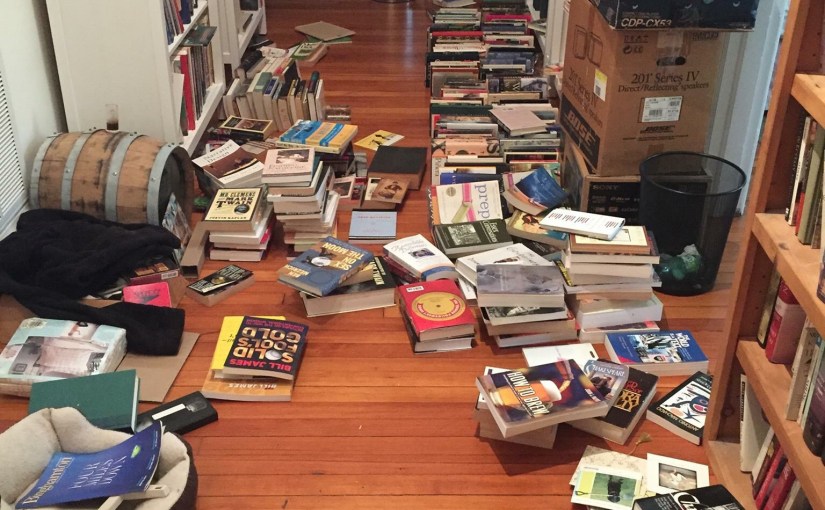
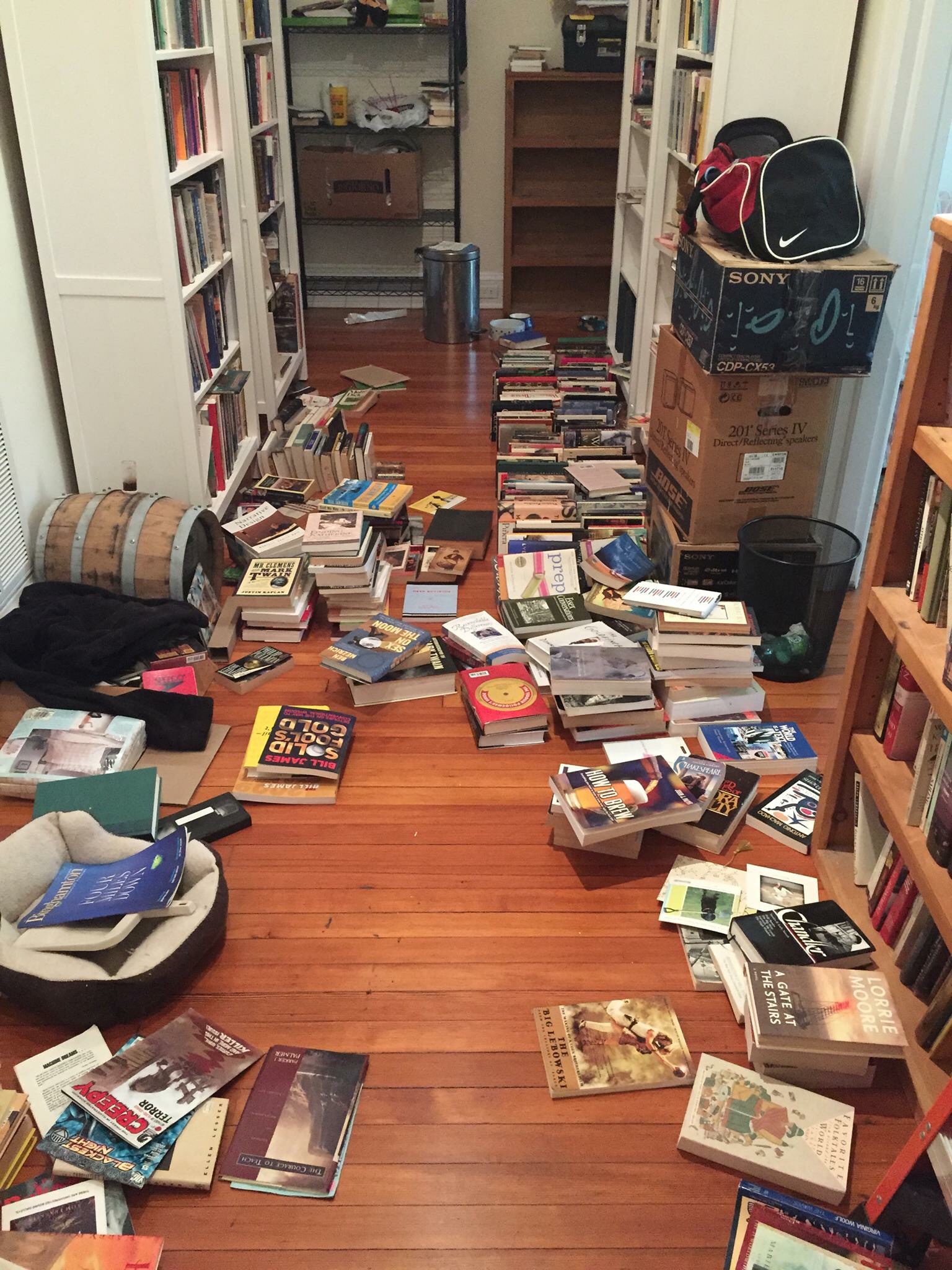
Almost fifteen years ago, I put my books in the attic. They were out, in shelves, but tucked beneath a sloping ceiling and packed behind all manner of family detritus. When my ex-wife and I separated, I moved them into my main living space, where they sang back to me after their—or my—sojourn.  My books matter to me, and I felt their absence. Getting them back onto tall shelves, walking past them every day, reminded me of what I had done, what I had learned, and what I wanted to do with my life and mind.

I have books about writing, books about religion, books about education, history books, philosophy (what we called theory in graduate school), fiction, poetry, books full of art and art history, and even books about sports—mainly baseball. I have a hard cover edition of Dickens published by Chapman and Hall with pages that requires a pocket knife to cut open.  I own a set of Andrew Lang’s color-coded Fairy Tale books.

The books reflect my preoccupations over the past thirty years.  Much of what is on my shelves I first read while I was in graduate school. Some I acquired afterward to keep me in touch with what I spent six years studying. Some comes from undergraduate college—books about gothic art and architecture, an old edition of Joyce’s Portrait of the Artist as a Young Man. There are some newer books that reflect my current interests: a collection of Sumerian mythology, a book about Djinn.

As much as I love my books, as much as they tell a story of my past, as much as they feel like an external manifestation of my mind, I think it may be time to lose them.

How long can one hold onto the past—a past that weighs an actual ton—without moving into the future? Yes, there are some things that I would keep, and this is true of more than my books, but they possess so much gravity. What is the past to me? Of course it is, was, everything. However, the future beckons, and requires a kind of lightness to which things do not lend themselves. Even memorable things.

There are other presences in my life—deep and profound connections. This time last year, I started unraveling the two jobs I had in Norfolk, Virginia. I moved away from those jobs and in the process also moved away from my daughters, who continue to live with their mother in Norfolk. Of course, I separated from and divorced their mother. It may seem inconsequential, but over 30 years ago, I picked a cat off the street, and have had cats ever since. I have never been more than three weeks away from them. This year I considered giving up a long standing fantasy baseball game that I have played for nearly 30 years with friends.

I wonder about what I have given up, but also what I have stayed with over the years. I have been a teacher for over 20 years—including my work as a TA in graduate school, over 25 years. What would it be like to not teach? I wrote for years, and then, if I didn’t stop, I slowed considerably—at what hazard, I cannot guess. I am writing again now, and have been, but can’t help wonder why my work slowed to a trickle.

I wonder would it would be like to be free of obligation and free of the gravity of myself—that ton of books, the closet full of clothes, my job, my family, my cats, even my friends. I wonder what my life would have been like if I had just chased words—the stories that I had declared as my purpose when I went away to and then stayed in graduate school. When I went away to graduate school, I traveled in a single car, with a mattress tied to the roof, and a single cat riding in the passenger seats. What would it be like to travel to what’s next with even less?

I do not regret the life I led, nor the life I lead; regret possesses a gravity greater than all the books own own, and I have no time for that. Not now. Nonetheless, I am aware of another life that exists, not over the horizon, not over the rainbow, but buried deep within me. I don’t know how I have kept it buried for so long, or at what cost—or even at what gain. Still. It is there.

I wonder, and wonder hard, and the wondering stirs something in me, something alive and insistent. What will I carry into the future? What must I carry? And what must I leave?

Imaginary Destinations

There are imaginary places that call to us. Illyria. Macondo–though be careful of that one, friend. The Invisible Cities that Polo reports on to the Khan. And Cocaigne.

And so, at the end of the day, when I have spent the precious fortune of my wit and energy, spent it for what? Money? Success? Some recognizable residue that others may tout as virtue? I return to the nearest country I can find–the one adrift in the books on my shelves, or the sea of my imagination. Return traveler, with ships once more laden with waking dreams.

Until such time as I may board a ship, an airplane, or some contrivance to carry me into strange and wonderful streets, I have this. Baudelaire…

L’Invitation Au Voyage

There is a wonderful country, a country of Cocaigne, they say, that I dream of visiting with an old love. A strange country lost in the mists of the North and that might be called the East of the West, the China of Europe, so freely has a warm and capricious fancy been allowed to run riot there, illustrating it patiently and persistently with an artful and delicate vegetation.

A real country of Cocaigne where everything is beautiful, rich, honest and calm; where order is luxury’s mirror; where life is unctuous and sweet to breathe; where disorder, tumult, and the unexpected are shut out; where happiness is wedded to silence; where cooking is poetic, rich, and yet stimulating as well; where everything, dear love, resembles you.

You know that feverish sickness which comes over us in our cold despairs, that nostalgia for countries we have never known, that anguish of curiosity? There is a country that resembles you, where everything is beautiful, rich, honest and calm, where fancy has built an decorated an Occidental China, where life is sweet to breathe, where happiness is wedded to silence. It is there we must live, it is there we must die.

Yes, it is there we must go to breathe, to dream, and to prolong the hours in an infinity of sensations. A musician has written l’Invitation a la valse; who will write l’Invitation au voyage that may be offered to the beloved, to the chosen sister?

Yes, in such an atmosphere it would be good to live—where there are more thoughts in slower hours, where clocks strike happiness with a deeper, a more significant solemnity.

On shining panels or on a dark rich and gilded leathers, discreet paintings repose, as deep, calm and devout as the souls of the painters who depicted them. Sunsets throw their glowing colors on the walls of the dining-room and drawing-room, sifting softly through lovely hangings or intricate high windows with mullioned panes. All the furniture is immense, fantastic, strange, armed with locks and secrets like all civilized souls. Mirrors, metals, fabrics, pottery, and works of the goldsmith’s art play a mute mysterious symphony for the eye, and every corner, every crack, every drawer and curtain’s fold breathes forth a curious perfume, a perfume of Sumatra whispering come back, which is the soul of the abode.

A true country of Cocaigne, I assure you, where everything is rich, shining and clean like a good conscience or well-scoured kitchen pots, like chiseled gold or variegated gems! All the treasures of the world abound there, as in the house of a laborious man who has put the whole world in his debt. A singular country and superior to all others, as art is superior to Nature who is transformed by dream corrected, remodeled and adorned.

Let them seek and seek again, let them endlessly push back the limits of happiness, those horticultural Alchemists! Let them offer prizes of sixty, a hundred florins for the solution of their ambitious problems! As for me, I found found my black tulip, I have found my blue dahlia!

Incomparable flower, rediscovered tulip, allegorical dahlia, it is there, is it not, in that beautiful country, so calm, so full of dream, that you must live, that you must bloom? Would you not be framed within your own analogy, would you see yourself reflected in your own correspondence, as the mystics say?

Dreams! Always dreams! And the more ambitious and delicate the soul, all the more impossible the dreams. Every man possesses his own dose of natural opium, ceaselessly secreted and renewed, and from birth to death how many hours can we reckon of positive pleasure, of successful and decided action? Shall we ever live in, be a part of, that picture my imagination has painted, and that resembles you?

These treasures, these furnishings, this luxury, this order, these perfumes, and these miraculous flowers, they are you! And you are the great rivers too, and the calm canals. And those great ships that they bear along laden with riches and from which rise the sailors’ rhythmic chants, they are my thoughts that sleep or that rise with the swell of your breast. You lead them gently toward the sea which is the Infinite, as you mirror the sky’s depth in the crystalline purity of your soul;—and when, weary with the rolling waters and surfeited with the spoils of the Orient, they return to their port of call, still they are my thoughts coming back, enriched from the Infinite to you.

London Thoughts

History is a story of discontinuous events—events that collide like weather systems or galaxies, having barely understood origins, and even less decipherable records. All the witnesses were destroyed in the collision. What they saw, what they thought, and what they felt—even if they recorded their observations on stone, paper, steel, or silicone, have been destroyed along with them. We are living in the age of delusion, in which we believe in the sanctity of our recorded history—either self-scribbled or captured by another.

This thought is brought about by two things. First, wandering, quickly—this time—through the British Museum (or Westminster Cathedral, or almost anything else in London), what becomes painfully obvious are the gaps. All these artifacts, so painstakingly arranged create an idea that history is continuous, and has flowed in a linear pattern. And then a closer inspection shows that over and over again, things haven’t come that way. There are sudden breaks in history, when entire empires vanish, or when they change—seemingly overnight—religions, or methods of governance, or technologies, and the old gets swept away, almost as if it was a betrayal of the new.

England as it shifts back and forth between Catholicism and Protestantism bears these marks hard. Or, reading through the story of Ashurbanipal and the claims of glory made by this king reminds me of Shelley’s “Ozymandias.”

Thinking of history reminds me of Stephen Jay Gould’s idea of punctuated equilibrium—evolution proceeding in long quiet periods of little change, and then having sudden outbursts of change. I know, we are taught that slow and steady wins the race, but, we are also taught to believe in the nature of story as an overarching “way things are.” We see things through that frame, and it doesn’t always support the picture inside—or outside—the frame.

Second, in the musical Hamilton (which was also part of this trip to London), the character of George Washington warns Hamilton that we do not control who writes our stories. He’s telling this to a man who believes in his power to literally write his own story—and to use his words to cement his reality. He can’t—and doesn’t. His wife, Eliza, sends his legacy forward—and Lin Manuel Miranda brings us her legacy. But, as Miranda admits in interviews, even this moment for Hamilton—and therefore, for him as well—is provisional and subject to changing tastes and critical opinion.

Does everything disappear? No. There are 2000 year old Roman walls in London. But Rome? Everything can disappear. And we will tell stories that soften the loss.

I wonder, I can’t help but wonder, what I am doing when I write: whose story I am writing? It isn’t my story. Of course it’s my story–as if it could be anything else. Nonetheless, as I write about characters who are 5000 years old–older in some cases–I think about history, because they think about history. How can they not? How can any of us not? It is everywhere–in the streets, and in the faces, here in London.