It is different for each of us, but being a fiction writer means living a large part of one’s life in the realm of make-believe. Wait, that’s not quite right. It means that we build something new—over and over again—in the land of make-believe. Fiction writers are artists of the possible. Sometimes the possible looks an awful lot like the everyday, and sometimes it does not. Sometimes the possible is just as sad or happy as the everyday, and sometimes it is happier or sadder. We decide what it will look like and how it will feel, and then use our prose to create a circumstance in which those visions and feelings come to life. In the most prosaic terms, we make the hammer that the protagonist drops on his bare foot, breaking his toe, and sending him into howls of hurt and anger. The hammer, the hurt, the anger, the foot—and the rest of the protagonist—come from the writer.
One of the joyful challenges of writing is not simply making a world that does what I want, but in making a world in which what I want makes sense. There is a difference. I am certain that all writers struggle with the switch from a world in which they create everything—and in which most of it works—to the world in which they do not—in which the deft use of language has absolutely no impact on reality, or worse, in which their singular ability to shape the world is denigrated, or produces an opposite effect than intended.
John Gardner said the goal of fiction is a “vivid continuous dream.” That’s a damn good metaphor for how fiction should work. The whole piece needs to bind together with the logical and artistic consistency of a dream—nothing that wakes the reader from that dream can be included. But a dream—with all its truth and disjunction—is hard to create intentionally. We’ve all seen—or read—dream sequences that were stupidly obvious. A great dream draws us in, surprises us, and finally wakes us from slumber wondering, “What the hell was that?”—and maybe, if we are lucky, driving us back into sleep for the chance to retrace our steps back to that magical lost garden. There is a reason that we pour over books of dream interpretation to discover the real meaning of the nightly synchronized swimming show our brains orchestrates for our (dis)pleasure.
The odd thing is that the real world sometimes feels more like a poorly written dream than my fiction does. People behave in random—seemingly so—ways. We are subject to momentary desires, and desires that have little to do with our present circumstances. No amount of professional therapy will ever translate a deep understanding of our pasts into a reasonable pattern of behavior in our present. Knowing why we are who we are does not give us the sudden ability to act other than we have been. If characters in fiction acted the way people do in life, we would all throw the books out the nearest windows.
When we write the dream, we must select and we must focus. The genuinely random bits of life must be jettisoned for a kind of “unity of effect” (that’s a term that Poe uses in the “Philosophy of Composition”) Hence writers fall back on routine while they write—trying to evoke this unity by listening to the same music (if they do) while they write, or writing in the same space, at the same time of day, using the same pen or pencil or computer, and the same kind of paper—or typing in the same font. The tricks are endless. The goal is the vivid continuous dream.
And yet, we are like the actors in Shakespeare’s time: we get our roles—just our lines—and little else. We must pull our parts together based on the parts we have already played—young lover, perfidious King, lascivious barmaid, starry-eyed daughter. Or so I imagine. Somehow, perhaps, we craft a starry-eyed King, or perfidious daughter. Shakespeare did.
When I was a child, we had a favorite book in the house. It had split pages and you could make new animals by combining the top of this animal, the middle of some other, and the bottom of that one. Some of the combinations were absurd—and that was the point. So, we experiment and put our stories together.
As for what to do with real life, I do not have an easy, or a happy answer. It will not be shaped. I write this even though I work as a teacher, a so-called shaper of young minds. Too much has happened in my life that has defied shaping. Like a fairly conscious dreamer, I have learned to act on the stage of the unconscious—which happens in the waking life just as much as the sleeping—and to fly into the tornado that devastates the landscape. I avoid destruction. I cannot stop the tornado though.
And here’s the secret: when I write, I pray for the tornado. Everything else is wind too calm. I need a wind wild enough to carry me. And it does.
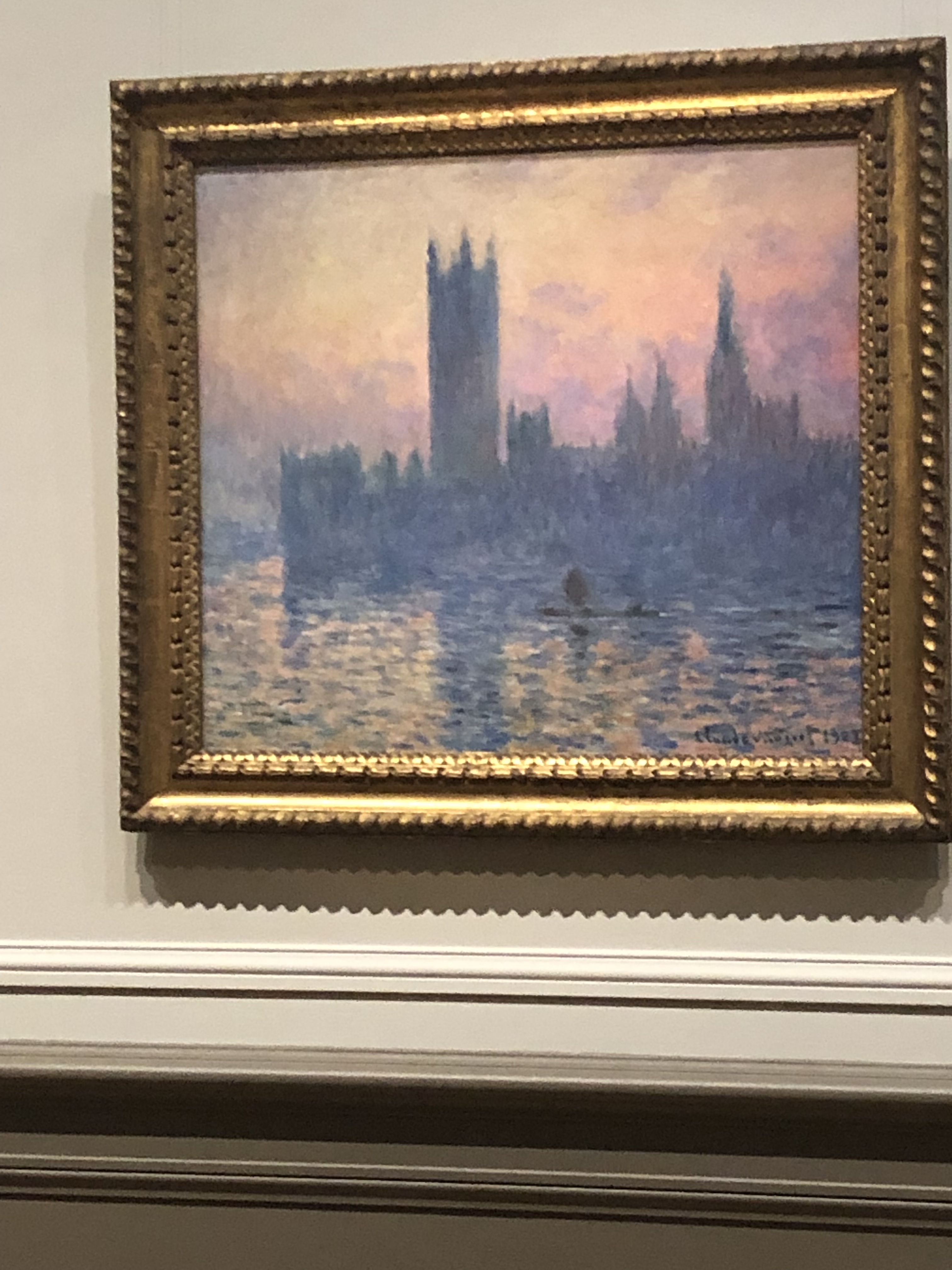 I am looking at a painting made by a French artist of a British building that hangs in an American museum. This seems at once perfectly natural—what else would I be doing? What else would a French artist paint (or an Italian, British, Russian, Afghan, or American)? And where else would a painting be? Of course, this seems only natural because it is what we have become accustomed to, since the time when Ennigaldi-Nanna opened the first museum.
 I began graduate school in the fall of 1988. Writing was still new to me. I had written in high school then in college, but the daily life of writing was only a shadowy presence. I had begun a novel, and tended it during the free time of my six day weeks managing a small Italian restaurant in the Manayunk neighborhood of Philadelphia. Which is to say, that I had written enough to gain admission to a program, but not enough in any real kind of way.
 Since the 1987, I have started at least five novels. Some I carried with me for a few months—the story of a wedding, unfolding like the petals of a rose. Others lingered over decades—the story of a woman who stole paintings. None of them lasted beyond seventy or eighty pages, or in the case of the long project, fifteen or twenty starts at initial chapters. I had notebooks full of scenes, outlines, character sketches, dialogue, and thematic connections. All the while I wrote other things. Shorter pieces, poems, prose poems, essays, sermons, children’s stories. Or I wrote nothing at all and suffered in silence. I believe that I was unbearable in those times.
 The impulse is to judge, and then to correct. Don’t do that, do this. Or at the very least, Don’t do that.
 Almost thirty years ago, I was eating dinner at a little restaurant on the edges of Johnson City and Binghamton, New York. My mentor and her husband had invited me along. These were heady occasions, full of discussions about writing and literature, and the program in which we all worked. I was a student, but, still, I worked. On this particular occasion, they started talking about writers manqué—although I heard it as writer manqués. It was a new word for me. Manqué: having failed to become what one might have become; unfulfilled. They started listing writers who had been in the program, writers who had published and stopped, and writers who were currently in the program. It was sharp and cruel, and the sobriquet stood out as one to be avoided at all costs. These may not have been eternal footmen, but there was snickering enough to go around.
 Nonetheless, the fear of being unfulfilled lurks. In a
  continuoussearch