One of my teachers described a novel as a long piece of writing with a flaw in it. I’m not sure whether she meant us to examine our favorite novels for their flaws, or to pre-exonerate us from the inevitable mistakes we would make. Either way the thought stuck. I get a bit obsessed with perfection—thinking that is the armor against failure. It isn’t.
One of the reasons I frequent art museums is because I am constantly reminded that there isn’t one perfect work of art, or rather, that there are thousands of works that are perfect. My Sunday strolls take me from Kandinsky’s Succession to Raphael’s Alba Madonna. I need that reminder because I have a horrible time making peace with the imperfections—the flaws—in my work.
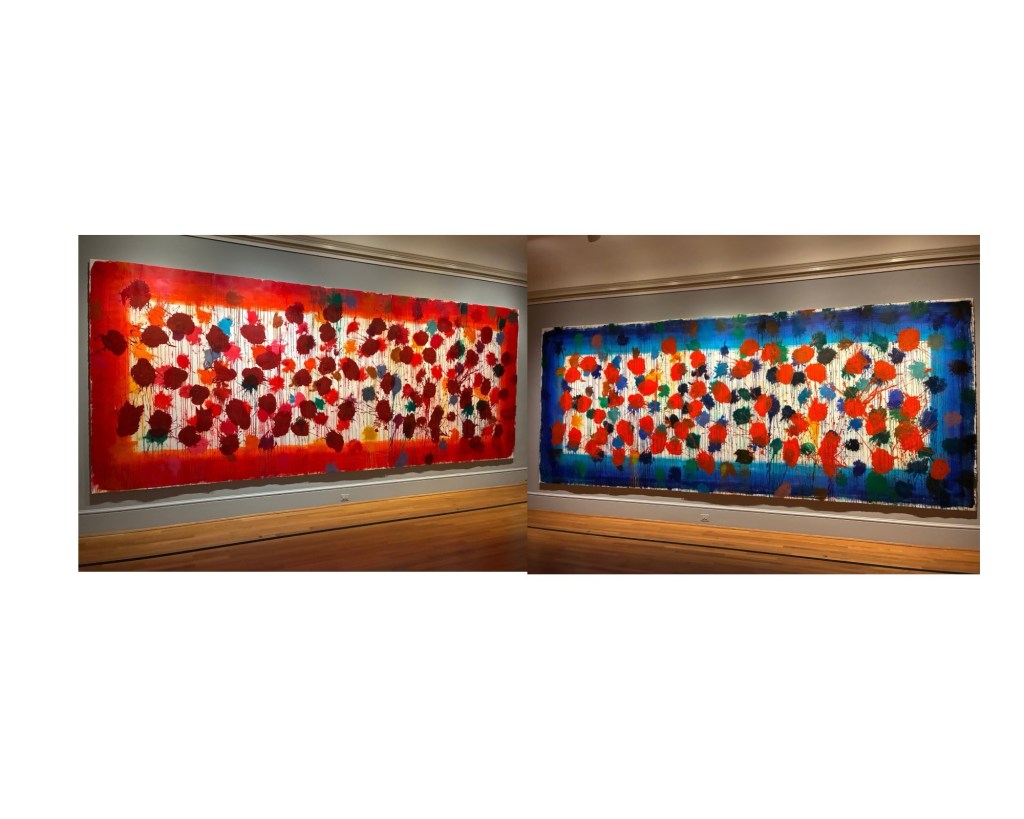
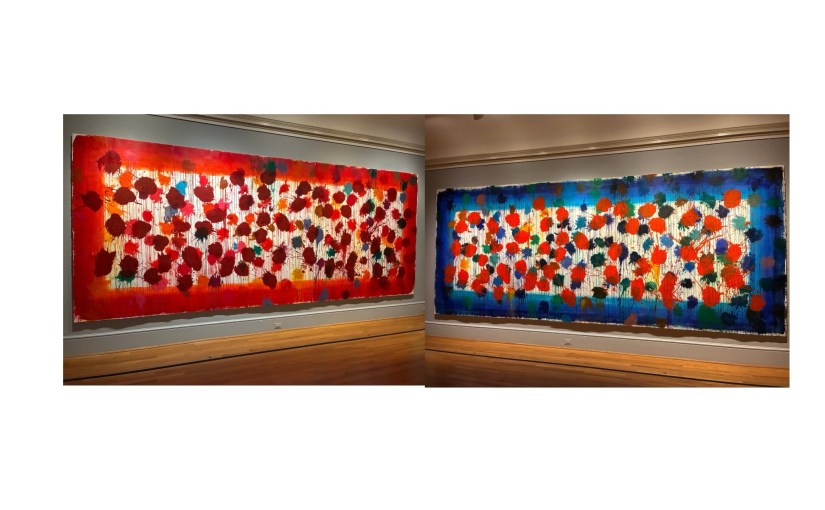
Right now I am taking particular delight in two painting/prints at the Phillips Collection. The two monumental works—each takes up the better part of a wall—are by the British artist, Howard Hodgkin. They are As Time Goes By (red) and As Time Goes By (blue). Each is a print made across five panels of handmade paper with substantial over-painting. They echo each other and diverge in some wonderful ways (the primary being their predominant colors). I pointed out to one of the docents that these works give the neurodivergent mind quite a lot to play with with. The docent kindly, and as a kindred spirit, agreed.
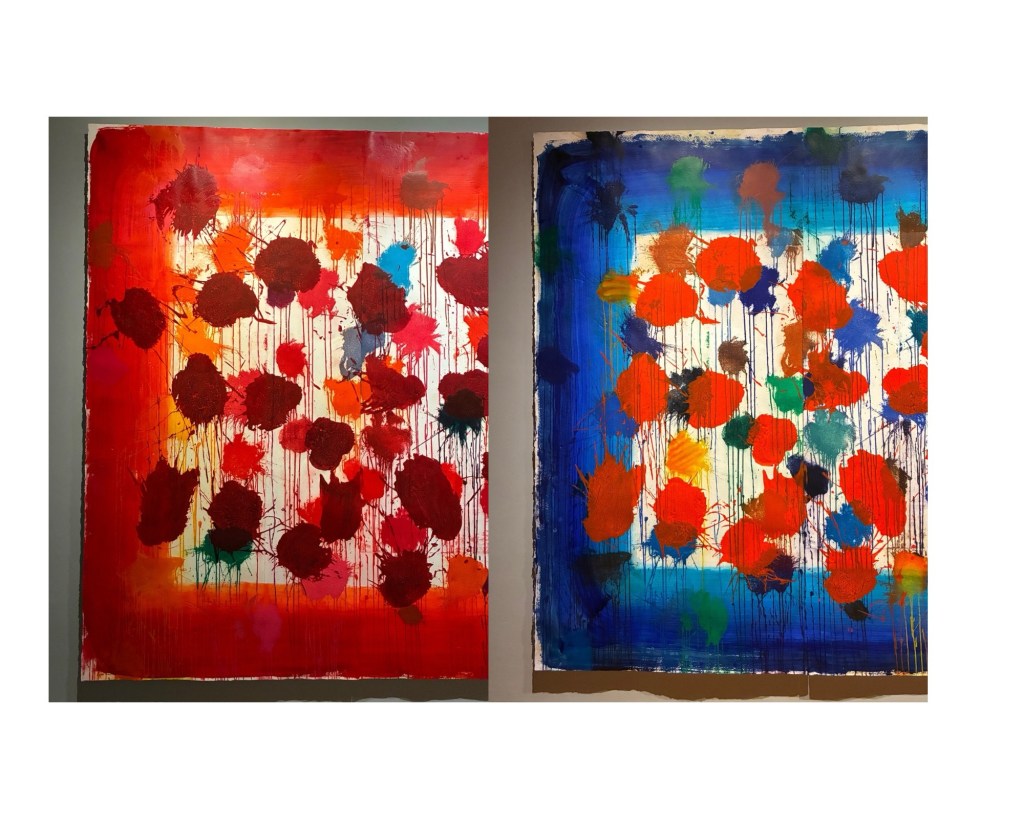
These are the first (of five) panels of the prints hanging on opposite sides of the room. How do you know they are “prints”? You can see that many of the color patches are not just similar, their placement and shapes are the same. The colors differ to be sure, and there is more than a fair amount of hand painting as well that distinguishes the two. I spent more than a bit of time between the two enjoying the interplay of same and different.
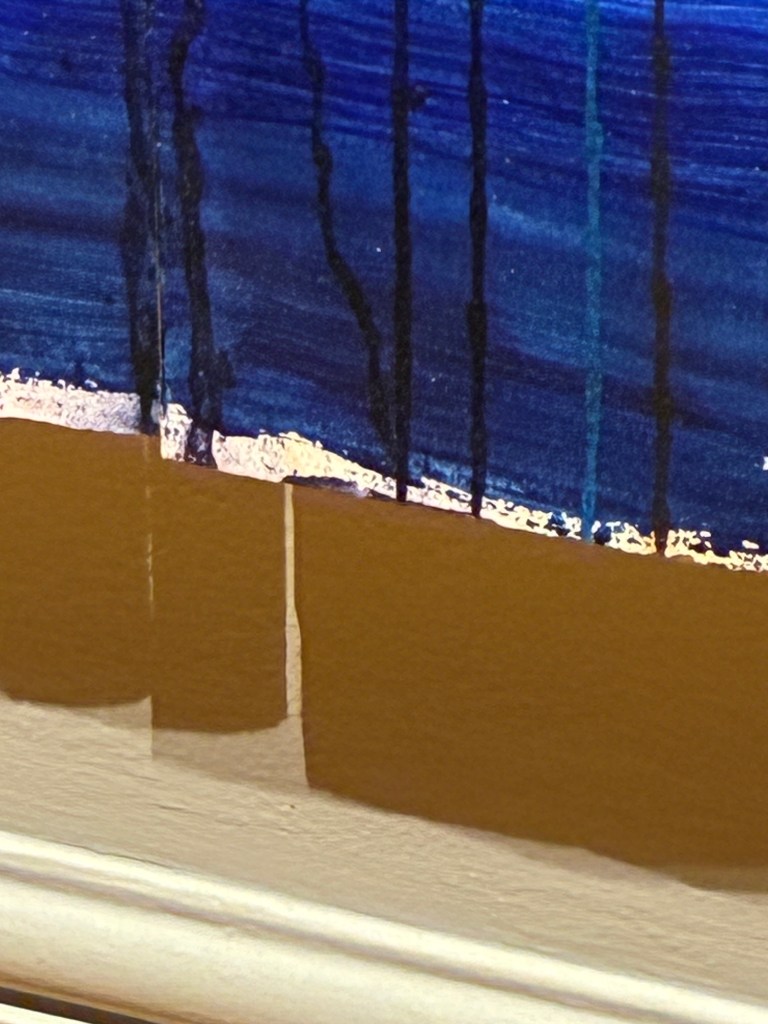
Looking closer at the work, specifically, the shadows the blue painting cast on the wall behind it, I noticed that the seams between the panels are not perfectly aligned. Putting these large pieces together must have been a challenge. When asked about them, Hodgkin said, “They’re big to show that I can do it, despite everything. It’s not a very noble reason, but having been ill with this extremely sinister illness, I felt challenged…It’s the last time I’ll do anything like this…it’s hard work.”
Any work should be a challenge. Sometimes we chalk excellence up to genius, and while I never want to diminish the role of an artist’s peculiar talent—their genius—what distinguishes most work, even beyond the perfection, is the challenge of making—and then seeing—a particular work. As Time Goes By embodies this, because what looks haphazard—like water balloons of paint burst onto paper—is the culmination of precise tactical effort. The artist even made these huge sheets (each sheet is 8’ x 4’) of paper.
What stands out is that in some places Hodgkin painted across the seam, and in others the painting or printing took place on each sheet separately. Do I think the imperfection—the two sheets in the blue not quite matching up—was intentional? A friend once looked at one of Jackson Pollock’s paintings and noticed a daub of brownish paint. “He left it in.” Maybe. Well, he did, but what would removing it have done to the painting. I don’t know why Hodgkin left an uneven seam in his work, and whether it was intentional or not seems to miss the point. The work was hard to make, so much to manage, and the mild misalignment may—may—point to the difficulty of making the piece.
Personally, I love this rough seam, and these two companioned works. But I also love that they are a combination of printing and painting. There are distinct repetitions and distinctly different additions. One might go so far as to say that all his work—all any artist’s work—bears this hallmark. Yes, there are changes. In another gallery at the Phillips there are three works by Picasso—all distinctly “Picasso” and yet and different.
I am aware that I write the same things over and over again. Yes, there are variations and the variations matter, but I do this to show (to myself, to the world) that I can do it, and to express the varieties of experience. The work takes time—no one wrote a novel in a night—and the effort is central to the writing (and the reading). I do it to show myself—and the world—I can. Hodgkin’s work buoys my spirit; it is a challenge worth the effort.


