 History is a story of discontinuous events—events that collide like weather systems or galaxies, having barely understood origins, and even less decipherable records. All the witnesses were destroyed in the collision. What they saw, what they thought, and what they felt—even if they recorded their observations on stone, paper, steel, or silicone, have been destroyed along with them. We are living in the age of delusion, in which we believe in the sanctity of our recorded history—either self-scribbled or captured by another.
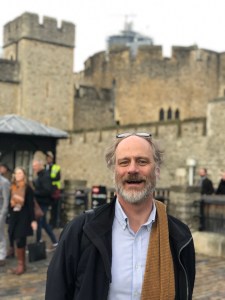
This thought is brought about by two things. First, wandering, quickly—this time—through the British Museum (or Westminster Cathedral, or almost anything else in London), what becomes painfully obvious are the gaps. All these artifacts, so painstakingly arranged create an idea that history is continuous, and has flowed in a linear pattern. And then a closer inspection shows that over and over again, things haven’t come that way. There are sudden breaks in history, when entire empires vanish, or when they change—seemingly overnight—religions, or methods of governance, or technologies, and the old gets swept away, almost as if it was a betrayal of the new.
England as it shifts back and forth between Catholicism and Protestantism bears these marks hard. Or, reading through the story of Ashurbanipal and the claims of glory made by this king reminds me of Shelley’s “Ozymandias.”
Thinking of history reminds me of Stephen Jay Gould’s idea of punctuated equilibrium—evolution proceeding in long quiet periods of little change, and then having sudden outbursts of change. I know, we are taught that slow and steady wins the race, but, we are also taught to believe in the nature of story as an overarching “way things are.” We see things through that frame, and it doesn’t always support the picture inside—or outside—the frame.
 Second, in the musical Hamilton (which was also part of this trip to London), the character of George Washington warns Hamilton that we do not control who writes our stories. He’s telling this to a man who believes in his power to literally write his own story—and to use his words to cement his reality. He can’t—and doesn’t. His wife, Eliza, sends his legacy forward—and Lin Manuel Miranda brings us her legacy. But, as Miranda admits in interviews, even this moment for Hamilton—and therefore, for him as well—is provisional and subject to changing tastes and critical opinion.
Does everything disappear? No. There are 2000 year old Roman walls in London. But Rome? Everything can disappear. And we will tell stories that soften the loss.
I wonder, I can’t help but wonder, what I am doing when I write: whose story I am writing? It isn’t my story. Of course it’s my story–as if it could be anything else. Nonetheless, as I write about characters who are 5000 years old–older in some cases–I think about history, because they think about history. How can they not? How can any of us not? It is everywhere–in the streets, and in the faces, here in London.
 I had always shrugged off the idea of traveling to the Grand Canyon. I was one of those, “what’s the big deal about a big hole in the ground” skeptics. I was wrong. Of course I was wrong. The Grand Canyon is an amazement—and of course, I was properly amazed when I saw it—looking into two billion years of rock will do that, should do that. I realized that what I had held aside was not the geology or the landscape, but the travel. Why had I discounted my ability to be amazed by travel? I had done it all my life. Going, all kinds of going, even if so much of it has been more local—on this continent, in this country—has been part of me all my life.
 I loved airplanes and airports. Departures were invitations to new adventures. When I traveled with my family, I usually sat alone—the hazard or benefit of being an odd numbered group. I took my first plane flight alone when I went to Iowa to swim; I was 15. I traveled by train and bus alone all through my early adult life. I usually traveled to visit friends. However, I also went to cities to simply see them, to look at buildings, and camp in museums—visiting and revisiting works of art that held sway over my imagination.
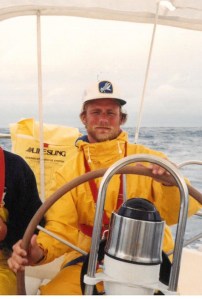 There were trips under sail with my father and brothers. These were tests as well as trips. The ocean makes us foreign to ourselves, our bodies not made to be perpetually wet, and perpetually in motion—shaken and stirred. I have never been anywhere larger than surrounded by sky and ocean, never felt as alive, nor as alone.
 A current meme on Facebook compares what Moms used to say to their kids with what they say now. It is held up as a clarion call to the virtues of yesteryear, when Moms—and their kids—knew what was what. Over and over again, stuff (stuff) like this careens around the internet, in casual banter on news shows, in conversations in my workplaces. Those of us who grew up in the mythical “then” look back with nostalgia, and look at this moment with a jocular disdain. I would like to call “bullshit” on the whole enterprise.
 My mother did what she thought and felt was right. She learned her lessons from her mother and family—and what lessons they were. Some things, she changed. She never leashed us to trees in the front yard. Others were more indelible. I am certain that most of us parent in the same way—sifting through the conscious and unconscious lessons that we received from our parents. What we do, we do almost on a kind of autopilot—in the heat of the moment, dumb memory takes over. Change is hard.
 So much of wit is based on shared experiences. I know I can toss in a “Brian Clements, we love you, get up!” to my friend Brian, and he will smile that wry smile that accompanies a reference to O’Hara. Or proclaim, “Hell, I love everybody!” and he will know what I mean. If I draw my finger across my eye, we have traveled into Bunuel’s fractured mindscape. We share those images and words. I can tell my brother to “Blanket the fucking jib,” and he will know the context. My mother can call me a “Son of a Bitch,” and know the ground upon which she treads. My father would offer a “You have all done very well,” recognizing the provenance of ignorance that surrounded Mr. Grace’s signature line.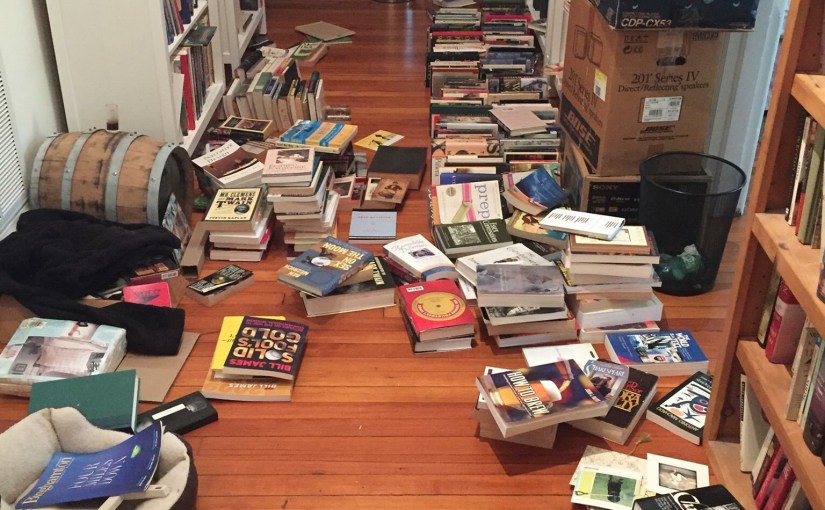
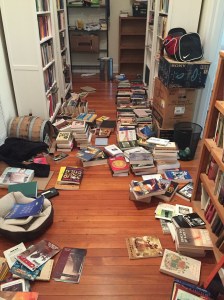 At some point—and it happens fairly quickly—the life of an English teacher becomes more about re-reading than reading. This is a preposterous change from the life of a graduate student, when everything is reading. As a student, there may be a handful of books that one reads a twice, but those are also the books with which one spends an engaged period of time—there is an essay in the offing. If you read them twice, chances are you read them a half dozen or dozen times. By the time you start teaching, the repetition is no longer driven by your desire or directed curiosity, but by a curricular roadmap that more often than not, you have not decided.
 I feel the loss keenly. I am dissatisfied with the too morbid outcomes that serious writers propose, and with the deathly insistence on disconnection and disappointment. And I am dissatisfied with trudging over this same ground over and over again. There must be the possibility of joy, and please, for gods’ sakes, there must be discovery. Which means new works. In “Seymour: An Introduction,” Salinger allows Seymour to give his brother, Bruno, the single best piece of writing advice—and by extension, life advice—I have ever read. It is hopeful. “Imagine the book you most want to read… Now write it.”
 When I sit down to write, I haven’t thought about an audience. Often I feel more like an amanuensis, copying down whatever the universe commands. The universe commands much, by the way. You might call it inspiration—divine or otherwise. I have not spent much time trying to figure out “my voice,” as much as I have trying to listen keenly to what comes my way.
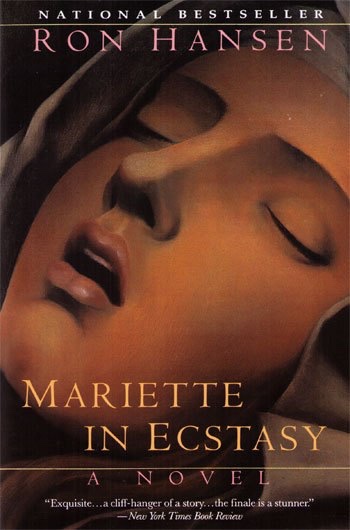 One of my first teachers, Ron Hansen, ends his spectacular novel Mariette in Ecstasy with Mariette’s message from her muse (who just happens to be God). The message is, “Surprise me.” I read that years and years ago, and only now has the lesson begun to take hold. How I wish I had stumbled into that realization 20 years ago. But better now, late as it is, than not at all.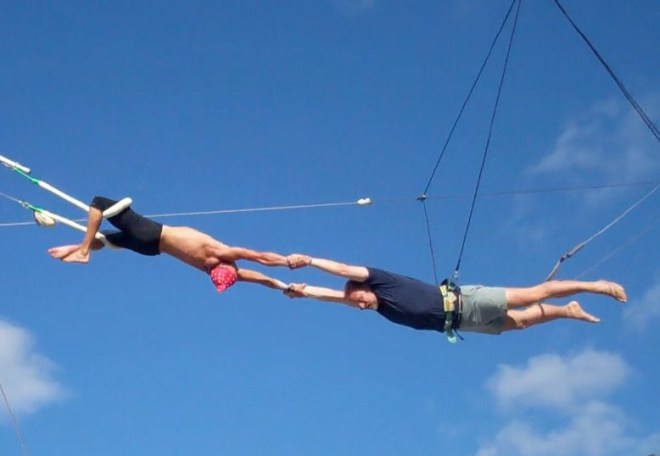
 In between units of my AP English class, I spent a few days with William Blake’s Songs of Innocence and Experience. Blake doesn’t fit nicely into any tradition of British Literature, but his work touches on some of the realities of life in London that other writers ignore. So before we charge into Jane Eyre, Blake.
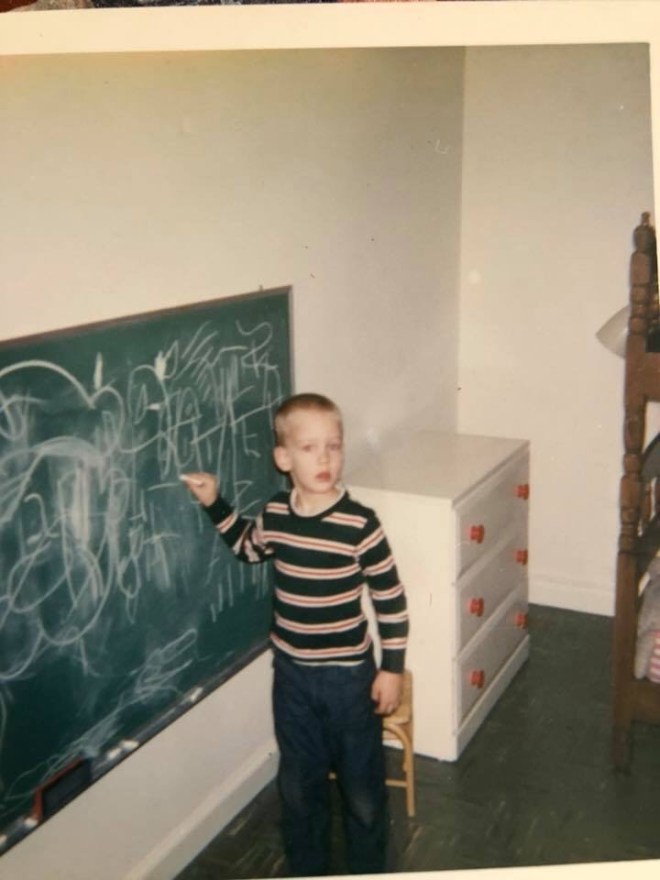 In many ways, I take solace in being surrounded by memories, and there are some that I purposefully mine. The routine of the same lunch—on most days—reminds me of years of similar lunches from the time I was five—earlier—until just last week—and all the lunches in between. I feel comforted by the way those memories permeate my present so easily.
 I have written about the powerful memories associated with places—a rolling set of hills on a road headed north, an intersection with two right turn lanes, a road sign, the curve of a shoreline, a buoy. But, it is everything else as well. All the things. My walls at home are lined with books, and the books speak—not just of what is contained in their pages, but of the times I read them, the places I was, the company that surrounded those moments. And there is more, a gesture, my hand on a doorknob, the sudden turn of my head when I look for something, the way my foot falls on a stair. I am out of myself in a flash, or at least out of this time—even though I know that I am inextricably in it—and another older time surges through me. Even when still, this heartbeat explodes into a thousand, a million other heartbeats, and time collapses.
 And so, beside my own strange face, I also take pleasure in crowds of strange faces, all of whom present unknown avenues, untapped sources of experiences and memories. I know the echoes will come to the strange person I will again be tomorrow.