A woman reads in the lower left-hand corner of the painting. She reads at the side of the bend in the brook under the shadow of a tree growing on the opposite bank. In the center, a patch of light bursts from the sky off in the distance, and two figures—are they fauns?—sit in the shadows underneath trees. She is smaller than the trees in the Forest of Fontainebleau, smaller even than the stone that juts out over the stream. Because she is human, she draws our attention. She is not nude. Her gaze does not capture ours; she is reading.
She is reading, and perhaps we would scold her for not paying attention to nature. “Look at the trees!” we might exhort, much in the same way that we scold friends on cellphones. “Look up!” How little things change in 200 years.
And yet, that rock that the stream has not worn away is like a fulcrum; it balances the reading woman and the rest of the world. Literature vs. Nature. Or maybe a portrayal of nature balanced against nature itself. Much like me, today, at the museum. I could be walking on a trail, along a beach, or on a sidewalk that borders the Thames. I am not. I am in the National Gallery, looking at paintings and writing about what I see.
Perhaps you could read the painting as a dream: the forest is what the woman reads about. Everything above the thin sward of grass where she reads is the thought ignited by the words in her book. Or perhaps Corot wants to tell us that a book has the same weight as everything else in the painting. That may be a warning as well—literature (what kind of literature? genre fiction? epic poetry? something Pynchon hasn’t written yet?) is going to replace nature.
I think of it as a challenge. Write something that can match nature. I love the made thing, the work of hands, whether it is an almond croissant or a cathedral. When we make beautiful things, we transcend the ingredients of our craft. And this: write something that keeps her reading. Yes, writing is about me—my words! my vision!—but what else matters more than that woman by the brook? I write for you.
The year came and went. After having change imposed on me, all I could think of was, what could I change? What would match the upheavals of the past fifteen months? The pandemic, my mother’s death, the next round of the pandemic, my school’s response to the pandemic, the election, the pandemic, the insurrection. It felt as all I did amounted to little more than defensive maneuvers: wearing a mask, cleaning my mother’s house, writing words for her service, eating outside, voting, reading the news, and charting the waves, eating outside in cold weather, wearing two masks. All I could do was persist.
I hate “persist.” Fuck resilience.
And yet, I love to persist—to take the helm in a storm. But to go! To have a destination and a challenge in mind, and then to pursue it heroically. Listening to The Iliad (because what else does one do when one needs to be reminded of heroic persistence?), I am struck by the grinding effort of warfare, even heroic warfare. In among the shining moments of triumph, Ajax sweats. Idomeneus is wounded and then returns to battle. Achilles waits. Before we witness his mastery of battle, he is a master of brooding. A friend said, “But he’s a god.” He is the son of a god, but many sons of gods perish at Troy. War does not distinguish—or it did not.
Over the past two years, I have learned the value of persisting at my work. This does not mean learning to put up with the slings and arrows of outrageous fortune or the stupid requirements of the day—of all the other things I must do. This year, everything that took away from that work became anathema. Returning to the slog and joy of persistent daily writing has reminded me that anything else is not enough. While I am willing to work and commit to the project, I also need to throw overboard everything—and everyone—who does not contribute to my journey.
After all, writing is work. It isn’t something I do to make me feel better. I listened to a young man who said that his writing “picked up during the pandemic” that it helped bond him to his friends. These posts try to reveal some of the bones and muscles and nerves of the writing animal. And while I may feel connected to some of you when I write them, I am still at work. I may not sweat as much as Ajax, nonetheless I aspire.
One of the clichés about writing is that it comes from inspiration. We focus on art and the ineffable merits of vision. Yes, some writers are more talented than others and have a scope and art that exceeds all others. If you don’t have a list of 10, or 100, then you haven’t really thought about the problem and challenge of excellence. It’s a worthwhile list to make, so long as you don’t turn that list into a wall or a fortress. Walled cities do fall, but the casualties are as numerous as specks of dust in the air. You would die counting them.
What sets most writers apart isn’t vision. Writers write. Yes, Harper Lee goes silent after her one great book, and after a flurry, so does Salinger. Dickens, Woolf, Rushdie, Mahfouz, Kawabata, Austen, Eliot, Morrison. Or consider Rowling, King, Grisham, Steel, Gabaldon—writers whose books edge others off the shelves in bookstores. If there is inspiration, then it is the inspiration to sit down (or stand up) and write. Success—often determined in monetary terms—helps fan that inspiration (You like me! You really like me!), but chances are that those writers already established a habit, a ritual, or, more likely, a regimen. They worked, and the work was their inspiration.
I have the natural bent to slog but have lacked the discrimination to choose the slog that best suited me. It is so easy to fall into work that offers something like a reasonable remuneration. Except no amount—neither how little nor large—is enough to satisfy. I am reminded of the psychology experiment in which a rat is rewarded for performing a task—pressing a lever. The rat that received a reward each time it completed the task stopped; fat and happy rats will not work. The rat that received no reward gave up quickly. No shock there. However, the rat that received rare and random rewards pressed the lever feverishly. I have been that rat. Give me a task—any task—and watch me work for unpredictable and unsustainable reward.
When I began writing in earnest three years ago, after a hiatus driven by all manner of tasks (worthy, meaningful tasks, I should add)—I knew that I was fighting against the idiot rat. Or that I was in the wrong experiment. Because I do not expect the rewards to be anything other than rare and random: someone from Senegal read my blog post; an agent sent a complimentary rejection; the audience at a reading sat enraptured and gasped in unison at the right place. There are moments when, after putting words on the page that I raise my arms in triumph. I delight myself, which is, fortunately, neither a rare or random occurrence.
And I am not a rat. Neither am I an ape nor a proto-human. While those instincts and drives may be part of the first draft of my evolving consciousness, evolution has provided me with a brain that can reflect. My brain (and yours) produces an inner voice that can guide me out of danger or deep-seated dissatisfaction. So, back to resilience—while I can persist or, even better, thrive in less than ideal circumstances, I can see that if those circumstances can be changed, I can change them. I can rewrite the early draft of my life.
The challenge for the late writer is that unlike Dickens or Woolf or take your pick, I do not have habits so ingrained that an explosive event—or a persistent eroding series of nonproductive events—will not affect them. And so, I must make a way forward that limits time spent elsewhere. I have lessons—the Sailing Lessons included—for how to plot my course. I have completed my practice sails. It is time to go, leave this year behind, and count the words as they tumble down.
I got chickenpox, mumps, and measles. I had my tonsils out—an operation that required an overnight stay –when I was in 3rd grade because they had been the source of repeated infections. I bounced through cases of flu and other passing illnesses. Years later, I had mononucleosis during the first semester of college. Nothing keeps us from bumping into some microscopic problem. And forget about the web of mysteriously genetic and environmental causes that lead to Parkinson’s Disease or Non-Hodgkins Lymphoma—the two illnesses that plagued my parents—but that was on the distant horizon.
I read Alistair MacLean’s novel The Satan Bug—in which a mutant virus threatens to wipe out humanity—in the 7th grade. In a world that lived under the menace of nuclear war, a biological threat was quieter and almost less tangible, and therefore more insidious. I traced these threats through films and books like The Andromeda Strain,Pursuit, and Rage. Even Close Encounters of the Third Kind used the possibility of a gas or disease outbreak to move the plot along. The insidious unseen nature of these gaseous or microscopic adversaries held my interest.
In my 20s, the HIV-AIDS epidemic galvanized my attention. How could it not? The emergence of a disease that would kill you after sexual intimacy staggered all of us who enjoyed the freedom afforded by birth control and an unshackled moral climate. We felt screwed (and not).
Whether fear or mordant curiosity drove me, I began to study viruses and epidemics with fury. The sudden spread of hemorrhagic fevers that Richard Preston (The Hot Zone) and Laurie Garrett (The Coming Plague) wrote about exacerbated my concern. It was impossible to moralize about what was coming—this wasn’t about sex. Deadly diseases lurked. Diseases have always been half a hair away. In Norfolk, a small park memorializes those who died during an outbreak of Yellow Fever in 1855. I lived a block away.
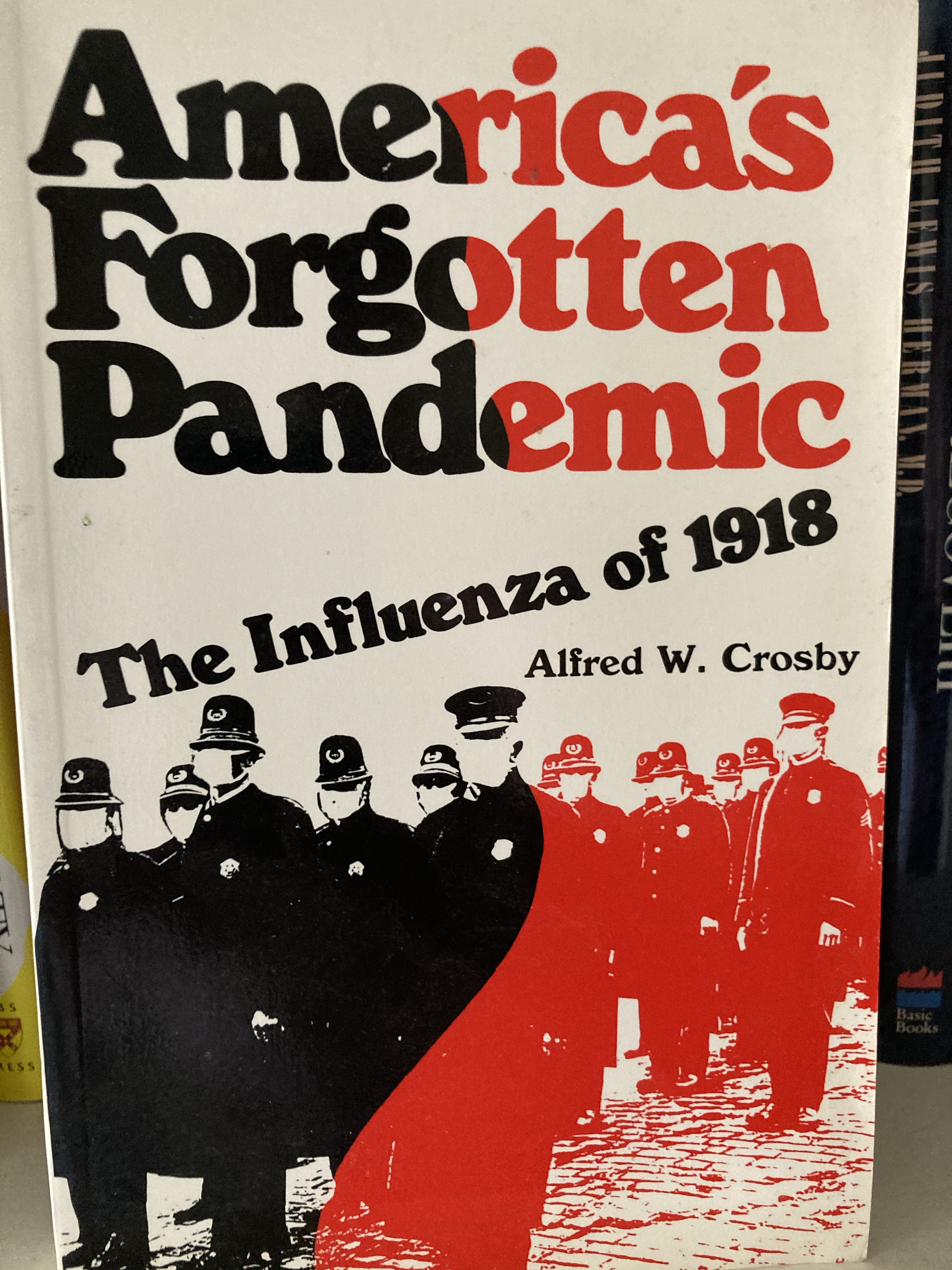
Still, in my 30s, I read Defoe’s Journal of the Plague Year and Garcia Marquez’s Love in the Time of Cholera. And then, almost by accident, stumbled on reports of the Spanish Flu Pandemic of 1918. I read Alfred W. Crosby’s America’s Forgotten Pandemic at some point in the late ’90s and then John Barry’s The Great Influenza when it came out in 2004. How could it be that we all knew about the Great War, but not the pandemic that occurred at the same time? We know about this now; Barry’s book made it to the bestseller list in 2020, but the memory of the pandemic faded in popular culture. I was surprised this past year when I realized that Mr. Gower’s son dies of influenza in It’s a Wonderful Life; it was the Spanish Flu. Where else was the pandemic?
So when COVID emerged in the winter of 2020, I was not surprised. After all, SARS and MERS had already flourished in their own specific ways. When it became clear that this would be more serious, I bought masks as soon as possible, kept my distance, washed my hands even more assiduously than usual, and settled in for the count. History provided stern warnings; I knew that a count—of cases and deaths—was coming.
We like to predict what will happen, and strangely enough, we tend to think that the future is unwritten. It is, and yet, for a good indication, look to the past. This is true whether you want to know what the weather will be like on May 14th or if there will be traffic on I-95 tomorrow morning. Yes, there are exceptions and random occurrences that will skew the numbers, but the past is all too reliable a guide. Fifty Million people have not died from COVID as died in the last great pandemic, nor have half a billion people contracted the disease. But our imagination does not need to stretch far to encompass those numbers. 675,000 United States citizens died in the influenza pandemic; that number is all too close to where we are headed this year. Yes, the population was smaller in 1918-19, but did anyone expect this to happen?
Over the past year, I gobbled down the numbers. I felt a strange intoxication with having a sense of where things were headed and seeing them move, painfully, sadly in that direction. Anthony Fauci, and most of the medical community, played Cassandra to a population that wished for another outcome. As if wishing could make it so. But what good did it do to know? What effect did my knowing have on anyone other than me? The numbers were a despairing gruel that neither nourished nor encouraged me. I had to wait them out. Eventually, I stopped reloading the numbers every hour and settled on the grim results that appeared each morning in the New York Times.
So what’s the point? Partly this: when you see it coming, get ready: hurricane, pandemic, or whatever is on the horizon of time and place. Get ready before you see it. You have been sick before; people have been sick around you. We should have known better, and our ignorance cost lives. The obvious is always right there. Yes, while knowledge can be overwhelming, there must be a sweet spot: enough information to teach us and lead us into productive discomfort without flooding us into anxious inaction The only way we learn is by exposure.
But there’s something more.
There must be a reason that the pandemic of 1918-19 disappeared from memory. Why and what do we forget? We forget, or remember selectively, and not just about events like pandemics. I’m not aiming at what we don’t retain. As a teacher, I am too aware that students do not retain everything. I wonder why do we forget some things and not others? This is not a reflection just on this pandemic or the last or the run of diseases. What else have I forgotten? I scramble to instill new habits and new awarenesses or avoid falling down the well of past practices. To borrow from Robert Creely, “[w]hat am I to myself that must be remembered, insisted upon so often”? But more, what have I failed to remember and insist upon?
We resume the remembered rhythms of our lives and return to our old habits and anxieties as if they were never interrupted. Repetition has essential gravity and draws us back. Except sometimes some things should interrupt us. The persistent nudge of discomfort—that we do have something new to learn and some new way to behave—should goad us onto a new course. Except, we stay the course and return to the known, even if it is a life half-lived.
I can (and I suspect that I will) point to the world and shout, “J’accuse! You forgot!” I shout at myself. I must insist that I remember—or that I remember to insist. I write in the face of forgetting, in the face, to borrow once more from Creely, of “the tiredness, the fatuousness, [and] the semi-lust of intentional indifference.” I must return to the hard work of insistence.
I grew up reading the news. We did not watch it in my house; my mother felt that the news, which included reporting from Vietnam, was too ugly (her word) for her sons. Keep in mind, this was the same mother who read Edgar Allan Poe to us at bedtime. However, my father brought home the Philadelphia Bulletin every night—back when the Bulletin was Philadelphia’s evening newspaper. He also had Time magazine delivered weekly, and my brothers’ names were often on the subscription. Whether my father was honoring us or getting a new subscriber’s bonus, who knows? I read both.
Later in life, I listened to Philadelphia’s all-news radio station KYW-1060 and grew inured to the rhythm of repeated stories. If they were updated over the course of hours, I noticed. Even later, when I was a night owl, I would slot in my 35 cents for a freshly delivered morning paper. A newspaper and breakfast before bed was near to heaven.
Cable news in its early iteration varied little from the repeated scroll of radio news. That was no matter in Philadelphia, which delayed the spread of cable TV until I was on my way to grad school and other obsessions. Nowadays, whatever used to be journalism has faded out of reportage to be replaced by a carnival barker’s promotion of something like the news. Reporting is more about the changing opinions than the changing facts. The internet does better, providing repeated updates of the day’s events: everything from the stock market to an ambassador arriving in Bahgdad to a 3-2 count on a hitter in the fourth inning of a baseball game in Seattle. Information pours out. At first, it came through the box on my desk, but then it glimmered miraculously from my phone. I pay attention.
I get obsessive. I chase the news with the same intensity that I once chased down sources in the library. And worse. I sit as rapt as I had when I churned through drafts of stories until 7 o’clock in the morning—if I slept at all.
I recognize that I had fallen into the trap that Henry David Thoreau noted back in 1854 when he claimed that “[h]ardly a man takes a half hour’s nap after dinner, but when he wakes he holds up his head and asks, ‘What’s the news?’ as if the rest of mankind had stood his sentinels.” I felt that if I knew, then I could be one of life’s sentinels. On guard, on the post, always. There was no radio, no television, and no internet, and still, he bemoaned the obsession with “news.” Go figure, our national illness.
I tried to know everything. When my family gathered, we were all expected to hold forth on any topic of the day: popular music, politics, foreign affairs, movies, the weather. Our knowledge was expected to be sweeping and insightful. I could not understand people who did not consume—and comment on—news as we did. My father spent hours wringing information from the Wall Street Journal and passed that fervor onto his sons. My mother, despite herself, had some news station, finally settling on NPR, blaring in the background.
It was too much. This past year’s perpetual blast of breaking news—the fires, the politics, the case numbers—drove me to distraction. And I realized that I had been distracted for years. I don’t believe that “ [a]s for Spain, for instance, if you know how to throw in Don Carlos and the Infanta, and Don Pedro and Seville and Granada, from time to time in the right proportions… it will be true to the letter, and give us as good an idea of the exact state or ruin of things in Spain.” While there are recognizable patterns to history—and history’s first draft—the distinguishable differences are meaningful and worth noticing. And yet, the news can pile up.
Thoreau was on to something, if only that our drive to know masks another deficit: a feeling that life is out of our control. Information is the salve to uncertainty, but it’s snake oil, especially when opinion is disguised as fact.
Writing, for all my appreciation of the uncertainty, is about control. At the very least, and perhaps the very most, I control when I write and that I write. As for the what, well, I take a gentle hand, relying on surprise and a fair amount of chance. Yet, I am aware that no writer, short of a few Dadaists, Postmodernists, or Pornographers, slaps words on the page and waves, “Voila!” I avoid Prufrock’s “hundred visions and revisions”; I don’t have time for such nonsense. The work needs to be done.
During the first draft, I write to discover—just as I listen to the news to find out what is happening in the world. I research my subject the same way I study how the new vaccines work. I have learned (painfully and too slowly) that I must write to the point where I do not know what will happen next; there must be surprises. I go back, organize the words, and develop the surprises, letting them, and not all my preplanned ideas, serve as guides. The writing must be out of control for me to find control. Otherwise, it all falls flat. That was not an easy lesson. No one can stand that—not the reader and not the writer. Not this writer.
This past year, while everything felt out of control: the fires in Australia, the pandemic, my mother, the election, and its aftermath, I charged back into the news. Did knowing all about it help me? Maybe. But knowing got in the way of the creative uncertainty that I needed to engage. I have spent years wielding some kind of authority, and like it or not, that has been the death of my creative life. I do not know how other writers do it. So, for now, I am backing away from the news, cutting the cable, and heading back into the unknown.
Emily Dickinson writes about the “Route of Evanescence”—the road of fleeting possibility. Take her advice. This way can be daunting, especially for someone who likes—no, loves to know. You too write to be in control, except, finally, we are not. But the route Dickinson so briefly and beautifully delineates is one way to uncover the mysteries that wait: “Some mail from Tunis, soon.” So must it be. The unknown and fleeting. Get there.
I had changed my life, leaving a world in which I was relatively secure and not writing. I had made walls for myself to hang paintings and prints, in which friends could visit, and my daughter could stay three nights a week. Like the song says, this was not my beautiful house, this was not my beautiful life. There are a thousand, no a million people who would have doggedly pursued the life they made, the life I created. I was a principal, a teacher, a program director at my church. And I felt profoundly unsatisfied.
Just recently, I finished teaching Joyce’s “The Dead.” Again. I pointed out to my students that the whole point of literature is to learn about life. In “The Dead,” Gabriel Conroy is an English teacher; he has, for all his life, read and learned about life. And yet, when life comes at him, he fails. He is stuck—beautifully stuck if we believe that the story’s closing coda is his thought. Yet stuck he is, like the “never-to-be-forgotten Johnny” going round and round the monument of King Billy. And if the beloved Gabriel, the angel of the Annunciation, the deliverer of the good news, is stuck, what hope have we?
I was stuck.
I had set out on a course years before and had finally begun my way back. I had started writing—nonfiction, but words are words—and I began to reapportion my responsibilities. I left my jobs and my home.
“You are in transition,” she said; it was not a compliment.
When I think about literature, which I often do, most of the lessons are about managing change or how to change well. The ponderous chain that Scrooge girded on with his own two hands represents one form of paralysis: bondage of the heart and soul. Odysseus stuck on Calypso’s Island is a variation; the prison of our hopes and dreams can be ecstatically pleasant. In her book of poems Dream Work, Mary Oliver acknowledges the pain and weight of abuse and her need to live on despite that weight. Either we recognize “What good does it do to lie all day in the sun loving what is easy?” or we simply resort to the easy. Sometimes the weight is what is easy. Habit is like that.
Writers must have habits. In the end, no matter what we write, we must write—every day. But we must also write outside the narrow band of habit, beyond the immediate limit of what we already know. This—pushing the limits—is not true of all writers. Some work the known to great effect and profit. While I recognize the value of profit (Mr. Dickens tilled his well-worn field to fame, as have most successful authors), I come to writing as a way of discovering
I have discovered this: I must mine uncertainty. I have friends who claim that when they begin a novel, they know the last line and write toward that goal. I tried that, and it did not work for me. I tried and tried and mapped and mapped and was stymied. I lost faith and put my efforts into other work, into another life. The work was good and meaningful, as was the life. Still, I felt unfulfilled; a promise went unmet. Maybe I needed to suffer that loss (maybe) to find the spring. What good would regret do now?
Gabriel regrets. Marley regrets. Peter Walsh regrets. I had tried that too easy suit as well. I took it off.
I began without even so much as a first line. I charged in and kept going. I churned through a hundred thousand words. Not a day passed when I knew where I was going. I trusted the process. “I learned,” as Roethke wrote, “by going where I had to go.” And that’s the point—I had to go. While I fill my life with routines, as long as I conserve enough energy and joy for the project at hand, the writing surprises me. That is how I must proceed. Surprise is met on uncertain ground, and there it is I must go.
“You are in transition,” she said, and yes, I am. I must make peace with that—that my method needs me to be ever in the air, landing where I need to be for a year or a minute, long enough to write for a day and a month and the rest of my life, and then, always, casting my lot with chance and discovery. The old song commends “to turn, turn will be our delight/‘Till by turning, turning we come round right,” and, yes, this is the simple lesson I have learned—and which I have fought against too often in the past.
There are risks to this: to be always turning. But holding tightly to the chains also presents a risk—and a certain one. Back into the maelstrom I must go. Time to turn.
Will this work for you? Will change and uncertainty produce a sudden outpouring of words? I do not know. I do know that surprise is what brought me to literature in the first place. Writing that made the world bigger than it was before I started reading kept me reading. Is that true for you as well? Perhaps you seek confirmation and affirmation. I understand the gravity of both, and that may well be what you need. Or, you may already know what makes the world larger. Maybe you are sure about that. Then perhaps we are different kinds of writers and this advice is lost on you.
If not, in spite of yourself, in spite of your routines, charge into the unknown. Embrace uncertainty. And write.
Two years ago, I rekindled this blog with reflections about what I learned about love from movies I watched in my youth. Love—in all its tangled brilliant forms—is the flame for this moth. Contemplating that light allows me to see through the darkness. Over 40 years ago, my cinema professor, Kaori Kitao, asked us what cinema was—the big question—to which she supplied the final answer after we had all tried our hands. “Cinema,” she said, “is light.”
Of course. What we saw on the screen was light obscured at 24 frames per second—light shaded and shaped into colors (or not) and accompanied by sound (or not). In our Wednesday afternoon classes, we sat and watched—over and over, for 3-6 hours—film projected onto a small white screen. Professor Kitao would speedily rewind reels of film so she could point out—over and over—the traces of light on the screen. There were secrets to be found.
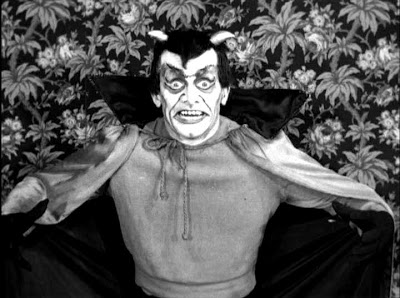
I found love—or at very least, desire. The opening scenes of Bergman’s Persona spelled out what the light could do. I was too shy at 20 to comment on the erect penis that flashed oh so briefly (not that briefly!) on the screen in the opening montage. Love and sex. Desire and death. The devil that dances in that opening sequence reminded me of a childhood dream I had of a green-skinned devil who hopped about in our living room. Cinema is a dream—all dreams—distilled by light. And dreams take place in the dark.
If love is my light, there is also darkness. I struggle with darkness—with seeing it too much. In Peter Chelsom’s underrated Funny Bones, one of the characters remarks that Jack Parker—the comic genius of the film—sees the dark side of comedy too clearly. I saw that movie on my 35th birthday, and it crystallized my thoughts about comedy and tragedy. There are things that some of us see too clearly, that most of us just laugh or cry away. We turn our faces to what suits us best and call what does not please us “the other” in one of its many names.
However, the dark is not merely the absence of light or its easily demonized opposite. It is a vital source of energy. How long did it take me to accept that? I’m still working on it.
I saw the movies that taught me those first lessons about love when I was a teenager—or younger. With a few exceptions, the films that helped me grapple with the dark were part of my twenties—the lost years after I graduated from college and before I began graduate school. With few exceptions, I saw all these in movie theaters (or I have seen them all in theaters). I was fortunate that there was a revival house in Philadelphia (the TLA) that showed old movies. And, while Philadelphia had no cable TV, one of the UHF stations played classic films late at night. I watched. And dreamed.
Unlike the movies that taught me love lessons, these are uniformly great films. There are no April Fools or Hotel here. Maybe that’s because after taking Kaori’s class, I had learned to turn my eyes to more serious work, or maybe that’s because darkness instigates a different kind of art—more obviously profound, more apparent attempts at art. The distinction matters and does not matter. What we see in the dark is a dream. Great or not, these are no more real—or just as real—than the films I wrote about two years ago, the same way that my dreams are neither better nor worse than when I was a boy. Out of the light and into the dark.
Evil. What is evil in these films? Inhumanity. Failure. Fatal inevitability. Some incredible compunction on the part of the characters to launch headfirst into harm, and to take large swaths of their world with them. I saw these at a time when I became more starkly aware of the evil that was at once accepted and codified in the world around me. Sure, I had warnings along the way, and sure, these films are not life—any more than the movies that taught me about love ever substituted for the harder lessons that life delivered. Still, they offer up the contradiction: darkness painted with light. And each one provided a lesson that stuck, even if I disagreed with its premise.
At some point, you are going down the tubes, over the edge, off the rails. You may have something to do with the inexorable demolition of your temporary hopes and dreams, or a house may fall on you from out of the sky, while you are in mid-sentence about to say the most profound thing anyone has ever heard. Or not. You may be doing nothing more than mowing the lawn and wondering why it has gotten so dark so suddenly.
What prepared me? Nothing. I led a life of easy glory. Success came without consequence, well other than the third grade geography teacher who told me that my coloring was atrocious, or awful, and I wondered how the other kids filled in the map without the striations of crayons. So what, I won the class spelling bee. I sang in the chorus and joined the math club. Years passed, achievements accumulated.
I sat in my car after the first night I played in our local poker game in Pittsburgh. My heart pounded wildly in my chest, and my hands shook too much to take the wheel. I had lost sixty dollars, which was, at the time, the most I had ever lost at cards. I had played in a casual game in graduate school, and rarely lost, and when I did, it was the cost of a couple of cups of coffee at the local diner. And my winnings were rarely more than a few plates of hotcakes. Sixty dollars hurt. When I returned the next week—it was an amiable bunch of guys, and I sought their company as much as the play of the game—I played to watch and learn. I did.
Over time, I earned back my initial loss, and rarely lost in that group of players. When I sat down to play, I sat down with a plan, and with the hard-honed anger that allowed me to focus on the task. One player’s wife remarked that I had more testosterone than anyone else at the table. It was a back-handed compliment. She was—still is—a feminist, and masculinity, even back in the nineties, was out of favor, especially among academics. Which we were. The game was made up of Ph.D. candidates and recently minted Doctors, along with a few locals (a movie reviewer for a local paper, a former Priest turned pharmacist, a former UPS worker, a purveyor of goods imported from South America and Southeast Asia). We played the gamut of Friday night neighborhood poker games—all sorts of strange and changing wildcards. Maybe that was why I lost the first time I played. Probably not. Later, when Texas Hold ‘Em became de rigueur, the table talk abated. Most games are quieter now. I miss the conversation—it took the edge of the testosterone. But I never forgot that first night.
We don’t learn from losses unless they hurt. A short sharp shock teaches better than a slow accumulation of pain. Maria Konnikova includes an early chapter on loss in her book about poker, The Biggest Bluff. She writes, “After all, losing is what brought me to the table in the first place. It makes sense that learning to lose in a game, to lose constructively and productively, would help me lose at life. Lose and come back. Lose and not see it as a personal failure… When it comes to learning, triumph is the real foe. It’s disaster that’s your teacher. It’s disaster that brings objectivity. It’s disaster that’s the antidote to that greatest of delusions: overconfidence.”
Later in the book, when she begins to recount the disaster that ended one particular tournament to her mentor, Eric Seidel, he tells her, “Stop… Look, every player is going to want to tell you about the time their aces got cracked. Don’t be that player. Bad beats are a really bad mental habit. You don’t want to ever dwell on them.” This may seem contradictory. Learn that losing is part of the game, but don’t talk about them. As long as you made good decisions, the outcome does not matter. Win or lose.
But, you say, don’t we play for an outcome? No. We play because we love the thrill of sustained focus. Making precise, intricate, and meaningful decisions allows us to shine. Define “shine” as you will. I recall Baudelaire’s poem, “Get Drunk”—“With wine, with poetry, with virtue, as you choose!” Choose where you will shine, and focus furiously. I stopped playing poker, saving my focus for what brings me back to the world. I write.
In my classroom, there are a series of posters proclaiming, “Think like a poet,” “Read like a poet,” “Write like a poet.” They were there when I arrived, and I left them up. The joy of writing (and yes, here’s where this comes back to writing), is the simplest of pleasures—making decisions, and learning as you go. You learn the process when you learn to read. (Or not.) You approach the text as a series of branches. “Tomorrow and tomorrow and tomorrow…” Why the tripled “tomorrow’s”? Why the “and’s”? What comes next? (Creeps…). If you learned to read like THAT, then you have practiced how to write.
And losing? What is the bad beat in writing? Rejection? Better writers than I save rejection letters; there are even books full of them. A book of bad beats. Why? Writer’s block caused by what? A lack of simply sitting and scratching out a few words on unproductive days? Hardly. Turn on the music and write about that. Watch the news and write about that. Talk to your friends and write about them. Walk and write about what you saw. Just write.
The bad beat is the loss of faith, in the belief that your vision is enough. I don’t know what caused it for you, or how to restore your loss. Follow me, let me be the Virgil to your Dante. Imagine that—me, Virgil. You will lose—midway on life’s journey, the right road lost. But there is a way. Follow.
Say, you live in Maine, far from the coast, in the softly rolling hills in the part of the state known as “The County.” In Winter, the days are short and bitter with cold. You are not at war with the dark, and the winter wind is not your enemy. You may decide to move someplace warmer, where the sun rises earlier and warms the world even in January, but no matter where you go, The County will be cold in January.
Say, you live in Florida, and for four months each year, you pay special attention to the weather forecast in the morning. You have sheets of plywood stowed away in your garage, just in case. In Winter, the streets fill with license plates from places up North. Hurricanes and snowbirds are the limits of your life, but you aren’t ready to chuck it all and move to Tempe. You aren’t at war with hurricanes—what a futile battle that would be. They pass through, soaking the earth and knocking down trees. At least they aren’t earthquakes—unpredictable and worse than ornery.
My father planned his trips to Bermuda in late May and early June—when the weather was usually warm enough and before hurricane season roared into full flower. Only once did a tropical depression explode into hurricane force. We were still inside the reef, making our way from Hamilton to the customs house in St. George. One of the ferries veered off its routine course to check on us as we were about to depart Hamilton Harbor. My father’s stubbornness was as unrelenting as the weather. It took us a day to power around the island’s northern passage—a trip that usually took scant happy hours. I held the helm as we motored inch by inch into idiot winds. I slept well in an uneasy anchorage that night. By morning, most of the cell had crawled on, slowly dissipating in the pan of the chilly Atlantic.
A sailor, a Floridian, or a Down Easter all understand that weather comes and keeps on coming. Some cycles are reasonably predictable, but day by day, if you are planning a day sail, a picnic, or a ski trip, you better check ahead.
There’s a lesson here, and it’s full of holes. Not everything is like the weather. When we describe people as walking hurricanes or icicles, we make metaphors to explain their character. We know that their behavior did not originate as the result of cold air spinning over warm water, or that they are actually frozen. We alert ourselves to the difficulty of such people because we know that grappling with rain and wind or freezing cold is a fool’s errand.
The coronavirus is more like weather than some “invisible enemy.” We will not “contain it,” or “defeat it,” as much as adapt to it—the way that we put on a heavy coat in the Winter, or attach plywood outside our windows when the storm heads toward us. Yes, the virus can kill us, but it’s not a willful assailant. It did not attack us or declare war on us. It has no strategy learned at war college. The virus just is.
We think of the world in terms of stories. Even the way I began this—weather—is just a story based on my experiences, although I have never sealed a window behind plywood or hunkered out to check fields in the brief sun of Winter. I can imagine such things because I have seen them depicted in the news or heard these stories from people who have done them. Or because my life has brushed close enough to these places and that weather. Besides, these are common enough stories.
But war? A friend reminded me—over and over—how poorly the military was depicted in film and television. The military and war are described to conform to our sense of what they are—to fit the stories we already have. I recall Henry in The Red Badge of Courage, marching off to war with heroic accounts of the Greeks dancing in his mind. And then the battle happens.
There was a singular absence of heroic poses. The men bending and surging in their haste and rage were in every impossible attitude. The steel ramrods clanked and clanged with incessant din as the men pounded them furiously into the hot rifle barrels. The flaps of the cartridge boxes were all unfastened, and bobbed idiotically with each movement. The rifles, once loaded, were jerked to the shoulder and fired without apparent aim into the smoke or at one of the blurred and shifting forms which upon the field before the regiment had been growing larger and larger like puppets under a magician’s hand. (Crane, The Red Badge of Courage)
Of course, this is a little too poetic. Crane gets at the chaos and absence. The overall effect of his novel is the persistent shift from order to chaos and back again. He did not experience war but learned by listening to veterans as he prepared to write. We can learn new stories.
We fall back on stories that we already know. The gravity of the familiar is too powerful for most to escape. We repeat and replicate the stories from our lives with tidal regularity. We do it automatically and insensibly. And that is fine and sensible when what we already know helps guide us back to familiar places. However, when faced with the exceptional, we must learn, quickly, to adapt and revise those familiar stories into something that will suit the present moment. “Must”? Why “must”? We do well enough with the old ways.
Metaphors, which are all that stories are, helpful tools that can open and expand our understanding. In Range, David Epstein writes how Kepler used metaphors to help him discern the motion of the planets. However, metaphors come imbued with values and can ensconce our judgment with moral values that impede clear vision. In Illness of a Metaphor, Susan Sontag points how “[i]llnesses have always been used to enliven charges that a society was corrupt or unjust.”
So, if we are at war with the virus, it must be a foe with corrupt and evil origins. We demonize the virus to create a familiar story of us vs them. We go to war with the virus to stir a sense of urgency; war is the epitome of urgency. The evil enemy must be defeated. Leave out the chaos and unpredictability. The slip of genetic information becomes an “invisible enemy,” the President takes on the mantle of “War President.” Except this enemy does not stand on a field and fight, does not snipe at us from a jungle blind, does not line up or plan or have a General in charge of strategy. There is no Rommel, no Lee, no Hannibal directing the forces. No more than some angry, vengeful force directs the cold wind to gnaw off the fingers of your left hand, or tears trees up by their roots and smashes them down through your roof.
The man who attacks the wind is worse than a fool and doomed to fail. Even if the wind abates, and the serene sun returns like a balm, he did not defeat the wind, and he did not bring the sun.
Still, we feel the need to play the useful if futile part. We must do something. During the pandemic, many will do—and should do— much, as we slowly find out a way to live with this next new virus. There have been other illnesses, and there will be others. We can be sure of that. We will learn this lesson, or forget it and retreat to the familiar old story. The story was there before and will wait for us, as it always has.
Writing during the pandemic has been difficult. Each day I felt the tap-tap-tap of news on my shoulder. The muse grew silent and was replaced by an incessant whisper about infection rates, intubations, and death tolls. Sometimes the whisper roared into a press briefing, and I listened, wanting to know, firsthand, not trusting the arbiters of history to tell me what was what.
To be fair, since AIDS swept over the landscape, I have been virus-obsessed. I read about pandemics in the 80s and 90s. Diseases are one of the secret threads that weave in and out of history. When COVID-19 struck, I felt enmeshed in an account that I already knew, but that did not make me any less interested. I watched and listened as the tale unfolded, aware of the habits that surround such events. None of the rhetoric or the inaction surprised me, which is not to say that I hoped for better or despaired when the all too predictable happened. I take solace in the knowledge that it was not as bad as it might have been.
Still, it was a distraction. Add in the other distractions in my life, and writing has been difficult.
I have written about distraction before here, and about listening to the muse. Until the pandemic, I spent a day each week writing in noisier spaces—surrounded by art and people. Throughout my writing life, I have gotten much when surrounded by others. The presence of human voices and human effort inspires me. When I write, I am conscious of the conversation that surrounds my words, and I add my words to that conversation. Sometimes the conversation is less grand than a response to the announcement of Ashurnarsirpal II of his greatness. It may be a polite transactional response to the sale of a napoleon and coffee—the man at the counter has them waiting for me before I reach the front of the line—at the Courtyard Café in the Smithsonian American Art Museum.
Words—even these—are little more than transactions. We like to romanticize the expressive characteristics of language—the eternal “I am here!” Yet, even that is meant to turn a head or stop a step. Even the king, especially the king, wants to be noticed. Otherwise, why speak? The transaction here is less quantifiable. A friend once asked, “What do you see your work leading to?” It was a marketing question, and it’s a fair question. As a budding novelist, I am aware that at their hearts, novels are a commercial form—a grand transaction requiring the enduring attention of a reader. The request each word makes is: “Keep reading.”
Each word also requests, “Keep writing.” In this way, words are kind of tricky, and, if you will, like a virus, creating the conditions for their replication and spread. I’m not sure what the words actually spread (more words?)—the ideas and quality of the writing do not seem to matter so much (a terrifying thought to a writer who attempts something more). Of course, lousy writing will fail (mostly), and like a virus that cannot find a host, it disappears. I will not extend the metaphor; I have viruses on my mind.
Perhaps what writing creates is attention: the attention of the writer who creates it and the reader who what? interprets it? Consumes it? Well, let’s settle on: reads it. During the pandemic, other viruses have taken possession of my attention. Enough. It’s time to give into my original illness.
In 2016 HBO aired a radical revisioning of Michael Crichton’s clunky trash science fiction thriller, Westworld. The old movie issued a direct threat and moral: technology combined with profit motives is bad. Nothing new here, just a variation on the muck-racking novels of late 19th century America or a schlockier version of Fritz Lang’s Metropolis. The series that launched in 2016 delved into deeper issues: consciousness formation, the nature of humanity, and, yes, the moral bankruptcy of late capitalist culture. There was more if you wanted to find it, all wrapped up in a glossy, sexy, and violent package. Quintessential HBO.
The drive for climactic set-pieces led to a gruesome and fairly well-earned massacre at the end of the first season. However, gruesome massacres are not easy to build on. The second season stumbled through the aftermath of all that death—even if many of the dead were robots. The rest of the dead were the rich—or servants of the rich—and, as such, were easy prey. The third season addressed the “real world” (such as it was portrayed in the show) consequences of those deaths and added human characters whose lives were made robotic by, yes, you guessed it, the rich.
I teach creative writing. When I started teaching, I forbade my students from killing characters in their stories. Yes, the presence of death galvanizes fiction, bestowing instant importance on what might otherwise be a mundane series of events. When I think of some of my favorite short pieces, death abounds. Think of Shirley Jackson’s “The Lottery,” or J.D. Salinger’s “A Perfect Day for Bannafish.” At least the threat of death—real complete annihilation—hovers around the characters. However, when it does, it has weight. Great—and most good—writers acknowledge mortality as a meaningful limit.
The first season of Westworld used cavalier attitudes about murder and violence to make a point—all the while delighting viewers with plenty of simulated death (the show walked on a sneaky edge) The point was that the cavalier attitude about death and violence revealed a moral failing in the characters. Even when the violence was simulated. That edge has become more and more blunted with each new season, finally becoming little more than a heavy and dumbly wielded club.
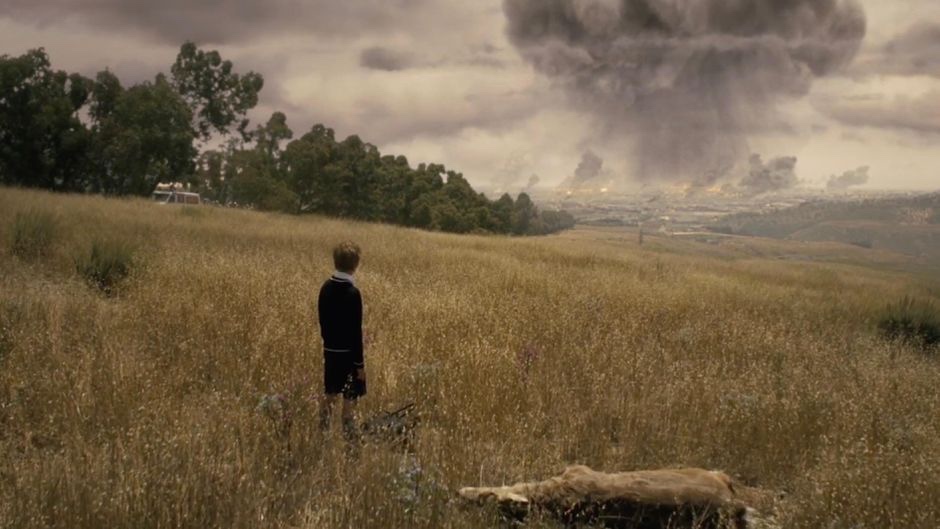
Halfway through the third season, the main antagonist, Serac, reveals that he and his brother built the monstrous AI, Rehoboam, after witnessing the nuclear bombing of Paris. The bombing is not explained. It exists only to justify Serac’s desire to prevent either another such event or series of such events. Boom! goes Paris. And Boom! Westworld tottered off into the realm of irretrievably bad writing.
I teach my students that anything can happen in their fiction. I try not to put false limits on their work (no fantasy, no science fiction, no romance). I only ask that whatever they do, they must avoid cliché, which is hard for young writers because everything seems so new to them. And this is hard for older writers too, because everything seems to have been done. How many ways can two people arrive at “I love you”? Or “I hate you” for that matter? And everything in between. Make it your own, and find the surprise.
Also, I advise that they treat their fiction as if it is true, that they should consider themselves magicians of a sort, wielding magic words to create reality. They must be responsible for the world they create, not just for the beetles that scurry across the floors of the houses they build with words, but for the vision of the world they invent. If someone falls in love in one of their stories, then they are nothing less than Eros, conferring love on the world. If someone dies in one of their stories, then they wear the grim reaper’s long black robes. No, not all writing is made with such high purpose. Plenty of successful prose falls back on sheer entertainment. Love and death are little more than emotional levers that the writer pushes and pulls to keep the reader reading. So does plenty of literary fiction—thank goodness.
Sometimes writers break the compact with the reader. They pull the levers without any concern for what they have made. A friend once asked whether I could just do what I wanted in my work. I can, of course, I can, but I must grapple with the repercussions of what I write. Does what I want to happen fit the world which I have created? Not just, “Does it make sense?” but does that sense bear up to moral, emotional, and intellectual scrutiny? Not only must there be a feeling of necessity in the work, but that necessity must be guided by an inner logic that binds all the images, all the ideas, all the characters, and all the vision. That is no easy objective.
One way to guarantee that a work will miss that mark is to play fast and loose with life, to use death as a plot enhancement. By its own logic—by the claims it made in its first season—Westworld has fallen off the horse. Yes, the show remains pretty (sexy and gruesome) picture, but the writing no longer cares to do anything but sling gore and blow up cities. Nothing matters. Time to move on.







 In 2016 HBO aired a radical revisioning of Michael Crichton’s clunky trash science fiction thriller, Westworld. The old movie issued a direct threat and moral: technology combined with profit motives is bad. Nothing new here, just a variation on the muck-racking novels of late 19th century America or a schlockier version of Fritz Lang’s Metropolis. The series that launched in 2016 delved into deeper issues: consciousness formation, the nature of humanity, and, yes, the moral bankruptcy of late capitalist culture. There was more if you wanted to find it, all wrapped up in a glossy, sexy, and violent package. Quintessential HBO.
 continuoussearch