When we are young, we change. The hurtling forward into growth exhilarates us. We learn at full gallop, disastrously adding new ideas before old ones have taken shape. We are gluttons, and the table is richly laid out and endless. Our Apollonian and Dionysian sides eat together—the only rule is More, and more we do have. We learn and learn, good gods I hope we do, like gods.
 Some people, most people, grow up, and cast their lot on one side or the other. Apollonian selves dream into an idea of logic and order—think a sonnet by Shakespeare, glorious in its arrangement of rhythm, rhyme, and idea. This is Apollo brought to earth, walking firmly on the ground. Dionysian selves trumpet feelings and instinct: Ginsberg’s “first thought, best thought” is as much a dictum as can be borne.
Rule three thousand one hundred and sixty-two: if you are one, do not marry the other. And do not ask about the other five million rules.
And recognize that just because one is Dionysian, do not think there is a lack of rules about how to go wild. A little Apollonian memory slips in. You need to party like this, or you aren’t really partying, dude. On the flip side there may be a wild inconsistency built into that Apollonian logic—call it hypocrisy if you feel like it but know that wildness finds a way.
A few people never settle into one side or the other. The two halves bristle within like ions in a storm cloud. Ambi-valent: charged in two directions, fire in both hands. We don’t grow up, but out, finding hidden paths through the forest, wanting one last opinion, and reassessing as we charge into conflict. Yelling at our superiors and demanding a reckoning. Being schooled by our students and admitting our blindness. and always, always learning.
I bemoan my ambivalence; I cherish my ambivalence. It’s a dirty little secret about my life. I hate being fenced in, and I love the elegant symmetry of a well written novel. You point out chaos, and I will chart the forcelines that create paisley swirls. I want to love someone and build a life with them and I want them to dance right out of the picture on their own. I want to lead the way, and I am happy to chase comets.
Oh, it’s the worst. And the best. Or the other way around. And the other way around.
Some folks tell me that I’m too strict, or not enough of an adult, or that I have too many rules, or that I don’t follow their rules. Dude, this is how we party. How am I a teacher? How could I be anything else? How can I not shake up my life and take my daughter along for the ride: reassuring her, giving her the foundation she needs, and teaching her that when the earth shakes, the ground still loves her. And that everywhere I am, I will love her.
 My youngest brother has told me many times that I am too serious. And of all the boys, I am. And not. My wildness is serious, and my seriousness is wild. Flip a coin, and watch the light glint off side after side after side as it tumbles through the air. Heads or tails, the glinting wins.
 Although it has maintained a broad appeal, telling a beautifully depicted story and asking questions about artificial intelligence and the nature of humanity in a comfortable and technologically advanced world, the second season of Westworld has been shackled by narrative devices that give it little room to move or grow. First, a signal climactic event is visited and revisited in the initial episode of the season, from which there has been no narrative space to move into. The deeper issues of how we use stories to perceive and create reality (or consciousness) have been discarded in advance of a plot driven by revenge and violence.
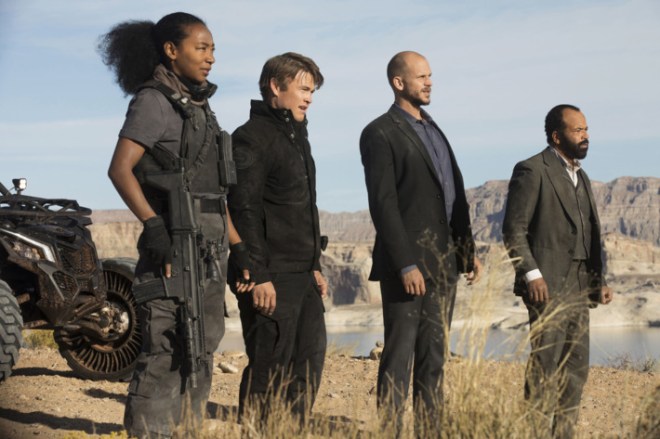 The war begins in the first episode and is shown in two closely linked timelines: one immediately following the uprising that ended season one, the other taking place a few weeks later. In the first timeline the hosts decimate the guests, in the second nearly all the hosts are found “dead” in an artificial lake. The season has been spent linking these two timelines and filling in some backstory to explain the “true” rationale for the park. We see waves of humans face the hosts, each one being dispatched with swift and stylized violence. We also watch as the hosts turn on each other. Set free from their controlled loops they repeat and amplify the excesses they had suffered as vehicles for the guests “bloody delights.”
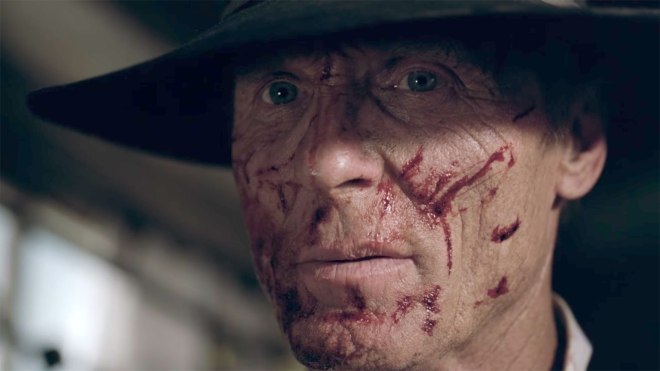 While the first season was unabashedly bloody it also had four major narrative strands of awakening: Dolores gained consciousness and free will; William became the “Man in Black”; Maeve gained a kind of consciousness, but on a separate and less certain course than Dolores; and Bernard had his humanity stripped from him. Each of these plots had a cumulative development: each episode moved these stories forward, and there was a distinct pleasure as we discovered the stories for ourselves. That discovery was shared by the characters as well, some with pleasure, and some without. The climax of each story—personal revelation for good or bad—mirrored the overall plot. There was simple structural pleasure to be had.
 In the second season these four characters have remained the main focus. But now, because the climax preceded all the events to follow, the action is more repetitive. Where else is there to go after mass slaughter? The characters do not grow so much as have secrets revealed to them or new powers added to them. They are at the mercy of plot needs. When Shogun World and Raj World, or the named but unseen Pleasure Palaces are introduced they are just grim mirrors of what goes on in Westworld. When the Cradle and the deeper purpose of the park is revealed, the viewer may have been able to anticipate their existence, but both feel like sleight of hand adjuncts to a story about characters. “Look over here! Isn’t this fancy? Don’t pay attention to the repetitiveness of the story.”

 I have been thinking about feelings. Which means, of course, that I have been having them, or rather, overwhelmed by them of late. I wouldn’t bother to write about them if they were good feelings. When I am in love, I tend to write less about that feeling, in part because my need to communicate to the world is being so generously satisfied by the person I love. The feeling of being so thoroughly understood (she gets me!) is like putty in the gaps through which the words drift out (or in). The feeling of being misunderstood blows all the putty out.
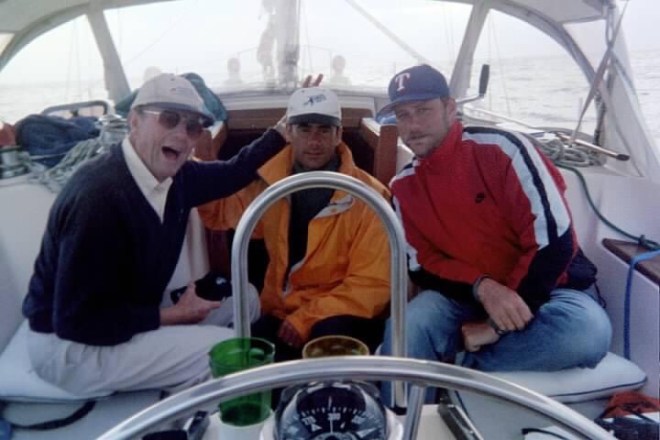 Over twenty-five years ago I started sailing on the ocean with my father. We would leave the Chesapeake Bay in the last week of May and spend five or six days out of sight of land on the way to Bermuda. Some days the weather was lovely. I read The Pickwick Papers on deck during my first trip, lying on the cabin roof in generous sun and a steady breeze. Some days the rain found every gap in the foul weather gear, and every inch of skin wrinkled to a puckered wet mess. There were days when no wind blew, and the foul diesel exhaust clung to the boat like regret, and days when the wind blew too hard to unfurl the smallest triangle of sail.
 Dr. Strangelove (1964)
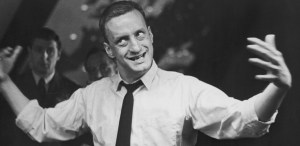 pilot screaming over the countryside to deliver his payload. I had experienced the misbegotten “fairness” doctrine—just as President Muffley tries to be fair with his Russian counterpart over the hotline. I had witnessed the driven madness of conspiracy that illuminates General Ripper, and the dedication to duty that Colonel Guano defends. Dr. Strangelove’s and Major Kong’s maniacal genius and drive was often held out as a, more sanely but only just barely, goal. Only Mandrake’s befuddled competence stands out as a lone vision of something like sanity—and he is a stranger in a strange land.
 Thoreau wrote in Walden that “the mass of men lead lives of quiet desperation.” In the late sixties and through the seventies, I didn’t know Thoreau at all, but I was naggingly aware of another desperation: one borne of the recent history of perpetual war and nuclear weapons. Those bombs waited like an exclamation point at the end of every thought about war, from World War Two, through Korea, the Cuban Missile Crisis, and then the Vietnam War. I often wondered who the men who bore responsibility for the weapons were, and if they were anything like the all too human men in my life. There came a point—it had passed to my way of thinking—when our weapons outstripped our ability to know how to use them. Desperation—existential anxiety—was a low thrum beneath all the humor, all the politics, and all the intensity of my teen age years.
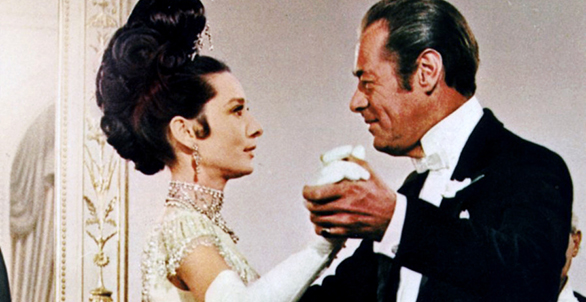 I first saw this with my family in the den of the house on Tinkerhill Road in Phoenixville. It was a Sunday Night event movie, probably on ABC. This was also how I first saw Lawrence of Arabia and The Great Race and Ben Hur and The Ten Commandments. I later saw My Fair Lady in a theater, first at Swarthmore College on a Friday or Saturday night movie night, and later when the print had been restored, most likely at the TLA in Philadelphia. I have seen it on television several times.
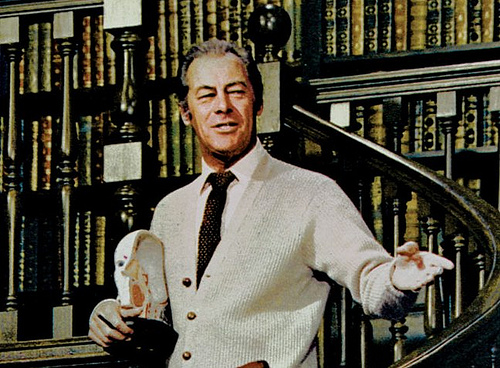 Higgins is a brilliant driven man, and he is also, what? “a bad tempered… conceited success.” He declares himself “an ordinary man,” a “very gentle man,” and a “quiet living man,” when all evidence points to the contrary. He is an idealist and a snob. He rails against “verbal class distinctions,” while living in the lap of all the benefits of his class. I was fortunate that when I first saw this, I was able to instantly recognize that Higgins was a fool, if a fool surrounded by a stultifying upper class, and a set of gender norms (I did not call them that then) that constricted his heart and mind. When he sings, “I’m an Ordinary Man” and “A Hymn to Him,” I knew he was delusional.
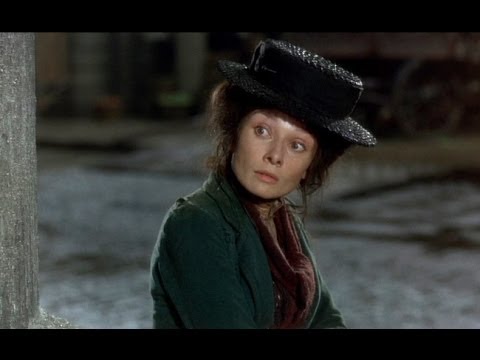 and “I Could Have Danced All Night,” are genuine, human wish songs. Eliza’s vision is never in doubt in this movie. She is a “good girl,” but early on, while watching a group of older women string beans before the market opens, she realizes that they are her future, and if she wants something else, she is going to have to change. Higgins words, “I could even get her a job as a lady’s maid or a shop assistant, which requires better English,” haunt her. She goes to Higgins and undertakes the work of transformation.
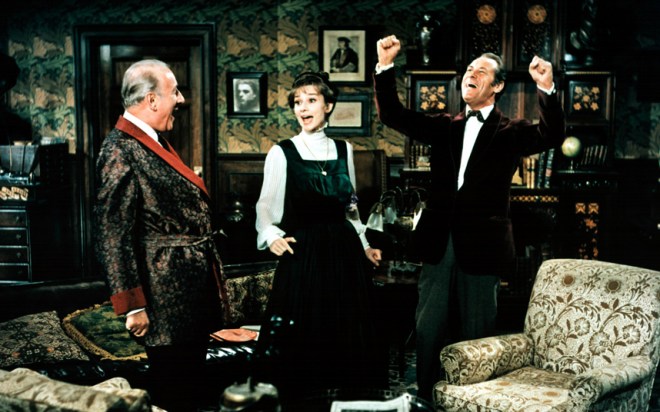 And now to come back to those two little men living in my brain: Higgins is not aware that he has to change (or he will lose Eliza), nor is he aware that in his vulnerability he will gain strength (Eliza’s company). How often have I had to distract my thoughtful, intellectual self to gain access to the more vulnerable feeling self? Higgins, for whatever reason, has girded himself with thought and professional aloofness. The endlessly repeated exercises with Eliza—the servants only hear “Ay not Aye”— distract Higgins, and allow something new, something finer, to flower within him. Yes of course, it’s just Eliza’s newly potent personality that finally wins him over, but the seeds took root during those exercises.
