I was stuck in the middle of a revision. Yes, when I recognize that something is missing—that I had I glided over some weird canyon in the conversation between two characters—I drop a helpful “ADD” into the text to point out my omission. “Helpful.” If I could, I would paste a gif of someone yelling “Clean up on aisle 5!” into the text. This happens frequently. The excitement of a first draft leads to mysterious elisions and weird gaps in logic and consistency that reveal themselves during revision.
Upon reflection, I knew I needed a story at this juncture of the novel. One of my main characters needed to respond with a story—not one from his life (he can remember nothing of his past)—but from the ocean of stories that shine like distant stars in his mind. Wow, mixed metaphor. And so, I spent a few hours digging through folk and fairy tales that somehow suited the novel’s moment, and, finding nothing, I decided to wake up the next day and head back to work to wrestle with this problem.
On the way to work, I happened to be listening to Steve Silberman’s NeuroTribes (I am leading a discussion about the book in August and wanted to polish my thoughts) and this passage played:
In recounting the tale of his famous breakthrough to his colleagues, [Leo] Kanner compared himself to the legendary Persian prince Serendip, who “went for a stroll one day, with no particular quest in mind, and unexpectedly came upon a hoard of treasures,” as he put it.
Steve Silberman, NeuroTribes, 141
And that’s how I made a mad dash back through the copy of the Shanameh that sits near my desk, a quick detour through the 1,001 Nights, then a couple of other sources, and added something meaningful to the conversation between my two characters.
I am not above noting the happy irony of serendipity. In fact, I suggest that a writer—at any and every stage of writing—court serendipity with unmatched fervor. Perhaps your mind is constantly percolating with ideas already. Perhaps you feel that you need a kind of absolute quiet to access some hidden cave of treasures accessible only with the gentle murmur of some magic words. Perhaps you fear that you have forgotten the magic words. Or, perhaps serendipity will provide if you open yourself to the possibility.
As he stared at the land around him, he began to see footprints from an earlier time, but not just earlier on this day, from days and years past. He saw how travelers had crisscrossed the terrain—running after a stray animal, chasing their heart’s desire. No portion of the land was untouched. When he concentrated, he saw how set after set of footprints overlapped and extended back in time. There was a history in the land. He walked for hours, accompanied by all the travelers from the past. He imagined his prints mixed with those of all the people who had passed, all those yet to come. The landscape sang with the presence of travelers; he was only one among many.
What had they seen? Did they share his awareness? How could he have forgotten so much? How could he see all this and not remember his past and all the paths he had walked? And yet, he began to see, almost for the first time, something else. He felt himself walking again on this ground, felt a future unfolding before him. He could not forget what had not yet happened, and so it began to flow into him—thousands of footsteps, more, millions began to unfurl ahead of him. He saw the future and all the possible paths. The future led him this way and that. It blew him here and there, and he propped himself against the strong wind. Not remember, but imagine.
After my last post, my friend, Brian Clements, responded:
“Writing is more about limiting the scope of one’s vision, on not-seeing.” This is exactly why I gave up on writing fiction—seeing too many possible directions and being unable to focus on a path. In poetry, leaping around can be more of a virtue.
A quick note, you should read Brian Clements’s poetry, especially his Book of Common Rituals. It does leap, in fact, Brian’s leaping goes a long way back to when Robert Bly’s Leaping Poetry was a regular feature of his early Introduction to Creative Writing syllabi.
And here, let me disagree and agree with my friend—and myself. Yes, novel writing is about staying on a path, but like any wonderful walk along a path, the point of the walk is not the gravel, pavement, or dirt under the walker’s feet. We walk to see, to be surprised by the hue of an early autumn petal, or the way the person we walk with traverses a wet rock, or the conversation heard in passing (“Who’s castle was that?” asks the woman with a group of her friends while passing the Smithsonian Castle). Yes, when reading (or writing) a novel we want to follow the lives of the characters, but because the novel should in some way mirror some kind of experience of the world, what makes the reading (and the writing) breathe are the surprises (distractions) along the way.
Today at the National Museum of Asian Art, a screen caught my attention. It was painted by Tawaraya Sōsetsu early in the 17th century—400 years ago. It is a painting (on a screen) of painted fans: 30 or so fans over 6 panels. My initial impression—a painting of paintings (art of and about art) puts it in along line of more recent works (Monet’s Rouen Cathedral paintings, Marcel DuChamps’ LHOOQ, Matisse’s artist’s studio paintings, an innumerable run of pop art works, works by Carrie Mae Weems and Cindy Sherman, this list is far from exhaustive, feel free to suggest additions). I briefly dove down an attribution rabbit hole (is it “Sōsetsu” as the gallery card reads, or “Sōtatsu” as the website indicates? Has the name been revised as an understanding of transliterations of Japanese has altered? There is research ahead and an email to send). So the distractions and connections are many.
The one that I hold onto, that brings me back to my path, are the duplications and variations, and that both fans and screens, while art, are also useful objects. They exist in distinct categories (or realms)—not only useful and, for want of a better word, useless, but also “art” and “decoration.” Things (or people) that exceed the boundaries of single categories? I’m all in, and I suspect that all the work I produce over the next 20-40 years will hearken back to this. The current work is hitting that hard.
So these screens are a distraction and a reminder. While my book has nothing to do with 17th century Japan, no one in it carries a fan (Could they? Should they?), and no Tawaraya Sōsetsu (or is it “Sōtatsu,” damn, that’s going to bug me until it doesn’t) appears, thwacks me in the head and gets me on something like the path.
Last week I received a post card from this same Brian Clements. It reminded me of another old friend, Ross Martin, an artists who made (and please let it be “makes”) “mail-art” and then “book art” (quick check on Ross, whose friendship I lost in a break-up two decades ago). Brian’s card—prose poem, really—echoes back to many things we shared (Lupos, Nebraska, seriously, Newt Gingrich?) and all the automatic writing leaps that guide and distract us. It’s always both, yes? Surely this won’t be on the path.
But then there is an incantation, magic words that change the course of the characters in the book—some stripped down to their most basic, path-like essence (“Forget” and “Remember”), others more ornate, more specific, and less understandable—as if specificity conferred clarity. I will be sure to hone that incantation as this final revision wraps up, and then will consign the project to someone else’s hands while I get back to the next, applying the lessons I have learned to what follows. I will “move along.”
I finished a first draft of a novel in the fall of 2019–a smidge past 88,000 words, huzzah! huzzah! I almost immediately began working on the next one. While at this new work, I managed a copywriter-style edit over the next year that swelled the thing by another 5,000 words, but other than adding connective tissue, it hadn’t substantially changed. I kept at the next book but felt a nagging unfinished feeling about the previous one that hindered my progress. Other events conspired (as they often do). An annoying fallow period set in when the twinned butterflies of ideas and scenes clashed until book #2 relented and declared, “Finish the other one and get back to me when you’re ready.”
It took about 15 painful minutes to realize I had arrived at the wrong ending. Actually, 15 glorious, freeing, soaring minutes, but then came the less soaring, freeing, and glorious realization that the hard work of revision waited. “Why not just change the ending?” you might ask. Because no matter how messy a novel is, with its few hundred threads strewn across the living room floor—some leading to the kitchen, some to the garage, and some impossibly outside through the dryer vent (can we not talk about those that lead down the WC, please?)—the line from beginning to end is the single thread that holds the vivid, continuous dream together.
And so, revision. Fortunately, the events will remain (mostly) the same (that much I got right). Still, the permutations of characters and the thickets of motivations they brought with them to, say, a stone wall in Central Asia, changed. And so how characters walked, strode, strolled, marched, limped, ran, trudged, or galloped (one of the characters is a horse) to that wall also changed.
I know exactly why I ended the book as I had—a kind of brutally insistent wish fulfillment. And one of the nice things I realized is that the book had been fighting that resolution at its bones. So now it is throwing flowers at me as I realign characters (Oh, he said that–not her, and she said this instead—head smack—duh!), even though it demands new work and new consideration. I don’t know exactly how it all will come off, but it beckons with a willingness that is at once surprising and exacting. As I fall asleep, the book whispers, “You see this now, yes? So, do it.”
I will share a few of the changes as I proceed. I will try to explain why these changes occurred and what they mean in a general way. If this process only helped me with this one book and not in all the books to follow, what’s the point? We take the lessons as they come; I hope I’m not too obstinate to apply them. Others will surely follow.
There is no guarantee that these changes they will make it through to some “it’s out of my hands now” final draft. But I think much will.
Several months ago, my right shoulder started to hurt—not the dull pain of repeated effort, but a sharp bite. The trainer at my club diagnosed it as a rotator cuff injury. I was not surprised. Years ago, I tore at my shoulders when I swam miles and miles every day. Another trainer put a finer point on my struggles, telling me that backstroke (which had been a staple of my midlife training regimen) often drove swimmers out of the pool. And so, I tended my form, keeping my hands and grips in neutral positions while I pushed and pulled weight. Then I gave up the weights for a couple of months and added exercises to strengthen my rotator cuffs. Time has taught me to listen to my body more carefully. And taught me that old wounds can return decades later.
This past month, stuck inside during the pandemic, I started lifting again and welcomed the natural hurts that result from earnest work. It feels good to work and to bear with the pain. The endorphins from extended workouts help carry me through the barrage of news, which, much to my chagrin, I cannot ignore. Lift this. Watch the heart rate settle into the 170s. At least it makes sleep come more easily.
Not everything true for the body is true for the mind. Or the heart. I also wrapped up a more extensive revision of one book while stewing over the next. The most recent update of Grammarly highlighted the more prolix passages of the old work, so even though images and scenes in the new book pile up, I felt the call to rewrite. Rewriting leads to re-visioning. The question, “How did I leave that out?” occurred more than I liked, and so I added connective tissue. I edited my more complicated impulses into simpler—and more direct?—chunks.
And revision, though inspired by some strange angels, does not require the same fiery vision as the initial draft. Without rooms of art to goad me (the DC museums have been closed since early March), it was easier to return to the old work. “Easier” is hardly the right word. The same way that I had to restart lifting below the peaks I had reached in December, I came back to the book with a diminished sense of it. In that diminishment, I found a new way in. I was no longer in love with the characters, or with myself as their creator. I was able to question my motives and choices in ways that I was unable six months ago when I made my first rattling revision.
Still, as much as I rediscovered and redirected in this recent edit, I felt as if I was betraying my new work. I have begun to dream about those characters. While others around me are infected with fever driven dreams of the pandemic, I have felt pulled to another vision—the anxiety churns a different sea. Just as I lift barbells in an otherwise empty gym—counting my reps out loud while Arthur Morey narrates Steven Pinker’s The Language Instinct—this new work pushes me. It is familiar and different.
The ache in my shoulder is familiar and different. I know what to avoid and how to strengthen the weak places. The old wounds and old ways remind me of a past that I have lived, but there are new steps to take. My narrator welcomes me into her thoughts and reflections and challenges me to get out of my own way. A whole world opens ahead of me, dream-laden, and no longer bound to anything I have worked on before. There will be work.
It has been a year and a few months since I was in London. I’m thinking about London while I sit and study Monet’s “Houses of Parliament, Sunset” at the National Gallery of Art. The memory of looking across the Thames at that building, with Big Ben swathed in the latticework of repair, has faded only a little. The memories of walking the streets of the original square mile and beyond remain startlingly vivid. I used them to paint scenes when the characters in my novel walked through London. The memories of the places and the memories of the feelings.
When I was there, I had just begun what would become my first completed novel. I had changed my life, but was only taking the first steps out of the extended shadow under which I had lived my life for much too long. I had been grounded—too grounded.
This morning I woke from a dream of flight. I had to deliver a package, and the way to the place I had to deliver it to was blocked. The streets were closed—barricades blocked alleys and police redirected traffic. I picked up the box—a box of books, perhaps? In a previous job, I often carried boxes of books and was required, on occasion, to pick up from warehouses and deliver them. I carried the box through city streets, all the while receiving instructions about exactly where I was and exactly where I should go. Except, I knew where I was, and knew where I had to go. The instructions were extraneous, the kind of litany of “You are… You should…” that have too long tethered me. And so I did the only thing left to me. I flew. I flew in between the buildings in the city, sometimes following the spaces above the streets, sometimes flying over the buildings—skyscrapers. I flew past a circus parade, as performers prepared to enter their theater. I flew and wondered where I should ply my flying trade—the circus came to mind, naturally, but so did the military (I was a secret weapon). I scooped up a bully who was tormenting a younger child and instructed, “Superheroes live, and we are watching,” before setting him back on the ground, edified.
When I was last in London, I was taking steps into a world where I knew I could live, where I had longed to live. Just like in the dream, writing—flight—was not foreign to me, but something I had traded in for a more certain, more directed existence. While “You are…You should” can feel like shackles, flying—writing—is formless and uncertain. Anywhere is possible. Everywhere is almost a mandate. Just like in the dream, I had written before—had flown—and had lived closer to the limits of my existence. But I had to leave my self-imposed limits. I had to accept that I might fall—and fail—but just as I accepted that in my dream—soaring up the side of a steel and glass edifice, wondering, “What if I forget? What if I fall?—I thought, even as the thrill of fear invigorated me, “You are flying now. Even if you fall, you will remember as you fall, and fly again. Keep flying.”
Two women look at the Monet—taking seat in the National Gallery beside me. They think it is beautiful, but claim, “It doesn’t look like that.” Of course, the Houses of Parliament look like that, as does the river Thames, as does the sunset. “We didn’t see it,” they claim, “We were tourists, doing touristy things, like thinking about where to have dinner.” I did not think about dinner when I was in London. As much as I love dinner, even food became a secondary thought while I was in London. Even the pubs and ales became little more than way-stations along the bigger task—the journey, the seeing, the walking, and the flying. And the writing.
At some point, you leave behind what holds you back, and you push off the ground and make your first tentative moves into the air. At first, it feels more like swimming than flying. Wait. That will change. Once you have flown, you do not lose the gift of flight. You may set it aside, for whatever reason (You are…You should), but when you—finally—return to it, the inspiration, the ecstasy, and the certainty will return as well. You will accept the fear and even turned it to your use—flying and writing into places that scare you, outpacing your fear and using it as a goad—higher, faster, stranger, more beautiful, and then more.
I want to say that you do not have to wait until you are 58 years old to rediscover flight. But even at 58, then 59, you can recapture that rapturous joy of flight—and writing. While, in the dream, I was younger than I am now, and yet I could remember all of my current life. Maybe that was what I carried in my box: life. My life.
When I made my way to the circus—because, of course, the circus calls for a flier—an older man (I recognized him as the father of a former girlfriend, although I never met him in real life) warned me against the life I desired, not merely the circus, but flight in general. He did not say, “You are, you should,” but as his daughter had inveighed, he advised, “You are not… You should not.” He was an old musician, and soured by his work in the circus band. Another older man joined us and said, “Let him fly.” But he was dotty, had tufts of white hair on his fingers, and was probably drunk. Looking at these two, I thought, perhaps, that the circus is not for me. There are other places to fly—not into the dark above the audience’s —but into the light. I thought that while I dreamt.
I think about all this while I dream. And when I walk. And when I see. And when I write. And when I wake up.
I write this to you now because you may be 59. Or 29. However, you stopped flying—or writing. You stopped something. Or maybe you never started. I wrote in 9th and 10th grades. Again as a senior in college. Then I started working on a novel when I was 21. Again when I was 24. Again when I was 26. In grad school, I wrote 20 stories, a short book of prose poems, and two starts at novels. Then nothing that endured for years. A few poems, some prose (sermons and stories and articles), the start and start and start and start of a novel. Whatever I was doing felt like silence. You may be facing a silence of your own. I write to you.
Barricades may block the road ahead of you. You may need to get out of your dream car and carry that box (what is in your box?) through the city on foot. You know the way. Plus—and this is your secret—you know how to fly.
There is another world. It doesn’t feel like there is. I remember that feeling, and the horrible weight of “should and should not,” “are and are not.” Part of the way back to this world is the repeated practice of returning to it—fingers to keyboard, pen to paper. Revel in the count of words, in the hours in the air. Try to think of the inches, then yards, then miles you have traveled, and enjoy the journey.
Plenty of people will remind you of what you lack, will cast blank aspersions on the life you have lived, will denigrate what you have done to get where you are, and will sow doubt in the field where you play. They are not your friends, and you can do without them. Do not try to solve the problems they foist on you, or—worse—take them on as your own. The work, even when you fly, is hard enough without taking on unnecessary freight. There is weight enough in this work.
And there is lightness ahead. And light. You can soar as you wish. I wait, standing on the ground, or suspended in the air among clouds and antennae, and wait to cheer you. Fly! Wake up and fly again.
Thousands of jade bi (pronounced bee) have been unearthed in elite Liangzhu culture burial sites, varying in size, quality of stone, level of workmanship, and finish. Yet the meaning, purpose, and ritual significance of bi remain unknown.”—from display text at the Freer Gallery of Art
The bi in the Smithsonian National Museum of Asia Art (The Freer/Sackler Galleries) are 4000-4500 years old. Some of the other jades are a thousand years older. I like that bi are so old, and among the earliest pieces of art in all the museums in Washington DC. I also like that we do not know the significance of the bi—that over 4000 years, their meanings have gone missing. They had a significance; we just don’t know what it was.
What matters is what we leave behind.
In the other corner of the Freer Gallery, an exhibit of Hokusai’s paintings and illustrations includes quotations from the artist about what he intended—not just in the specific works, but as an artist. He wrote about discovering himself as an artist late in life. He was already an artist, but he claims to come into his own in his 50s and thought that he might attain his most complete vision if he lived to 110. He died at 90. His work is sweeping and intimate—monumental nature and quiet personal moments—fantastic and humorous—heroes wrestling demons and uproarious coworkers. Whatever else he meant to last in his work—why that hero wrestled that demon (as if one could easily answer such a question)?—he meant it to last. He aspired to capture a vision that would last long after he died.
What matters is what we leave behind.
My students struggle with knowing what writers meant when they wrote a particular poem or piece of fiction. I try to help them understand that the question is nearly impossible to answer, that the writer’s intention is a mystery even to him or her self. There’s a parcel of psychology served with that lesson—the ineffable subconscious meets the unruly and unpredictable conscious mind. They get confused when I make assertions about what is in James Joyce’s fiction—and, honestly, I have no idea what the human being writing his stories intended, but I can perform some intertextual acrobatics that will catch many of the ideas that spin through his work—thinking that I am implying that Joyce intended one thing or another. I’m just making connections informed by study and a willingness to play with and without a net.
What matters is what we leave behind.
Bi, ca. 3300-2250 BCE
Of course, I tell my young writers to align their intentions with what is on the page. It is nearly impossible to write without a sense of the outcome. We, quite naturally, want our ideas and images to catch fire in the mind of our readers. I cannot help but think of the artist who chiseled an image into the side of a bi. The images are so faint that one can easily overlook them. Were they only meant for decoration? Someone, sometime knew. We can only guess. What excites me is that someone did know, once, 5300-4250 years ago. Imagine making a mark and that it lasts long enough to cause some stranger to wonder thousands of years in the future.
What matters is what we leave behind.
When I write about the djinn, I am aware that I do not know how or why they were called into being. What made us need or want an order of magical creatures separate from gods and angels? I am aware that our perception of the djinn changed over time, in some part, due to the influence of Islam. But Islam—as a formal religion—is only 1400 years old. Only. Djinn and gods existed in Mesopotamia for thousands of years before Islam gripped the region—and a quarter of the world. But, for the most part, they are a mystery—as are the gods and goddesses I call into my fiction. While there are fragments of stories, the past has swallowed them.
What matters is what we leave behind.
I wonder, if in 5000 years, whether I will be a mystery. A friend commented that writing and reading are escapes, and I disagree. I read to reclaim the past and reframe the present. Knowledge of the past makes our understanding of the present more complex, more nuanced, and more true. I write to give life more weight, more depth, more of what the past holds, and what the present should hold. After all, that is what makes a good story a good story—a vision that makes us stop and take account of our present moment and our lives. If I have any intention that lasts past the next three months, let alone 300 years, or 5000 (5000 years?), that is it.
While I like to write while surrounded by people, once my eyes are on the page, and once my fingers are working, a kind of wall goes up. Writing is solitary. And it is not.
The whole point of writing is for there to be a reader.
Every time I write, I am thinking of you. You could be sitting right behind me at this coffee shop in Gainesville, VA. Or at an internet cafe somewhere in Pakistan. You could be someone I have known for years. Or someone who has stumbled into my work on a whim.
When I write, I imagine myself as that “you.” I am the woman writing about transformation in her blog and that man who took a break from writing about horses and Johnny Cash. I am my daughter, who, perhaps, will look back at this years later when she decides she wants to know something more about her father. And I am you, unknown and unknowable, reading this now. And even you, who I have known, once—maybe for a few glorious months—are still unknown.
These days, I wear reading glasses when I write. The glasses give the letters on the screen crisper definition. When I look up though, the world is blurred. I cannot be focused on the there that is twelve feet away from me and the here that is a ranged configuration of black shapes. Letters. I think of all the alphabets and how arbitrary those shapes are—they stand from left to right or right to left. We see a sequence that shapes the way we read and understand the world as much as the simple shapes try to define that word. Why am I watching those random shapes when other human shapes drift in and out of my blurred vision?
Sometimes, I write for me—not to express my thoughts or feelings, but so that sometime later I can become my own reader. I will remember this person who sat in fairly comfortable, if strange, surroundings, among people who spoke my language and people who spoke other unfamiliar languages. I will remember those who sat with me while I wrote or those who slept in rooms nearby. The strange shapes that I decipher will point me to another time, another me. I will treat whatever is contained in these words as properly strange, belonging to someone who is not me, any more than you are not me.
There is a plate at the Freer Gallery in Washington DC. Around the rim are an elongated set of letters in Arabic. Even if you knew what those letters meant, would you know about the person who wrote them before the platter was fired in a hundreds of years old kiln? Or what to make of the carved insignias on a Neolithic disc from China? Sometime, 5000 years from now, will these shapes still make sense? Will they point some future reader back to me? Or to anyone else who writes now?
I write to be in the moment. I love the process of getting lost in the words, in trying to connect thoughts and feelings to this electronic scrawl. I loved diving back into the world of the djinn day after day and discovering what he—and all the characters in that book—saw and heard and felt. Writing took me out and away from my self, and gave me a place to visit and revisit.
I know all too well that the moment does not last. I write ensconced in both the past and the future. Everything I know—59 years of experience—and everything that will open before me—another 59 years?—balances on the self that writes here. Each time, the words bring me back to the self who wrote that fragment, and I keep returning to that self while I work on a particularly long piece of writing. But that self never remains static—returning requires an effort.
The self that writes is almost more like a mask—something and someone stopped in time. I write in and on that mask, but underneath, on my face, in my hands, and in my heart and mind dreams of change and something I have not imagined continue. Last night I dreamed that I was making dinner—a recipe I did not know with someone I did not know. My mind invents and travels and changes. I long to remove the mask, but I accept the part I play. For now.
There will be another mask, just as there will be another dream, just as today’s experiences will shape me. The mask-maker. The writer. The man. And you, also, always. Perhaps you will find your way to here from wherever you are, and you will find your way back to some unknown place. And write.
“What am I to myself that must be remembered, insisted upon so often…”
Over and over in these blog posts, I look back to events in my life, trying to put my work and life into a context that makes sense. I am aware that I am insisting. I hearken back to Creeley’s poem, “The Rain,” because, like the speaker of the poem, I feel locked in some “final uneasiness.” I have had too much “intentional indifference”—that kind of willful professional distance that is meant to keep the ravages of freely ranging emotions at bay.
Creeley’s poem—tightly lined and sentenced—runs counter to the other great insistent poet in my life, Walt Whitman. Whitman’s Song of Myself insists stridently, and I wrote about the struggles my students face in the face of his relentlessness. I do not struggle. If anything, Whitman energizes me. His work reminds me that brio teetering on masculine bombast has its place. “Don’t restrain yourself, Brennan! Be all you are!” the poem declares. It urges me on.
“The Rain” does too.
Called between lyrical precision and unbridled energy, I find my balance in prose. I write fiction and nonfiction accepting the imperfections and imprecision, hoping that some meaning gets from here to an unknown there.
Besides I have been in the rain, under steady wet conditions on the ocean. I imagined myself as the “storm helm”—ready and able at the wheel in rough weather—when I sailed. I insisted on taking the wheel when the rain ran horizontally. I shooed my mates below decks while making way around Bermuda—from Hamilton to St. George—in hurricane wind. The local ferry even diverted course to check on us—it was not a day to be in the channel, but my father had a schedule. I kept us appointed.
Rain did not need to be as dramatic. Some stretches were just days long spirit flattening bouts of precipitation. Sailing did not have to be pleasant to feel necessary. Often, it was not. And yet, I felt called to it, in part by a commitment to my father, but also by the beauty of the ocean. Only onshore obligations kept me from finding further passages. Do I regret not having made them? Yes. Do I regret having kept my commitments? No.
Did the rain out there on the ocean wash away regret? Was I made clean? I wish it were entirely so. My experiences on the ocean are essential to the writer I have become, as all my experiences are. There are more salient lessons there though, if only because the lessons came with abrupt consequences. Life does not always have such clearly defined moments—it is more often like a day that is half-rain and half-sun. There is a reason that Thoreau calls life “quiet desperation”—it happens so silently that we do not even recognize the need.
Whitman—damned insistent Whitman—can loafe and still find original energy in that spear of summer grass.
I look skyward, into the rain.
Song: “When that I was and a little tiny boy (With hey, ho, the wind and the rain)”
By William Shakespeare
When that I was and a little tiny boy,
With hey, ho, the wind and the rain,
A foolish thing was but a toy,
For the rain it raineth every day.
But when I came to man’s estate,
With hey, ho, the wind and the rain,
’Gainst knaves and thieves men shut their gate,
For the rain it raineth every day.
But when I came, alas! to wive,
With hey, ho, the wind and the rain,
By swaggering could I never thrive,
For the rain it raineth every day.
But when I came unto my beds,
With hey, ho, the wind and the rain,
With toss-pots still had drunken heads,
For the rain it raineth every day.
A great while ago the world begun,
With hey, ho, the wind and the rain,
But that’s all one, our play is done,
And we’ll strive to please you every day.
At the end of Twelfth Night, Feste sings and sums up life. It is a particularly British vision of life. One merely needs to visit England to realize that the rain does indeed “raineth every day.” Of course, Shakespeare does not mean only actual rain, but that virtually everpresent British rain is not the storm on the heath, not the “Howl! Howl! Howl!” It just comes every day—not as a reversal, just as a steady ubiquitous presence. “The rain it raineth every day.”
Shakespeare is another touchstone for me. His plays contain absolute reversals and despair—too often self-inflicted injuries, and injuries that harm not simply the self but the state of the world. Consequence abounds. I am drawn to consequence.
Even Feste, the fool, is consequential. He helps to shape the story; he guides Olivia. And then he leaves. I love Trevor Nunn’s framing of Feste—and Ben Kingsley’s portrayal—in no small part, because of how Feste commands the end of the play. Feste walks off and insists, “Every day,” directly to the audience. This is the fool’s job—to entertain every day, and more, always more. If there is rain every day, so too must there be entertainment.
And the writer is the fool. I have always felt that. There is more than something foolish about attempting to entertain, especially when the entertainment strives to do more than simply delight. Although, delight is enough at times—“Be wet with a decent happiness.” More. I want more, of course, I want more. I want exuberance and ecstasy, a sundering of all that we simply accept—that intentional indifference. “Creeds and schools in abeyance!”
It is no surprise that I have supplemented my writing life with creeds and schools. I was drawn to them to overturn them. I wanted to make those worlds bigger. I have given up on one part of that desire. I have realized that as far as the other, it will not be enough. It cannot be enough, as attractive and meaningful as being the teacher-fool can be—and how enchanting teaching can be (and it can be! Watching the lights go on in my students’ eyes is beyond satisfying). I have to be the writer-fool.
Every day has been the mantra of the work. In rain. In sun. In light. In dark. Even though I cannot see your eyes while you read, or hear your gasps while I read, I undertake this foolish, giddy task. I am not indifferent, no matter what the cost, and there is a cost to caring. The reward is uncertain. Success is a chimera. And yet. It rains.
The rain came to the book. My characters ran through it on their way to seek shelter. Or they walked on streets slick with rain. Yes, those streets were in London. The city waits for me to return. The rain was real and metaphorical, as all rain must be. It came through happiness and sadness, as it must. And so the rain, the same rain in Creeley’s poem, in Feste’s song, and that I brought with me from London and the ocean came here. It is the rain that returns as persistent as ever. Always.
If she still felt love for him, it had become the love that the universe holds for all creation—children running down hallways and rocks washed onto distant shores. It had become permanent and impersonal. Or so she had convinced herself, how long ago? It was a night when she stayed out while it rained. The water drenched her, and she felt it seep into her. She worried, with a wild anxiety, that she would melt, dissolve into the ground, and disappear. The fear of disappearing made her heart pound—it felt as if it was pulsing into the mud beneath her, propelling her life into the ground. She was becoming part of the land. The tears that she cried became part of the rain. Was she crying because she had lost him, or because she was lost? She did not know. The water and the ground opened a space for her.
She did not go into the earth. The rain stopped. Her tears stopped. Her heart settled back into her chest, where it pulsed life back through her, rejuvenating her nearly lost body. In the morning, she rose, whole, not forgetting his absence, but welcoming the world as it was.
A year ago I was in London. My first night there, it was cold and rainy—the worst weather of my short trip. In spite of that, there was a walk to take—a walking tour of locations connected to Dickens and A Christmas Carol. Only a handful (6? 8 at the most) came out for that walk. At some point in the night, I was recruited to help read from The Pickwick Papers. The walk ended at The George with mulled wine, and guests out of doors in the cold singing.
The memory is happy and sad. I had traveled to London with a woman whom I deeply loved. I had traveled with some amount of trepidation; I knew she had other stars in her eyes, or, at the very least, that she doubted that I was star enough for her eyes. However, London was a promise I had made to myself long ago, and I was fulfilling that promise, or, again, at the very least, making the first steps toward that promise. The trip was a dream and reminded me of why I made that promise years ago.
One part of the promise involved travel. When I was a graduate student, I had been accepted to travel to London to help with a program at my school. I did not go. I had met a woman and thought we were going to be married, so I reneged on my duties and planned a wedding and a life. The marriage did not happen. I stayed in Binghamton for the spring instead of traveling. I promised myself that I would go, and go beyond.
The other part of the promise was to write.
I had gone to Binghamton to be a writer. I began grad school at 28 with only a thin idea of what I wanted to write. To be honest, my idea of myself as a writer was entirely romantic—in that way Shelley’s idea of the poet from In Defense of Poetry is romantic. Such an idea, without a steadily glowing ember of practice, is not sustainable. My writing, though full of hopeful ideas, had not taken proper root. I was a dilettante—determined, but without that obsessive drive that propels most writers. While I was in grad school, I delved into the academic side of my studies—the ideas were thrilling, and it was easier to make headway there.
My first writing workshop focused on short fiction. Although I had written a couple of short stories and read some, especially when I was younger and gobbled up anthologies of supernatural stories, I came to writing because of novels, especially the magical realism of Gabriel Garcia Marquez and Mark Helprin. I wanted big strange things to happen in my work, and for my work to reflect a world in which the impossible was ever-present—if stalwartly and stupidly ignored. I wanted to shine a light on that world. Did I know that then? I do not think that I could have made a clear statement of exactly what I wanted, besides to “be a writer.” That is hardly enough.
I struggled with short work. I wish I could say that I had ten dozen ideas waiting to spring Athena-like from my forehead. I did not. After two years, I somehow cobbled together enough work for a Master’s Thesis, but the work relied too much on retelling stories from my life. I invented nothing. It wasn’t until my third year that I began to find my footing, and then only in the shortest of pieces, prose poems.
While academic writing can flourish jumping from George Chapman to Virginia Woolf to Charles Dickens, from Michel Foucault to Alice Jardine to Judith Butler, creative writing needs a steady—almost boring—focus. You have to sit at the grindstone. You have to want to sit at the grindstone, putting the millstone around your neck the way someone else might blithely doff a silk cravat, tied while running toward a morning meeting, or an afternoon assignation. It’s a damned heavy tie. And there must be something magical and transformative. The words must have the power to change the world.
And here’s the thing—as I have written in some of these posts, obsessive drive was antithetical to my idea of how I wanted to live. I had seen too much obsessive drive and distrusted it. Where some saw vision, I saw blindness. I felt it in myself, especially when I was “in love.” I distrusted the way I experienced romantic love and doubted whether I would be able to love anyone. At 28. I may not have had a clear idea about my writing, but I did have a clear—if wrong-headed—idea about my heart. I had much to learn. Now, I feel called to write every day, and if I do not, I feel the bite of old dogs. If days go by, the dogs grow younger and hungry.
And, I had given up on magic. Are the two things, love and writing, all that separate? Sadly, or happily, for me, they are not.
What happened? Well, this, for one. In January of 2018, I started reflecting on lost bits of my life. I had something to reclaim. It started with reflections on love and what I learned from a selection of movies—some obscure, some well known. Then I started musing on happiness and moving and beginnings and, of course, writing. I had something to reclaim. I explained to a friend that my newfound sense of urgency was the result of losses around me and my own gnawing loss of self. I felt my life slipping away.
What am I to myself
that must be remembered,
insisted upon
so often?
Robert Creeley
One of the early writing lessons was that one had to fight against insistence on anything other than the artistic integrity of the work. Art was all that mattered. Everything else was selfish preoccupation. There is a nascent Buddhism in this practice. Writers must not crave; they must simply let the perfect “be” and then get the hell out of the way. Great writing was, at some level, an act of self-erasure—the presence of absence. Especially when I was a young romantic writer-to-be, this appealed to my innate perfectionism and idealism. In a world full of corrupted motivation and suspect morality, attempting to make something beautiful was honorable. This is part of the elusive call of writing, and of all art. Everyone else must live reined in by the art of the possible: politics and compromise. Writers and artists strive for the unobtainable. Even when we engage the flaws in our work, as often as not we are performing some subtle—or not so subtle—sleight of hand. We are like the carpet weaver adding the imperfection because the perfect is reserved for God alone. Or for Shakespeare.
Which brings me back to London, a city in which Shakespeare’s famous theatre was rebuilt through the efforts of an American actor. When I went to London, I was a month and a half into a novel, and I knew that it would be a novel. I had imagined other work as long as novels before, but this was different. I had never felt drawn into the writing as I had with my book about the djinn. I knew it was going somewhere, and I did not know how it would get there. I was not simply writing about characters who were magical and from the world of enchantment; I was enchanted by the work. I researched djinn as I wrote, and would go back and revise whole sections to suit what I learned while I wrote. I let myself be out of control and let the book go out of my control.
The closest comparisons I can make to this were the feelings I had when I was at the crest of a wave—either on my father’s boat on the Atlantic Ocean or when I was body-surfing off the coast of California. In both cases, I was out of control and exhilarated. I felt the same way in London—that the waves of history, of literature, of streets, of unknown alleyways, and yes, of love could all come crashing down. They could, and some did, and I had to go ahead and throw myself into the waves anyway.
I wonder how this last novel came about so easily, but, really, it did not come easily. It began ages ago and I did not know it. I made a promise. As I gear up for the next, I am surprised that I am finding enchantment. Again. I am also pleasantly surprised that I know, a little, how to uncover enchantment when I need it. I have not needed to travel back to London. And yet, on this day—and if I am honest, every day—I feel the call. I have promises to keep. And miles to go…


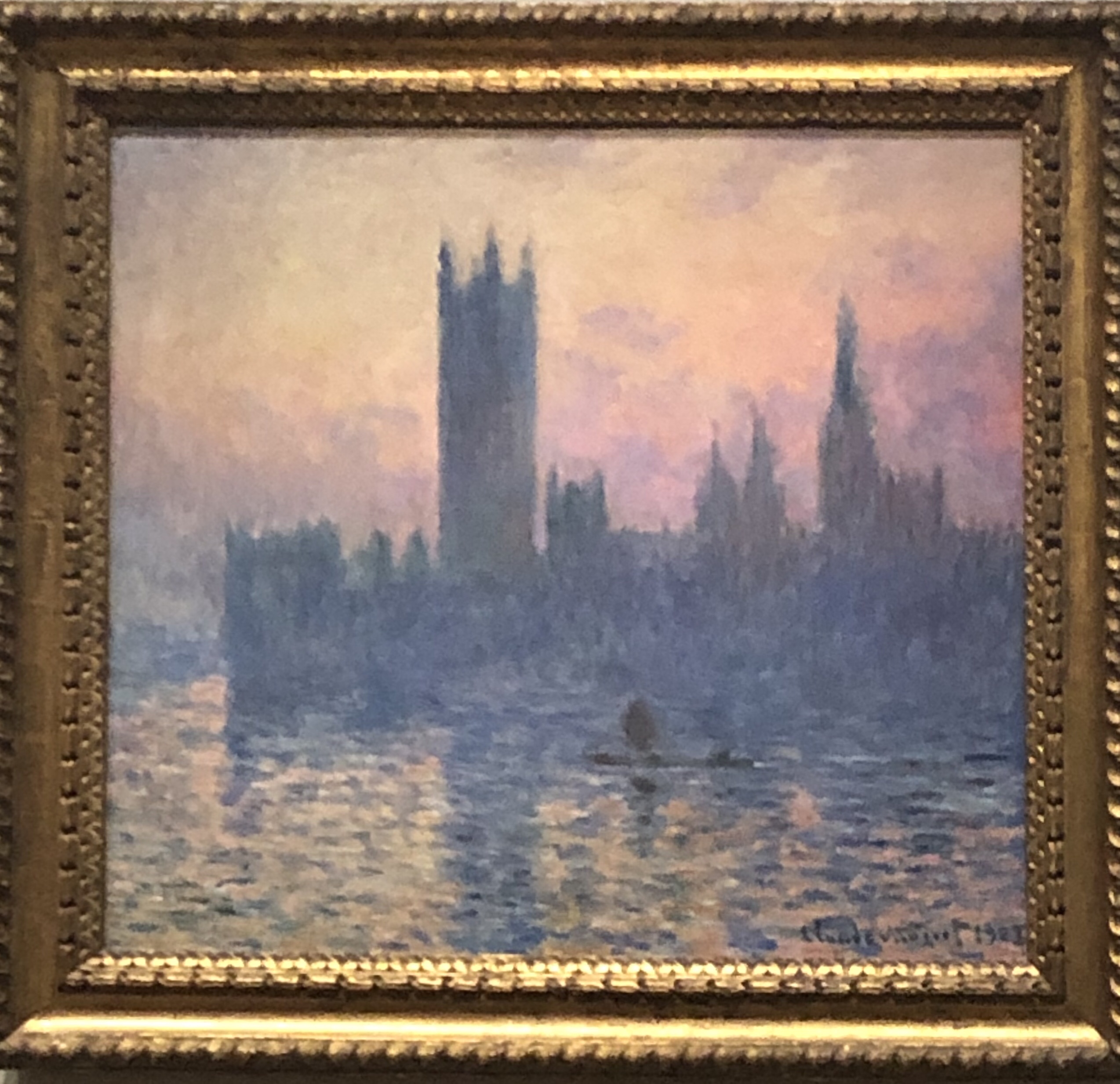 It has been a year and a few months since I was in London. I’m thinking about London while I sit and study Monet’s “Houses of Parliament, Sunset” at the National Gallery of Art. The memory of looking across the Thames at that building, with Big Ben swathed in the latticework of repair, has faded only a little. The memories of walking the streets of the original square mile and beyond remain startlingly vivid. I used them to paint scenes when the characters in my novel walked through London. The memories of the places and the memories of the feelings.
 When I was last in London, I was taking steps into a world where I knew I could live, where I had longed to live. Just like in the dream, writing—flight—was not foreign to me, but something I had traded in for a more certain, more directed existence. While “You are…You should” can feel like shackles, flying—writing—is formless and uncertain. Anywhere is possible. Everywhere is almost a mandate. Just like in the dream, I had written before—had flown—and had lived closer to the limits of my existence. But I had to leave my self-imposed limits. I had to accept that I might fall—and fail—but just as I accepted that in my dream—soaring up the side of a steel and glass edifice, wondering, “What if I forget? What if I fall?—I thought, even as the thrill of fear invigorated me, “You are flying now. Even if you fall, you will remember as you fall, and fly again. Keep flying.”
 Two women look at the Monet—taking seat in the National Gallery beside me. They think it is beautiful, but claim, “It doesn’t look like that.” Of course, the Houses of Parliament look like that, as does the river Thames, as does the sunset. “We didn’t see it,” they claim, “We were tourists, doing touristy things, like thinking about where to have dinner.” I did not think about dinner when I was in London. As much as I love dinner, even food became a secondary thought while I was in London. Even the pubs and ales became little more than way-stations along the bigger task—the journey, the seeing, the walking, and the flying. And the writing.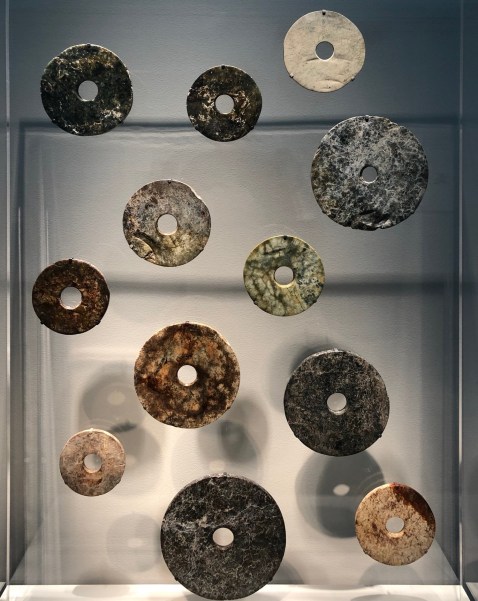
 In the other corner of the Freer Gallery, an exhibit of Hokusai’s paintings and illustrations includes quotations from the artist about what he intended—not just in the specific works, but as an artist. He wrote about discovering himself as an artist late in life. He was already an artist, but he claims to come into his own in his 50s and thought that he might attain his most complete vision if he lived to 110. He died at 90. His work is sweeping and intimate—monumental nature and quiet personal moments—fantastic and humorous—heroes wrestling demons and uproarious coworkers. Whatever else he meant to last in his work—why that hero wrestled that demon (as if one could easily answer such a question)?—he meant it to last. He aspired to capture a vision that would last long after he died.
 While I like to write while surrounded by people, once my eyes are on the page, and once my fingers are working, a kind of wall goes up. Writing is solitary. And it is not.
 There is a plate at the Freer Gallery in Washington DC. Around the rim are an elongated set of letters in Arabic. Even if you knew what those letters meant, would you know about the person who wrote them before the platter was fired in a hundreds of years old kiln? Or what to make of the carved insignias on a Neolithic disc from China? Sometime, 5000 years from now, will these shapes still make sense? Will they point some future reader back to me? Or to anyone else who writes now?

 continuoussearch