I was in my classroom one morning in April of 2021, but later in the month, so no fooling. and Mike Hughes, the director of my school’s theater program, stopped by. “I have an idea,” he said and asked whether I had been on the stage or sang. “We’re putting on Oliver! next spring, and I think you would be a good fit for Fagin.”

Here’s the skinny: I had a small part in a school play in the 6th grade and again in the 8th grade (King Ferdinand in a historical pageant). My mother made my costume—a cape—by ironing brown stripes onto a cheap yellow beach towel. In high school, I sang in the choir—we sang four days a week, and I could read the music for about a year. There was a play in Philadelphia—an avant-garde piece about the French Revolution; I was recruited by regular customers at my restaurant in Manayunk for this strange one-night venture. The congregation I served might remember me singing “Jingle Bells” during a holiday service and when a minister asked me to mime a juggler while she read Robert Fulghum’s “The Juggler.” Another holiday performance. That’s my resume.
Maybe you’ll argue that teachers are always on stage, and up to a point, that’s true. But one of the reasons we teach is to have our own meager fiefdom to direct what we will. Whether you do it, either as a sage on the stage or facilitator par excellence, your class is your own. Every class reflects its teacher, and even Bibliographic Methods could have been a lively and engaging experience (it wasn’t). Putting yourself in the hands of a director and in service to someone else’s vision—all those words, all that music—requires an entirely different discipline.
The closest I ever came was reading my work in front of a live audience. I recall the first time at a Friday night graduate school event. I was anxious, and the poet Ruth Stone told me that anxiety was an appropriate emotion any time you do something meaningful. Later, when I read for a panel of judges, I admitted my nerves—I am always too honest about such things—and was counseled by them to treat them like my students. I was a young teacher at the time but already a classroom performer. I once swam across a run of tables to demonstrate the difference between simile and metaphor. Either one does, or one does not do—there is no “like.”
The short of it—I have virtually no experience on the stage. Did I tell Mike Hughes that? Yes. I visited him in his office to confirm that the only time I sang in front of people and actually made an effort was when I sang “Angel from Montgomery” with two students at an open mic event. His colleague, who had heard me, commented that I could good relative pitch. As if I knew what that was.
However, a teacher’s job is to get out of the way and let our students succeed or fail on their own terms. When I mentioned that I had been “recruited” to take part in the school musical, someone I had just met suggested that I should let a student take the part. Even if I had been invited, even if I knew that my school was currently short on depth, was I extinguishing a nascent flame? Nonetheless, I asked my colleagues, and they trusted that the request came from a place of need and respect.
But, what was I thinking? How much I can possibly suck crosses my mind at every rehearsal. If I haven’t performed, I have watched my share of excellent and delightful performances. And star turns that should have been eclipsed. We all have. This is not simply “imposter syndrome” run wild. I have done nothing like this before.
Daring and humility are uncommon psychic partners, and I am often genuinely ambivalent. People who almost know me make the mistake of either seeing my geysers of chutzpah or my lakes of self-doubt. In “The Waking,” Roethke writes, “This shaking keeps me steady”; my two minds do that dance. If only there were just two. In the second of his thirteen ways, Wallace Stevens offers this:
I was of three minds
Like a tree
In which there are three blackbirds.
A writer must learn to inhabit at least two minds—the writer’s mind and the reader’s mind. A fiction writer is even more fractured. We are, as often as possible, out of our minds. I was going to write, “Perhaps I embraced this too late in life, but better late than, well, you know.” I spent years in the maelstrom of one, then the other, then the other. And then, and then, and then. I have learned how to push the storm forward or in some direction. I won’t get stuck swirling on one spot, a dervish without purpose.
What does this have to do with playing Fagin? Taking a risk and facing doubt expands the mind. And learning to do something new—working at it and, possibly, finding success—opens the world. I could claim that I took on the part of Fagin—leader of a band of thieves—because he has something to do with the characters I am writing about (thieves). While this is true, doing something I had never done before—committing to a process and seeing it through to its end—drove my choice.
A writer must explore possibilities—this is the heart of Socrates’s dictum about the unexamined life. Too often, people quote “the unexamined life is not worth living” to justify the attitude that life is like a buffet and every morsel must be piled onto one’s plate. “I tried it” is not the same as “I examined it.”
And so, I played. I will continue to play. As should you, dear reader—and dear writer. There are worlds to examine and lives to live.


 Out of the Past (1947)
 None of this is surprising or unexpected. It’s almost too easy and too obvious. Out of the Past is a movie that continually works between the obvious and the hidden. The main character, Jeff Bailey, is hiding in Bridgeport, a sleepy little California town with a diner owner who knows everyone’s business. Jeff is the wild card, which draws the attention of the town’s beautiful Ann Miller. She is straight out of a fairy tale. We first meet her fishing in secret with Jeff, he declares, “You see that cove over there? Well, I’d like to build a house right there, marry you, live in it, and never go anywhere else.” She answers, “I wish you would.” Ann comes from a world where wishes come true. Jeff does not.
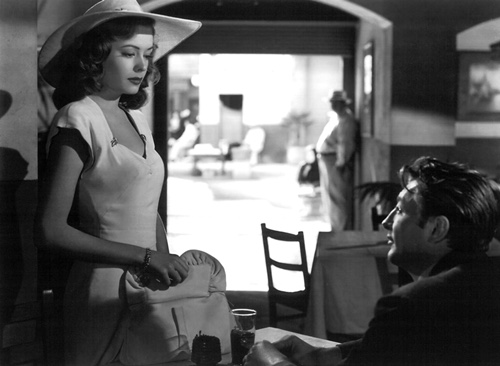 Some critics will let Jeff off the hook—an appropriate metaphor in this film because we are introduced to Ann and Jeff while they are fishing—and claim that the film frames Kathie. After all, Jeff acts nobly at the end of the movie, when the Kid tells Ann, in unspoken accordance with Jeff, that Jeff was leaving with Kathie. This clears the way for Ann to return to her old reliable beau. And Kathie did kill three men.
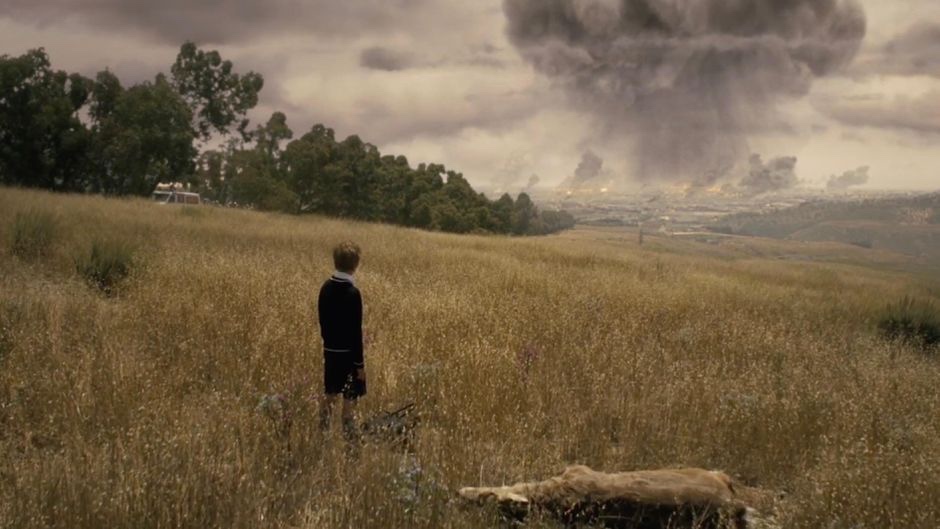 In 2016 HBO aired a radical revisioning of Michael Crichton’s clunky trash science fiction thriller, Westworld. The old movie issued a direct threat and moral: technology combined with profit motives is bad. Nothing new here, just a variation on the muck-racking novels of late 19th century America or a schlockier version of Fritz Lang’s Metropolis. The series that launched in 2016 delved into deeper issues: consciousness formation, the nature of humanity, and, yes, the moral bankruptcy of late capitalist culture. There was more if you wanted to find it, all wrapped up in a glossy, sexy, and violent package. Quintessential HBO.
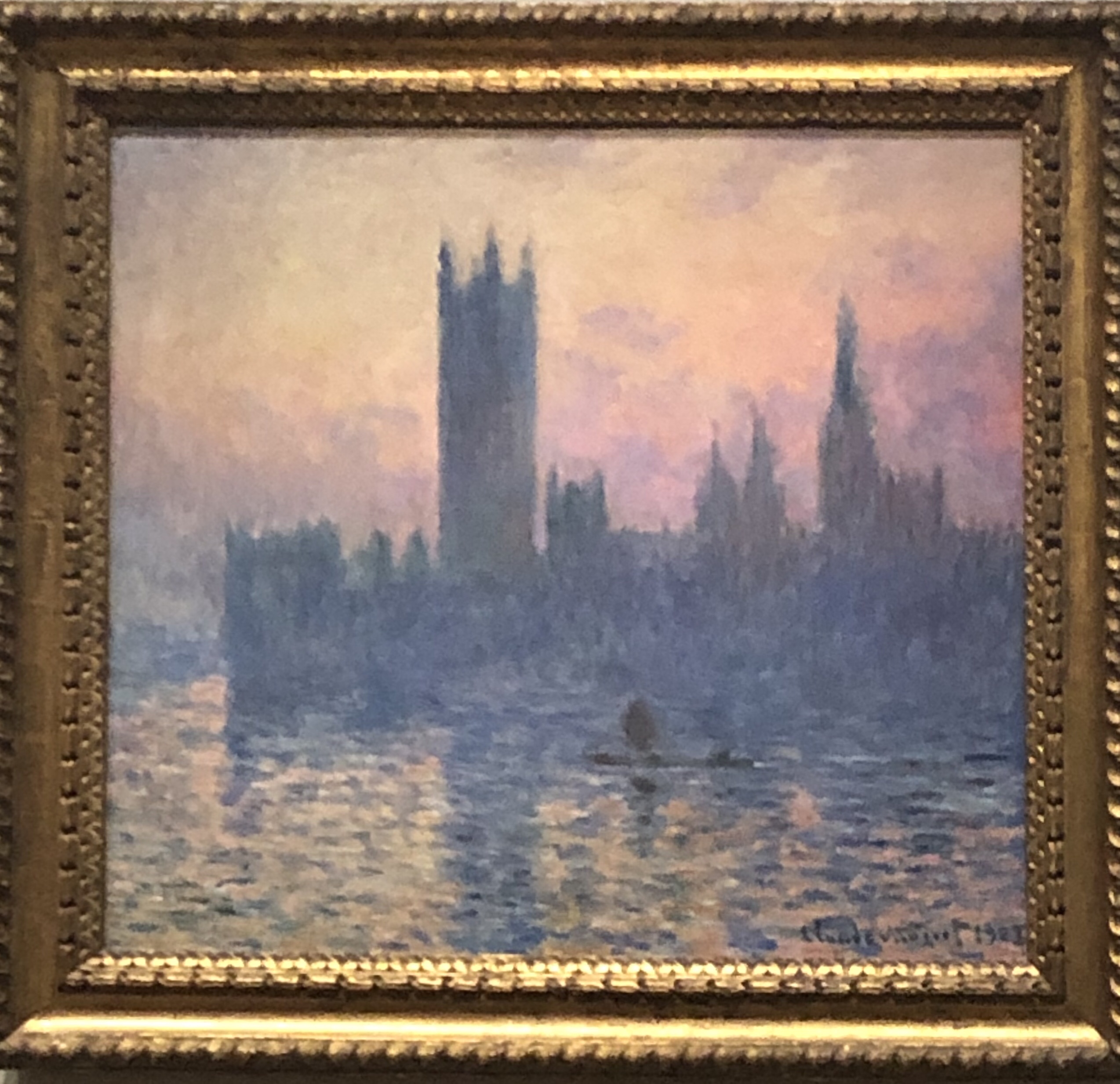 It has been a year and a few months since I was in London. I’m thinking about London while I sit and study Monet’s “Houses of Parliament, Sunset” at the National Gallery of Art. The memory of looking across the Thames at that building, with Big Ben swathed in the latticework of repair, has faded only a little. The memories of walking the streets of the original square mile and beyond remain startlingly vivid. I used them to paint scenes when the characters in my novel walked through London. The memories of the places and the memories of the feelings.
 When I was last in London, I was taking steps into a world where I knew I could live, where I had longed to live. Just like in the dream, writing—flight—was not foreign to me, but something I had traded in for a more certain, more directed existence. While “You are…You should” can feel like shackles, flying—writing—is formless and uncertain. Anywhere is possible. Everywhere is almost a mandate. Just like in the dream, I had written before—had flown—and had lived closer to the limits of my existence. But I had to leave my self-imposed limits. I had to accept that I might fall—and fail—but just as I accepted that in my dream—soaring up the side of a steel and glass edifice, wondering, “What if I forget? What if I fall?—I thought, even as the thrill of fear invigorated me, “You are flying now. Even if you fall, you will remember as you fall, and fly again. Keep flying.”
 Two women look at the Monet—taking seat in the National Gallery beside me. They think it is beautiful, but claim, “It doesn’t look like that.” Of course, the Houses of Parliament look like that, as does the river Thames, as does the sunset. “We didn’t see it,” they claim, “We were tourists, doing touristy things, like thinking about where to have dinner.” I did not think about dinner when I was in London. As much as I love dinner, even food became a secondary thought while I was in London. Even the pubs and ales became little more than way-stations along the bigger task—the journey, the seeing, the walking, and the flying. And the writing.
 Just over a year ago, I went to the LA Bar in Arlington and did karaoke. It was New Year’s Eve, and I had just come from a fairly routine party, where we had counted down the end of the old year and beginning of the new. It wasn’t enough. And so, away I went with my date, and we signed up to sing the Talking Heads’
  continuoussearch