Trusting imagination

I have carved a method out over the several months. I am writing smaller chapters, and it seems to suit the task. Someone may correct this later, make a suggestion to combine and reorder, but for now, my brain jumps from scene to scene, from image to image, from scrap of dialogue, well you get the idea. But I have no plan, no worksheets containing outlines hung on the walls. No maps with pins tracking destinations tacked to a slanted ceiling. No scribbled notes in the margins of a dozen or two books. I have done all of those things over the past twenty years. And not written. I am working without a plan.

This method requires trust. First, and foremost, that I will continue every day, no matter what. I have done plenty of things every day over the past twenty years, but never my work, always someone else’s work, and often done with their idea of what I should be doing. How much does “should” become a cage, and I paced like Rilke’s Panther. I had to change my life.

Second, I have to trust the story as I write it. While I know where it will end up (provisionally), the work opens before me. The writing unlocks images and settings. As I wrote before, surprise is the generative heart of this work. But I have learned that the simple act of writing is like scraping away at the rust and dirt that covers something beautiful. All I need to do is scrape. I find this amazing.

Third, and this is related to the previous one, I have to trust my imagination. This is what I am uncovering. This is what had grown rusty. What I have uncovered isn’t exactly waiting for me, already made, it is the thing that does the making.What I am scraping away at is me, my hands, my mind, my heart, my imagination. Mostly my imagination.

And my imagination includes, as the dictum goes, everything. I went horse riding in the fall, and now there are horses, and one fabulous horse, in the book. I saw the Assyrian Lion Hunt reliefs at the British Museum, and the lions are there. A friend went to Kathmandu and heard an American band playing reggae at a bar called “Purple Haze”; that’s in there too. Patagonia? In the book. Another friend pointed out that what one of my characters was doing was a metaphor for how I felt about making up for lost time. Yes, that’s in there too.

The imagination eats all of the world and transforms it into some odd new thing. I trusted my imagination before, making up shorter pieces. But not like this. And so I scrape away, and find it, as vital as it was when I was a child and fell in love with Sinbad and the genie, which I learned was a story from Scheherazade and the Djinn. It all comes back.

Piece by piece, and like Scheherazade, I know I must keep telling this stories, and trust to make it through another day. The alternative is most unfortunate, but even that will be a surprise.

Losing the Path—How a writer can get lost

Along the way, I lost the true path. So many of these past posts have been about finding my way back to the right road—to my purpose, to writing, and to love. Like the Italian poet, I am perhaps a little attuned to an inspiring force—a Beatrice, if you will—and so as writing has come back into my life, I have found inspiration as well. But the path is writing, and I blundered off.

Dante begins The Inferno:

Midway on our life’s journey, I found myself

In dark woods, the right road lost. To tell

About those woods is hard–so tangled and rough

And savage that thinking of it now, I feel

The old fear stirring: death is hardly more bitter.

And yet, to treat the good I found there as well

I’ll tell what I saw, though how I came to enter

I cannot well say, being so full of sleep

Whatever moment it was I began to blunder

Off the true path.

Of course we ask, “Why? How?” For each of us who blundered off, the cause of our blundering was specific. Perhaps there are similarities. Here are mine.

Some of my challenge is surely due to some odd predisposition against the kind of selfish drive that must accompany the purposeful and durable impulse to write—or do anything. I recall when I was twelve or thirteen and we were electing pack leaders in my Boy Scout troop. I was nominated, and I did not vote for myself. I did not do that because I had been taught, always and hard, to think of others first, to not be selfish. I had two younger brothers—and not just younger, smaller—and was expected to make way for them, to not impose myself. Whether the overall message came from my parents, from teachers, or from some other source, I cannot say. When the time came for me to vote for a pack leader, part of being a leader, so I thought, was making the generous and considerate move. It was an early lesson.

My life in the world has set me against those who are primarily selfish. I see selfishness everywhere—the thousand daily infractions of an overarching ethical code. Be strong. Do more than your share. Tell the truth. Be kind. I do not understand behaviors that subvert those rules, and when I have broken them, or come close to breaking them, I have borne that certain weight. At some point on a dating site, there was a question, “Do you know the worst thing you have ever done?” I know the ten worst things. One was yelling at a boy with a physical disability to not block the stairs going into school. It is far from the worst. I work to balance the ledger.

I have framed the writing life, my writing life, as a calling. While that is a powerful vision of writing, a calling has its drawbacks, even dangers (see “The Dangers of a Calling“). It means that our work is not about or for us, but for something outside us, and this can lead those who live within this frame, to sacrifice, even sacrificing what is at the heart of that calling. Somewhere along the line, we must learn to be ferocious, obsessive even, about our purposes. This, and nothing else. No matter what.

Beyond that, there are many other roads, especially when one is in the dark—whether suffering through a bout of creative disconnection (no stories!), or suffering through the slings and arrows of outrageous fortune (the daily bits of life and love)—and a wrong road can seem very much like a right road. There are so many opportunities for success, and routes that promise fulfillment. The greatest dangers to purpose are not dissolution and waste; they are “almost purposeful” fulfillment. How hard to turn away from success (or the road to success) as a leader, as a teacher, as a father, as a spouse. Who would not want all these successes in his life? I am writing about me, so the male pronoun is appropriate here; I imagine that a “she” or a “they” would have the same kind of struggle.

One of the attractions of success across a broad range of fields is the push to be well-rounded. How many times was passion curtailed because it was deemed too obsessional, too blinding to a balanced life. From early on in my life, I was strongly encouraged to be conversant in several fields of study. To understand science, math, history, and, English. To be a scholar athlete. To be well-informed about the news of the day (not just local, parochial news, but in the world as well, and not just news about proto-historical events, but arts, sports, business, everything). To play a number of sports. Always more. The monomania to do the 10,000 hours of practice was seen as ungentlemanly. Me, the last amateur, breezily succeeding, breezily failing, breezily letting life slide past.

Purpose was nearly antithetical to my life. And I have paid for that. Midway on our life’s journey, I reclaim the right road. I leave these markers for you, and for me. Follow.

The Way Back to Writing

Today, teaching Mark Haddon’s Curious Incident of the Dog in the Night-time, I asked my students about the little ways that they organize their worlds (the book’s narrator has autism, and has strategies to do exactly this). This is one of those “connect to the text” questions that teachers love to ask, and often, promptly regret asking. The regret can have two sources: information given that is wildly inappropriate, or worse, that flattened response of sheer disinterest. Fortunately, today’s foray was fruitful.

In the process, I thought about what I did—especially how I trigger my writing. And as soon as my classes ended, I played a song that opens the magic doors (a symphonic version of Led Zeppelin’s “All My Love”), and have been hitting the keys since.

I have fought so long to give myself proper and indelible roads back to my work—unencumbered by other concerns or commitments. This has been a challenge, because my magpie brain connects everything. There are few things—song, food, image, street sign, building, landscape, plate of food—that do not immediately trigger a dense and specific memory. The chance that something, anything, has latched itself to just the dream of writing, has been less than slim.

I do not know why, finally, after decades of struggle, the bonds of memory have taken looser hold of my consciousness and my writing process. Perhaps, as much as I needed to remember, to hold onto some past fiction of myself, I also needed to forget, to release that great anchor and drift.

The poet Antonio Machado wrote,

Mankind owns four things

that are no good at sea:

rudder, anchor, oars,

and the fear of going down.

Here, on the ocean of my dream, deep into the sea of fiction, I find my way back to the sea roads, and let the current take me.

Manqué—a Writer’s Predicament

Almost thirty years ago, I was eating dinner at a little restaurant on the edges of Johnson City and Binghamton, New York. My mentor and her husband had invited me along. These were heady occasions, full of discussions about writing and literature, and the program in which we all worked. I was a student, but, still, I worked. On this particular occasion, they started talking about writers manqué—although I heard it as writer manqués. It was a new word for me. Manqué: having failed to become what one might have become; unfulfilled. They started listing writers who had been in the program, writers who had published and stopped, and writers who were currently in the program. It was sharp and cruel, and the sobriquet stood out as one to be avoided at all costs. These may not have been eternal footmen, but there was snickering enough to go around.

The muse is a durable construct for the writer, because the muse can go away. Most writers I know have experienced life-crushing bouts of silence. It is the single worst event in the life of a writer: when the inward eye stares and stares and sees nothing, and all the inward voice can do is wait, or write, less vividly, about less, or about the nothing. Think of Wallace Stevens’ poem “The Snowman,” and the listener, who “listens in the snow,/ And, nothing himself, beholds/ Nothing that is not there and the nothing that is.”  A writer who has faced silence has faced the absolute nothing. It makes the writer question her or his ability to evoke a world, to create, to even be. Stevens turns it into a gift—the ability to not see anything but what is, to inhabit a “mind of winter” without preconceptions or preconditions.

The writer carries a slew of preconceptions and preconditions. While most can leave their jobs and go home to become a mother or a husband or something, the writer, like a soldier, is on duty all day. Unlike a soldier, who can remove the uniform, and briefly be, what? human? the writer never becomes anything else. Her or his humanity is bound into this one peculiar characteristic: they make worlds with words. I’m sure this is true of artists of all sorts. A friend recounted an interview with a composer who told how each time when she wrote and felt that the work was wonderful and that she was flying, when she started the next day, she had to learn to fly all over again, that she was rooted to the ground. Success is no bulwark against the feeling of starting all over each and every day.

And so, locating that characteristic in a muse—and those old Greek muses were incredibly flighty—was, is, a safe way to inoculate oneself against the silent times.  It isn’t me! It’s that damn fickle muse!

Some writers simply prescribe habit to overcome the silent times. Stephen King wrote the commonplace advice: “Writing equals ass in chair,” which is a grittier take on Mary Heaton Vorse’s “The art of writing is the art of applying the seat of the pants to the seat of the chair.” Getting used to daily practice removes the onus of waiting for the muse. Sit down and write. Repeat. Of course King provides an example of a diligent sitter in The Shining, when Jack Torrance produced reams of “All work and no play makes Jack a dull boy.” A little more than sitting can be a help.

Nonetheless, the fear of being unfulfilled lurks. In a prose poem called “Ants,” I render it as a mass of ants that eat the speaker, even while success beckons. Having come to writing in stages, and later than many, I was thrilled by the force of words as they seemed to tumble forth. I was also a little suspicious. Was this really what I could do forever? What about money? or success? Hearing my mentor denigrate those poor “manqués”—I imagined little monkey of Isak Dinesen’s tale “The Monkey.” How horrible to lose oneself to that invidious transformation.

Like any great and terrible idea, this one lurked. Even when I was writing every day, and earning the admiration of friends and mentors for my creative and scholarly work, I worried. Perhaps that is exactly because I did come late to the craft, that coming so late, I did not have a firm belief either in it or myself. There are half a dozen other reasons, all of them lying in wait. Monkey. Like the law-seeker in Franz Kafka’s “Before the Law,” I was ready to be stopped at the wall, and wait. I knew better—I even knew the antidote! I did!—but the idea of “manqué,” so formidable, grew out of proportion to all reason.

When the silence came, I was unprepared, or, rather, I was over-prepared. Too ready. I sought and found success outside of my work, and followed those paths for years. However, the muse—or the mind—did not forget. It simmered there, stoking my peripheral vision for years. Characters and stories inhabited the edges of my consciousness, darting away when I turned my inward eye upon them. Chiding me—don’t you know how to see us? I did not. It hurt. I carried half a heart in my chest, wearing an inner funeral black no matter what flags of color banded my body.

And I had success. But what is success to a writer, to an artist, but the work? Teacher, husband, father, religious leader. I had to tear my life apart, reorganize it.

Kafka has another short story, “My Destination” (“Das Ziel”), in which the traveler declares “I need [no provisions], the journey is so long that I must die of hunger if I don’t get anything on the way. No provisions can save me. For it is, fortunately, a truly immense journey.” I knew this long ago, and sang it out to any who asked, but could not hear it, not truly, myself. Physician, heal thyself. I could not. And a silent wound festers until it explodes. Or until the call is heard. Again.

And, as if by magic (and not magic at all, old artificer), seeing that I had given myself back to the craft, that I was writing every day—these blog posts included—the vision began to hold. I wrote, I changed my life, and continue to write, out a sense of surprise and without expectation. I write without a plan—and that is my secret. Without a goal, other than writing, there is no question of staring straight at something, or letting the peripheral vision take precedence. I can move forward by sidelong glances. Into the unknown, ignorant of my former limits—and not, stupid memory—and finding the old useful joy and craft.

Repetition, again.

Is it any surprise that repetition plays a significant role in my life? I came of age as an athlete knocking out sets of 30 200 yard freestyle swims. They were yardage eaters—a quick and dirty way to lay in 6000 yards of workout and buy time for rest of the yards that the coach had in mind. We finished them at intervals of 2:30, 2:20, and 2:10, which left 50 minutes for the rest of the practice—an easy pace for the two to four thousand yards to come. Pushing off the wall every two minutes and thirty seconds, there was time for conversation between swims. Leaving at every two minutes and ten seconds put a crimp on anything other than brief exchanges: “This sucks,” “Stop hitting my feet,” “I’m hungry.”
We did this day after day.

With my head down in the water, my eyes trained on the feet of the swimmer who left 5 seconds before me—chasing, always chasing. In high school I was far from the fastest swimmer on the team. I made myself a better swimmer. One summer I traveled to Iowa and a training regimen that increased the junior varsity’s load of 3500 yards in an afternoon’s hour long practice, to 22,000-28,000 yards spread over three practices every day. I lost whatever baby fat—and whatever other fat—that my 15 year old frame carried, crashed my immune system—catching a nasty staph infection that laid me up for days after I returned home—and sliced ten seconds off my hundred breaststroke time. No mean feat. I made the varsity team. Repetition was the way.

Years later, when I was a graduate student in English, I read books two and three times. I would attack most of the books for my classes in two weeks before the beginning of the semester, then again as we read them as a class. The initial reading with facile, getting the joys and traps of plot out of the way, allowing the words—and all the ideas in the words—to come to the fore when I read along with the class. If I wrote about a particular book, I read it again, and some passages, dozens of times.

Since I was in school to write, I wrote and rewrote some stories six or seven times. My classmates, colleagues, cow-writers, and teachers, shared the demanding mantra: “All writing is rewriting.” And we practiced what we preached.

As a teacher, I sometimes warn my students that this—and the years to come in college—are the best years, because of the preponderance of the new. Almost everything they learn is, will be, new. Each encounter with something new gives a new opportunity for mastery—another shot at sudden improvement and the giddy transformative moment of adding some unknown idea to the swirl of self.

I warn them because at some point there lives will bend toward repetition. Yes, the repetition may lead to a finer, hard-earned mastery. I think of all the miles that I put into the pool, and how it shaped and shapes my body (still). I think of the ways that great works give up new meanings after repeated shared readings, and how I became a more aware reader. And while I may not rewrite as much as I once did—obsessively, compulsively, debilitatingly—I know that writing begets writing—good, bad, or otherwise. The thing is to write, over and over, every day, without fear, even without hope. The words will bear you up. Push off. Go again.

Well do I know that repetition can suck the joy from the flower of life—making no honey, leaving all empty, colorless, scentless. I do not how how I managed all those laps in the pool, with nothing but the dull roar of water passing my ears, the steady ache and agony of my muscles, and the songs that played in my mind, setting an unimaginable pace. There was joy at the end of each 200 yards—“Good time!”—and these little victories provided enough of a goad to return to repeat success. Who determined what was a “good” time? I did, in concert with the clock—the cold but consistent arbiter of performance. Time, as opposed to opinion, never wavered. The clock was not making a comment because it had a good or a bad day. Go again.

I hope that my students will discover some place where they can demonstrate mastery, and change the long monotonous drone of repetition into a glorious repeated success. That they will find a way to insist, “Again, again,” holding on to that inner childlike joy. That in spite of how hard their task may be, that their arbiters are, if not cold, consistent and consistently challenging. I hope all this for myself as well.

The sweeping red hand of the clock on the wall flies past the black hashmarks: two minutes and one second; two minutes and two seconds, two minutes and three seconds. I breathe deep, and get ready. Here I go. Again.

Back to the Forge: Learning from Portrait of the Artist as a Young Man

I revisit texts—novels, stories, plays, and poems—with joy. They stand as mileposts, as reminders of the paths I have walked. I have not always enjoyed this journey, but it has been my journey. No one else has walked this path. I have never wanted it to end, even when the trails of my imagination have become untended and overrun with weeds, when it seemed too difficult a task to return to those paths, to follow where they led, to cut new ways into the wilderness.

The mileposts that speak loudest to me are those that recall not simply the distance but the method of travel. How many times have I dipped into Whitman to find a way I thought I had lost? Perhaps not enough. Or the more diminutive Dickinson, who reminds me of the power of possibility? I re-encounter Prospero every few years, not yet ready to cast my books of power into watery graves.

The first time I read Joyce’s Portrait of the Artist as a Young Man, I was 20, a junior in college. I read it in one furious sitting, rushing as was the case in undergraduate school. The book shot through me—the sermons in the third chapter frightened me, and the ending befuddled me.  I had not written since the rhyming verse I attempted in high school. It would be a year before I started to cobble together my own stories.

I encountered it again when I was 28, and in my first year of graduate school. I wrote every day and was just learning to read by making connections—or rather, by freeing my mind to read as expansively as possible. I did not see a mirror in Stephen Dedalus, not yet, but I saw how Joyce was beginning to challenge the reader, and followed his challenge into Ulysses, and peered obliquely at Finnegan’s Wake. Reading Joyce intoxicated me—all the word play, all the allusions, all the swirl of events. This is how my brain worked, and I felt a kindred spirit at play in Joyce. Perhaps this was too great a burden to lift as a young writer—to think like Joyce, to aspire to something like his work, but I saw the path, at least one path. There were others, and I tested many.

The next time I was 41, and in my first high school teaching job. For whatever reason, my writing had slowed. The difficulties I encountered in my work made me doubt every word I wrote—and even every word I read—which made reading more distant and difficult. I could read a novel as a collection of themes and ideas, which made for fine if programmatic teaching, but the hearts of the works did not beat with the same sense of connection. I felt hollow. I read Portrait as a kind of roadmap for one man’s feelings about Ireland, faith, men, and women. I nodded toward his art but felt closed off from that part of Stephen’s story. I knew it was there—I sensed it—which made the experience strangely worse. This is what you should be doing, the book chided.

I spent several years away from my life’s work. I wrote here and there—stories for kids, sermons, and—in fits and starts—this blog. I suffered for it, as, I am sure, did those around me. I am not a man who can be what he is not and put on the trappings of happiness. “Fake it until you make it,” may work for some, but I need connection—not simply interpersonal or romantic connection, but to the universe, to some deep unconscious thrum that turns words into flesh and flesh into a play of bright and dark and dense presence. While I started to craft a life that combined the spiritual threads I would need to reconnect me to that seen and unseen world, it wasn’t until I started writing daily that my words found the old (new) purpose. Over the past year, I have kept a daily writing practice that, with very few exceptions, has brought me back.

Now I am 58. I am not young. I have long past the point where Stephen stepped into his work, but my heart bursts, as if newly forged—reforged by my years long effort. I read the book again, and this time I hear the singing—it is for me, and for my students too. I orchestrate a class that includes Portrait, weaving together strands from universes that while shadowy—more to my students than me—move with playful grace. The book sings to me, calls to me, demands my attention, my thought, and my response. Not simply in class, but in my work.  Not just these words, but other words.

I no longer feel called to write like Joyce, or Dickens, or Marquez, or Woolf, or Calvino (though, wouldn’t that be nice). Or, or, or. All the words—from every page, from the labels of soap, from the scraps of memes, to the shifting exchanges of my students call, all the words—insist “forge.” And so, I will, I must. Old father, old mother, old artificers, all of you, “stand me now and ever in good stead.”

The Books

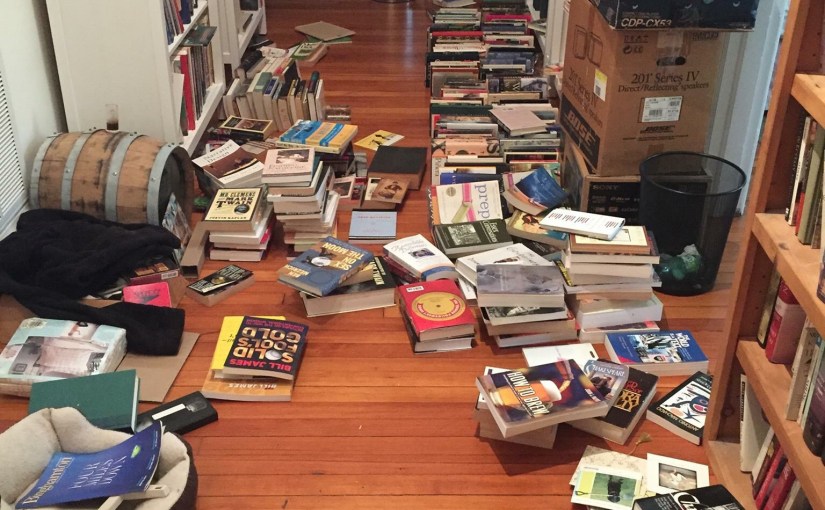
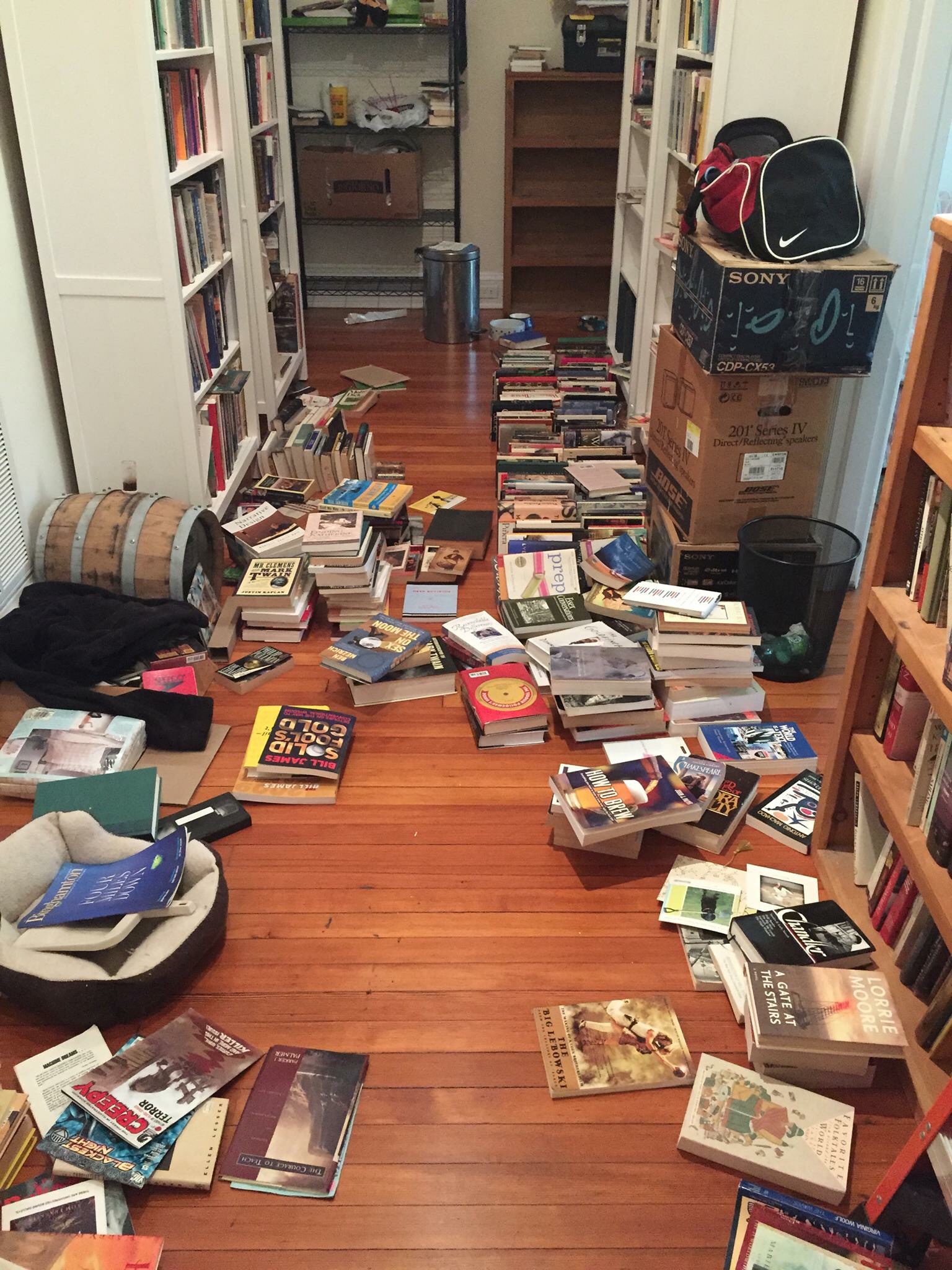
Almost fifteen years ago, I put my books in the attic. They were out, in shelves, but tucked beneath a sloping ceiling and packed behind all manner of family detritus. When my ex-wife and I separated, I moved them into my main living space, where they sang back to me after their—or my—sojourn.  My books matter to me, and I felt their absence. Getting them back onto tall shelves, walking past them every day, reminded me of what I had done, what I had learned, and what I wanted to do with my life and mind.

I have books about writing, books about religion, books about education, history books, philosophy (what we called theory in graduate school), fiction, poetry, books full of art and art history, and even books about sports—mainly baseball. I have a hard cover edition of Dickens published by Chapman and Hall with pages that requires a pocket knife to cut open.  I own a set of Andrew Lang’s color-coded Fairy Tale books.

The books reflect my preoccupations over the past thirty years.  Much of what is on my shelves I first read while I was in graduate school. Some I acquired afterward to keep me in touch with what I spent six years studying. Some comes from undergraduate college—books about gothic art and architecture, an old edition of Joyce’s Portrait of the Artist as a Young Man. There are some newer books that reflect my current interests: a collection of Sumerian mythology, a book about Djinn.

As much as I love my books, as much as they tell a story of my past, as much as they feel like an external manifestation of my mind, I think it may be time to lose them.

How long can one hold onto the past—a past that weighs an actual ton—without moving into the future? Yes, there are some things that I would keep, and this is true of more than my books, but they possess so much gravity. What is the past to me? Of course it is, was, everything. However, the future beckons, and requires a kind of lightness to which things do not lend themselves. Even memorable things.

There are other presences in my life—deep and profound connections. This time last year, I started unraveling the two jobs I had in Norfolk, Virginia. I moved away from those jobs and in the process also moved away from my daughters, who continue to live with their mother in Norfolk. Of course, I separated from and divorced their mother. It may seem inconsequential, but over 30 years ago, I picked a cat off the street, and have had cats ever since. I have never been more than three weeks away from them. This year I considered giving up a long standing fantasy baseball game that I have played for nearly 30 years with friends.

I wonder about what I have given up, but also what I have stayed with over the years. I have been a teacher for over 20 years—including my work as a TA in graduate school, over 25 years. What would it be like to not teach? I wrote for years, and then, if I didn’t stop, I slowed considerably—at what hazard, I cannot guess. I am writing again now, and have been, but can’t help wonder why my work slowed to a trickle.

I wonder would it would be like to be free of obligation and free of the gravity of myself—that ton of books, the closet full of clothes, my job, my family, my cats, even my friends. I wonder what my life would have been like if I had just chased words—the stories that I had declared as my purpose when I went away to and then stayed in graduate school. When I went away to graduate school, I traveled in a single car, with a mattress tied to the roof, and a single cat riding in the passenger seats. What would it be like to travel to what’s next with even less?

I do not regret the life I led, nor the life I lead; regret possesses a gravity greater than all the books own own, and I have no time for that. Not now. Nonetheless, I am aware of another life that exists, not over the horizon, not over the rainbow, but buried deep within me. I don’t know how I have kept it buried for so long, or at what cost—or even at what gain. Still. It is there.

I wonder, and wonder hard, and the wondering stirs something in me, something alive and insistent. What will I carry into the future? What must I carry? And what must I leave?

London Again

Think of London, a small city
It’s dark, dark in the daytime
The people sleep, sleep in the daytime
If they want to, if they want to

Cities, The Talking Heads

The sun rose at 8:04 am in London on the shortest day of the year. It set at 3:53 pm. A shorter day than Fort Fairfield in northern Maine. Add clouds and rain, and the day seems shorter. Is it any wonder that people on their ways home from work find their way into pubs lit with fireplaces? Our days in London were marginally longer, and after walking through the city each afternoon, we found our way to a pub. The Paternoster, The Old Red Lion, Punch and Judy’s, The Swan, Lady Abercorn’s, The George. Some of these were easy to find, others required a turn down a slender lane. Each was bustling.

The charm of London is found in its strange alleyways, endlessly curled streets, and tucked away history. If there is a grid, and in some way, there is, it is bent around the past and the ox bow turns of the Thames, and everything attached to it has been attached in a haphazard fashion. For instance, the coagulation of insurance buildings in central London: the gherkin, the cheese-grater, the scalpel, and the inside-out building; defy any sense of a rational aesthetic plan. Or the juxtaposition of the Tower on one side of the Thames and the glass pineapple of the City Hall just across the river.

I have wandered down the narrow canyons of New York City, through low slung neighborhoods in San Francisco, across broad avenues in Chicago, in and out of fish stalls in Seattle. Even my home city, Philadelphia, built as it once was, on squares, in spite of the Schuylkill river turning into the Delaware, and the oddly oblong expanse of Fairmount Park, makes easy sense. Get oriented and go. London seems to double back on itself, and in doing so, has folds and torn edges through which a body can slip out of any regular order.

And so London’s history is oddly folded into the cityscape as well. A tour through the city—you cannot tour the whole city, or tour it on a bus; you must walk it—folds two thousand years of history, creased around a Roman occupation, a French conquest in 1066, and a fire that destroyed 80% of the city in 1666. And the city is just the square mile that had been walled and gated, but is now open and underlaced with a rail system that carries you quickly to nearly every point beyond the old wall.

The people who live there are folded too. The streets are packed with diverse faces—a variety of eyes and ears and cheeks and chins that make them all different, and so different from the faces in American cities—and sounds. Their voices carry languages from Europe, Africa, and Asia—all of which are easy (and relatively cheap) to get to, even from this island nation. It is as if a map of the world has been folded and brought all these people here. Scarves are the only nearly universal banner, and men tie theirs tightly around their necks. Women walk down streets in shoes ill made for walking—but that is, sadly more universal than naught.

There is an orderliness to the whole affair. Announcements in the Underground direct people where to walk down hallways and on escalators. Advertisements along the walls of the stations counsel caution with wallets and and advise care with alcohol. “Mind the Gap” is stenciled on the ground where the trains stop, and cheeky announcers corral riders whose fancy Italian made shoes have strayed over the yellow safety line. Cross walks show a green walker when it’s time to cross—around Trafalgar Square the walkers take on a variety of LGBT friendly forms: couples and symbols. Just remember to cross when the green light comes!

In so many ways, walking through London was like walking through my mind–folded and full of associations and reveries. My fellow traveler asked what surprised me most, and I answered, nothing. Of course, the fact of a place like London is a surprise all by itself. Are there more surprises to come, more cities to inhabit, that will fill my mind with visions—or somehow, match my visions? Yes. And, yes.

London Thoughts

History is a story of discontinuous events—events that collide like weather systems or galaxies, having barely understood origins, and even less decipherable records. All the witnesses were destroyed in the collision. What they saw, what they thought, and what they felt—even if they recorded their observations on stone, paper, steel, or silicone, have been destroyed along with them. We are living in the age of delusion, in which we believe in the sanctity of our recorded history—either self-scribbled or captured by another.

This thought is brought about by two things. First, wandering, quickly—this time—through the British Museum (or Westminster Cathedral, or almost anything else in London), what becomes painfully obvious are the gaps. All these artifacts, so painstakingly arranged create an idea that history is continuous, and has flowed in a linear pattern. And then a closer inspection shows that over and over again, things haven’t come that way. There are sudden breaks in history, when entire empires vanish, or when they change—seemingly overnight—religions, or methods of governance, or technologies, and the old gets swept away, almost as if it was a betrayal of the new.

England as it shifts back and forth between Catholicism and Protestantism bears these marks hard. Or, reading through the story of Ashurbanipal and the claims of glory made by this king reminds me of Shelley’s “Ozymandias.”

Thinking of history reminds me of Stephen Jay Gould’s idea of punctuated equilibrium—evolution proceeding in long quiet periods of little change, and then having sudden outbursts of change. I know, we are taught that slow and steady wins the race, but, we are also taught to believe in the nature of story as an overarching “way things are.” We see things through that frame, and it doesn’t always support the picture inside—or outside—the frame.

Second, in the musical Hamilton (which was also part of this trip to London), the character of George Washington warns Hamilton that we do not control who writes our stories. He’s telling this to a man who believes in his power to literally write his own story—and to use his words to cement his reality. He can’t—and doesn’t. His wife, Eliza, sends his legacy forward—and Lin Manuel Miranda brings us her legacy. But, as Miranda admits in interviews, even this moment for Hamilton—and therefore, for him as well—is provisional and subject to changing tastes and critical opinion.
Does everything disappear? No. There are 2000 year old Roman walls in London. But Rome? Everything can disappear. And we will tell stories that soften the loss.

I wonder, I can’t help but wonder, what I am doing when I write: whose story I am writing? It isn’t my story. Of course it’s my story–as if it could be anything else. Nonetheless, as I write about characters who are 5000 years old–older in some cases–I think about history, because they think about history. How can they not? How can any of us not? It is everywhere–in the streets, and in the faces, here in London.

My Destination

I had always shrugged off the idea of traveling to the Grand Canyon. I was one of those, “what’s the big deal about a big hole in the ground” skeptics. I was wrong. Of course I was wrong. The Grand Canyon is an amazement—and of course, I was properly amazed when I saw it—looking into two billion years of rock will do that, should do that. I realized that what I had held aside was not the geology or the landscape, but the travel. Why had I discounted my ability to be amazed by travel? I had done it all my life. Going, all kinds of going, even if so much of it has been more local—on this continent, in this country—has been part of me all my life.

When young, my family would take day trips—Sunday drives—through the Amish country in Pennsylvania. We got in the car and headed out Route 30. Or we would go to the West Chester airport and walk among the privately owned single prop planes. In the summer, we headed to Longwood Gardens for fountain shows. There were trips to nearby parks—I remember lakes with small patches of added sand for “beach.” We routinely drove to Long Island—heading up the New Jersey Turnpike past the refineries—to visit family. When I was ten, we headed to Maine, a day long drive with three boys and a dog. Once we began sailing, it did not take long to head to the British Virgin Islands—my first plane rides, and first swimming in warm Caribbean seas.

I loved airplanes and airports. Departures were invitations to new adventures. When I traveled with my family, I usually sat alone—the hazard or benefit of being an odd numbered group. I took my first plane flight alone when I went to Iowa to swim; I was 15. I traveled by train and bus alone all through my early adult life. I usually traveled to visit friends. However, I also went to cities to simply see them, to look at buildings, and camp in museums—visiting and revisiting works of art that held sway over my imagination.
I loved driving, and would sometimes eschew expedience for country roads, foregoing straight, broad, multi-laned ribbons for winding paths along mountain sides and down by river beds. Landscapes called to me as well as vaulted ceilings. Beauty was everywhere.

And, I loved walking. I hiked 500 miles when I was 12. As an adult, when I took myself to Maine, I would walk the beaches in Phippsburg, breaking up my study sojourns with hours long ambles. When I arrived in Bermuda, I walked off my sea legs with long walks and runs around the island, walking into local places, on roads no taxi or rented moped hazarded. Once, on a trip to NYC, I walked, in winter, from Soho to the Met, freezing along the way, but surrounded by shops and towers and people. When I spent a conference week in Portland, Oregon, I took a day off to wander to Portland Museum of Art to see Native American artifacts from the Pacific Northwest, and a painting by Clifford Stijl. Afterwards, I headed onto Powell’s Bookstore, then to the DeSchutes brewpub. All on foot.

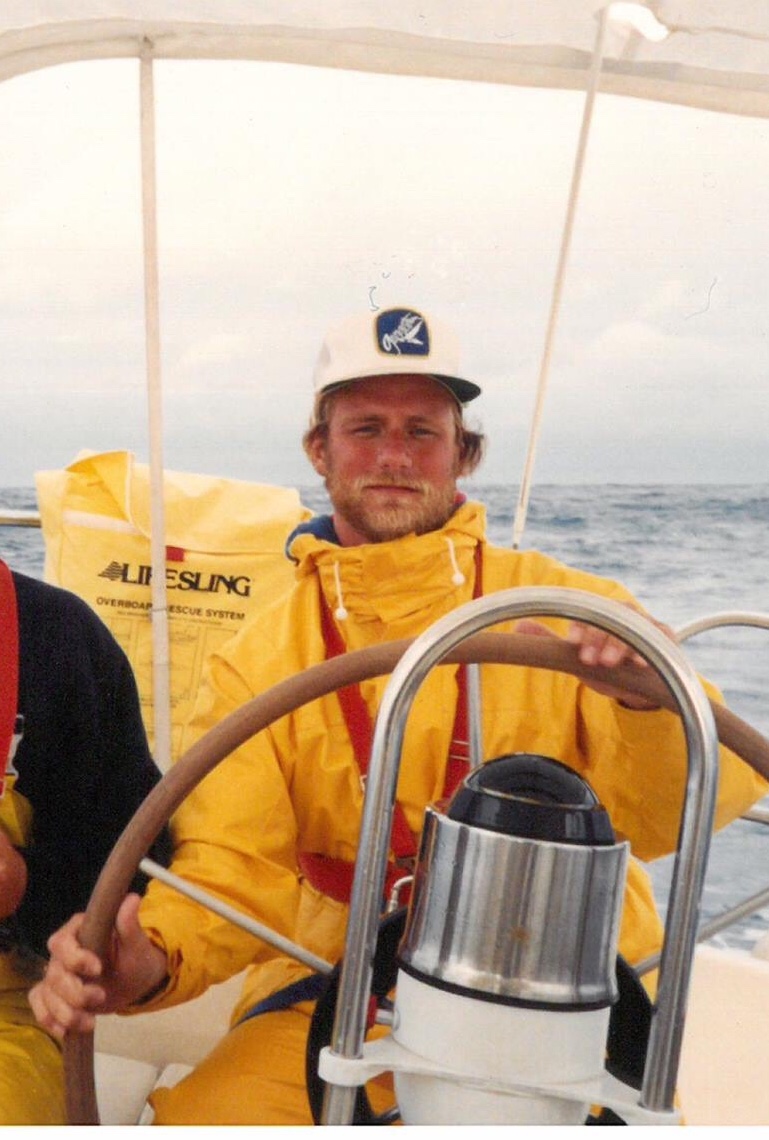
There were trips under sail with my father and brothers. These were tests as well as trips. The ocean makes us foreign to ourselves, our bodies not made to be perpetually wet, and perpetually in motion—shaken and stirred. I have never been anywhere larger than surrounded by sky and ocean, never felt as alive, nor as alone.

This blog began with travel some four years ago—a trip to China, to a strange land to bring a stranger into my life. There are so many strange places yet to go—so many friends to visit—people I have not yet met, whose tables have an open seat waiting.

So, walking to the edge of the canyon should not have surprised me. I am sure that some snobbish impulse to avoid what millions of others had done informed my thought. But I am not like millions of others. I forget that sometimes. On purpose—as a bulwark against being a snob, against falling into the easy habit of travelers to simply bring myself wherever I go. I would rather be a stranger—not just to the place, but to myself, and welcome this new person into my already teeming life.

And so, finally, after one long ago missed opportunity, I am traveling to London. It is an easy enough first step to Europe. I wonder what I will find there, what old memories will rise up, what new experiences will awaken. And I wonder, who I will find there in among the histories and wanderings. Who will come home, amazed, this time? And what will happen if the wanderlust takes a firmer hold of me this time? How will that change me–or, rather, change me again. Eyes up, here I go.