I don’t know how long I have been preparing for my mother’s death. It has been for some time. The first inklings came by way of my father.
My father had suffered with Parkinson’s Disease over the last ten years of his life. I choose “suffer” and not “struggle” because “struggled” is too valiant a word; he suffered from the diminution of his physical abilities, of a stutter, and drugs that knocked him out. Nonetheless, he insisted on driving, even after the autonomous reflexes that make safe navigation of country roads at high speeds had abandoned him. We—his family—worried that his end (and someone else’s end) would come on the road. It did not.

Before the disease, my father sailed. He began when I was 11, and I took lessons with him. He sailed on the Chesapeake Bay, spending weekends looking for wind. When he retired from full-time work, he began to sail on the ocean.
Everyone who has sailed on the ocean has a story of a near-miss. Some idiots sailed onto a reef, and lost their two million dollar boat. A cargo container (my father’s persistent concern) floated like a metal iceberg and ripped through the fiberglass hull of a ship. There was a boat whose hull breached when it was nudged by a whale—“Once the water got into the cabin, the keel pointed it to the bottom. Like an arrow.” Any number of unforeseen accidents could turn a gentlemanly jaunt across the waves into a disaster. Even without the gales and following seas, sailing, for all its trappings, is a dare.
When I sailed with my father, I was folded into the fraternity of casual, privileged risk. It is a different bargain than that made by those who forswear safety for a higher cause. Only a fool invites disaster, tempts it, for what? A dare? An assertion of meaning and purpose? A sunny destination? All those and more. We may have been foolish, but we prepared for the worst.
My father’s disease added to the risk. He was the captain and an unsteady hand. Often he was the only one on board who could do the little tasks that needed to be done in a storm. He wanted to do them; he liked to do them. When I sailed with him, he ruefully asked me to tie down a loose sail. “I can’t do it,” he admitted. He would not say why he could not. He never admitted to the disease.
When other less sure crew was with him, he pushed himself to do those tasks, and came off the ocean bruised and beat up. He knew his time of risk was drawing to an end. He told me that he was contemplating selling his sailboat and buying a motorboat to “gunkhole” around in the Chesapeake Bay. A signal of its own.
In 2002, cancer—non-Hodgkins Lymphoma—struck my mother. She was not pleased, just as she had not been pleased with my father’s illness. Disruptions were anathema to my mother. However, her illness stunned my father. Whatever else in his life was uncertain, my mother’s tenacity was inflexible. I drove from Baltimore to the Philadelphia area to take her to chemotherapy sessions, sparing him as much as comforting her. After a few months, her doctor thought she had gone into remission, but then a second wave collapsed on her. Her liver swelled to the size of a football, and her blood became the consistency of maple syrup. We girded ourselves for the worst. And then it passed.
Six months later, my father slipped on a wet dock, fell into the water, and drowned.
Because of this, for the past 18 years, death has been a sometime presence in my relationship with my mother. My mother was nearly 72 years old when her husband died. He was diseased and at risk; the reef was hidden under the waves. We knew the odds.
My mother was halfway through her 88th year when she died. Otherwise, she was not a halfway kind of person. She was a pistol—full of energy and ready to go off in an instant. She was fiercely independent—a characteristic that could make her difficult, but which also fired her painting. She started making art in her forties. Painting was a source of independence, stability, and consistency in the second half of her life.
While others made paintings that were representational and, well, let’s be honest, commercial, she stuck to abstraction. A quick word about abstraction: while some might imagine that abstraction is easy—just smear some paint on canvas—my mother found a challenge in getting a gesture onto the surface, and then a further challenge in adding a color, a second gesture, then another color. She labored over maintaining control of her gestures and palette and took solace in the layering of decisions that created a finished work.
If you had ever seen our house and its spare, precise decor, you could have seen how she battled chaos. Add to your imagination the rambunctiousness of her three sons, and the knowledge that we were forbidden from several rooms of the house until we were older and more settled. Her artistic life stood against the (self-invited, self-created) disorder of the outside world. She did not take to sailing—to the unpredictability of wind. She would retreat to the cabin when the boat heeled on a beat. She poured a glass of scotch, finding ballast and balance where none existed.
When I visited her with my family in 2014, a copy of Derek Humphry’s Final Exit ( a handbook for assisted suicide) was on one of the side tables. She was 82 and fully in remission, but arthritis made walking painful. She was sending up a flare of dissatisfaction. She had watched her mother linger and die in a nursing home. If my mother was a pistol, her mother was a blunderbuss, sour with nostalgia for a time before her marriage—the good old days. My mother did not want the end she had witnessed there. She put the book out to warn us: I am unhappy, and will not fade out of control.
The intervening years have unfolded with a number of slaps—like a cat playing with a mouse. Small strokes and other ignominies took small but noticeable bites out of my mother. When she gave up her studio—located in a community art building about 20 miles from her home—it was a keen signal.
The past year she has navigated toward an ending, and I have been, as I often was with my father, a helping hand on the helm. It has been a strange duty. I encouraged her to work because I knew and shared the value of daily work with her. But I also listened to her dissatisfaction. “When I go to the studio, all I do is nap,” she told me. She told me more and told others more as well. She did not withhold complaints.
Last year as my mother began to make this final journey, I had started to date a woman. I told her about where my mother was, and what she asked of me. Rightly or wrongly, this woman noted the possibility of “unhealthy” and retreated. I cannot disagree or blame. I took the helm for my mother the same way I did for my father when he—foolishly, dangerously—kept to a schedule despite the weather. If, in telling the story of my mother’s death, I have returned to my father and his end, it is because they are intertwined—bookends spaced twenty years apart.
I ended my brief graveside eulogy for my mother, “She leaves us with this legacy, and with a vision of how to thrive in the garden of challenges that faces us all. Even this challenge. We go on, making our marks, as she taught us.” While many of my posts have been about my father, my mother was also my teacher. The lessons—both fortunate and unfortunate—that I took from my parents shaped me and prepared me. For what? For his death? Hers? My father once asked me if I could bring the boat home without him. He was prepared for disaster. I answered, as I must, as was true, “Yes.” These are the sailing lessons.
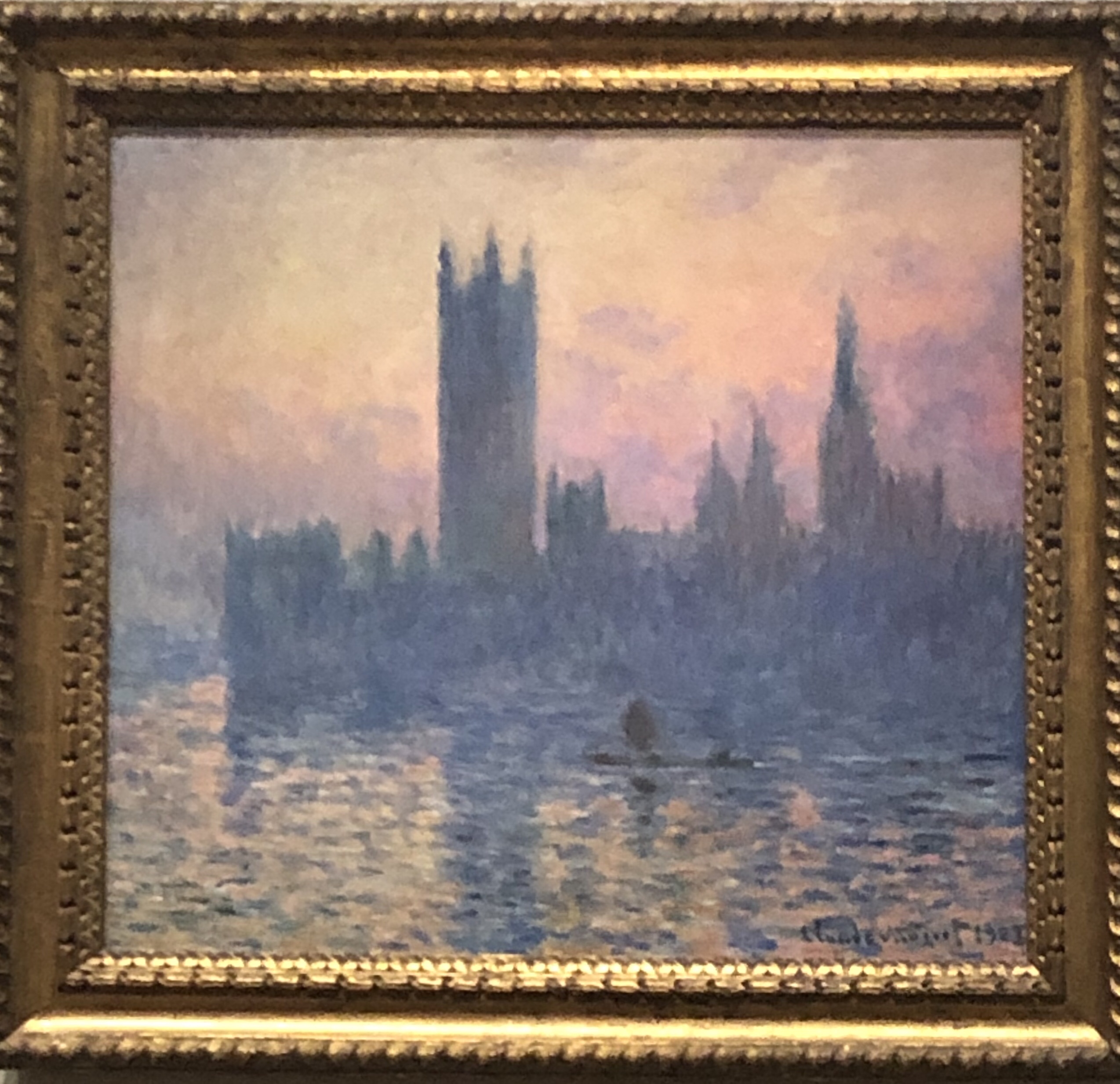 It has been a year and a few months since I was in London. I’m thinking about London while I sit and study Monet’s “Houses of Parliament, Sunset” at the National Gallery of Art. The memory of looking across the Thames at that building, with Big Ben swathed in the latticework of repair, has faded only a little. The memories of walking the streets of the original square mile and beyond remain startlingly vivid. I used them to paint scenes when the characters in my novel walked through London. The memories of the places and the memories of the feelings.
 When I was last in London, I was taking steps into a world where I knew I could live, where I had longed to live. Just like in the dream, writing—flight—was not foreign to me, but something I had traded in for a more certain, more directed existence. While “You are…You should” can feel like shackles, flying—writing—is formless and uncertain. Anywhere is possible. Everywhere is almost a mandate. Just like in the dream, I had written before—had flown—and had lived closer to the limits of my existence. But I had to leave my self-imposed limits. I had to accept that I might fall—and fail—but just as I accepted that in my dream—soaring up the side of a steel and glass edifice, wondering, “What if I forget? What if I fall?—I thought, even as the thrill of fear invigorated me, “You are flying now. Even if you fall, you will remember as you fall, and fly again. Keep flying.”
 Two women look at the Monet—taking seat in the National Gallery beside me. They think it is beautiful, but claim, “It doesn’t look like that.” Of course, the Houses of Parliament look like that, as does the river Thames, as does the sunset. “We didn’t see it,” they claim, “We were tourists, doing touristy things, like thinking about where to have dinner.” I did not think about dinner when I was in London. As much as I love dinner, even food became a secondary thought while I was in London. Even the pubs and ales became little more than way-stations along the bigger task—the journey, the seeing, the walking, and the flying. And the writing.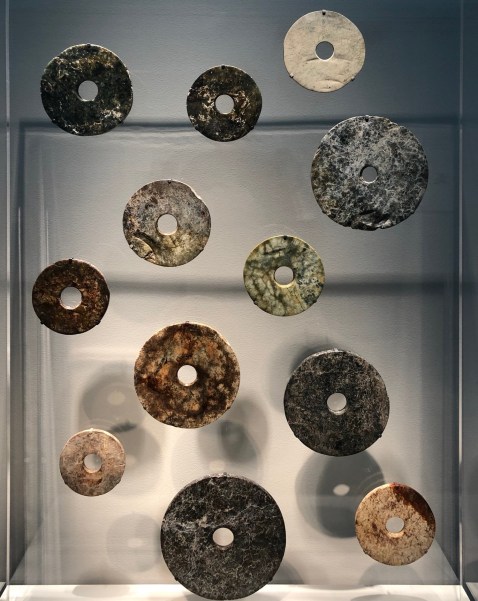
 In the other corner of the Freer Gallery, an exhibit of Hokusai’s paintings and illustrations includes quotations from the artist about what he intended—not just in the specific works, but as an artist. He wrote about discovering himself as an artist late in life. He was already an artist, but he claims to come into his own in his 50s and thought that he might attain his most complete vision if he lived to 110. He died at 90. His work is sweeping and intimate—monumental nature and quiet personal moments—fantastic and humorous—heroes wrestling demons and uproarious coworkers. Whatever else he meant to last in his work—why that hero wrestled that demon (as if one could easily answer such a question)?—he meant it to last. He aspired to capture a vision that would last long after he died.
 While I like to write while surrounded by people, once my eyes are on the page, and once my fingers are working, a kind of wall goes up. Writing is solitary. And it is not.
 There is a plate at the Freer Gallery in Washington DC. Around the rim are an elongated set of letters in Arabic. Even if you knew what those letters meant, would you know about the person who wrote them before the platter was fired in a hundreds of years old kiln? Or what to make of the carved insignias on a Neolithic disc from China? Sometime, 5000 years from now, will these shapes still make sense? Will they point some future reader back to me? Or to anyone else who writes now?

 It happens to us once or twice in a lifetime to be drunk with some book which probably has some extraordinary relative power to intoxicate us and none other; and having exhausted that cup of enchantment we go groping in libraries all our years afterwards in the hope of being in Paradise again.
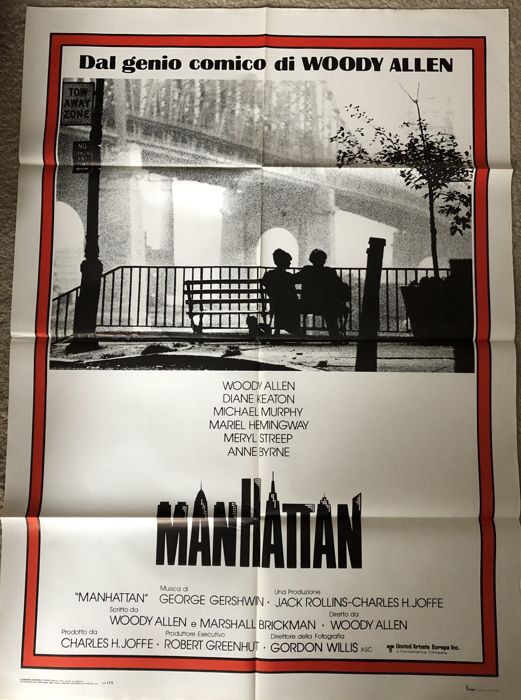 I first saw Manhattan in 1979, when I was 19 and thought myself precocious. I was a sophomore at Swarthmore College, a school full of young people who rebelled in their precociousness. Tracy’s relationship with Isaac simply echoed my sense of myself. Who among my friends would have put a limit on the seventeen-year-old Tracy? We were only steps away from that age; we were not intimidated by 42-year olds. What did we know about power dynamics or anything more than our own blossoming worth in the world? Blossoming? Fuck that—we were valuable and powerful as we were.
 continuoussearch