Figuring things out

My room of my own

I started writing poetry in the 10th grade, stopped, then started writing fiction in my final year of college. I got into a writing workshop on the strength of a story about a mine disaster based on fact (there were/are/will be mine collapses) and was inspired by the immediacy and detail of a scene in Conrad’s Lord Jim (a boiler explodes). After college, I tried to write a mystery/thriller novel with Monet’s Haystack paintings as its centerpiece. It didn’t get far. Then I started another about a pair of young men who masqueraded as even younger men so they could be freshmen again and restart the process. No. Then, another about a young man with no memory who happened to be an all-star pitcher. This one also died a quick and quiet death, but the idea of someone without a memory persisted, and 40 years later (after several odd turns) became the spine of the novel I finished.

I will leave out the other fits and starts and hazard to mention that I attended a Ph.D. program in Creative Writing for six years and have published a few stories and poems. My writing life has centered more on frustrating periods of silence than flourishing runs of production. I have written other things along the way—articles, curricula, and this blog—but the impetus (novel, novel, novel) that started me writing was not fully engaged until I set aside other obligations. I am no longer the manager of an Italian dive restaurant in Philadelphia. I am no longer a director of religious education or the principal of a small boys’ school. I am no longer a full-time teacher. I continue to teach part-time but spend the better part of my workday in a well-lit corner of the library chasing pages.

When I was younger, I thought I had plenty of time to figure out my writing and that I would somehow perfect the creative process to get properly tuned into the muse. Many of my teachers focused on quality, brandishing red pens, and working as gatekeepers, and I ate that up. Only one teacher wrote an encouraging “Keep Writing!” at the bottom of every story I delivered to workshop, no matter what other positive or adverse comments he made. Maybe my teachers took for granted that the most significant driver of creativity is not perfection in all its glory but a desire to spend hours every day at the task. And—and this is the hard pill to swallow—the world is not just set against providing anyone with the hours required to do the work; it will also sponge up and divert the emotional and intellectual attention that writing requires.

I acknowledge that some writers get by on an hour borrowed here and there, getting in a solid jag on their off days. Some. I had one—and only one—teacher who advised against attempting to balance writing with a full-time teaching job. He suggested that driving a soda delivery truck would be a better option. And he taught. He recognized how easy it was to get wrapped up in the briar patch of teaching. Even when it is a bed of roses. However, writers, novel writers at least (okay, this particular novel writer; I really can’t speak for anyone else), revel in the unceasing details of life. Even driving a truck full of soda bottles can provide grist for the attention mill. Writing is more about limiting the scope of one’s vision, on not-seeing. One either ignores everything that doesn’t advance the progress of the current project, or the attention-seeking device in the writer’s mind will fly with a preternatural attentiveness to every corner of the room, out the window, and down the street to a vast and varied countryside. Again, yes, some novels venture into the encyclopedic (including some novels I love), but once you lash yourself to the mast of a story, you must learn to pass through the siren songs of everything—anything—else.

As previous posts note, I value distraction. I welcome something (anything?) that nudges ajar the closed doors of perception and lets in the light of inspiration. Except.  The distractions I choose are just that: my choice. The inexorable enforced distractions that modern life promulgates, especially those that are delightful, noble, or profitable, will not contribute to the necessary accumulation of pages that a novel requires. Virginia Woolf recommended a room and three guineas as the basis for a creative life; something like that still holds.

In the end, I have become significantly less concerned about the origin arrival of the next idea and whether it is good than with securing time, place, and inspirational distractions. The mind will generate ideas as surely as it produces dreams night after night without prodding or worry. Back to work!

The Right Way

I’m sure it’s happened to you. Someone has told you the right way to do something. It could be something as simple as folding towels and then hanging them up on a towel rack in your bathroom, folding a t-shirt and putting it in a drawer, or wrapping a birthday present. Maybe you offer such advice, although it’s not really advice. It’s a dictum: THE RIGHT WAY. I wonder where people get these ideas, and I suppose, as often as not, they come from parents who explained how to wash a fork or how to tie shoelaces. Someone once watched as I tied my laces and corrected me. “That’s not the right way.”

My parents never offered such advice. After my mother taught me the wrong way to tie my shoes, I became a free-range kid—long before there were such things as free-range kids. My brothers and I roamed through our exurban neighborhood, sent on our way for hours every day with only a momentary return for a PB&J at lunch. When I was eleven, I read the instructions on a box of Chef Boy-Ar-Dee pizza and made pizza dough from scratch on Saturday afternoons. I asked for and received a pizza tin for a birthday. My father set out the chess pieces, and after explaining how the pieces could move, I was on my own. Did I find a book in the school library that offered suggestions? Yes, I did, and then, eventually, beat my father. I learned to tie a bowline knot in Boy Scouts (the rabbit runs around the tree method), and my father didn’t care how I tied it when we sailed on the ocean together, so long as I could do it when the ship was bucking over chop.

I can’t tell you how many things I learned on my own, occasionally seeking guidance. While I took swim lessons, first in the pool of a local family, then at a Red Cross class at a nearby pond, later when I wanted to ascend from the junior varsity to varsity team at my very competitive high school, I turned to Doc Counsilman’s Science of Swimming to work on my breaststroke. My first car was a Volkswagen Beetle, and I owned a copy of John Muir’s How to Keep Your Volkswagen Alive and used it to guide me through replacing the clutch; it was more complicated than I imagined. Replacing the McPherson struts was beyond my ken, mainly because I didn’t own something to compress the springs in the suspension. Even with expert advice, I knew when to turn to a professional.

I learned to cook by deciphering recipe instructions in my mother’s worn copy of The Joy of Cooking—the only cookbook she suffered to own. I watched cooking shows on PBS when I was a teenager, and in my early twenties read James Beard’s Theory and Practice of Good Cooking for fun. When I worked there as a waiter at La Fourchette in Wayne, I asked the head chef how to make a beurre blanc, which I needed to know to make scallops stuffed with pesto in a beurre blanc. I asked about the pesto, too; there was no internet. I learned about pastries from the pastry chef. For one Bastille Day dinner, I replicated his white chocolate mousse recipe, straining raspberry coulis through a well-cleaned lint screen from the dryer in my apartment’s basement. Not the right way, but one of many possible ways.

My early school teachers remain a blur. I remember one who told me my world map looked messy—my crayon blue oceans were too streaky. But there was Mr. Hecht, who asked me to join the math club, and Mrs. Vandergriff, who had us do a lesson in prejudice by segregating the blue-eyed blond students to a single table. We weren’t allowed to use our hall’s water fountains or restrooms. My seventh grade history teacher (Mr. Moore) taught us how to take notes, and I can still organize any lecture into a fairly plastic but organized outline. I made deeper connections with my teachers in high school, in no small part because we ate three meals a day with them; I attended a boarding school. But besides dates and processes (which I loved), I don’t recall learning how-tos. Ryck Walbridge did not walk us through how to work an autoclave; we had one, but how it worked was a lesson beyond us all. Buzz Gardner read Catcher in the Rye from start to finish aloud in class. Neither Dick Broad, Buzz Gardner, Arthur Jackson, nor Alexander Revell taught me how to read more effectively—or “Read Like a Professor,” as Thomas Foster advises. I came to reading on my own.

I was not an early reader. Sure, my mother dropped us off at the Paoli Library while she shopped. My brother and I wandered through the small dark corners, pulling books from shelves, settling on Dr. Seuss’s preposterous rhymes and Richard Scarry’s encyclopedic illustrations. We had few books at home: a multi-volume photographic history of World War II, another multi-volume medical dictionary acquired volume by volume by shopping at the Acme grocery store, and a few Reader’s Digest compilations of abridged novels. I must be misremembering a little because, at some point, the shelves in my 11-year-old bedroom began accumulating books, among them E.B. White’s Stuart Little and the anthology Rod Serling’s Triple W: Witches, Warlocks, and Werewolves, and a hard cover dictionary. In seventh grade, I met a boy who was reading Alistair MacLean’s Where Eagles Dare,and when he was finished, he loaned it to me. Thus began a reading bender that has not ended. I tore through those adventure novels, some early Michael Crichton, all of Vonnegut in paperback (Player Piano through Slaughterhouse Five).

Somewhere in that jungle of pleasure reading, I started to pull books apart. While reading MacLean’s The Way to Dusty Death, finding the title phrase buried in a description deep in the novel delighted me. I was 11 or 12 and began to dig through books looking for interconnected words as if the repetitions would unlock the book. I read books like puzzles. Of course, I never considered that MacLean alluded to Macbeth (I had, at the time, neither read nor watched a play by Shakespeare). Later, my magpie mind would make that connection and a thousand more.

I guess my point is that no one said, “Brian, look for repetitions” as a method for unpacking a novel (or, for that matter, the world). I learned to read, moving from Dick and Jane to The Story of Ferdinand the Bull to “Who Am I This Time?” to Leviathan to The Waves without anyone saying, “This is the right way to read.” Did I stumble along the way? Yes. Even in graduate school, one of my professors marveled at my compendious collection of interlinked parts of Donald Barthleme’s The Dead Father but suggested that I hadn’t stumbled on a reason for that compendium. “This lacks a thesis,” she wrote—as if connection wasn’t the thesis. Sometimes I think that what I believe to be so obvious that it beggars definition. It’s not. I have to be painfully clear.

So, I want to tell you there is no right way; there is only your way.

But.

You will only find your way by working at it. You will need to test your method in several unrelated fields. “But I don’t like math,” you will complain. Or, or, or I don’t like “fill in the blank.” Look, even if you don’t like math, or Latin, or chemistry, you can’t say, “I don’t like trying.” You may be at a loss for knowing what you want to spend the rest of your life trying. The whole point of school is not to teach you some balance of everything. School is here to give you a reasonable amount of exposure to things you would not necessarily consider as avenues for something like success. And—and this will frustrate you—school teaches you that effort—genuine slog through the mud, sweat in the field, freeze on the mountainside effort—has lasting value. You may not remember the Krebs cycle or the quadratic formula, but you will remember the effort.

Let’s suppose you are that rarest of rare birds, “the natural.” What you are a natural at is not baking, auto repair, baseball, drawing, or writing. Naturals have the ability to expend genuinely unfathomable effort in some—usually one—direction over and over again without giving in to the fear of failure. They begin every day and try. The rest of us, the regulars, must learn how to try. “The right way” is just a shortcut—and when replacing a clutch, I’m happy to have that shortcut. Imagine winging a clutch. Good luck.

Even if there is a right way, there is no right way to try. That you have to figure out for yourself. Figure it out. Try. And you will find your way.

Process: Swimming and Writing (part one)

Every so often, Facebook reminds me of where I have been. I posted this a dozen years ago. I was still swimming, and this was the template for the 2500 meter swim I did that day. Not the most exciting workout, but after two or three hundred meters of warmup, I held hundreds at 1:15. Pretty fair for a non-competing 49-year-old swimmer. The swimmers out there will recognize that I was breathing bilaterally (on both sides) every five strokes; they will also acknowledge that I was taking 15 strokes each length. Again, pardon me for saying this, but that wasn’t bad for a 49-year-old. I trained myself to breathe bilaterally after I left college because my stroke had a hitch that breathing to each side helped eradicate. My right shoulder was happier.

A few things to note. First, I am virulently attentive to and oriented to process. Swimming was never a “zen” activity for me in which I transcended the effort to reach some peaceful state of mind. Instead, the effort focused me on the effort itself. I paid attention to where my hands entered the water, how they caught the water, how my body moved over my hands, and where my hands exited the water. I was aware of the position of my arms as they flew forward to grab the water again. And again. And again. In this case, I remember thinking, “1, 2, 3, 4, 5 (breathe)”—taking three breaths each length. Focusing on what I was doing helped fend off the building exhaustion.

I grew up swimming when there were no devices to pump music into wet ears to help keep the beat while you worked out. I developed an inner hortator who drummed out a rhythm to keep me on pace. It was similar to the inner voice that kept step following steps when I hiked 500 miles as a 12-year-old, but now more driven and more ecstatic.

“Ecstatic”? You might ask. Through my four years of high school, as I improved from a middling age group swimmer to what I eventually became, it seemed that every swim (in practices and meets) was faster than the last. Every set provided an opportunity for improvement. I may not have gone to the Olympic trials, but I swam faster, following the beat that my cruel inner taskmaster laid down. Swimming fast exhilarated me. The effort I made showed an immediate result. The sweeping second hand of the poolside clock never lied, never expressed an opinion. And I swam in the company of some of the fastest young men on the East Coast. Keeping up meant something. I never again swam without that goad in mind.

Throughout my life, swimming offered the solace of process, repetition, and speed. Tired and overworked? I swam. Heartbroken or happy, I swam. Sick? I swam. No matter the tumble of work and life, swimming was one thing I could control. It was years before I connected the bones of that daily practice with writing, drawing lines from “this” to “that.” While some people had told me that swimming and writing were twinned activities, I felt that writing required another kind of effort. I believed that creativity was antithetical to the dull repetition of physical exertion. Writing required audacious leaps. Even when I began to write, words ran like a flood, flowing from inspirations as varied as my life to what I read. And then, they didn’t.

When I lost the thread for writing, I poured my effort into teaching and, later, churchwork. I wrote everything an English teacher writes—class notes, assignments, student evaluations—and then curricula for Sunday school classes, children’s stories for worship services, and little else. I had a book in mind but no room in my day or brain. Work and family occupied my day—as they should. After years of being too busy to thrash about in the pool, as I approached 50, I answered the old call for 30-45 minutes in the pool. Everywhere else, I felt at someone else’s call.

So, I started swimming, and little by little started writing too. This post, with its repetition, was modeled on a kind of prose poem—a metapoetic “word word word word word punctuation ad infinitum.” I’m not claiming that it was a perfect prose poem. I have changed my mind about the value of writing when inspired. I have sung the praises of word counts in some of my blog posts. An accumulation of words will create its own gravity until it catches fire—almost the way the sun catches fire over and over again. Trust the process and write word after word after word. Don’t wait for inspiration—write yourself there.

My swimming post pointed me in a direction, and eventually, the fire took hold.

Swimming and Time

Every time I touched the wall, I looked up to check my time. The spinning red hand of the clock revealed how long it had taken since I began whatever swim I had started, however many seconds—or minutes—ago. We did two things at practice: we threw yards and meters at our bodies and practiced touching the wall. Whether it was a grueling set of 20×100 yard swims on a 65-second interval to wrap up a workout or the inane 3×1500 meter swims with 30 seconds between each as a warm-up (Imagine doing that at 6 o’clock in the morning on an already warm summer day, in a pool with only thin nylon ropes to separate the lanes), whenever you finished, you jammed into the wall. You lifted your head from the water to see the clock. How fast did I go? How much time until the next swim begins?

I was not a world-class swimmer. When I was little, I tended to sink rather than proceed at pace. I wore a Styrofoam bubble on my back.  There were lessons. My parents took me to Red Cross run classes in a lake near our home in Paoli. I flailed, resisting the head turn required for a proper crawl. Still, I loved the water and turned blue when my parents took us to Jones Beach when we visited their parents. Who would want to leave the churn and rush of waves? We joined local pools and passed our deep-end tests, treading water for an absurd amount of time under the watchful eye of a lifeguard. Once passed, my mother would drop us off while she shopped or played tennis at the Great Valley Country Club. Swim teams only started when I was 11.

In my sophomore year of high school, I was a fair Junior Varsity swimmer. The Hill School had a nationally ranked independent school team, and I was far from fast enough for that. I was only 4 years removed from goggle-less practices in the insidiously warm indoor pool at the Phoenixville Y. I came home bleary-eyed and teary. As far as other sports, I had been an indifferent Little League baseball player—more interested in the planes in the sky than balls hit in my direction. Because I was tall early, my father—a scholarship athlete at Niagara in the 40s—signed me up for basketball. It did not take. I enjoyed gymnastics: the rings and parallel bars carried me a little out of gravity’s grasp. You had to play a sport each afternoon, fall, winter, and spring at my high school. In my first year, I opted for soccer, swimming, and golf.

The 3500 yards that the JV team swam between 3-4 in the afternoon were as many yards as I had ever swum. Fred Borger was the JV coach and threw easily attainable sets at us: ten 100s at 1:45, then 1:30 as we improved. I started off swimming the 500 yard freestyle at meets. My early times were over seven minutes. I ended my first season at 5:55. My 100 breaststroke was north of 1:20, which rarely merited placement in one of the three lanes for meets. During my second year, after spending the fall playing water polo (a ploy to get fall training in for the varsity), my 500 time dropped to 5:20, and my 100 breast hovered at 1:15. I knew if I wanted to improve, I would need to change something.

As a sidebar, I was not happy at my school, an all-boys bastion against, what? a fear of falling? I spent the spring of my sophomore year stoned and looking for a new school for the following year. I crept out after curfew and brought pizza for my dorm mates. I never studied—my memory for most things kept my grades well above water. This was the year that ditched my longstanding boyhood aspiration: to attend the Naval Academy. I wanted a more diverse, less dick-driven environment. After all, how could you read Catcher in the Rye and not feel as if you wanted to turn away?

A friend on the Varsity swim team shared a flier from a swim camp/AAU team in Iowa. Glen Patton was building the program at the University of Iowa and was contacting good young swimmers like my friend as a way of recruitment. I applied to Swimming School and was delighted to be accepted. If I wasn’t going to go anywhere else, at least I could be a better swimmer.

At Iowa, we had three practices a day, totaling as many as seven hours in the pool. I had never swum more than one hour on any day and rarely more than 4000 yards. We swam between 20,000 and 28,000 meters every day. The general philosophy was “Get in. Keep up. Move inward.” Slower swimmers—I was one of them—populated the outside lanes. You shifted from lanes one and ten to two and nine, then three and eight, and so forth. The fastest swimmers—and there were Olympians on that team—swam in the center of the pool: lanes four and five. In the two summers I swam there, I never nosed into the center (not 4 and 5, not even 3 and 6), but I could see them. I chased and swam faster. 

When I swam in Iowa in 1976, we gathered in the evenings to watch the Montreal Olympics. The American men won every event except one (Britain’s David Wilkie took the 200 Breaststroke), and the men set world records in every event except the 100 Butterfly (Mark Spitz’s last record). The East German women had a similar performance, helped, as we know now, by PEDs. The revolution in training (all those miles) caused significant drops in times for those of us who did not use steroids. We were swimming fast, and we all could swim faster. We wore T-shirts emblazoned with the motto: SWIMMING IS MORE FUN WHEN YOU’RE IN SHAPE. And we got in shape by watching our times.

When I returned to my school, I leaped onto the varsity, still not the best, but game. I kept up in practice, By the fall, I was under five minutes in the 500, and my breaststroke time dropped over ten seconds. Raw and brutal repetition rewarded me. The two-hour practices we did at school were intense and competitive. If you weren’t the leader in your lane, you damn well chased the leader, and if you caught them, then you had to lead. Leading was a privilege, but your trailing feet became targets for the hungry swimmers behind you. We each had our strengths, each took the lead on various sets. I had a vicious breaststroke kick, which meniscus surgery 30 years later can attest to. I swam hard, and even later, when I swam just to stay fit, the habits continued. I checked my pulse. I looked at the clock.

 During the 2021 Olympic swimming coverage, I saw the swimmers stare at the clock (digital, not analog) in the distance. I saw the looks of joy and disappointment driven not by winning or losing but by their times.  Was that my best? Did I meet my goal? While the competition may drive many, after a while, the clock becomes the primary combatant. I may have been cognizant of where my teammates were in the pool (chase! chase!), but mostly I looked up and saw that red clock hand sweeping past a black hash mark. Watching the Olympics, if I yelled it once, I yelled it a dozen times, “Show the times!”

The next time you watch swimmers (or runners), notice where they look at the end of their races. If you want to know how they feel, know that they are keenly aware of the inexorable, implacable opponent of the clock. They have looked up thousands of times. And then they have put their heads back down. It is time to go again.

Insistence of Memory

I got chickenpox, mumps, and measles. I had my tonsils out—an operation that required an overnight stay –when I was in 3rd grade because they had been the source of repeated infections. I bounced through cases of flu and other passing illnesses. Years later, I had mononucleosis during the first semester of college. Nothing keeps us from bumping into some microscopic problem. And forget about the web of mysteriously genetic and environmental causes that lead to Parkinson’s Disease or Non-Hodgkins Lymphoma—the two illnesses that plagued my parents—but that was on the distant horizon.

I read Alistair MacLean’s novel The Satan Bug—in which a mutant virus threatens to wipe out humanity—in the 7th grade. In a world that lived under the menace of nuclear war, a biological threat was quieter and almost less tangible, and therefore more insidious. I traced these threats through films and books like The Andromeda Strain, Pursuit, and Rage. Even Close Encounters of the Third Kind used the possibility of a gas or disease outbreak to move the plot along. The insidious unseen nature of these gaseous or microscopic adversaries held my interest.

In my 20s, the HIV-AIDS epidemic galvanized my attention. How could it not? The emergence of a disease that would kill you after sexual intimacy staggered all of us who enjoyed the freedom afforded by birth control and an unshackled moral climate. We felt screwed (and not).

Whether fear or mordant curiosity drove me, I began to study viruses and epidemics with fury. The sudden spread of hemorrhagic fevers that Richard Preston (The Hot Zone) and Laurie Garrett (The Coming Plague) wrote about exacerbated my concern. It was impossible to moralize about what was coming—this wasn’t about sex. Deadly diseases lurked. Diseases have always been half a hair away. In Norfolk, a small park memorializes those who died during an outbreak of Yellow Fever in 1855. I lived a block away.

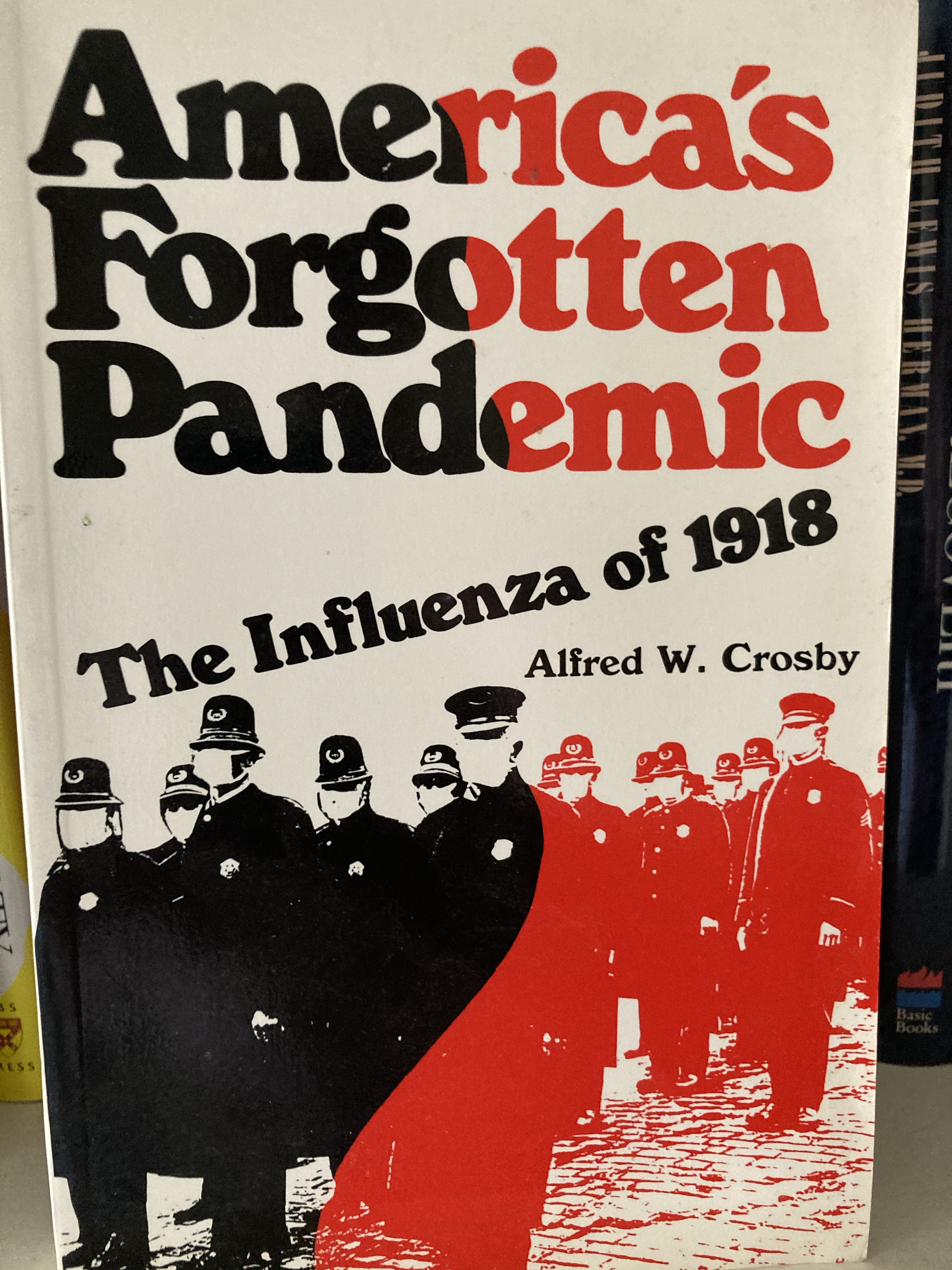
Still, in my 30s, I read Defoe’s Journal of the Plague Year and Garcia Marquez’s Love in the Time of Cholera.  And then, almost by accident, stumbled on reports of the Spanish Flu Pandemic of 1918. I read Alfred W. Crosby’s America’s Forgotten Pandemic at some point in the late ’90s and then John Barry’s The Great Influenza when it came out in 2004. How could it be that we all knew about the Great War, but not the pandemic that occurred at the same time? We know about this now; Barry’s book made it to the bestseller list in 2020, but the memory of the pandemic faded in popular culture. I was surprised this past year when I realized that Mr. Gower’s son dies of influenza in It’s a Wonderful Life; it was the Spanish Flu. Where else was the pandemic?

So when COVID emerged in the winter of 2020, I was not surprised. After all, SARS and MERS had already flourished in their own specific ways. When it became clear that this would be more serious, I bought masks as soon as possible, kept my distance, washed my hands even more assiduously than usual, and settled in for the count. History provided stern warnings; I knew that a count—of cases and deaths—was coming.

We like to predict what will happen, and strangely enough, we tend to think that the future is unwritten. It is, and yet, for a good indication, look to the past. This is true whether you want to know what the weather will be like on May 14th or if there will be traffic on I-95 tomorrow morning. Yes, there are exceptions and random occurrences that will skew the numbers, but the past is all too reliable a guide. Fifty Million people have not died from COVID as died in the last great pandemic, nor have half a billion people contracted the disease. But our imagination does not need to stretch far to encompass those numbers. 675,000 United States citizens died in the influenza pandemic; that number is all too close to where we are headed this year. Yes, the population was smaller in 1918-19, but did anyone expect this to happen?

Over the past year, I gobbled down the numbers. I felt a strange intoxication with having a sense of where things were headed and seeing them move, painfully, sadly in that direction. Anthony Fauci, and most of the medical community, played Cassandra to a population that wished for another outcome. As if wishing could make it so. But what good did it do to know? What effect did my knowing have on anyone other than me? The numbers were a despairing gruel that neither nourished nor encouraged me. I had to wait them out. Eventually, I stopped reloading the numbers every hour and settled on the grim results that appeared each morning in the New York Times.

So what’s the point? Partly this: when you see it coming, get ready: hurricane, pandemic, or whatever is on the horizon of time and place. Get ready before you see it. You have been sick before; people have been sick around you. We should have known better, and our ignorance cost lives. The obvious is always right there. Yes, while knowledge can be overwhelming, there must be a sweet spot: enough information to teach us and lead us into productive discomfort without flooding us into anxious inaction The only way we learn is by exposure.

But there’s something more.

There must be a reason that the pandemic of 1918-19 disappeared from memory. Why and what do we forget? We forget, or remember selectively, and not just about events like pandemics. I’m not aiming at what we don’t retain. As a teacher, I am too aware that students do not retain everything. I wonder why do we forget some things and not others? This is not a reflection just on this pandemic or the last or the run of diseases.  What else have I forgotten? I scramble to instill new habits and new awarenesses or avoid falling down the well of past practices. To borrow from Robert Creely, “[w]hat am I to myself that must be remembered, insisted upon so often”? But more, what have I failed to remember and insist upon?

We resume the remembered rhythms of our lives and return to our old habits and anxieties as if they were never interrupted. Repetition has essential gravity and draws us back. Except sometimes some things should interrupt us. The persistent nudge of discomfort—that we do have something new to learn and some new way to behave—should goad us onto a new course. Except, we stay the course and return to the known, even if it is a life half-lived.

I can (and I suspect that I will) point to the world and shout, “J’accuse! You forgot!” I shout at myself. I must insist that I remember—or that I remember to insist. I write in the face of forgetting, in the face, to borrow once more from Creely, of “the tiredness, the fatuousness, [and] the semi-lust of intentional indifference.” I must return to the hard work of insistence.

The pandemic passes, the lessons must not.

Certainty, News, and the Way Ahead

I grew up reading the news. We did not watch it in my house; my mother felt that the news, which included reporting from Vietnam, was too ugly (her word) for her sons. Keep in mind, this was the same mother who read Edgar Allan Poe to us at bedtime. However, my father brought home the Philadelphia Bulletin every night—back when the Bulletin was Philadelphia’s evening newspaper. He also had Time magazine delivered weekly, and my brothers’ names were often on the subscription. Whether my father was honoring us or getting a new subscriber’s bonus, who knows? I read both.

Later in life, I listened to Philadelphia’s all-news radio station KYW-1060 and grew inured to the rhythm of repeated stories. If they were updated over the course of hours, I noticed. Even later, when I was a night owl, I would slot in my 35 cents for a freshly delivered morning paper. A newspaper and breakfast before bed was near to heaven.

Cable news in its early iteration varied little from the repeated scroll of radio news. That was no matter in Philadelphia, which delayed the spread of cable TV until I was on my way to grad school and other obsessions. Nowadays, whatever used to be journalism has faded out of reportage to be replaced by a carnival barker’s promotion of something like the news. Reporting is more about the changing opinions than the changing facts. The internet does better, providing repeated updates of the day’s events: everything from the stock market to an ambassador arriving in Bahgdad to a 3-2 count on a hitter in the fourth inning of a baseball game in Seattle. Information pours out. At first, it came through the box on my desk, but then it glimmered miraculously from my phone. I pay attention.

I get obsessive. I chase the news with the same intensity that I once chased down sources in the library. And worse. I sit as rapt as I had when I churned through drafts of stories until 7 o’clock in the morning—if I slept at all.

I recognize that I had fallen into the trap that Henry David Thoreau noted back in 1854 when he claimed that “[h]ardly a man takes a half hour’s nap after dinner, but when he wakes he holds up his head and asks, ‘What’s the news?’ as if the rest of mankind had stood his sentinels.” I felt that if I knew, then I could be one of life’s sentinels. On guard, on the post, always. There was no radio, no television, and no internet, and still, he bemoaned the obsession with “news.” Go figure, our national illness.

I tried to know everything. When my family gathered, we were all expected to hold forth on any topic of the day: popular music, politics, foreign affairs, movies, the weather. Our knowledge was expected to be sweeping and insightful. I could not understand people who did not consume—and comment on—news as we did. My father spent hours wringing information from the Wall Street Journal and passed that fervor onto his sons. My mother, despite herself, had some news station, finally settling on NPR, blaring in the background.

It was too much. This past year’s perpetual blast of breaking news—the fires, the politics, the case numbers—drove me to distraction. And I realized that I had been distracted for years. I don’t believe that “ [a]s for Spain, for instance, if you know how to throw in Don Carlos and the Infanta, and Don Pedro and Seville and Granada, from time to time in the right proportions…  it will be true to the letter, and give us as good an idea of the exact state or ruin of things in Spain.” While there are recognizable patterns to history—and history’s first draft—the distinguishable differences are meaningful and worth noticing. And yet, the news can pile up.

Thoreau was on to something, if only that our drive to know masks another deficit: a feeling that life is out of our control. Information is the salve to uncertainty, but it’s snake oil, especially when opinion is disguised as fact.

Writing, for all my appreciation of the uncertainty, is about control. At the very least, and perhaps the very most, I control when I write and that I write. As for the what, well, I take a gentle hand, relying on surprise and a fair amount of chance. Yet, I am aware that no writer, short of a few Dadaists, Postmodernists, or Pornographers, slaps words on the page and waves, “Voila!” I avoid Prufrock’s “hundred visions and revisions”; I don’t have time for such nonsense. The work needs to be done.

During the first draft, I write to discover—just as I listen to the news to find out what is happening in the world. I research my subject the same way I study how the new vaccines work. I have learned (painfully and too slowly) that I must write to the point where I do not know what will happen next; there must be surprises. I go back, organize the words, and develop the surprises, letting them, and not all my preplanned ideas, serve as guides. The writing must be out of control for me to find control. Otherwise, it all falls flat. That was not an easy lesson. No one can stand that—not the reader and not the writer. Not this writer.

This past year, while everything felt out of control: the fires in Australia, the pandemic, my mother, the election, and its aftermath, I charged back into the news. Did knowing all about it help me? Maybe. But knowing got in the way of the creative uncertainty that I needed to engage. I have spent years wielding some kind of authority, and like it or not, that has been the death of my creative life. I do not know how other writers do it. So, for now, I am backing away from the news, cutting the cable, and heading back into the unknown.

Emily Dickinson writes about the “Route of Evanescence”—the road of fleeting possibility. Take her advice. This way can be daunting, especially for someone who likes—no, loves to know. You too write to be in control, except, finally, we are not. But the route Dickinson so briefly and beautifully delineates is one way to uncover the mysteries that wait: “Some mail from Tunis, soon.” So must it be. The unknown and fleeting. Get there.

Howl

Howl, howl, howl, howl! O, you are men of stones:
Had I your tongues and eyes, I’ld use them so
That heaven’s vault should crack. 

                                    King Lear V.III

My father and I traded knowing looks when one of our crewmates complained about the weather. Anyone who heads out onto the ocean for anything more than a day sail should understand that the weather will change and, then, change again.

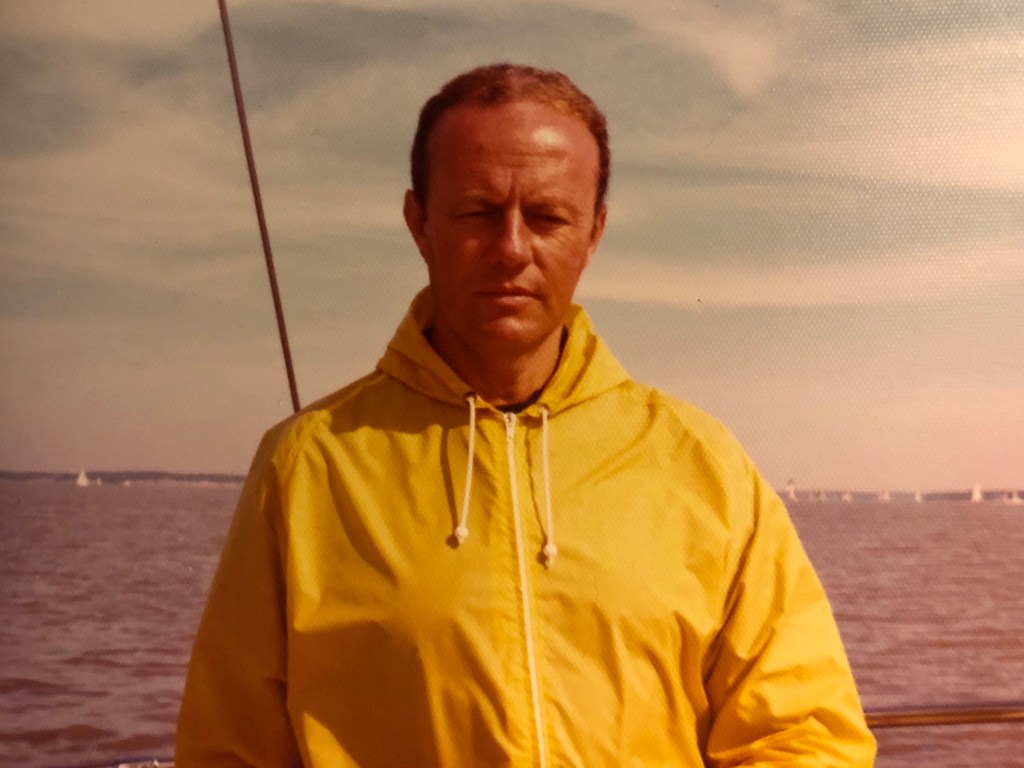
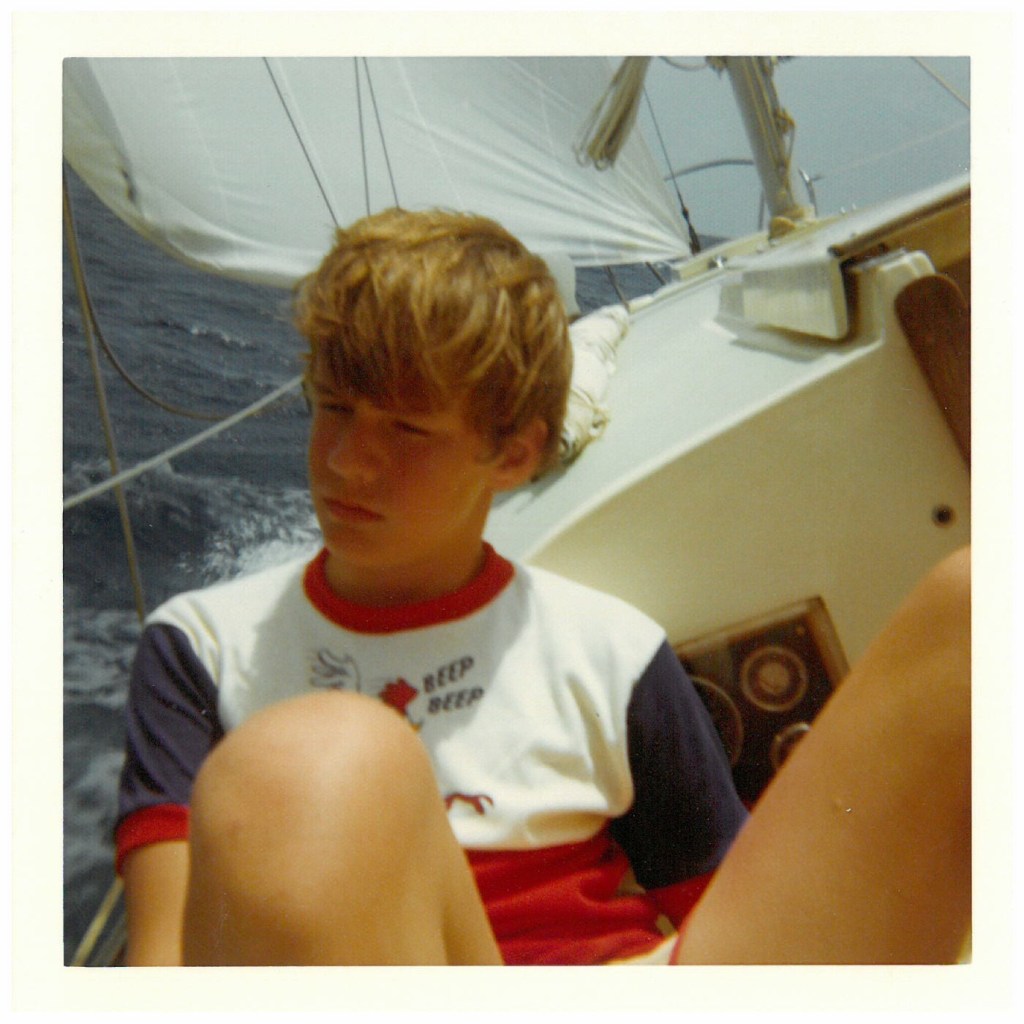
My father, my brother Peter, and me

There is nothing a sailor can do to change the weather. You can alter course when conditions make the way forward nonsensically impassable. You should. Otherwise, onward.

That said, there are days on the ocean when all you want is weather of any sort, when the sea is glassy in every direction, and the horizon is a long uninterrupted line in the distance. The only wind blows in your memory, and even there, it is nothing more than a hot, lazy zephyr. If you chose to complain, your voice would rise only up to an endless and cloudless blue sky.

If you sail to find perfect weather, you waste your effort. Each day—whether bound with boredom or rapt with terror—is a test to match intention (your course) to the conditions. If you really are a sailor, the weather is always already perfect—such as it is. The same holds true for your vessel: the quality of your sails, the weight of your keel, the hull speed. Once you take the helm, you—your intentions, your ability, your fitness–are the only genuine, imperfect variable.

Complaint becomes, therefore, a reflection of the one thing that you can change: yourself.

When Lear unleashes his “Howl,” it demonstrates the dissonance between his internal state—his intellect and emotions—and the external state. He seeks to crack the vault of heaven not only to mourn Cordelia but because Cordelia died as a result of his inability to match his intentions to the world around him.  He rails against God because he cannot reconcile the failure of his plan.

So too, the sailor who complains, “The rain sucks.” Or, “I hate this rain.” No, it’s not quite a “howl,” but what that sailor really means is that she—or he—does not like rain. The rain, in and of itself, does not suck. The lack of proper heavy weather gear sucks (Be prepared, the old Boy Scout proviso). The desire for sunny weather sucks (the Buddhist approach). The pink beaches at our destination would be better (A quick visit to the deeper tangles of Epicurus). But complaint is not grief.

When I drove home after identifying my father’s body on the dock of the Tolchester Marina, I howled in the car as I drove west over the Chesapeake Bay Bridge. It was a rainy Wednesday night, and a cat had wandered onto the dock while the emergency crew arranged his body between two pylons. They pulled the tarp back, and there he was, sodden and swollen from 36 hours in the water, and torn from where the hook found his body on the silty bottom of the boatyard.

As I drove over the bridge under which I ended my first glorious sail home—making 8 knots on a firm beam reach, nearly a perfect sail in that old Cape Dory—I let loose one long howl, holding it for the length of the span, tears flowing freely. While we, my brothers and mother, all anticipated his death, we still mourned his passing. He was, as we continued to toast him in his absence, “the founder of the feast.”

A younger captain

He was also, over the last decades of his life, a sailor. He had his flaws—there were times when we should not have left port, despite the sacrosanct schedule that he typed up and kept in a folder on the navigator’s desk. But who’s perfect?

We looked at each other and then turned our vision to the horizon, grey and wet in every direction—no matter where we sailed, the rain would find us. We were wet beneath our foul weather gear. What did it matter? We are made of water. We never said as much, but we knew. It was perfect.

In the British Virgin Islands, 1972

I was not always a sailor, even though I learned when I was 11. Sailing on the Bay bored me; even the crystalline beauty of the British Virgin Islands failed to hold my attention until we dropped anchor and snorkeled our way through schools of brilliant fish and then down to fans of coral 30 feet below the surface. I did not find my way until I was in my thirties, and we were on the ocean in heavy weather. Because I am not perfect, I left those lessons on the ocean for too long. Memory is a boon and a bounty—with each remembered hurt, there is a corresponding gift.

There is a time for grief, and for some, a time for complaint. For sailors, once the course has been settled, there is only the sail and a wish for steady wind. And then, an acceptance of whatever comes. There will be howls.

Sailing Over the Horizon

I don’t know how long I have been preparing for my mother’s death. It has been for some time. The first inklings came by way of my father.

My father had suffered with Parkinson’s Disease over the last ten years of his life. I choose “suffer” and not “struggle” because “struggled” is too valiant a word; he suffered from the diminution of his physical abilities, of a stutter, and drugs that knocked him out. Nonetheless, he insisted on driving, even after the autonomous reflexes that make safe navigation of country roads at high speeds had abandoned him. We—his family—worried that his end (and someone else’s end) would come on the road. It did not.

Before the disease, my father sailed. He began when I was 11, and I took lessons with him. He sailed on the Chesapeake Bay, spending weekends looking for wind. When he retired from full-time work, he began to sail on the ocean.

Everyone who has sailed on the ocean has a story of a near-miss. Some idiots sailed onto a reef, and lost their two million dollar boat. A cargo container (my father’s persistent concern) floated like a metal iceberg and ripped through the fiberglass hull of a ship. There was a boat whose hull breached when it was nudged by a whale—“Once the water got into the cabin, the keel pointed it to the bottom. Like an arrow.” Any number of unforeseen accidents could turn a gentlemanly jaunt across the waves into a disaster. Even without the gales and following seas, sailing, for all its trappings, is a dare.

When I sailed with my father, I was folded into the fraternity of casual, privileged risk. It is a different bargain than that made by those who forswear safety for a higher cause. Only a fool invites disaster, tempts it, for what? A dare? An assertion of meaning and purpose? A sunny destination? All those and more. We may have been foolish, but we prepared for the worst.

My father’s disease added to the risk. He was the captain and an unsteady hand. Often he was the only one on board who could do the little tasks that needed to be done in a storm. He wanted to do them; he liked to do them. When I sailed with him, he ruefully asked me to tie down a loose sail. “I can’t do it,” he admitted. He would not say why he could not. He never admitted to the disease.

When other less sure crew was with him, he pushed himself to do those tasks, and came off the ocean bruised and beat up. He knew his time of risk was drawing to an end. He told me that he was contemplating selling his sailboat and buying a motorboat to “gunkhole” around in the Chesapeake Bay. A signal of its own.

In 2002, cancer—non-Hodgkins Lymphoma—struck my mother. She was not pleased, just as she had not been pleased with my father’s illness. Disruptions were anathema to my mother. However, her illness stunned my father. Whatever else in his life was uncertain, my mother’s tenacity was inflexible. I drove from Baltimore to the Philadelphia area to take her to chemotherapy sessions, sparing him as much as comforting her. After a few months, her doctor thought she had gone into remission, but then a second wave collapsed on her. Her liver swelled to the size of a football, and her blood became the consistency of maple syrup. We girded ourselves for the worst. And then it passed.

Six months later, my father slipped on a wet dock, fell into the water, and drowned.

Because of this, for the past 18 years, death has been a sometime presence in my relationship with my mother. My mother was nearly 72 years old when her husband died. He was diseased and at risk; the reef was hidden under the waves. We knew the odds.

My mother was halfway through her 88th year when she died. Otherwise, she was not a halfway kind of person. She was a pistol—full of energy and ready to go off in an instant.  She was fiercely independent—a characteristic that could make her difficult, but which also fired her painting. She started making art in her forties. Painting was a source of independence, stability, and consistency in the second half of her life.

While others made paintings that were representational and, well, let’s be honest, commercial, she stuck to abstraction. A quick word about abstraction: while some might imagine that abstraction is easy—just smear some paint on canvas—my mother found a challenge in getting a gesture onto the surface, and then a further challenge in adding a color, a second gesture, then another color. She labored over maintaining control of her gestures and palette and took solace in the layering of decisions that created a finished work.

If you had ever seen our house and its spare, precise decor, you could have seen how she battled chaos. Add to your imagination the rambunctiousness of her three sons, and the knowledge that we were forbidden from several rooms of the house until we were older and more settled. Her artistic life stood against the (self-invited, self-created) disorder of the outside world. She did not take to sailing—to the unpredictability of wind. She would retreat to the cabin when the boat heeled on a beat. She poured a glass of scotch, finding ballast and balance where none existed.

When I visited her with my family in 2014, a copy of Derek Humphry’s Final Exit ( a handbook for assisted suicide) was on one of the side tables. She was 82 and fully in remission, but arthritis made walking painful. She was sending up a flare of dissatisfaction. She had watched her mother linger and die in a nursing home. If my mother was a pistol, her mother was a blunderbuss, sour with nostalgia for a time before her marriage—the good old days. My mother did not want the end she had witnessed there. She put the book out to warn us: I am unhappy, and will not fade out of control.

The intervening years have unfolded with a number of slaps—like a cat playing with a mouse. Small strokes and other ignominies took small but noticeable bites out of my mother. When she gave up her studio—located in a community art building about 20 miles from her home—it was a keen signal.

 The past year she has navigated toward an ending, and I have been, as I often was with my father, a helping hand on the helm. It has been a strange duty. I encouraged her to work because I knew and shared the value of daily work with her. But I also listened to her dissatisfaction. “When I go to the studio, all I do is nap,” she told me. She told me more and told others more as well. She did not withhold complaints.

Last year as my mother began to make this final journey, I had started to date a woman. I told her about where my mother was, and what she asked of me. Rightly or wrongly, this woman noted the possibility of “unhealthy” and retreated. I cannot disagree or blame. I took the helm for my mother the same way I did for my father when he—foolishly, dangerously—kept to a schedule despite the weather. If, in telling the story of my mother’s death, I have returned to my father and his end, it is because they are intertwined—bookends spaced twenty years apart.

I ended my brief graveside eulogy for my mother, “She leaves us with this legacy, and with a vision of how to thrive in the garden of challenges that faces us all. Even this challenge. We go on, making our marks, as she taught us.” While many of my posts have been about my father, my mother was also my teacher. The lessons—both fortunate and unfortunate—that I took from my parents shaped me and prepared me. For what? For his death? Hers? My father once asked me if I could bring the boat home without him. He was prepared for disaster. I answered, as I must, as was true, “Yes.” These are the sailing lessons.

Little Women and the Writing Life

Watching Greta Gerwig’s adaptation of Little Women for the second time (I suspect that I will see it again), I cannot help but see it as a writer’s movie—a movie about a writer and her craft. Jo March wants to write a good story (or novel). She succeeds by writing commercially viable stories the contain murder, betrayal, and scandal; they are “short and spicy.” However, when she faces the impending tragedy of Beth’s death, she begins something new: a story about domestic struggles and joys.

All romance aside, writing is a domestic struggle and joy.

Jo’s life as a writer defines how she lives her domestic life. At first, her writing helps support her family. It gives her independence from the economic reality that women face, and the film paints a clear picture of those economics. Amy’s assertion of what she would give up—property, children—if she married is bracing, as it should be. There is an economic reality to writing as well, and one of the joys of the film is watching Jo negotiate with her publisher. In a triumph, she decides to hold on to the copyright of her novel, instead of taking an upfront payment in exchange for those rights.

Here is one of the significant places that the film takes liberties with the source material. Gerwig knows the story of the novel’s author, Louisa May Alcott—a woman who never married. Gerwig turns Jo into a version of Alcott and allows Jo to understand the bargain Alcott will make—forgoing married life for a writing life. Jo relents only when she feels the pangs of loneliness and allows her family to goad her into chasing her Professor. When Jo chooses Professor Bhaer, the film cuts between Jo’s discussion with her publisher (who insists, “If you decide to end your delightful book with your heroine a spinster, no one will buy it. It won’t be worth printing.”), and Jo’s consummation with Bhaer.

Gerwig has things both ways when this occurs. The film flows out in two directions afterward—one with Jo and her family opening the Plumfield School, and the other with editions of Little Women coming off the press with Jo’s name, not Alcott’s on the cover. It gives us two happy endings, one in which Jo is married and living an honorable and acceptable purpose, and another where she is a successful author.

Do I believe that the endings are exclusive of each other? They were exclusive of each other in Alcott’s life—for whatever reason. For the rest of us, I am not so sure.

I am sure that it takes a crisis to force the writer to come to compel the writer to mine—and compulsively mine—the deep sources of the story they will tell. John Gardner recommends, “[a] psychological wound is helpful, if it can be kept in partial control, to keep the novelist driven.” Jo’s grappling with Beth’s death, and the outpouring of work that follows seems true enough. She props up her notebook, open to one story, “For Beth,” and it opens her up to her novel. It pours out across her attic floor.

How long a wound can fester before it scars over and prevents the writing is another question entirely. How many wounds, how many crises can the nascent writer face before the fountain cracks, and the story dribbles away in dust?  But that is not the story of Gerwig’s Little Women; it is gloriously hopeful and shows the way ahead.


Reclaiming Enchantment

SAAM-1929.6.127_1It happens to us once or twice in a lifetime to be drunk with some book which probably has some extraordinary relative power to intoxicate us and none other; and having exhausted that cup of enchantment we go groping in libraries all our years afterwards in the hope of being in Paradise again.

Ralph Waldo Emerson

Why did I think I would have to live without enchantment?

Maybe, because enchantment—sheer magic—seemed all but impossible. Or if not impossible, somehow immature. Children believe in magic, not rational, brilliant adults, and I am both reasonably rational and brilliant within reason. Still, I fell in love with reading by pulling every book from the shelf about myths from all over the world. Later, I would come to appreciate the ache of Hardy and James. I discovered that after reading James, I could write like him, plumbing the mind with prolix sentences. But I wasn’t enchanted, either by the reading or by what I was writing. These sentences were not mine, even if the ideas came from my heart. I found truth, and truth would have to do in a world that had banished magic.

And then…

“Many years later as he faced the firing squad, Colonel Aureliano Buendía was to remember that distant afternoon when his father took him to discover ice.”

I had written some before I read Gabriel Garcia Marquez’s One Hundred Year of Solitude. There was a story about a disaster in a mine that I cribbed from Conrad—or it felt cribbed—it had the same sense of urgency and dread that Jim felt before the explosion in the ship. But it wasn’t until every impossible thing happened in One Hundred Year of Solitude, combined with the steady implacable voice of that novel, that a work of literature echoed the voice in my head.

While growing up, I had read some fantasy and horror—Ursula K. LeGuin’s Earthsea Trilogy delighted my adolescent heart, and Stephen King was good for an easy shock—but for the most part that kind of writing calls too much attention to itself. The tone does not so much enchant as cudgel. And yes, I understand, some people like to be cudgeled. Marquez’s tone created a silkier enchantment—so much so that some of the sentences forgot that they had ended. It was all spell, but a spell told at the dinner table.

Art is enchantment and artists have the right of spells.  Jeanette Winterson

During the in-between years, I also read Mark Helprin’s novel, Winter’s Tale, which begins: “There was a white horse, on a quiet winter morning when snow covered the streets gently and was not deep, and the sky was swept with vibrant stars, except in the east, where dawn was beginning in a light blue flood.” The novel careens into twists and turns of incredulity—what the hell is that ship?—however, the horse that began the novel enchanted me as it ran over the streets of New York City, and became, years later, my horse, although of a different shade.

A friend gave me a copy of Italo Calvino’s Cosmicomics, which blends science with whimsy. Two stories, “The Distance of the Moon” and “Dinosaurs,” are touchstones of longing—a sure sign of enchantment. Calvino’s Invisible Cities remains unteachable for me because I cannot help but fall into its spell each time I read it.

If I am not enchanted, what is the point?

I tried to write impossible stories when I began writing, and instead, returned over and over to stories from my life. The examples of writers who had preceded me on that path were innumerable—and many of those writers are among my favorites: Joyce, Woolf, Dickens. Even Marquez, it turns out, was mining his past—a magical realist past, but a past that existed nonetheless. Reading his memoir, Living to Tell the Tale was surprising. Perhaps impossible things can really happen.

Magic is hard to write. Too often magic feels like a trick, some cheap deus ex machina to shorten the distance between here and there. I tried. I had struggled with a story about a father who became the Cat in the Cat in the Hat (a great absent father story), and that became another story, of all things, about a man driven by love to masquerade as a Russian carpenter.

I wrote prose poems about my city of origin, Philadelphia. Philadelphia, as much as any city, rises from contradiction after contradiction. I had lived in West Philly when the MOVE fire took place. I had worked in an Italian restaurant with dubious connections. I had done other things. Philadelphia seemed impossible enough. I wrote stories and poems in which the sun failed to rise or a girl shot the moon out of the sky or angels gathered after the end of the world or a man gave away parts of himself as he walked through the city one morning. One of my mentors chased me away, asserting that I was singing in one key. I was still young enough, and tender enough (my great flaw) to step back.

After all, it was simpler to write about disenchantment. It felt more realistic, more, what? truthful. Disenchantment and disillusionment are the foundations of so much literary work. Even One Hundred Year of Solitude ends on a thudding note of despair.

 Like all dreamers, I mistook disenchantment for truth.  Jean-Paul Sartre

I took many steps back. I grounded myself, got a series of real jobs, and lost my sense of magic. No, of course, I did not lose it. I put it away. I attempted to replace it with something like a reasonable substitute—an honorable and valiant substitute. A wiser soul would insist that there is no substitute, no more valiant way forward. They would not have been fooled by my efforts at sublimation. I tried to fool myself, and threw myself into work and life, and lost sight of myself.

How did that work out?

There are times when we can feel destiny close around us like a fist around a doorknob. Sure, we can resist. But a knob that won’t turn, a door that sticks and never budges, is a nuisance to the gods. The gods may kick in the jamb. Worse, they may walk away in disgust, leaving us to hang dumbly from our tight hinges, deprived of any other chance in life to swing open into unnecessary risk and thus into enchantment.

 Tom Robbins

This time last year I was a mere 30 pages into a new work. It did not have a shape, and I did not know how it would end. I hoped that it would end with a love that persisted over thousands of years, but what did I know? There were some 270 pages ahead. All I did know was that I had allowed myself to become entirely enchanted by what I was writing. Was it good?  Was it bad? What did I know? I kept writing.

I began writing and trusting in enchantment—rough magic to be sure—because I changed my life to reclaim enchantment. I set aside a life I had lived. I left two jobs—and a career of sorts—that had made the distance between my heart and hands more pronounced and distinct. And I began calling enchantment back into my life.

There must be people, writers, whose lives and work can take separate but equal tracks. I cannot. One part of me still feels that is a failure. As a mature adult, I should be able to compartmentalize the various parts of my life and live with the contradictions between what I dreamed of in my fiction and what I did at work and how I lived as a father and husband.

One of the great attractions of writing is that one is in complete charge of what one does. And what one does is, in the end, something like the most profound and energetic kind of play possible. The only rule of this game is: play more. Play more precisely. Play more wildly. Play more passionately. Play more broadly, quickly, intensely, blithely. Play into and out of contradictions. Play. More.

Try and lead the rest of life with that dictum in mind. Especially when one is a principal of an Orthodox Jewish boys school, or the director of religious education for a Unitarian Universalist congregation. Or as a husband. Or as a father. It all worked fine while I played in graduate school and wrote essays about William Blake or Virginia Woolf or Charles Dickens or George Chapman. Or dropped everything and sailed for a month. Or ran through streets at midnight. Or. Or. Or. The ability to take play in many different places became a strength. It even was a strength while I tried to write fiction and explore where my craft would take me—and the field seemed open and endless. It was also a field without guarantee, which can be daunting, even to a 34-year-old newly minted Ph.D. I had to learn to make peace with unnecessary risk and enchantment. It took a while.

I am in the middle of it: chaos and poetry; poetry and love and again, complete chaos. Pain, disorder, occasional clarity; and at the bottom of it all: only love; poetry. Sheer enchantment, fear, humiliation. It all comes with love.

Anna Akhmatova

Allowing myself to be enchanted again meant allowing myself, for the first time in a long time, to fall inescapably in love. I do not know if other writers struggle with this. If they are like the rest of humanity, they all come to their work from different places and with different impediments. I came freighted with years away from writing, years of attempting to lead a life that was a little more guaranteed—a life that would make sense to others. I let much of that go and, without ballast, took flight. For me, that meant opening myself up to love. I realize that you, dear reader and (possibly) fellow writer may have been able to balance life—your craft—and love more successfully. In order for me to fall back into writing’s long dark spell, I had to give in to the complete chaos of love. All of it. I had to be vulnerable to unnecessary risks. I had to risk everything—it was the only way that I could reconnect with the bright source of possibility that inspires my work.

Enchantment had to be unreasonable and total. I could not corral it into one part of my life. Or I could, and did. And I could not, not this time, not with everything waiting ahead of me in the gloaming.

I once argued with a friend that the whole point of writing (I was talking about critical essays at the time) was to praise. I know that many writers would strenuously disagree. They leverage opposition to create—resorting to a kind of perpetual Hegelian dialectic. My best work simply praised. Why note failure, when some more glorious success awaits? It is so much easier to look back in anger—or disgust or disdain. Looking forward means looking into something that does not yet exist. When I praised writers in my essays, I praised them for their forward-looking vision.  I praised the chances they took. I have been singing to the risk-takers for a long time.

How did it take me so long to hear my own old song?

At the outset, it is only liking, not understanding, that matters. Gaps in understanding … are not only important, they are perhaps even welcome, like clearings in the woods, the better to allow the heart’s rays to stream out without obstacle. The unlit shadows should remain obscure, which is the very condition of enchantment.

Andre Breton

I am in the shadowlands. Looking back will not get me where I am going. Asking the questions only serves to remind me that although I lost my way, I also found my way. There are some parts of this journey that are beyond my comprehension. Part of me hates that. I am a bright man and should be able to make sense of what happened and what changed. I have written these short posts as a way of reminding myself—and with any luck you—that the way ahead is not limited to the past. We can—and do—move in and out of understanding. But we move guided by our deeper inclination—what Breton calls “liking.” Let me suggest “loving,” which seems more committed, and therefore, riskier. I learn to live with the obscurity, even to court it, at my own peril, and for my own reward.

Writing must take us toward some inexplicable place. We read to be surprised and delighted by what we did not know when we began. Affirmation is fine. Discovery is essential. And when we write, we seek that same experience again—something like paradise. And again. And again. And this is how to live.