Why the Djinn?

A friend asked where I got the idea for the Djinn. Here is the long story.

I wrote poems when I was in ninth and tenth grade. They were lengthy works with regular rhythm and rhyme. They told stories. Men turned into dogs. Warriors battled ferociously. Queens and princesses sent boys on impossible quests. When I asked my school to allow me to do an independent study in poetry writing, I was turned down, but one of my teachers suggested working with him to write sonnets and other formal verse. He might have suggested an early round of talk therapy. Stung by early rejection, I refused his offer.

Every night before I fell asleep, I made up stories and told them in my mind. They reflected the source material I grew up with—books of myth and tales that I found in the Schuylkill School Library; comic books that my father doled out on trips to my grandparents; anthologies compiled by Rod Serling that I bought at book fairs.

I did not start reading adult novels until I was in 7th grade and a friend lent me his copy of The Guns of Navarone, after which I read everything that Alastair MacLean wrote. I made a mad dash through Kurt Vonnegut in 8th grade. I read all of Ursula K. LeGuin’s books before 9th grade. All this is a fairly slim bit of literature. My parents were not big readers—we had collections of Reader’s Digest Condensed Novels on our few bookshelves. My mother did read to us, sharing Beowulf and Poe stories. But we were not a bookish family. My brothers and I found what we looked for with relatively little guidance.

I was an able enough reader in high school, but short of Billy Budd, little of what I read stuck with me. On my own, I read all of Neil Simon’s plays, and other plays, and took up with science fiction and fantasy (Asimov, Tolkien, and a little known writer named Zenna Henderson). I read and reread Robin Graham’s account of his trip around the world, Dove. Mostly, I spent long hours listening to progressive rock, watching old movies, swimming, and driving the family car as far and as fast as I could.

In college, I discovered William Blake, James Joyce, Thomas Hardy, Henry James, and Gustave Flaubert. It was also when I read all of John Le Carre’s spy novels, The Joy of Sex, and the only Daniell Steel novel that ever passed my way—The Promise. The main focus of English Literature courses was exposure to more—and I share the story of having a short novel assigned between a Tuesday and Thursday class with my students now. I read widely and gleaned what I could as quickly as I could. I discovered that after reading Portrait of a Lady, my sentences changed. They were better: complicated and analytical.

In my junior year, I switched focus to Art History (same deal: memorize as many works of art—in order and with an understanding of importance—as fast as possible), which, fortunately included a Cinema class that greatly expanded my limited knowledge of film.

I started writing fiction in college, and was accepted into a workshop in my senior year. After graduation, I began an espionage novel that had something to do with Monet’s Haystack paintings in the Hermitage, in St, Petersburg. I fiddled with a story about a baseball player. I wrote a few chapters of something about two friends who decided to go to college and pretended that they were ten years younger than they were.

I had a sense of the novel, and novel length stories, but at this point in my life, I had only read a few hundred novels. I had never heard anyone explain rising action or a three act structure. I grasped scenes and could understand the books in an intuitive and intimate way. I wrote into the unknown without a plan, without having any idea of where to go, or what to do.

When I was 28, I went to graduate school to study writing, and even there the basics were not tended to. What I knew of Freitag’s pyramid, I garnered from John Barth’s “Lost in the Funhouse.” But fiction had never been about plot as much as characters and feelings. Maybe because I had never been drawn to plot. I often knew in a page or two what was going to happen in a novel—not the exact details but I could chart the end of the rainbow from the first curve of the arc.

So, what does any of this have to do with Djinn? I suspect that strains of all this—and of all the events of my life to date—appear in this work. Mainly, there is the myth, the early fascination with and appreciation of the fantastic as a genre, and the long interest in things that were away from here.

I encountered the djinn—as genies—in Sinbad and the Tales of the 1001 Nights. A widow who lived next door to us had those books. This book re-entered my life while I was in graduate school, in large part because of John Barth’s insistence on non-western sources of and for stories. But also because, once I encountered the djinn (or jinn), I was impressed by their wiliness and cruelty. I wondered—right or wrong—whether they had been mis-portrayed by the writer of the 1001 Nights. Why would such power need to be cruel? To refer back to Blake—“…what shoulder & what art,/ Could twist the sinews of thy heart?” I wondered. But I did not pursue the djinn, not yet.

I wrote in other ways. Although I have a set of prose poems set in Philadelphia that delve into the fantastic, I followed the realist tropes of my time. Perhaps this is what kept me from finishing—I was writing away from the story in my heart. Last year, when I dropped everything to take on new responsibilities—to myself and my work—I set aside the piece I had feverishly labored over for over ten years. During that ten years, I had written down a brief thought about a character who was keeping a secret (secrets will be something I grapple with forever). Five years ago, I was waiting for friends in a Mexican restaurant, and dashed out to buy a composition book, wrote a couple of pages before they arrived , and promptly forgot the book at the restaurant.

That story became the story of the Djinn.

I was dating a woman who shared my appreciation for the 1001 Nights—you have a copy too?—and that was enough of a spark to light the fire in this book, because the kindling, and the logs, had been waiting all these many years. Suddenly, I had a character whose secret was so closely held that he did not even know he was keeping it. He had forgotten that he was a Djinn.

There are other connections to other parts of my life and my studies that fueled this fire. Some of those will remain secret. Others are perhaps too obvious for me to mention here. For those of you who wonder how novels—or anything—gets written—by others or by your own hand—the short answer is that we tell the stories that enchant us. The shorter answer is that we sit down and write every day. No matter what. Perhaps because we are enchanted and under some infernal command—I wish that you write a novel, Djinn. So be it.
Routine

Every Sunday, save for one or two while I was traveling, since April, I have wandered through the various art galleries on the National Mall. I carried my notebook with me, and wrote. There was something invigorating about being in the presence of beautifully made things—whether a drinking horn from the 6th century BCE, or a bronze horse from the late 20th century. Bits and pieces of what I saw inspired my writing, which was about an entirely different time and place.

The routine gave me something to anticipate each week while I was in the middle of my project. The two hours—one spent driving in, another on the way back—were worth the result. I found favorite places and favorite works. Monet’s painting of the Houses of Parliament has been a touchstone on these trips. It reminds me of an early interest in his work, of travels I have since taken, and of an approach to work that I have come to appreciate more and more. Partly that approach means honoring the routine, no matter what.

Routine seems like it would be the antithesis of inspiration. Think of the ways we denigrate the grind or the slog of work. Or the way we quote Emerson: “Consistency is the hobgoblin of little minds.” However, I would point out that Emerson nails “A foolish consistency,” not all consistency. I would hazard that there is a wise consistency to be found as well. Like wisdom, it is hard-earned, and requires a kind of flexibility. For instance, when my daughter came to visit, I did not insist on making my weekly sojourn because other plans (a trip to see our family) interrupted my routine. Or last week, when I took a day off (my rough draft was done, and I felt spent), I granted myself some quiet time.

This week, I am back at it though. The sun is once more setting behind the Houses of Parliament, and I have walked about half the distance I will walk the rest of a cloudy day in Washington DC. And I am writing—this now, but the revision continues apace. My routine will be important in the coming months because school has begun again, and without some carefully delineated routines, schoolwork can too easily consume time. Teacher’s always feel as if they could do more—one more brilliantly placed comment on an essay, one more after school event, one more meeting, all while managing the daily preparation. I will get to the gym—the body work supports the brain work. And I will set aside an hour (more as needed) a day to write. I will guard my sleep.

And, I hate to admit this, I will do less of other things. Some were just distractions (Sunday Morning News shows), others (dating) brought joy with the distraction. Like it or not, the wise routine will preclude even delightful entanglements—at least until the process of getting to a final draft (agent, publisher) wraps up. And, of course, the next book is waiting.

I’m not sure what I will find on the way ahead. I know that I will rely on my routines to get me through the uncertain times. And I will seek wisdom, and a wise consistency as I go. Inspiration this way waits.

Resentment

There is always regret when one has not done not just what one has wanted to do, but has dreamed of all of their lives. “If only I had started sooner,” regret whispers. “If only I had not taken that job, moved to that city, loved that person.” Regret is a whispered siren’s song, and it can lead one toward a sadness that is disastrous to the work.

Regret has a companion emotion, and once one figures out exactly what one needs to do, this other emotion can assert itself in awful ways. This emotion is resentment. Anything—everything—that does not help us attain our vision—our purpose—can cause us to feel resentment. For instance: a job that takes our time—our necessary and limited time—even if that job is fulfilling and valuable. Even if that job pays the bills. Our family can cause feelings of resentment. This is a deep dark secret: the people we love can be the people who awaken resentment in us. Because they ask—as they are entitled—for our most precious resources: our imagination, our patience, our time; our essential necessary energy to do the work at hand. And this is terrible. No one wants to resent for their family or loved ones. And yet, we do.

Anything—everything—that takes away from the energy needed to do the creative work that gives our lives meaning cause resentment. One must learn to carve out sufficient time to be fully engaged and to spend the energy at the work required to fulfill one’s purpose. This is true in any circumstance—with or without family, with or without loved ones, and with or without other work. Once one sees what can be done, one must change one’s life to fulfill one’s purpose.

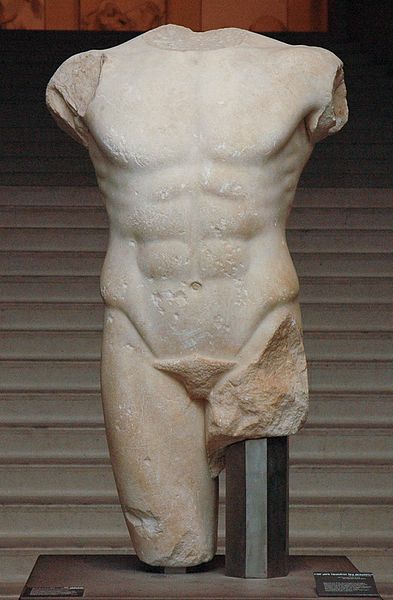
Archaic Torso of Apollo

However, resentment is not located in those other places. Neither my child, nor my job, nor anyone else in my life is the actual wellspring of resentment. It comes from me. Of course there are stupid little human annoyances—the woman who sliced into the left lane ahead of me on I-95 today, then just as abruptly, sliced back through traffic across two lanes to make a sudden right exit. The anger caused by such behaviors only lingers for so long. Resentment comes from an inward driven anger that sharpens regret and turns it back out to the world. The clearest targets are those who are nearest us.

Yes, there may be times when those close to us do ask us to stop our most purposeful work for reasons that are worthy of resentment. They may question your sense of self, and cast aspersions on your work and aspirations. Sometimes people cannot escape the deep-seated injuries and resulting resentments that their injuries caused, and they struggle, not with themselves, but with you. Just as you may struggle with resentment. Just as I have struggled. And one must escape that false judgment, and not validate it in any way. For the most part, we are the main manufacturers of our own grief. We stop ourselves. We foist anger on ourselves and take handfuls of earth and shower ourselves in dirt. We manifest an anger that eats us from within.

I am not suggesting that one should not be angry. Anger can be a source of energy, a goad to action when complacency or sadness or depression has settled too deeply on the creative mind. I let that anger into my work—allowing characters to taste it and spit it where it needs to land. So too with me, I learn, daily, the difference between anger caused by genuine external sources and that which has simply emanated from some ancient sun within me.

When I feel resentment, I check my sources first, and realize that, more likely than not, that I am not doing what I need to do. I am not tending my work and my purpose as I should. I have taken—for reasons at once honorable and misguided—someone else’s charge and anger as my own. I put it down, gently, if I can, and get back to work. The way forward—to fulfillment, to joy—is here.

The Vision before the Travel

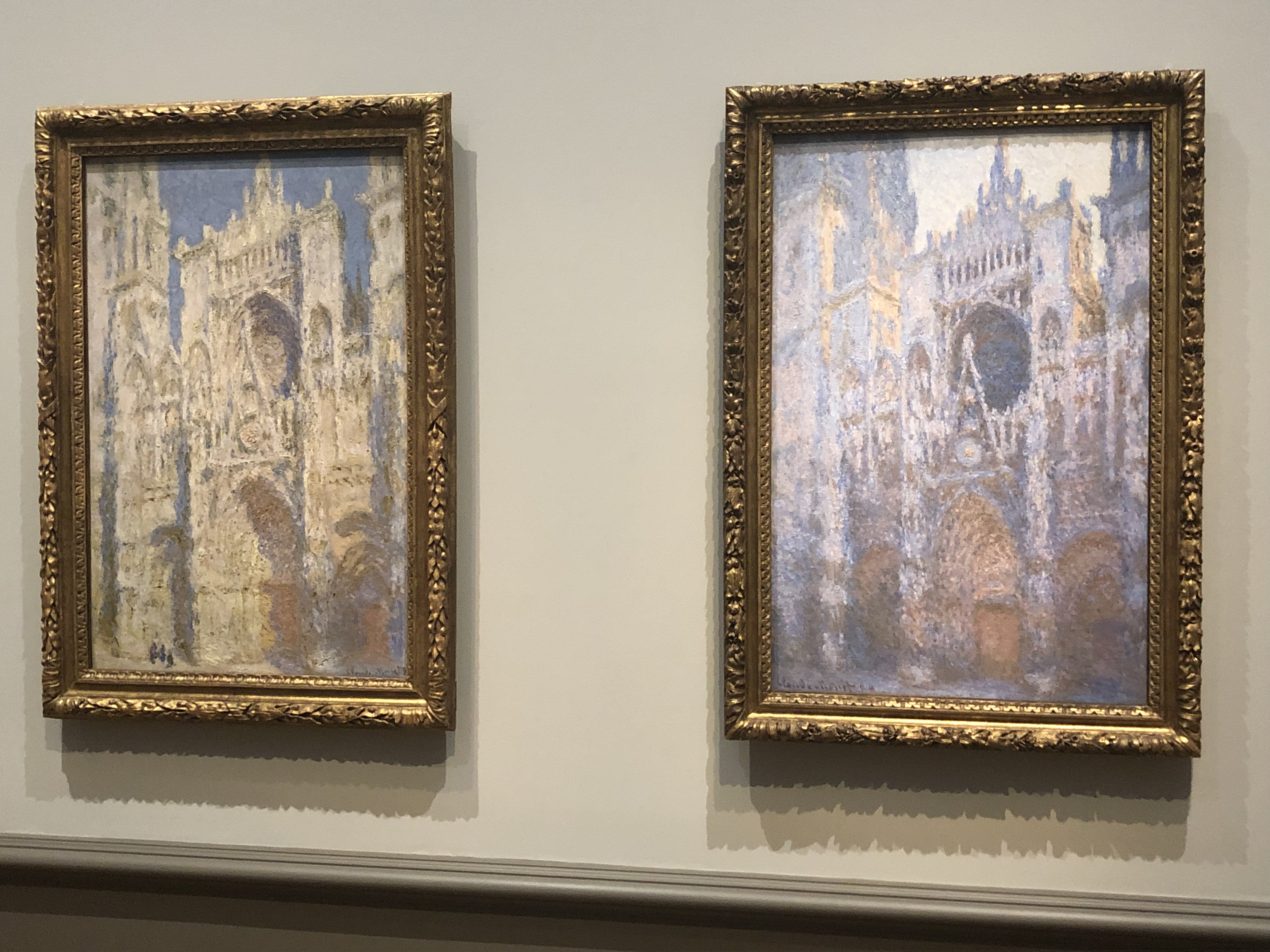
It seems impossible to me that when I finally see the cathedral at Rouen, I will already know the shadows of the late afternoon sun, and the way the morning light illuminates its porticos. How much of the world do I already know through the eyes of artists—the representations and words of painters and writers?

And not just buildings, but people as well. How have Uriah Heep, and Cassius, and Peter Walsh shaped my understanding of certain kinds of men? Or the countless representations of “The Man of Sorrows”?

If I have not traveled, I have imagined, and born witness to hundreds—no, thousands, more—of depictions of the world. I know that I have only traveled through the eyes and thoughts of others, but what others!

And yes, each place I have traveled enters my work, makes it larger, gives me insight to reveal some feeling in each of my characters. However, the travel out into the world is like practice for the travel I must do into the imaginary world I wish to create. I write, again and again, about the gifts that the universe provides, but, in the end, I must make something of them. I must use my imagination to recreate the world.

Which brings me back to the two views of the Rouen Cathedral by Monet at the National Gallery of Art—and all the other renditions I have seen in books and projected onto screens. I see these, and begin to build—in my mind, based on all the cathedrals I have seen in my travels, on all the slants of light, on all the play of clouds—a vision that will become my own. I look forward to seeing the actual building—soon! soon!—but I also know that it exists, somewhere, in my mind already.