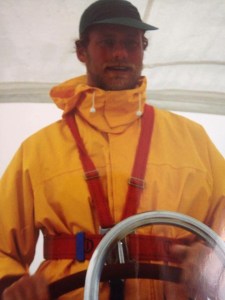
 We gathered a twice a day to listen to the nautical forecast, usually in the cockpit, but when the weather was execrable, in the cabin. For days on the ocean it was the only external information we had, and the computerized voice that intoned the zones and conditions annoyed and entranced us. My father never explained which particular slice of the forecast we should heed. If there was one, it was his secret. We did get a general sense: the information could reveal a significant change from the forecast with which we headed onto the ocean. For the most part, the weather we encountered was weather we could see.
Besides, what did the weather matter? We were going into it one way or the other. If something sudden arose—and in a storm, wind and rain could change direction in a moment—we had one rule: change course. At 3 a.m. on a Monday morning, Saturday afternoon’s destination could wait. That lesson only took one stern delivery.
I think I became an atheist on the ocean, or at least a pragmatist. If there is a god, it answered my prayers for relief with a simple, “You put yourself out here, jackass. You are going to have to get through it on your own.” At the same time I learned to believe in and respect a power much larger than my desire. Only a fool raises a fist against the weather or the ocean and then dares an impossible course. We had our foolish moments. On particularly bad days, my father would simply decree, “This is shitty.” If it was, we sailed through it.
In this way, we learned a sensible passivity on the ocean. Our single dare was the initial impulse: sail. After that we trimmed sails, corrected course, vomited, slept poorly, ran the engine through flat days, cursed the diesel odor, and gloried. We were sailors.
Every so often, the moment called for essential courage: tying down loose sheets at the bow while the boat bucked through night storm. I could hold onto nothing while grabbing the clew of the working jib and the sheet (line) that whipped back and forth, having worked itself loose. “You get that,” my father said, in a tacit admission that his Parkinson’s Disease would prevent him from ever again wandering forward in less than pleasant conditions. “It’s shitty, but we have to get that.” He didn’t even need to add that proviso. I had hooked my tether to the line that ran from bow to stern and was scrambling ahead—cursing, as is one’s right, and scrambling.
One learns not to wish for courageous opportunities. Danger is not a reward, even if it frees the soul from, what? complacency? On the ocean, complacency is death.
I knew about my father’s illness because, on the ocean, every limit will be tested, but it is essential to acknowledge those limits. You do not ask a first time sailor to take the helm in a gale, nor do you ask uncertain hands to tie a bowline. Few are those who ask for something hot to eat and a place at the helm in any weather. And my father’s illness was a limit–he wanted, desperately, to be the one who managed every danger; after all, he was our father. When he could not, we had to know it, and keep him safe.
Even while waiting on the ocean, one never stops being on alert, ready to absorb the next challenge—and boredom (bored in a week? Bah!) must be one of those challenges. But, who gets bored between the sun, the sky, and the endless blue?
Still, I wonder about the lesson—prepare and wait. It is easy to forget that while I waited, I was on board a 36’ sailboat that made steady and infernal forward motion—through all kinds of placid and idiotic weather. Yes, wait, be patient, but for the love of all that’s right, keep going. Even if the pace is a mere 6 knots, keep going. Even if a storm causes a momentary reversal, there is a destination, perhaps on the other side of the world. Keep going. And be prepared for what comes. It is, it will.
 It is difficult to explain the existential risk that the writer—at least this writer—undertakes when working. It is tantamount to this:
 Since the 1987, I have started at least five novels. Some I carried with me for a few months—the story of a wedding, unfolding like the petals of a rose. Others lingered over decades—the story of a woman who stole paintings. None of them lasted beyond seventy or eighty pages, or in the case of the long project, fifteen or twenty starts at initial chapters. I had notebooks full of scenes, outlines, character sketches, dialogue, and thematic connections. All the while I wrote other things. Shorter pieces, poems, prose poems, essays, sermons, children’s stories. Or I wrote nothing at all and suffered in silence. I believe that I was unbearable in those times.
 I was compiling blog posts today—why not a second book about writing and second chances? (Yes, but first things first)—and realized that I had written over 60,000 words in two directions since the beginning of September. While working at a new job. While beginning a new relationship.
 The impulse is to judge, and then to correct. Don’t do that, do this. Or at the very least, Don’t do that.
 Almost thirty years ago, I was eating dinner at a little restaurant on the edges of Johnson City and Binghamton, New York. My mentor and her husband had invited me along. These were heady occasions, full of discussions about writing and literature, and the program in which we all worked. I was a student, but, still, I worked. On this particular occasion, they started talking about writers manqué—although I heard it as writer manqués. It was a new word for me. Manqué: having failed to become what one might have become; unfulfilled. They started listing writers who had been in the program, writers who had published and stopped, and writers who were currently in the program. It was sharp and cruel, and the sobriquet stood out as one to be avoided at all costs. These may not have been eternal footmen, but there was snickering enough to go around.
 Nonetheless, the fear of being unfulfilled lurks. In a
  continuoussearch