The Right Way

I’m sure it’s happened to you. Someone has told you the right way to do something. It could be something as simple as folding towels and then hanging them up on a towel rack in your bathroom, folding a t-shirt and putting it in a drawer, or wrapping a birthday present. Maybe you offer such advice, although it’s not really advice. It’s a dictum: THE RIGHT WAY. I wonder where people get these ideas, and I suppose, as often as not, they come from parents who explained how to wash a fork or how to tie shoelaces. Someone once watched as I tied my laces and corrected me. “That’s not the right way.”

My parents never offered such advice. After my mother taught me the wrong way to tie my shoes, I became a free-range kid—long before there were such things as free-range kids. My brothers and I roamed through our exurban neighborhood, sent on our way for hours every day with only a momentary return for a PB&J at lunch. When I was eleven, I read the instructions on a box of Chef Boy-Ar-Dee pizza and made pizza dough from scratch on Saturday afternoons. I asked for and received a pizza tin for a birthday. My father set out the chess pieces, and after explaining how the pieces could move, I was on my own. Did I find a book in the school library that offered suggestions? Yes, I did, and then, eventually, beat my father. I learned to tie a bowline knot in Boy Scouts (the rabbit runs around the tree method), and my father didn’t care how I tied it when we sailed on the ocean together, so long as I could do it when the ship was bucking over chop.

I can’t tell you how many things I learned on my own, occasionally seeking guidance. While I took swim lessons, first in the pool of a local family, then at a Red Cross class at a nearby pond, later when I wanted to ascend from the junior varsity to varsity team at my very competitive high school, I turned to Doc Counsilman’s Science of Swimming to work on my breaststroke. My first car was a Volkswagen Beetle, and I owned a copy of John Muir’s How to Keep Your Volkswagen Alive and used it to guide me through replacing the clutch; it was more complicated than I imagined. Replacing the McPherson struts was beyond my ken, mainly because I didn’t own something to compress the springs in the suspension. Even with expert advice, I knew when to turn to a professional.

I learned to cook by deciphering recipe instructions in my mother’s worn copy of The Joy of Cooking—the only cookbook she suffered to own. I watched cooking shows on PBS when I was a teenager, and in my early twenties read James Beard’s Theory and Practice of Good Cooking for fun. When I worked there as a waiter at La Fourchette in Wayne, I asked the head chef how to make a beurre blanc, which I needed to know to make scallops stuffed with pesto in a beurre blanc. I asked about the pesto, too; there was no internet. I learned about pastries from the pastry chef. For one Bastille Day dinner, I replicated his white chocolate mousse recipe, straining raspberry coulis through a well-cleaned lint screen from the dryer in my apartment’s basement. Not the right way, but one of many possible ways.

My early school teachers remain a blur. I remember one who told me my world map looked messy—my crayon blue oceans were too streaky. But there was Mr. Hecht, who asked me to join the math club, and Mrs. Vandergriff, who had us do a lesson in prejudice by segregating the blue-eyed blond students to a single table. We weren’t allowed to use our hall’s water fountains or restrooms. My seventh grade history teacher (Mr. Moore) taught us how to take notes, and I can still organize any lecture into a fairly plastic but organized outline. I made deeper connections with my teachers in high school, in no small part because we ate three meals a day with them; I attended a boarding school. But besides dates and processes (which I loved), I don’t recall learning how-tos. Ryck Walbridge did not walk us through how to work an autoclave; we had one, but how it worked was a lesson beyond us all. Buzz Gardner read Catcher in the Rye from start to finish aloud in class. Neither Dick Broad, Buzz Gardner, Arthur Jackson, nor Alexander Revell taught me how to read more effectively—or “Read Like a Professor,” as Thomas Foster advises. I came to reading on my own.

I was not an early reader. Sure, my mother dropped us off at the Paoli Library while she shopped. My brother and I wandered through the small dark corners, pulling books from shelves, settling on Dr. Seuss’s preposterous rhymes and Richard Scarry’s encyclopedic illustrations. We had few books at home: a multi-volume photographic history of World War II, another multi-volume medical dictionary acquired volume by volume by shopping at the Acme grocery store, and a few Reader’s Digest compilations of abridged novels. I must be misremembering a little because, at some point, the shelves in my 11-year-old bedroom began accumulating books, among them E.B. White’s Stuart Little and the anthology Rod Serling’s Triple W: Witches, Warlocks, and Werewolves, and a hard cover dictionary. In seventh grade, I met a boy who was reading Alistair MacLean’s Where Eagles Dare,and when he was finished, he loaned it to me. Thus began a reading bender that has not ended. I tore through those adventure novels, some early Michael Crichton, all of Vonnegut in paperback (Player Piano through Slaughterhouse Five).

Somewhere in that jungle of pleasure reading, I started to pull books apart. While reading MacLean’s The Way to Dusty Death, finding the title phrase buried in a description deep in the novel delighted me. I was 11 or 12 and began to dig through books looking for interconnected words as if the repetitions would unlock the book. I read books like puzzles. Of course, I never considered that MacLean alluded to Macbeth (I had, at the time, neither read nor watched a play by Shakespeare). Later, my magpie mind would make that connection and a thousand more.

I guess my point is that no one said, “Brian, look for repetitions” as a method for unpacking a novel (or, for that matter, the world). I learned to read, moving from Dick and Jane to The Story of Ferdinand the Bull to “Who Am I This Time?” to Leviathan to The Waves without anyone saying, “This is the right way to read.” Did I stumble along the way? Yes. Even in graduate school, one of my professors marveled at my compendious collection of interlinked parts of Donald Barthleme’s The Dead Father but suggested that I hadn’t stumbled on a reason for that compendium. “This lacks a thesis,” she wrote—as if connection wasn’t the thesis. Sometimes I think that what I believe to be so obvious that it beggars definition. It’s not. I have to be painfully clear.

So, I want to tell you there is no right way; there is only your way.

But.

You will only find your way by working at it. You will need to test your method in several unrelated fields. “But I don’t like math,” you will complain. Or, or, or I don’t like “fill in the blank.” Look, even if you don’t like math, or Latin, or chemistry, you can’t say, “I don’t like trying.” You may be at a loss for knowing what you want to spend the rest of your life trying. The whole point of school is not to teach you some balance of everything. School is here to give you a reasonable amount of exposure to things you would not necessarily consider as avenues for something like success. And—and this will frustrate you—school teaches you that effort—genuine slog through the mud, sweat in the field, freeze on the mountainside effort—has lasting value. You may not remember the Krebs cycle or the quadratic formula, but you will remember the effort.

Let’s suppose you are that rarest of rare birds, “the natural.” What you are a natural at is not baking, auto repair, baseball, drawing, or writing. Naturals have the ability to expend genuinely unfathomable effort in some—usually one—direction over and over again without giving in to the fear of failure. They begin every day and try. The rest of us, the regulars, must learn how to try. “The right way” is just a shortcut—and when replacing a clutch, I’m happy to have that shortcut. Imagine winging a clutch. Good luck.

Even if there is a right way, there is no right way to try. That you have to figure out for yourself. Figure it out. Try. And you will find your way.
Revision Work

I finished a first draft of a novel in the fall of 2019–a smidge past 88,000 words, huzzah! huzzah! I almost immediately began working on the next one. While at this new work, I managed a copywriter-style edit over the next year that swelled the thing by another 5,000 words, but other than adding connective tissue, it hadn’t substantially changed. I kept at the next book but felt a nagging unfinished feeling about the previous one that hindered my progress. Other events conspired (as they often do). An annoying fallow period set in when the twinned butterflies of ideas and scenes clashed until book #2 relented and declared, “Finish the other one and get back to me when you’re ready.”

It took about 15 painful minutes to realize I had arrived at the wrong ending. Actually, 15 glorious, freeing, soaring minutes, but then came the less soaring, freeing, and glorious realization that the hard work of revision waited. “Why not just change the ending?” you might ask. Because no matter how messy a novel is, with its few hundred threads strewn across the living room floor—some leading to the kitchen, some to the garage, and some impossibly outside through the dryer vent (can we not talk about those that lead down the WC, please?)—the line from beginning to end is the single thread that holds the vivid, continuous dream together.

And so, revision. Fortunately, the events will remain (mostly) the same (that much I got right). Still, the permutations of characters and the thickets of motivations they brought with them to, say, a stone wall in Central Asia, changed. And so how characters walked, strode, strolled, marched, limped, ran, trudged, or galloped (one of the characters is a horse) to that wall also changed.

I know exactly why I ended the book as I had—a kind of brutally insistent wish fulfillment. And one of the nice things I realized is that the book had been fighting that resolution at its bones. So now it is throwing flowers at me as I realign characters (Oh, he said that–not her, and she said this instead—head smack—duh!), even though it demands new work and new consideration. I don’t know exactly how it all will come off, but it beckons with a willingness that is at once surprising and exacting. As I fall asleep, the book whispers, “You see this now, yes? So, do it.”

I will share a few of the changes as I proceed. I will try to explain why these changes occurred and what they mean in a general way. If this process only helped me with this one book and not in all the books to follow, what’s the point? We take the lessons as they come; I hope I’m not too obstinate to apply them. Others will surely follow.

There is no guarantee that these changes they will make it through to some “it’s out of my hands now” final draft. But I think much will.

Drowning. Avatar: The Way of Water

Quick hot take: meh.

Positives: So much effort was made to get the visuals right, and they are crisp and awe-inspiring. However, I wondered more about the volume of computing power that made such a spectacle possible than I did about the story. Unlike the first film, in which Jake’s amazement stood in for the audience—we watched him watching this world (the scene in which he tapped all the plants—How cool!—until a vicious creature was revealed—Scary, but still cool!). There is no similar character with whom I bonded, no one whose awe provided a point of entry for mine. So yes, the movie was a visual feast, but it remained at a distance.

The addition of children and watching them as they learned how to be an adult, or warrior, or mystic (or human being because even though Cameron populates the story with Na’vi, his project is deeply humanist) provided a welcome entry point for me. It added a coming of age angle that felt more natural than Jake Sully’s man-child evolution in the first film. Perhaps Cameron believes that all men are essentially immature—it’s a common enough trope, so not a surprise, but really? Round characters, please.

Not so positives: Avatar: The Way of Water is not a complete story. It is packed with loose ends of theme and plot that do not resolve at the film’s end. A three hour movie that ends with a battle that clearly is only the opening event in a war, with an father-son conflict stretched across species and moral codes, and with such gross power imbalances between the Na’vi and humans (seriously, you watched the return of the Sky People to Pandora and didn’t think, “Well, that’s horrible, but unbeatable”?) stretches this viewer’s patience. Wrap something up, for goodness’ sake.

Who’s your daddy/mommy? Grace’s avatar was pregnant when Grace died? And so she was an immaculately conceived girl? What? And Quaritch (the bad guy) had a son? And Grace’s daughter and Quaritch’s son are in love? Is this fan fiction? Are we supposed to tune in next week—or sometime in the next three or four years to discover the answer? This is a corollary to the Chekov’s gun axiom: if you put a gun on the mantel in Act One, it better go off by Act Three; big questions asked in Act One better be answered by Act Three. Cameron may expect the audience to wait a decade, but please do something with all those loose threads.

An assortment of complaints: 1) When did Neytiri become shrill? Did motherhood change her from Jake’s patient and wise tutor to a hissing ball of rage? Or is this just a lazy “tiger mom” cliche? Maybe since Kiri seems a more complex female character, the writers did not feel compelled to make Neytiri more than a plot device (she might drown!). 2) Does Kiri have epilepsy, or a profound (and important) connection to Eywa, the pantheistic force that unites all life on Pandora? Will circumstance force her to risk her life for the greater good? Then sharpen that possibility. 3) Did we really need a Quaritch avatar/clone? While the juxtaposition of Sully and Quaritch as fathers has potential, the deus ex machina was a little too handy. I suppose if the Avengers can invent time travel to save Endgame, a memory download is not too far afield. Nonetheless, no thank you.

There’s more, and I have already spent more time on this than I originally thought I would. After over three hours in a movie theater, nearly as long as Lawrence of Arabia, at minimum I expect something more than boggling my mind about how many terabytes of computing power went into the special effects. Three hours requires story, and Avatar: The Way of Water seemed incomplete in too many ways to satisfy. Ooh ah! And not meh. Feh.

Two Voices

It isn’t always easy.

On Sunday at the French Open, Novak Djokovic, the number one tennis player in the world, dropped the first two sets of the championship to a rising star. He had faced the same situation in the fourth round of the tournament, but this was the final, and his opponent, Stefanos Tsitsipas, was poised to win his first major championship.

Djokovic retreated to the locker room after the second set and had a conversation with himself. “There is always two voices inside: one is telling you that you cannot do it, that it is done, it is finished,” he admitted. “That voice was pretty strong after that second set.”

Wait. The best tennis player in the world, a champion who had won 18 major titles (and would win his 19th that day), has a voice that says he cannot succeed?

 Sit with that for a moment.

Yes, he has another voice, and he described how he asserted that voice between the second and third set. “I felt that that was a time for me to actually vocalise the other voice and try to suppress the first one that was saying I cannot make it. I told myself I can do it and encouraged myself. I strongly started to repeat that inside of my mind, and tried to live it with my entire being.”

You can see him talk about the two voices here. Jump to about 3:10 in the video.

Success is not about living without doubt. Doubt exists, even in the mind of a champion. Success happens when that “other voice” contends with doubt. Djokovic, who has won 19 major tournaments, has also lost 10, and there was a time when his losses and wins (8 apiece) were equal. Even for the most successful, failure—and failure on a grand stage—still happens. We chose to contend.

I do not have the same record of success as a tennis champion, but, like him, I also have doubt. I have often chided myself for doubt, and this is a mistake. There are two voices: one that says, “Yes”; the other that says, “No.” I have learned—perhaps it took me too long—to listen to that “other voice,” and, when necessary, to give it a push. Vocalize it. Shout it.

Last winter, during the Australian Open, Djokovic was injured, and after leading Taylor Fritz 2-0, he dropped the following two sets. Djokovic has an imposing record after winning the first two sets of matches: 209-1, but injuries are a wildcard in sports. He prevailed, and the victory was especially sweet. “This is definitely one of the most special wins in my life,” Djokovic claimed. “It does not matter what round it is, against who it is. Under these kinds of circumstances, to pull this through is definitely something I will remember forever.”

His immediate response after winning was more revealing. He vocalized. “That’s why I play!”

That’s why I play!

Play? Novak declares that he loves tennis “with all my heart.” That is what it takes, no matter what, to do something with all my heart—with all your heart. I have no idea what else Novak Djokovic could have been. His parents ran several small businesses. Maybe that’s what he would have done had he not displayed a gift for tennis. Perhaps he would have become the best small business owner in Serbia; I do not know. He chose—as much as anyone chooses—to play.

Writing is play—at least it is a kind of play. We do not play against anyone, only with the reader. We entice and enchant them. Shock and soothe them. We afflict their doubts and shift their worlds. Maybe. And we face our own doubts—quietly and not so quietly. We enlist rituals and habits that either quiell those doubts or quash our urge to write. Which voice do we vocalize most?

Two voices? Like the two wolves from the story. Feeding the wolf? How about giving voice to the wolf? Howl louder. Jettison all the other voices that urge “No.” There will be enough of that—too much—within you. Listen to the voices that encourage, even demand, that you write. And then write more and love the writing with all your heart.

That’s why I play.

Writing and the Plague Year

The year came and went. After having change imposed on me, all I could think of was, what could I change? What would match the upheavals of the past fifteen months? The pandemic, my mother’s death, the next round of the pandemic, my school’s response to the pandemic, the election, the pandemic, the insurrection. It felt as all I did amounted to little more than defensive maneuvers: wearing a mask, cleaning my mother’s house, writing words for her service, eating outside, voting, reading the news, and charting the waves, eating outside in cold weather, wearing two masks. All I could do was persist.

            I hate “persist.” Fuck resilience.

            And yet, I love to persist—to take the helm in a storm. But to go! To have a destination and a challenge in mind, and then to pursue it heroically. Listening to The Iliad (because what else does one do when one needs to be reminded of heroic persistence?), I am struck by the grinding effort of warfare, even heroic warfare. In among the shining moments of triumph, Ajax sweats. Idomeneus is wounded and then returns to battle. Achilles waits. Before we witness his mastery of battle, he is a master of brooding. A friend said, “But he’s a god.” He is the son of a god, but many sons of gods perish at Troy. War does not distinguish—or it did not.

            Over the past two years, I have learned the value of persisting at my work. This does not mean learning to put up with the slings and arrows of outrageous fortune or the stupid requirements of the day—of all the other things I must do. This year, everything that took away from that work became anathema. Returning to the slog and joy of persistent daily writing has reminded me that anything else is not enough. While I am willing to work and commit to the project, I also need to throw overboard everything—and everyone—who does not contribute to my journey.

            After all, writing is work. It isn’t something I do to make me feel better. I listened to a young man who said that his writing “picked up during the pandemic” that it helped bond him to his friends. These posts try to reveal some of the bones and muscles and nerves of the writing animal. And while I may feel connected to some of you when I write them, I am still at work. I may not sweat as much as Ajax, nonetheless I aspire.

            One of the clichés about writing is that it comes from inspiration. We focus on art and the ineffable merits of vision. Yes, some writers are more talented than others and have a scope and art that exceeds all others. If you don’t have a list of 10, or 100, then you haven’t really thought about the problem and challenge of excellence. It’s a worthwhile list to make, so long as you don’t turn that list into a wall or a fortress. Walled cities do fall, but the casualties are as numerous as specks of dust in the air. You would die counting them.

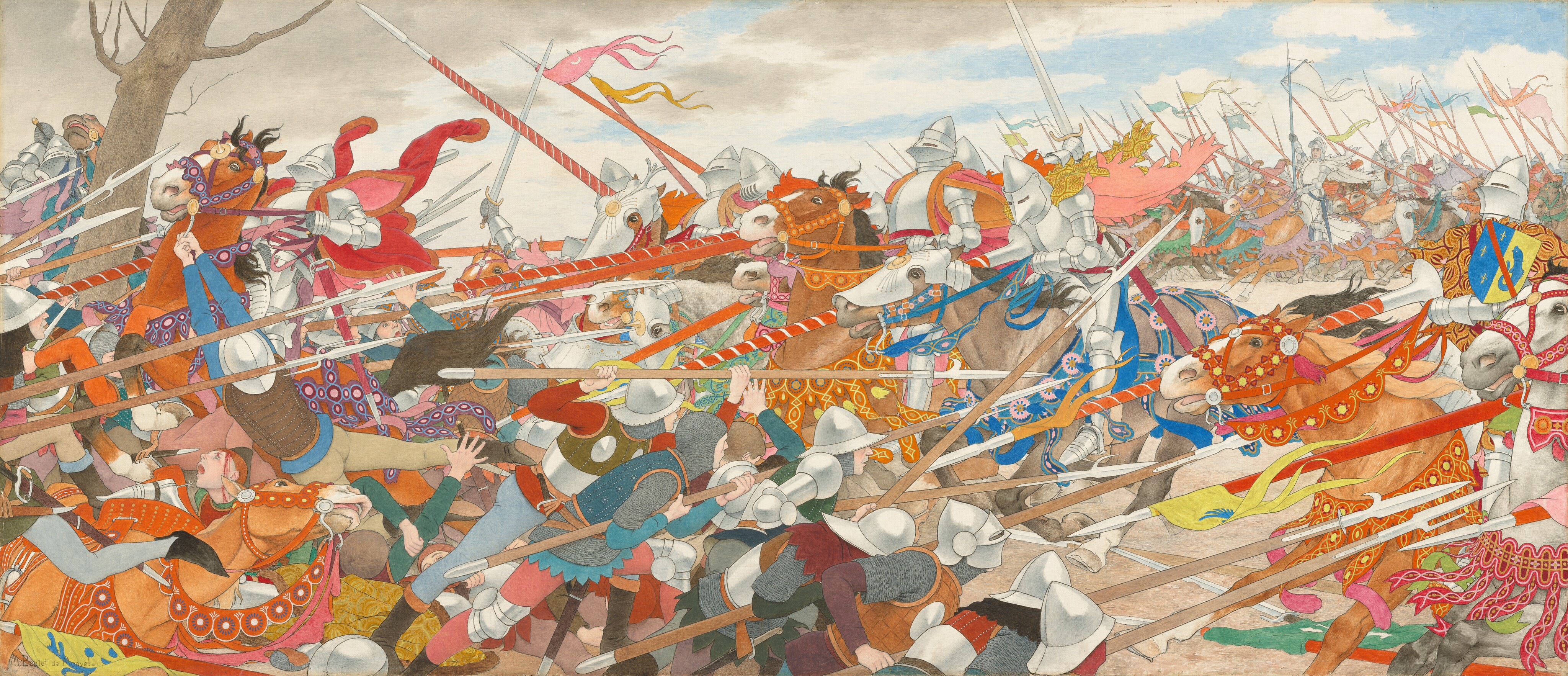
The Vision and Inspiration (Joan of Arc series: I)
Louis Maurice Boutet de Monvel

What sets most writers apart isn’t vision. Writers write. Yes, Harper Lee goes silent after her one great book, and after a flurry, so does Salinger. Dickens, Woolf, Rushdie, Mahfouz, Kawabata, Austen, Eliot, Morrison. Or consider Rowling, King, Grisham, Steel, Gabaldon—writers whose books edge others off the shelves in bookstores. If there is inspiration, then it is the inspiration to sit down (or stand up) and write. Success—often determined in monetary terms—helps fan that inspiration (You like me! You really like me!), but chances are that those writers already established a habit, a ritual, or, more likely, a regimen. They worked, and the work was their inspiration.

The Turmoil of Conflict (Joan of Arc series: IV)

Louis Maurice Boutet de Monvel

            I have the natural bent to slog but have lacked the discrimination to choose the slog that best suited me. It is so easy to fall into work that offers something like a reasonable remuneration. Except no amount—neither how little nor large—is enough to satisfy. I am reminded of the psychology experiment in which a rat is rewarded for performing a task—pressing a lever. The rat that received a reward each time it completed the task stopped; fat and happy rats will not work. The rat that received no reward gave up quickly. No shock there. However, the rat that received rare and random rewards pressed the lever feverishly. I have been that rat. Give me a task—any task—and watch me work for unpredictable and unsustainable reward.

            When I began writing in earnest three years ago, after a hiatus driven by all manner of tasks (worthy, meaningful tasks, I should add)—I knew that I was fighting against the idiot rat. Or that I was in the wrong experiment. Because I do not expect the rewards to be anything other than rare and random: someone from Senegal read my blog post; an agent sent a complimentary rejection; the audience at a reading sat enraptured and gasped in unison at the right place. There are moments when, after putting words on the page that I raise my arms in triumph. I delight myself, which is, fortunately, neither a rare or random occurrence.

            And I am not a rat. Neither am I an ape nor a proto-human. While those instincts and drives may be part of the first draft of my evolving consciousness, evolution has provided me with a brain that can reflect. My brain (and yours) produces an inner voice that can guide me out of danger or deep-seated dissatisfaction. So, back to resilience—while I can persist or, even better, thrive in less than ideal circumstances, I can see that if those circumstances can be changed, I can change them. I can rewrite the early draft of my life.

The challenge for the late writer is that unlike Dickens or Woolf or take your pick, I do not have habits so ingrained that an explosive event—or a persistent eroding series of nonproductive events—will not affect them. And so, I must make a way forward that limits time spent elsewhere. I have lessons—the Sailing Lessons included—for how to plot my course. I have completed my practice sails. It is time to go, leave this year behind, and count the words as they tumble down.

At War with the Virus

Say, you live in Maine, far from the coast, in the softly rolling hills in the part of the state known as “The County.” In Winter, the days are short and bitter with cold. You are not at war with the dark, and the winter wind is not your enemy. You may decide to move someplace warmer, where the sun rises earlier and warms the world even in January, but no matter where you go, The County will be cold in January.

Say, you live in Florida, and for four months each year, you pay special attention to the weather forecast in the morning. You have sheets of plywood stowed away in your garage, just in case. In Winter, the streets fill with license plates from places up North. Hurricanes and snowbirds are the limits of your life, but you aren’t ready to chuck it all and move to Tempe. You aren’t at war with hurricanes—what a futile battle that would be. They pass through, soaking the earth and knocking down trees. At least they aren’t earthquakes—unpredictable and worse than ornery.

My father planned his trips to Bermuda in late May and early June—when the weather was usually warm enough and before hurricane season roared into full flower. Only once did a tropical depression explode into hurricane force. We were still inside the reef, making our way from Hamilton to the customs house in St. George. One of the ferries veered off its routine course to check on us as we were about to depart Hamilton Harbor. My father’s stubbornness was as unrelenting as the weather. It took us a day to power around the island’s northern passage—a trip that usually took scant happy hours. I held the helm as we motored inch by inch into idiot winds. I slept well in an uneasy anchorage that night. By morning, most of the cell had crawled on, slowly dissipating in the pan of the chilly Atlantic.

A sailor, a Floridian, or a Down Easter all understand that weather comes and keeps on coming. Some cycles are reasonably predictable, but day by day, if you are planning a day sail, a picnic, or a ski trip, you better check ahead.

There’s a lesson here, and it’s full of holes. Not everything is like the weather. When we describe people as walking hurricanes or icicles, we make metaphors to explain their character. We know that their behavior did not originate as the result of cold air spinning over warm water, or that they are actually frozen. We alert ourselves to the difficulty of such people because we know that grappling with rain and wind or freezing cold is a fool’s errand.

The coronavirus is more like weather than some “invisible enemy.” We will not “contain it,” or “defeat it,” as much as adapt to it—the way that we put on a heavy coat in the Winter, or attach plywood outside our windows when the storm heads toward us. Yes, the virus can kill us, but it’s not a willful assailant. It did not attack us or declare war on us. It has no strategy learned at war college. The virus just is.

We think of the world in terms of stories. Even the way I began this—weather—is just a story based on my experiences, although I have never sealed a window behind plywood or hunkered out to check fields in the brief sun of Winter. I can imagine such things because I have seen them depicted in the news or heard these stories from people who have done them. Or because my life has brushed close enough to these places and that weather. Besides, these are common enough stories.

But war? A friend reminded me—over and over—how poorly the military was depicted in film and television. The military and war are described to conform to our sense of what they are—to fit the stories we already have. I recall Henry in The Red Badge of Courage, marching off to war with heroic accounts of the Greeks dancing in his mind. And then the battle happens.

There was a singular absence of heroic poses. The men bending and surging in their haste and rage were in every impossible attitude. The steel ramrods clanked and clanged with incessant din as the men pounded them furiously into the hot rifle barrels. The flaps of the cartridge boxes were all unfastened, and bobbed idiotically with each movement. The rifles, once loaded, were jerked to the shoulder and fired without apparent aim into the smoke or at one of the blurred and shifting forms which upon the field before the regiment had been growing larger and larger like puppets under a magician’s hand. (Crane, The Red Badge of Courage)

Of course, this is a little too poetic. Crane gets at the chaos and absence. The overall effect of his novel is the persistent shift from order to chaos and back again. He did not experience war but learned by listening to veterans as he prepared to write. We can learn new stories.

We fall back on stories that we already know. The gravity of the familiar is too powerful for most to escape. We repeat and replicate the stories from our lives with tidal regularity. We do it automatically and insensibly. And that is fine and sensible when what we already know helps guide us back to familiar places. However, when faced with the exceptional, we must learn, quickly, to adapt and revise those familiar stories into something that will suit the present moment. “Must”? Why “must”? We do well enough with the old ways.

Metaphors, which are all that stories are, helpful tools that can open and expand our understanding. In Range, David Epstein writes how Kepler used metaphors to help him discern the motion of the planets. However, metaphors come imbued with values and can ensconce our judgment with moral values that impede clear vision. In Illness of a Metaphor, Susan Sontag points how “[i]llnesses have always been used to enliven charges that a society was corrupt or unjust.”

So, if we are at war with the virus, it must be a foe with corrupt and evil origins. We demonize the virus to create a familiar story of us vs them. We go to war with the virus to stir a sense of urgency; war is the epitome of urgency. The evil enemy must be defeated. Leave out the chaos and unpredictability. The slip of genetic information becomes an “invisible enemy,” the President takes on the mantle of “War President.” Except this enemy does not stand on a field and fight, does not snipe at us from a jungle blind, does not line up or plan or have a General in charge of strategy. There is no Rommel, no Lee, no Hannibal directing the forces. No more than some angry, vengeful force directs the cold wind to gnaw off the fingers of your left hand, or tears trees up by their roots and smashes them down through your roof.

The man who attacks the wind is worse than a fool and doomed to fail. Even if the wind abates, and the serene sun returns like a balm, he did not defeat the wind, and he did not bring the sun.

Still, we feel the need to play the useful if futile part. We must do something. During the pandemic, many will do—and should do— much, as we slowly find out a way to live with this next new virus. There have been other illnesses, and there will be others. We can be sure of that. We will learn this lesson, or forget it and retreat to the familiar old story. The story was there before and will wait for us, as it always has.

London, Flying, Writing

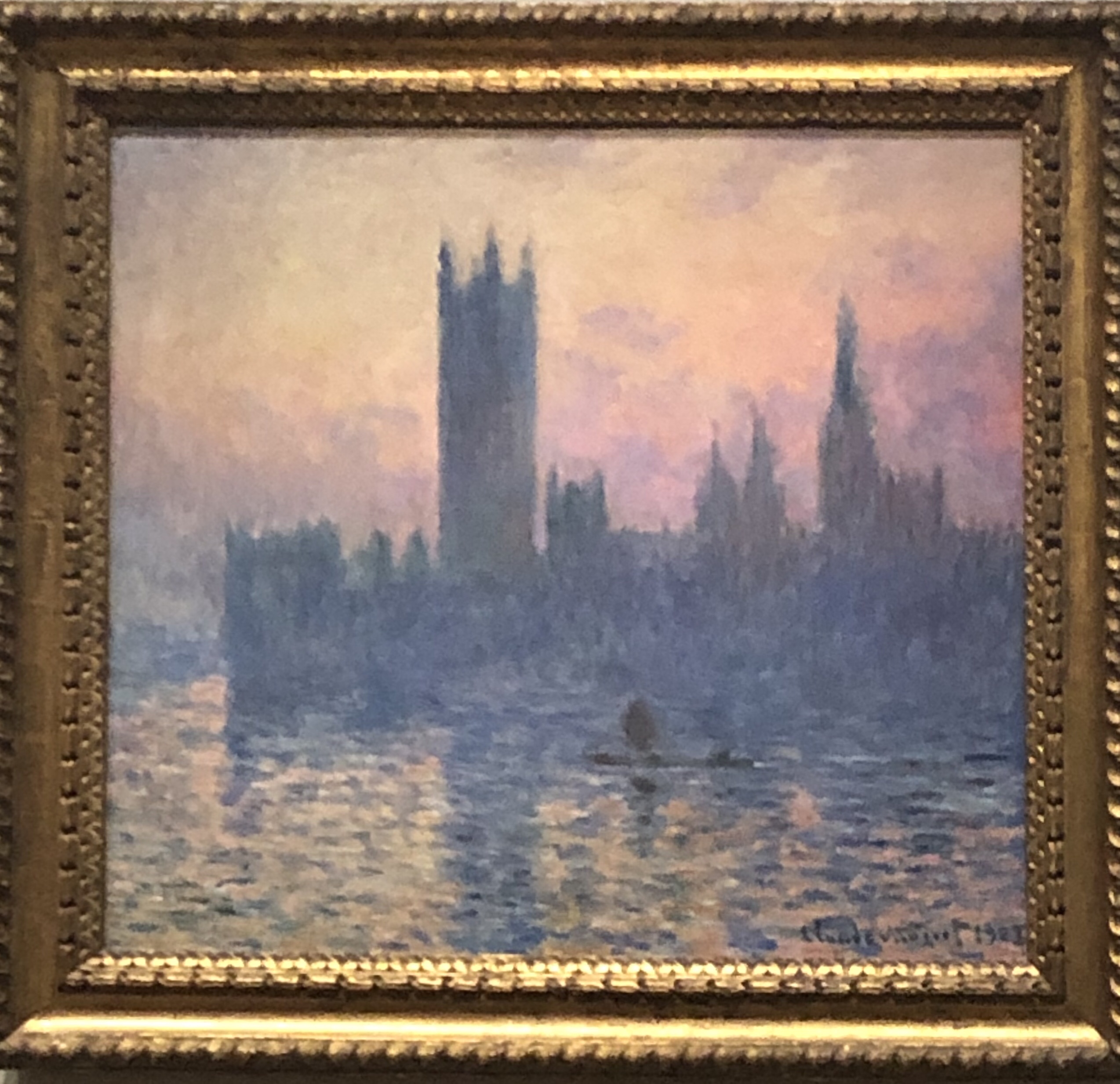
It has been a year and a few months since I was in London. I’m thinking about London while I sit and study Monet’s “Houses of Parliament, Sunset” at the National Gallery of Art. The memory of looking across the Thames at that building, with Big Ben swathed in the latticework of repair, has faded only a little. The memories of walking the streets of the original square mile and beyond remain startlingly vivid. I used them to paint scenes when the characters in my novel walked through London. The memories of the places and the memories of the feelings.

When I was there, I had just begun what would become my first completed novel. I had changed my life, but was only taking the first steps out of the extended shadow under which I had lived my life for much too long. I had been grounded—too grounded.

This morning I woke from a dream of flight. I had to deliver a package, and the way to the place I had to deliver it to was blocked. The streets were closed—barricades blocked alleys and police redirected traffic. I picked up the box—a box of books, perhaps? In a previous job, I often carried boxes of books and was required, on occasion, to pick up from warehouses and deliver them. I carried the box through city streets, all the while receiving instructions about exactly where I was and exactly where I should go. Except, I knew where I was, and knew where I had to go. The instructions were extraneous, the kind of litany of “You are… You should…” that have too long tethered me. And so I did the only thing left to me. I flew. I flew in between the buildings in the city, sometimes following the spaces above the streets, sometimes flying over the buildings—skyscrapers. I flew past a circus parade, as performers prepared to enter their theater. I flew and wondered where I should ply my flying trade—the circus came to mind, naturally, but so did the military (I was a secret weapon). I scooped up a bully who was tormenting a younger child and instructed, “Superheroes live, and we are watching,” before setting him back on the ground, edified.

img_2173When I was last in London, I was taking steps into a world where I knew I could live, where I had longed to live. Just like in the dream, writing—flight—was not foreign to me, but something I had traded in for a more certain, more directed existence. While “You are…You should” can feel like shackles, flying—writing—is formless and uncertain. Anywhere is possible. Everywhere is almost a mandate. Just like in the dream, I had written before—had flown—and had lived closer to the limits of my existence. But I had to leave my self-imposed limits. I had to accept that I might fall—and fail—but just as I accepted that in my dream—soaring up the side of a steel and glass edifice, wondering, “What if I forget? What if I fall?—I thought, even as the thrill of fear invigorated me, “You are flying now. Even if you fall, you will remember as you fall, and fly again. Keep flying.”

img_2761Two women look at the Monet—taking seat in the National Gallery beside me. They think it is beautiful, but claim, “It doesn’t look like that.” Of course, the Houses of Parliament look like that, as does the river Thames, as does the sunset. “We didn’t see it,” they claim, “We were tourists, doing touristy things, like thinking about where to have dinner.” I did not think about dinner when I was in London. As much as I love dinner, even food became a secondary thought while I was in London. Even the pubs and ales became little more than way-stations along the bigger task—the journey, the seeing, the walking, and the flying. And the writing.

At some point, you leave behind what holds you back, and you push off the ground and make your first tentative moves into the air. At first, it feels more like swimming than flying. Wait. That will change. Once you have flown, you do not lose the gift of flight. You may set it aside, for whatever reason (You are…You should), but when you—finally—return to it, the inspiration, the ecstasy, and the certainty will return as well. You will accept the fear and even turned it to your use—flying and writing into places that scare you, outpacing your fear and using it as a goad—higher, faster, stranger, more beautiful, and then more.

I want to say that you do not have to wait until you are 58 years old to rediscover flight. But even at 58, then 59, you can recapture that rapturous joy of flight—and writing. While, in the dream, I was younger than I am now, and yet I could remember all of my current life. Maybe that was what I carried in my box: life. My life.

When I made my way to the circus—because, of course, the circus calls for a flier—an older man (I recognized him as the father of a former girlfriend, although I never met him in real life) warned me against the life I desired, not merely the circus, but flight in general. He did not say, “You are, you should,” but as his daughter had inveighed, he advised, “You are not… You should not.” He was an old musician, and soured by his work in the circus band. Another older man joined us and said, “Let him fly.” But he was dotty, had tufts of white hair on his fingers, and was probably drunk. Looking at these two, I thought, perhaps, that the circus is not for me. There are other places to fly—not into the dark above the audience’s —but into the light. I thought that while I dreamt.

I think about all this while I dream. And when I walk. And when I see. And when I write. And when I wake up.

I write this to you now because you may be 59. Or 29. However, you stopped flying—or writing. You stopped something. Or maybe you never started. I wrote in 9th and 10th grades. Again as a senior in college. Then I started working on a novel when I was 21. Again when I was 24. Again when I was 26. In grad school, I wrote 20 stories, a short book of prose poems, and two starts at novels. Then nothing that endured for years. A few poems, some prose (sermons and stories and articles), the start and start and start and start of a novel. Whatever I was doing felt like silence. You may be facing a silence of your own. I write to you.

Barricades may block the road ahead of you. You may need to get out of your dream car and carry that box (what is in your box?) through the city on foot. You know the way. Plus—and this is your secret—you know how to fly.

There is another world. It doesn’t feel like there is. I remember that feeling, and the horrible weight of “should and should not,” “are and are not.” Part of the way back to this world is the repeated practice of returning to it—fingers to keyboard, pen to paper. Revel in the count of words, in the hours in the air. Try to think of the inches, then yards, then miles you have traveled, and enjoy the journey.

Plenty of people will remind you of what you lack, will cast blank aspersions on the life you have lived, will denigrate what you have done to get where you are, and will sow doubt in the field where you play. They are not your friends, and you can do without them. Do not try to solve the problems they foist on you, or—worse—take them on as your own. The work, even when you fly, is hard enough without taking on unnecessary freight. There is weight enough in this work.

And there is lightness ahead. And light. You can soar as you wish. I wait, standing on the ground, or suspended in the air among clouds and antennae, and wait to cheer you. Fly! Wake up and fly again.

Stage Fright

Just over a year ago, I went to the LA Bar in Arlington and did karaoke. It was New Year’s Eve, and I had just come from a fairly routine party, where we had counted down the end of the old year and beginning of the new. It wasn’t enough. And so, away I went with my date, and we signed up to sing the Talking Heads’ “Once in a Lifetime.”
I had never done karaoke.

I began to sing in elementary school. First in chorus, where we performed a melange of patriotic and Disney songs, along with the occasional show tune (think “Impossible Dream”). Later, I tried out for the musical Hans Christian Andersen. There were more performances in school, but music, such as it was, was not a priority in my family.

When I took up the trombone—I wanted drums, but the music teacher redirected me with “You have a trombone player’s lips”—there was no insistence on practice. Who could blame anyone for discouraging the initial rumblings of beginner trombone player from the evening routine? My father had a trumpet, which I switched to after a year of trombone. This too proved too much. A few years later my father gave away this instrument from his youth.

I liked music class though, which was almost entirely singing. I explored a bass voice as a counterpoise to my natural nascent tenor. It was fun to dig up those low tones. I also enjoyed singing along to songs on the radio and then to records. This persisted throughout my life, and I recall an incident in my 40’s when I regaled my passengers with “Get Me to the Church on Time,” following Stanley Holloway note for note and comic inflection for comic inflection.

I had long since stopped singing in public as part of a choir or chorus. I was strictly a car singer.

I was, and this surprises most, shy. After college, several years in the restaurant business took the edge off most of my shyness. I learned the value of being professionally—and personally—outgoing. But when I was doing something that mattered to me—interviewing for a position I really wanted, reading my work in front of a panel of judges, singing—the old reserve kicked in. In time, that abated. Mostly. Years in the classroom and standing in front of a congregation taught me how to perform. I may have had some nervous moments—leading “Jingle Bells” without accompaniment stands out—but I found my way. Once, I even promised my recalcitrant students that if they behaved for an entire class that I would deliver a solo rendition of Billy Joel’s “Piano Man.” They did, and I did.

But singing, really singing, belting it out or digging it up? I still experienced stage fright.

So, fueled by champagne and scotch, I took to the stage at the LA Bar, and my date and I traded verses in and out of the Talking Heads. Whether it was the booze, the company, or my familiarity with the song, which I had sung since I was 20, we killed it.

A year later, I joined my students at the mic for John Prine’s “Angel from Montgomery.” I had suggested the song to them months before, and they graciosuly allowed me to sing along. Not karaoke, but a couple of guitars and three voices weaving together the wistful “To believe in this living is just a hard way to go.” I had 40 years on my students but I remind myself that Prine was only 25 when he wrote the song. How did it turn out? Who knows? I think I stayed on key, and that maybe I added a proper sense of grey to the tenor.

I’m not sure where the shyness came from. Okay, that’s a lie. I know it it was one part nature and one part nurture and which of those parts was larger no longer matters. Derring-do, the genuine impulse to break the limits and cut loose occurs in my life in streaks—often at the edges. When I have been engaged in my most meaningful work (and yes, singing counts), an odd conservative bent takes over. The “Brian YaYa” that my friends called out seems to be replaced by a “Brian Yawn-Yawn.” Okay, it’s not that bad, but when you feel a wilder impulse in your guts, anything else—almost anything else, is a snooze.

Not any more. “I’ll sleep when I’m dead,” as Warren Zevon said. Until then, I have things to do. I remind myself even now, with 60 around the corner. I have things to do. Best to do them wildly, bravely, and with the full potential of failure waiting. And more, always more. I live with the stage fright.

See the man with the stage fright

Just standing up there to give it all his might

And he got caught in the spotlight

But when we get to the end

He wants to start all over again.

Stage Fright


It’s time to start all over again. Again.

Dumping Heroes: Gatsby, Manhattan, and coming to terms with it all

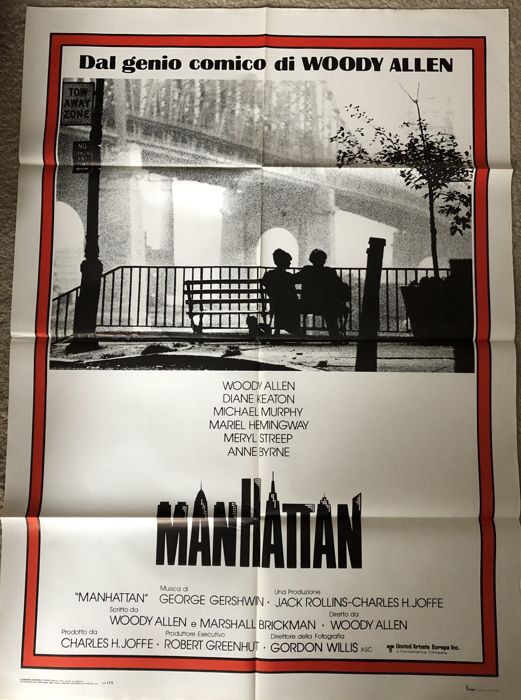
After watching Luhrman’s The Great Gatsby, and his introduction of Gatsby to Rhapsody in Blue, and reading Fitzgerald’s description of New York as Nick and Gatsby cross into the city:

Over the great bridge, with the sunlight through the girders making a constant flicker upon the moving cars, with the city rising up across the river in white heaps and sugar lumps all built with a wish out of non-olfactory money. The city seen from the Queensboro Bridge is always the city seen for the first time, in its first wild promise of all the mystery and the beauty in the world…

 “Anything can happen now that we’ve slid over this bridge,” I thought; “anything at all. . . . ”

Even Gatsby could happen, without any particular wonder.

I cannot help but recall Woody Allen’s opening of Manhattan. Manhattan elates and saddens me.

I first saw Manhattan in 1979, when I was 19 and thought myself precocious. I was a sophomore at Swarthmore College, a school full of young people who rebelled in their precociousness. Tracy’s relationship with Isaac simply echoed my sense of myself. Who among my friends would have put a limit on the seventeen-year-old Tracy? We were only steps away from that age; we were not intimidated by 42-year olds. What did we know about power dynamics or anything more than our own blossoming worth in the world? Blossoming? Fuck that—we were valuable and powerful as we were.

If anything, we looked at the adults: Isaac, Yale, and Mary, as failures. They were warnings against what adulthood held for us. How many of those warnings were broadcast directly to us—adults, even bright, hyper-intellectual, and connected adults, failed miserably at the single focus of life: true and abiding love. (Is that the focus of life? Should it be?) They were even willing to ensnare us in their tangled ruin. And yet we were becoming those adults.

I still hear Rhapsody in Blue as flirtatious, triumphant and orgasmic—just as Allen used it to begin his movie. It starts with the clarinet ensorcelling the listener, almost drunk, almost like the opening of “West End Blues.” Then it is answered by the horns—overwhelming in their insistence, and unable to be subdued even by the speedy-fingered piano that interrupts the answer. There will be horns. There will be crescendo and climax. Yes, there is more. It is hard not to feel movement through that city when hearing this music, but that city is full of sexual vibrancy, and sexual competency. We do it, and we do it right.

The sadness with Manhattan comes, of course, with the knowledge of what happened to Allen-—that youth and vigor swept him away. That romanticization won out over, what? Adulthood? And couldn’t we see in Manhattan all the signs of that? Where was there a space to be an adult in his work? Who knows what Tracy was going to come back to the city as—still full of possibility? or wrought into something, somehow less?

And here’s the thing—we are all going to be wrought by life, by struggle, by disappointment. It’s what we do after the first act that determines who we will be. Or the second act. Or the third.

Life contains an element of the bipolar—there will be elation and sadness. I embrace both. I struggle with both—or I try to. I tell myself to get ready for the fourth act; Agincourt, after all, takes place in Act IV. Still, the bitterness of disappointment is hard to set aside. And there have been so many disappointments, so many sadnesses, so many disenchantments. Heroes fall. I fail. What was once sweet on the tongue no longer pleases. My knees hurt. “I ache in the places where I used to play,” sings Cohen, and he sings in spite of his indelible croak. “Born with the gift of a golden voice,” indeed.

Manhattan elates and saddens me because it lays bare all the trouble to come and makes a statement about the seductive power of the city—a power I felt every time I visited it, every time I visit any great city. Life—like the city, the film about the city, and the novel by Fitzgerald—is rich and dense and confusing—and infuriating. I wish it was not so, and yet, it must be.

500 pages

I graduated from SUNY-Binghamton with a Ph.D. in English Literature/Creative Writing in 1994. Before I went to graduate school, I did not know what I wanted to be. I had written a little earlier in life, and had taken a fiction workshop while I was an undergraduate, but my sense of myself as a writer was hazy at best. Still, I had done some work and I applied to writing programs in the spring of 1988. I was accepted at Binghamton.

While I was in graduate school, I wrote stories, a novel that I shelved, some poetry, and essays. I also wrote a slew of academic papers. Mostly, I read furiously and widely, delving into a world of literature and philosophy that had not existed for me before I began this turn in my life. I still have many of the books that I read in those six years and they are either a bulwark or an anchor. Now, they seem more like part of a wall that divided my life into the time when I did not write, the time I discovered writing, and the time I stopped writing.

That time ended in 2018 when I considered moving away from family and the jobs I held in Norfolk. I had been separated and divorced for four years. Calamity at one of my jobs resonated in my life. I was at sea. I needed to find a ground that was not defined by the needs and desires of other people. I needed, frankly, to be selfish and directed. I do not believe that it is a surprise (to me at least) that my colleagues sent me packing with the book, The Subtle Art of Not Giving a Fuck when I left in August of 2018. Message received.

Because I did give a fuck — too many fucks — not just in my professional work and personal life, but in my writing. Unlike some of my one time classmates, I felt called to writing not so much because I had a need to express myself, but almost in spite of any need to exclaim, “Here I am!” I was obsessed with getting at some ineffable and intractable truth that existed outside my narrow sense of self. I wrote with an evangelical zeal. Can I say that art motivated by such a keening has little easy air to breathe? It does not. My stories, even when they were fantastic, needed to tread more often on the ground.

When I started writing this blog in 2014, I was in China to adopt my daughter. I started to write about simple human truths that were grounded in my simple human experiences. I hoped that my observations would have some resonance with others, but I wrote without too much of a concern for an audience. The work proceeded in fits and starts after that initial push. And then it flared into this—a daily practice of reflection and direction. That fire lit the flame of the novel I finished in August and has carried me into a second.

My writing projects since May of 2018 have produced over 500 pages of words. Some are good. Some are better. My nonfiction has been largely about my writing and writing in general. My fiction has just been a story about a Djinn, almost a retelling of an older—much older—story, with some of my preoccupations thrown in for good measure.

Writing (fiction and nonfiction) has felt revivifying. I have enjoyed the deeper reflection and playful invention. The writing has come more easily and far more consistently than anything else and at any time I have ever written. Ever. I have looked forward to the task and have left it—whether I write for an hour or the better part of a day—feeling replenished. More will—and does—come.

When I shared this insight—500 pages! More is coming!—with a friend, I did so with the proviso: “in spite of the past year.” She corrected me: “Because of it.” Perhaps so. Perhaps I spent the past year and a half knocking myself off my moorings just so that I could get this work done, just so that I could reclaim all that I had feared was lost.

I told another friend that I felt a kind of urgency to write. She worried that I was ill or distressed. Yes, I have been distressed. Old wounds have haunted me and focused my attention. I have allowed them the space to heal. And have used the writing to help me heal.

While the writing has helped me gird myself against that distress, it has also allowed me to wrap myself in joy. I feel that joy more profoundly now than when I was starting out some thirty years ago. The old uncertainties have fallen away. I do not ask, “Is it good enough? Will there be another? Do I have the right?” Instead, I take solace in a more durable method that suits my heart and mind. I go this way.