“I love you”

It’s a common enough occurrence, or at least I hope it is for you. Someone tells you, “I love you.” This seems like a simple enough thing. But I (and I am guessing this is true for some of you as well) did not grow up in a house in which that phrase was bandied about loosely. I do not recall my parents telling each other, “I love you.” Perhaps they did, but they did not in front of us kids.

My father only once told me that he loved my mother, and that was when he chastised me for arguing with her, “She’s my wife, and I love her. She’s always going to be right.” How’s that for a single explicit lesson on love and marriage?

Everything else I figured out on my own—with generous glimpses into the lives of families of my friends and the families of the women I dated over the years. Or movies. We have to learn somewhere.

So, when someone—that someone—tells me “I love you,” I know that there is an appropriate response, something distinctly other than, “That’s nice.” And here, I am distinctly not writing about the first time someone tells me that—I’m writing about months or years of love. Besides, if “That’s nice” is your response, it’s time to move on. You are doing that someone no favors.

First, and this is easy, reply with: “I love you,” or “I love you too.” If possible, touch that person’s hand or arm when you make this response. A simple physical gesture can help punctuate your words.

Maybe this seems too easy. “I want to say more,” you think. How about responding, “Every time you say that, I feel happy”? Imagine telling someone that after ten months or ten years, or, for that matter, ten hundred years. “Every time?” Every time.

Or, you could answer, “I remember the first time you told me that. It thrilled me. It still does.” Perhaps share the particulars of that first time. You remember, don’t you?

If words are not your thing, just stop, and stop them too. No matter where you are, or what you are doing. Take their hand, touch their cheek, kiss them—lightly or deeply as you wish. And then ask them, “Tell me again.”

Time to Fly

I begin easily enough. Before I know it, a length has passed in the pool—most of it underwater as I dolphin kick on my back until the flags at the far end of the pool pass over my head. Or a new job begins, with all the attendant paperwork and the meetings with people who think they know my job better than I do. They know something better, and I try to learn, as quickly as possible. Or a new romance, which is like falling, and is as easy as falling, the way falling is entirely effortless. What comes next?

The grind of workout #89, when the music on the waterproof MP3 player fails to inspire a quickened pace, and the bottom of the pool is endless. Or the month after the initial set of grades are due, and the fourth set of essays come across my desk. Not again. Not the same mess of misspellings and three page paragraphs. Or when the obligations of work and family eat into the blissful times, and bliss becomes quotidian. Imagine that, quotidian bliss.

In every aspect of my life, the transition from beginning to middle happens almost by accident. Like tripping over a carpet. I get used to the puckered places on the floor—or tug the whole thing up, and set it back down again, flat, until the gremlins shift it around again. And then I tug it up again. And again. One time will not do. One run of the vacuum. One load of laundry. Another set of tests to grade. Another and another and another.

But some things bear repetition, even improve. Like love. While it is hard to make the transition from falling to landing, it is better still to learn to fly, to find the joy. The old joke about, I just flew in from Los Angeles, and boy, are my arms tired. I would live for my arms to be so tired with the effort of flight. And it would be worth the effort, each fluctuation of my unseen wings, soaring in unison with my love.

It is the same with writing. I have used this blog as practice off and on for the past few years. It has been a way to scribble and not to worry about the duration of longer effort. Longer effort—let me call it what it is, a novel—can be daunting. What if, like falling and flying, one mistimes the creative leap and ends up hobbled or broken, with months of work sent to sea like Icarus? I only I can think about something longer as, well, 1000 word spans. 1000 words is nothing. 60 days at that pace, and… But let’s not get ahead.

Is writing something longer romantic? For me, yes. I have fallen out of love with several novels that I have begun. The ideas and characters have soured, or I have not loved them well enough to let them live beyond my narrow conception of them. For me, as much as writing is a commitment of ass to chair (scribble, scribble, Dr. Brennan), it mimics the action of reading—a generous engagement with a book. Seymour Glass’s best piece of writing advice ever— “Imagine the book you most want to read. Now go and write it”—has always resonated with me. And until now, other than some shorter pieces, no longer piece has fully met that criteria. Or, I was not up to the flight.

In the end, really, I don’t write because I have something to say, but still, because I want to discover something. Before I was a writer, I was a reader, and I still love to read. The same way that I love to travel, I love to discover ideas and characters in books. It is flight into unknown places. I love discovering what I do not know. Somewhere along the way the creative process seduces one into intention—I get caught in the web of intention—thinking about what I want to say instead of praising what I see. And letting my words find a way.

I take refuge in Michelangelo’s vision of the sculpture already extant in the stone—we aren’t creators so much as revealers—discoverers if you will. So too, with flight, while there may be a destination, there are also loops and rolls and fields long enough to land, and walk to an untended apple tree, pick a ripe crisp fruit, and eat. Discover this on the journey.

How many other aspects of my life follow this impulse—reveling in discovery more than intentional design? I think too many. Most people still live their lives primarily by design. There is security and satisfaction in the sense of agency that willfulness bestows. My students clamor to know what they need to do to earn an “A,” or a higher score on an exam. How unsatisfyingly do I answer, “Discover more.” That is no way forward, at least no specific way. It is an attitude and not a route.

And frankly, in romance, I have scuttled relationships because I have fought against others’ plans, not happy to simply follow the natural stages of things, and unhappy when a relationship settled into a routine. Of course, life is routine, a series of repeated rituals, a hundred thousand undulations of wings. But that routine, those rituals, can, should, must help one reveal what is hidden in the marble, or what might be found when gloriously in flight.

Perhaps, what I wanted, without knowing it, was someone who was willing to fly with me. And in my writing, something that had the chance of slipping the bonds of my intentions. A goal I could fly toward, that would transport me the same way that love transports and transforms me.

There is a little secret though. I do have at least one intention, and that is for this longer work to last, for it to remain engaging and vital, even when the effort strains my arms. And so, I take small flights. And share these flights, for now, with one who flies with me. I discover something new, one winged trip at a time.
Purpose

“What do I have to say?”

How I wish that more people asked this simple question before adding to the public discourse. Instead of wondering about their particular expertise, or wondering about how their experiences have shaped them, most people weigh in, almost automatically, on nearly any occasion. We have become a nation of opiners, flexing our incredible verbal muscles in a display that rivals any body-building competition.

And for what? What are the effect of our words? What spaces do they carve out in the public square? How do our voices land in the ears of those around us? How does what we say actually represent our thoughts and feelings, and how much is made to simply compete with what we hear—a kind of verbal pyrotechnics meant to outblast, if not outshine, the sound and fury of our neighbors?

It is enough to make one meek. Since everyone expresses opinions at a level of intensity that rivals Jonathan Edwards—dangling our audience over pits of damnation—a quiet measured voice is like a spring zephyr in February—lost in the midst of winter rain and sleet, unless one can open oneself for that fleeting moment that the season will change, and that the one breath of gentler warmth can ease its way into our winter layers. But who has enough patience to be that harbinger? To breathe softer words? To hint?

And who would listen?

I begin with no grand proclamation to shout. My students would laugh to hear me say that. I have shouted, exhorted, acted—overacted—and entertained in classes for years. Inevitably, I will announce “Dr. Brennan’s Rule for Life #7,362: Buy flowers,” and acknowledge that there are as many rules to the north and south of that number. However, my students are a captive audience—they have to at least pretend to listen to me. The same goes for my daughters, or even the members of the congregation I served for nearly a dozen years. Yet, I never take any listening for granted.

Maybe this is true of others as well, and maybe this is part of the reason that there is so much shouting in the square—as if volume could take the place of wisdom. Say something loud enough and someone will pay attention. Get enough people to pay attention, and some number will believe what you are saying. Get enough people to believe and rule the world—or some slice of it.

What if all you want to do is quietly share. I saw this… I heard this… I thought this… I felt this… What if you wanted to just add to the world and not bend it to your will? To inspire some stranger to go and see, or hear, or think, or feel? To suggest, perhaps to persuade, but not to cajole or chastise?

I do not know. I wonder if there is a wisdom or wisdoms that might be shared, if a thought precisely crafted and shared will find purchase. Is there a value in inspired rumination? My students read Walden and bristle at Thoreau’s adamantine vision. Who is he to insist on how we should live? Didn’t he die penniless? Where did he go to school? Why isn’t he as well organized as Emerson? I don’t think about my pants. The same holds true for Whitman’s kosmic voice, and for Dickinson’s route of evanescence. Writers who stake a claim turn readers away. If that selection seems too narrow, Ellison’s blindingly light filled room, Woolf’s roomier postulations, and Marquez’s endless Aurelianos also turn readers into pillars of salt.

But, declare I must, because silence is not a story, and words may find purchase, somewhere, somehow. Time to work.

Naming it

My friends are pointing fingers, locking their anger on that man, laser focused, sharpened wits at the ready. Especially today, the day after he mocked the woman who stood up and made her claim. And yet, it is never one man who makes the hatred possible. It takes a thousand voices, a million. And they are ready, adamant, and they will do more than vote.

The easy comparison has been to the fiendish orator from the 1930’s in Germany. But are we not living in the Weimar Republic, trounced and wounded and in the middle of a seemingly intractable economic crisis, with people wheeling barrows of devalued currency to the store for bread. No. We are great. We gather to watch football in the fall. We go to the beach in the summer. Our lives are country sweet.

And yet, when one man strokes the match, we burn, ready to ignite a fire that can be seen across oceans—or at least into the homes of those who would stand against our righteous anger. If he throws the match, we provide the kindling and hardwood to guarantee the night will not take us.

And we are, somehow, inexplicably, afraid. Of what? Of whom? Of the stranger. And he brings evidence—these families torn apart by them, those strangers to our great nation. Or this woman, whom he mocks for being imperfect. And all the while, the danger comes from so much closer. For every brown and black assailant, there are a thousand who look like us, who live in our homes and worship at our churches. Are we afraid of them, of the familiar danger that sleeps next to us?

Perhaps, but how much would it cost us to put an end to that? How many families would be torn apart if we laid bare the terrible secrets that line our streets like so many comfortable white fences? Not him. Not one of us. And yet, that is where the danger waits.

And so, because we face an unnamable threat, because we dare not speak its name, we are ready to foist our fears, whole and significant, onto others. Or even take them upon ourselves—blaming the crimes we daily face on ourselves. Not smart enough. Not cautious enough. Not brave enough. Too foolish. Too sexy. Too brazen. Too forthright. Too outspoken. And we do not turn to those we love and say, “Stop. Stop yourself. Stop your friends. Stop the faceless brigades of those who look like you. Stop.”

Until we do, until we stop those who would persecute our mothers, our sisters, our wives, our daughters, our sons, until we name the true source of our gnawing fear and endless recrimination, until we demand a true accounting for the actions, not of a few, but of the many, and stop blaming the hurt, the wounded, the abused, the battered, the raped, and the killed, until we recognize that it is not that man, or those strangers, or those women. We need to do more than hold that man accountable.

It is time for us to hold ourselves and our men accountable. It is time to name the fear. And act.

Boys to Men

I do not know Bret Kavanaugh, nor do I have any idea what Georgetown Prep, his high school, was like.
I attended an all-male boarding school (The Hill School, in Pottstown, PA) and graduated in 1978. The school taught me explicit and implicit values. What I remember most about my late adolescence was that the values I was taught were not enough for me, that I needed bigger lessons, more durable lessons, lessons that would help me grow up and become a better man. When I decided to apply to and accept admission to Swarthmore College, some of my classmates teased me because The Insider’s Guide to Colleges mentioned that Swarthmore had a gay student organization. That’s what boys zero in on, forget the mention of coed dorms, coed bathrooms, and sex in the library. The teasing stung, but I knew that one of the reasons I chose Swarthmore was because it was a more open community and that it would expose me to ideas that were foreign on an all-male campus.

We were never taught explicitly about what women were like, and perhaps that’s not a surprise given that it was the late 70s, and teaching boys—boys who lived at school with each other and without women—would’ve been tantamount to a revolution. What we learned about women came mainly from pornography or word-of-mouth; neither of those sources was well informed or helpful. The female characters in our literature classes were the attendant characters in Shakespeare, The Glass MenagerieEmperor Jones, and later in an Ethics class, the mother in Mishima’s Sailor Who Fell from Grace with the Sea. Certainly, there was literature that would’ve helped address some of these issues: Jane Austen, the Bronte Sisters, Virginia Woolf, others, but we stuck to books like Billy Budd.

On reflection, maybe there were enough lessons in those books to teach us about how we should behave in the world. The lessons of the handsome sailor have always resonated with me. There was—is—a better way to be. There was—is—also a darker impulse, based in part on jealousy, and then something unmistakably evil. Each of us carries a Claggart—a heart of darkness—in us, whether we like it or not, and if we don’t wrestle with that presence in our daily lives, and set it back where belongs, then we will be susceptible to those darker impulses.

But how helpful it would’ve been, to learn about how women thought, not just about sex, but about how they felt about their lives, and about us, and what they expected from us. Those lessons came later, and not easily. Maybe they don’t come easily for anyone, whether they spent their adolescence in an all-male environment or not.

The first yearbook I saw at my school featured Christian Nestell Bovee’s quotation: “Our first love and last love is self-love.” I’m not sure whether the boys who chose that quotation meant it as an ironic statement or an actual claim of principle. But we were taught to love ourselves. That could be a selfish kind of love, when you are at the center of your own universe all the time. It took me years to knock myself out of that center, to learn how to lead as a form of service, not merely a form of heroic self-proclamation. We spend so much time as adolescents and young men planting our flags declaring ourselves, and declaring our desires, that we forget that there are other flags, other desires, and other selves beside our own. We think our anger is the most important anger. Our love, the most important love. Our selfishness, the most important selfishness. Our success, the most important success. And of course, and in some ways, it is. But when we live that way, we don’t think, and we don’t consider. We become islands.

And so we end up 17, thinking that we can have whatever we take for ourselves. Or we end up 35, or 50, or 70, with that same notion stuck in our brains. We enter a kind of Hobbesian world, where the strongest take what they want from those who are weak, where life is nasty, brutish, and short unless you are strong enough, successful enough, rich enough, to define the world on your own terms. The only way to succeed against such impulses is to be like Billy Budd, the handsome sailor, excellent on one’s own terms in a way that is beyond grosser manly definition. A glowing exemplar. Untouchable. And yet, fatally flawed.

In time I would learn other lessons, and they were among the most valuable lessons I ever learned. I learned to complicate my world, to see beyond my immediate desires, to see into the world. I learned this from teachers who were women from classmates who were women, from the authors who were women, from philosophers who were women. They deepened my understanding of the world.

I cannot help but wonder what my life, and the lives of the young men with whom I went to school, would have been like if we had received those lessons then, from our male teachers. I am well aware that some people—and not just men—will hear lessons from women differently, less seriously, because it is not a male voice speaking. This is a loss, a fatal and horrible loss. Our world is made up of so much complexity so much richness so much that is valuable. When we exclude ourselves from seeing these things because we are men, who once were boys, we fail. We fail the women in our lives, and we fail ourselves.

I don’t know Bret Kavanaugh, but I know something of the world of boys and men. We have an obligation to be better, to expect more, to not hide behind the “boys will be boys” mantra of the excusers and justifiers. We did learn to be better. And we did not. We own this one, and so does he.

The Cats

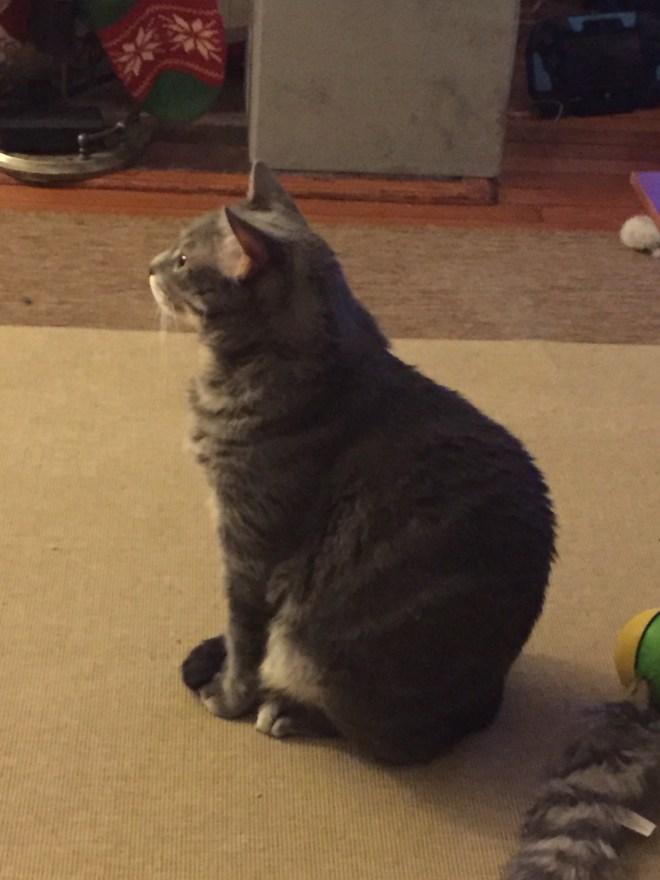
My cat is dying. I have four cats, and one of them is dying. In the past 35 years, I have had 9 cats. 5 of them have died. I have been present for the deaths of 4 of them—3 in the auspices of cat hospitals, where their deaths were hurried on beyond their suffering, 1 as renal failure finally blotted out his light. The cat who is dying now has some kind of neoplasm—a cancer—and his descent has been swift. He is just under 7 years old; he entered my life 6 years ago.
When you adopt a pet, you know you are, for the most part—tortoises and parrots aside—going to outlive your pet. Your cat or dog will die. A child’s first experience of death often happens when a pet dies (or Santa Claus is excised from their lives, another kind of death). But, by the time you are older, mortality has been hanging around, making itself known. It’s a savage kind of knowing.

I’m in the middle of teaching Shakespeare’s sonnets—bouncing between the appeal of the “eternal summer” and hard fact of Time’s “bending sickle’s compass.” There is no comfort in death, or in the slow inexorable passage of time. All the comparisons he discounts in Sonnet 130–the sun, coral, snow, roses, perfume, music, goddess—are ideals that flower easily in the imagination. These are worth striving for! And yet, we are all “Time’s fool”—how can we be anything else? We must “tread on the ground.” Life—and its end—happen here.

Of course, I hear Thomas’s “Rage, rage against the dying of the light.” And I do. I wear glasses that alleviate the dimming light. I adapt. I go to the pool and the gym, preparing to extend that rage, thinking “Only halfway!” Perhaps the rage blinds us to the grimmer particulars. Then I’ll take that blindness for now, and rage.

Still, my cat is dying, and is confused and anxious about what has happened, is happening to him. I try to comfort him, and know that in the end, easy passage may be the way (I have phone numbers at the ready). I wish I could hold him, pet him, and reassure him that his girls—the two kittens he tended when they followed him into my household, who are now 5 years old—will be all right. That I will take good care of them. That he has been a good cat and a good companion. And I know those reassurances are echoes of words and thoughts I had for other cats. And, of course, for other people.

I may be done with death, but death, I know, is far from done with me.

Disappearing Lessons

When kids are little, you can play peek-a-boo with them, and delight them for hours because they have not yet developed their sense of object permanence. Objects that drift out of their sensory field cease to exist—the perfect “out of sight, out of mind” circumstance. It does not occur because of anything they will—it just happens. Sometime during the second year of life (and this is an imprecise measure), children learn that there is a world beyond their immediate senses. Trial and error teaches them that parents and food and comfort exist (or, do not!).

Jean Piaget proposes that we learn schemas—models for understanding the world. As we mature—during our early life—these schemas become more complex. They show us how to navigate a world that is not in our immediate grasp—at our egocentric beck and call. But how much do we simply extend our egos—using the schemas as a way of organizing the world in accordance with our desires?

I wonder how this applies to how we develop a sense of the world—how the schemas we develop shape our senses of morality and mortality. Do the schemas imbue more ephemeral things with a greater permanence than is warranted? Can the trial and error of early childhood be subverted by experiences that teach us about the ambiguity and ambivalence of the world? Or do we, from an early age and onward, cling to one master vision that cannot waver?

Because, as we age, we learn that impermanence is the standard. People come and people go. There must be some kind of formula for this: for every two people who enter our orbit, one must be released. Later, the ratios rise, switching to 1:1, and then 1:2. The causes are myriad—death, disaffection, dumb luck. People appear and disappear with stunning frequency, with hardly a moments notice for peek-a—

For example, I often think of my father, and miss him. I know that he is dead and cannot be a part of the life I lead now, however, his presence feels like the lingering effects of object permanence. Somehow, I have located him in my schema of the world, and no loss, no absence can remove him from that schema. Just like the child who can hunt for the toy hidden beneath the sheet, I can find my father behind the darker veil.

And yet, I am also fully aware that he felt often absent while he was still alive. He entered my life at intervals—holidays, sailing trips. There were stretches of time when I only saw him once a year, other times when when he was without more than with—present in the dimes and nickels that he left on his dresser for us to buy milk and ice cream at school, but only appearing, briefly, in the flesh, at dinner, and then disappearing into his den. Was he really there, or have I constructed a vision of him that became a durable substitute for the times he was away?

My parents championed independence in their children. While we were expected to be independent from them, did we, by happenstance, learn independence or absence as part of the schemas on which we built our early lives? We became free-floating, detached, prepared, in advance, for the disappearances that life would throw our ways—not the peek-a-boos of play, but the more enduring, and finally, more heart-breaking absences of adulthood. There is some solace in that, but also a modicum of sadness. We were pre-lost, almost, before we were found.

Paying Attention

When I am out walking with my daughter I have one, simple repeated lesson: pay attention. Crossing a street? Pay attention. Walking past a flower bed? Pay attention. Meeting people? Pay attention. It is the cornerstone. I point out when I fail, as she does: Pay attention, daddy. Did you look? Did you see me? Two eyes seem like slim equipment for the work of days.

As a teacher, the central lesson is a finely tuned attention. The study of literature is a proving grounds for giving attention its fullest due. Words, images, sound. The unpacking of one of Shakespeare’s sonnets, or Joyce Carol Oates’s stories, or a passage from Joyce’s impossible novel relies on the attention one gives and the knowledge one brings. All the knowledge in the world is wasted if one does not look outward and pay attention.

When I write, I also pay attention—it is a balance between inward and outward attention—letting the still, strong voice inside reflect on the outward world. I try to write about what I see, what I learn, what surprises me—almost all outside of me. When I venture within, I hope to turn the same sharp vision within—seeing myself as if on a journey, as if I was foreign and strange—as I must be, even to myself.

But those are only three roles I play in life: father, teacher, writer. I am also a friend, and enjoy paying attention to my friends’ likes and dislikes, their peculiar fascinations and passions. We tend to have similar interests—we are, after all, friends. And I know that my friends pay attention to me—that they appreciate my odd vision.

There is one other role—and it is at once the easiest and most difficult. I love paying attention to the person I love. I love learning the stories that comprise a life, listening to the dreams of possible futures, and discovering the intricacies of another’s heart. All this is so easy—I could listen and learn for a lifetime—I feel like all else is practice for this.

The hard part is having someone pay attention to me. First, allowing someone to see me, all my flaws and strengths. That is, almost, easily assuaged by repeated kindnesses—I have learned to accept being loved.

Harder is accepting when someone misses something. When my daughter stumbles into a crosswalk, head tilted toward phone, there is a quick check—pay attention. When a student misses the meaning of the image: “star to every wandering bark,” I can quickly point out that Shakespeare is punnier and more ribald than serious young students give credit. When I make a mistake in an early draft, I can edit. And I can accept my friends “misses” easily—chalking it up to our simple flawed and generous humanity.

But, with love. Perhaps because it is only then—when I love romantically—that I feel most vulnerable. I sometimes become all but selfless—loving most and desiring least, as if true love could enable a perfect kind of detachment. So much for flawed and generous humanity—I must be perfect. Jeff Tweedy sings, “No loves as random as God’s love”—this random indiscriminate, impossibly generous love. Shakespeare calls it “lascivious grace”—unimaginable to those who walk upon the ground, and yet, the only ideal.

And yet, the hope, beyond hope, that someone is paying attention. One of the great joys of love—and of life—is feeling recognized, not simply on someone else’s terms (This is how you are like me! This is how you complete me!), but on your own terms (You showed me… You taught me… You amazed me… You surprised me… You changed me…). Isn’t this how we feel love, when we are at our best? Isn’t this how we want to be loved?

I share little details, bits and pieces, and listen and wait. What is she paying attention to? Through what screen does she see me? I expect hesitantly, trying not to overburden possibility with my hair-shirted set of (non-)expectations. And then, after sharing a story, a glimpse, a piece by Dinesen, some recollection of a journey, she travels away and returns with a small blue jar filled with water from two seas. I know there will be misses, but I also know I have been seen. And this makes all the difference. This is how.

Love (Part 2)

An occupational hazard of a career of reading English Literature is an almost fiendish doubt in the power of love. Just think of all the novels—serious literary novels—that you have read, and multiply the effect by a thousand. Sure, Jane Austen has something to offer, but seriously, Pride and Prejudice without Darcy’s fortune waiting to bail out Elizabeth Bennet is a tragedy.

Am I a cynic? Here in the early years of the 21st century, it is hard to be anything else. I fight this impulse with every fiber of my being, and yet, there is a quiet, persistent voice that advises, “Have you lost your mind?” Not so quiet after all.

So much of what I have written in these posts over the past several years is illuminated by the tension between the bountiful and generous impulse to love unabashedly and the counter impulse to protect (what is left of) myself. The gift—if there is a gift—I give is to wrestle between those countervailing forces—to recognize the struggle and not to deny the struggle.  It would be easy to give in to unbridled cynicism—I would not be alone, might even be called wise to make this decision. But even when I declare “(what is left of) myself,” I couch it parenthetically. I don’t believe that I have dwindled over the years and experiences and wisdom. Somehow I have grown—not just older, but deeper.

I can point to literature for this counterweight—just as I can point to literature for the darker impulse.  But not (most) novels.  When I read Whitman’s grand declaration of connection—“For every atom belonging to me as good belongs to you”—I know that there is no loss so large that can obliterate me, because there is no loss that can obliterate you—“You, whoever you are.” Or when Creeley writes, “Be for me like rain—the getting out of the tiredness, the fatuousness, the semi-lust of intentional indifference”—what could be worse than intentional indifference—or semi-lust? What good is anything short of Dickinson’s “Wild nights… Done with the Compass—Done with the Chart!”

The secret power of cynicism is that that it has a course. You can navigate to doubt in a straight line. There are doctrines and creeds to guide you to the heart of darkness. Tolstoy be damned—the road to an unhappy family is too familiar, too well worn and rutted. Happiness—not complacency, not mere contentment—but roof rending joy has no book of instructions.

If ever I doubt the power of unrestrained, unbounded, even unfounded love, I have a store of words and images to revive my failing trust. And if literature fails, I have taught kids and children for the past 25 years who give me palpable views of potential. And, if they fail, I have daughters who, even in querulous moments, give me hope. And when I am apart from them, I build one last bulwark against too easy doubt—have practiced building it for decades, and here, it is neither wall nor boundary, but an open road and unlimited horizon. It is a road built by these words, and met, beyond expectation, beyond hope, beyond doubt—met by another who builds a road to me—a road made with words and hands and trust and faith and an eye ever to the horizon.

Love

In one of his books, the literary critic Terry Eagleton, points out that “I love you” is always a quotation. Other writers offer the same warning. No one says “I love you” for the first time ever. And yet, no one (sincerely) says, “I love you,” while thinking about all the times it has been uttered—by others, or by oneself. Each utterance feels original.

I added the proviso “sincerely”—and who’s to judge if someone is really sincere? Some people, I suspect, must have this phrase slip over their tongue the same way they order tacos at the drive thru. They mean it in ways I can’t imagine. I don’t know. And I don’t know it the same way that I cannot know whether they feel it. The words rise above sea level like the tip of an iceberg, or the keel of a capsized ship, or the dorsal fin of a dolphin. I can make a guess, but what is below the water is a mystery to me.

Oh, I know the general outlines as well as any, perhaps better. Years of life, of watching those around me, and reading—and what else is reading but learning about life captured in words—have helped clarify the varieties of emotions. “Love is not love,” writes Shakespeare. And no, it is not. And it is. If anything, I have learned too much, both in watching, in reading, and in living about love—or at least too much to think I know that there is one love, one way, one answer. The shapes beneath the water could be anything—the way the fin of an ocean sunfish has nothing to do with what rests beneath the glassy surface.

What preoccupies me is less what is beneath some other surface, than what is beneath mine. I can hardly utter the first word, “I,” without replaying every other time I finished the phrase. No matter how many versions of love I have seen others act out, or that I have seen portrayed, my single clearest—or least clear—vision of love comes from my own experiences. I am sure this is true for everyone. Who, in the final moment before she or he declares her or his love, trusts anything other than the one set of experiences that illuminates only one heart?

What follows will be about me, but what else do I know? I may be well informed, but there is only one about whom I can speak with even fair, if inevitably dubious, authority.

I do not recall if I ever said, “I love you,” to my elementary school sweetheart. I know that I said it and felt it—in varying degrees—from when I was seventeen years old up to a few hours ago. I wonder how my love—my capacity to love and be loved—has changed in the intervening 41 years. The first ten of those years I was awash in joy and pain and frustration. I knew so little about myself and the world—let alone how to love, or what the person I loved actually felt. We grow up so selfish—I did. I was perfectly attuned to my desires, by which I mean, I did not feel there was any difference between what I deeply desired and the love I thought the universe should place at my feet.

It wasn’t until I started teaching—when I actively had to think about how what I said and did would further the progress of my students—that I began to have a serious idea about love. Teachers never think about themselves. Okay, that’s clearly not true. Great teachers think about their students, even when they think about themselves. I don’t know how I learned that—probably from the examples that great teachers gave me. I do know that the first serious relationship I had in graduate school was made more potent, and ended more peacefully—if not less painfully—than any romantic relationship I had up to that point.

When one teaches, there is a realization that some students simply will not get it. No matter how hard a teacher tries, it takes two (to make a thing go right). A teacher learns a kind of detachment—self differentiation. This is incredibly helpful and healthy for teachers—we care about, even love our students, but we do not engage them in unhealthy ways. Well, most of us do not. And learning that distance is hard for some teachers, because there is an impulse to care for our students. It is a human feeling.

Learning to self differentiate helped me when I loved—I knew there were proper differences and distances between me and the people I loved. There is, of course, a big difference between knowing and knowing. I never stopped longing for the kind of fully romantic immersion that I dreamed about when I was younger. My relationships after graduate school went from degrees of immersion to degrees of differentiation. Is it possible to do both? I have friends who will reassure me, and tell me that all I have to do is wait. I am 58 years old, waiting gets harder, and easier—I have had so much practice.

There is another essay about how children and becoming a parent affect all this.

So, I wonder what I carry, how I have loved, and how that shapes my expectations and capacities now. In many ways, I still feel infinitely young at heart. I may recall much, but I do not bear scars. I do not feel broken. Still, I wonder what it means when I say or write, “I love you”—whether that other will know what I mean, that I am not ordering tacos, but saying a prayer. For eleven years I worked for a church that claimed no doctrine or creed, but my faith is love—deep, enduring, self-effacing, self-affirming, life-affirming, other-affirming. I try to differentiate myself from those I love, but I dive in head first—falling then flying—out of the depths, unknown, but wholly knowable.