Roethke writes, “I learn by going where I have to go,” which is the story of writing—which is also to say the story of life. For the moment, lets stick to writing. There is no book, no instruction manual, and no teacher who can replace the hours of work you will spend at the work. You will learn to write by writing—by going where you have to go. The going is, of course, the writing. The “have to” is the need you do the work—perhaps the need to tell a story, but in the end, the need—compulsion, obsession—to to put words on the page.
You can redirect that need—turn it into a need to teach, a need to organize buttons in a jewelry box by size, color, and the number of holes drilled through their centers, or even the need to make a living. You can track your paychecks, note the yearly fluctuations in tax deductions and insurance payments, allot funds to various savings accounts, investments, and because you are not a pre-reformation Scrooge, charities. You will know where every cent ends up, and although you have plenty, there will always be a deficit—a shoe that pinches your toes together just a bit too snuggly, a pair of jeans that fits but is a shade away from the right color, a partner who looks at you as if you smell a little too much like their childhood doctor’s office.
Which is to say, no matter the wealth of lapis lazuli buttons with three holes bored into what must be the vertices of an isosceles triangle—should the sharp end point down or up when sewn onto the back of a blouse?—you will feel unnameably dissatisfied.
Writing will not solve the problem of dissatisfaction. You will be frustrated in a thousand and one new ways. You will complain about your inconsistent use of semi-colons—complaining to anyone who will listen, but mainly, and with a tone bordering on abusive, to yourself. You will natter on about story shapes, query letters, and the predominance of Latinate words, but your feet will slide into your shoes, into every pair of shoes, with an ease you forget to notice because you are working. And you must work.
Perhaps not. Sublimation—damned Latin—is a powerful force, a whirlpool that can suck you into something like a normal life. Writing is not normal—not the way she does it, or he does it, or you do it. You may have snuck it in, adding unnecessary flourishes to your annual report (your supervisor redlined that entire paragraph), but you never did it because you “liked to write.” You may not like to write. You might rather binge the entire run of Buster Crabbe’s Flash Gordon serials, or sew, or take your dog for interminable walks. Writing may make you fundamentally unhappy, but, to be honest, you are fundamentally and essentially unhappy, so writing was never the problem.
You have to write. You don’t like it, as a date once said to me as an offer of amnesty—red, not white, flag. If you have given into the work, it pursues you the way the bottle chases the alcoholic, or the tulip chases the sun—logotropically. You may choose some attendant activity that grants you the release of completion—all those pick-up basketball games that end when one side score 21 points, poker tournaments, or clean plate after clean plate—but until you learn that completion is a grift as glittering as accolades, you have not learned that writing is where you have to go. The ticket is sewn into the lining of your coat, with any luck you will know when it is time to rip it out and show it to the conductor.
This train is for you and you alone, and you will never arrive anywhere but here. And before you know it, you will be the conductor, the engineer, the porter, and the signalman. The train will shake as it crosses the trestle over what—a ravine, an ocean, a galaxy, just a street in Tokyo?—but the shaking will help settle and steady you on your way. You have already arrived.
I was stuck in the middle of a revision. Yes, when I recognize that something is missing—that I had I glided over some weird canyon in the conversation between two characters—I drop a helpful “ADD” into the text to point out my omission. “Helpful.” If I could, I would paste a gif of someone yelling “Clean up on aisle 5!” into the text. This happens frequently. The excitement of a first draft leads to mysterious elisions and weird gaps in logic and consistency that reveal themselves during revision.
Upon reflection, I knew I needed a story at this juncture of the novel. One of my main characters needed to respond with a story—not one from his life (he can remember nothing of his past)—but from the ocean of stories that shine like distant stars in his mind. Wow, mixed metaphor. And so, I spent a few hours digging through folk and fairy tales that somehow suited the novel’s moment, and, finding nothing, I decided to wake up the next day and head back to work to wrestle with this problem.
On the way to work, I happened to be listening to Steve Silberman’s NeuroTribes (I am leading a discussion about the book in August and wanted to polish my thoughts) and this passage played:
In recounting the tale of his famous breakthrough to his colleagues, [Leo] Kanner compared himself to the legendary Persian prince Serendip, who “went for a stroll one day, with no particular quest in mind, and unexpectedly came upon a hoard of treasures,” as he put it.
Steve Silberman, NeuroTribes, 141
And that’s how I made a mad dash back through the copy of the Shanameh that sits near my desk, a quick detour through the 1,001 Nights, then a couple of other sources, and added something meaningful to the conversation between my two characters.
I am not above noting the happy irony of serendipity. In fact, I suggest that a writer—at any and every stage of writing—court serendipity with unmatched fervor. Perhaps your mind is constantly percolating with ideas already. Perhaps you feel that you need a kind of absolute quiet to access some hidden cave of treasures accessible only with the gentle murmur of some magic words. Perhaps you fear that you have forgotten the magic words. Or, perhaps serendipity will provide if you open yourself to the possibility.
The end of Lent means that I can eat sweets again. Even though I am years removed from my Catholic upbringing, and I don’t recall my parents ever guiding us through some chosen fast during the six-week run-up to Easter (although we did not eat meat on Fridays, enjoying fish sticks and cheese pizza during that time), I try to give up something I enjoy during Lent. My practice is partly an exercise in self-control but also, and perhaps mainly, an extended ritual. I wonder how many rituals I practice.
I used to work for a Unitarian Universalist congregation, and they treated rituals like a kind of smorgasbord (one of these, one of those, absolutely none of those), depending on the season. While I understand being open to possibilities (I often quote Dickinson: “I dwell in possibility, a fairer house than prose”), that kind of openness can too easily lead to egoism: my belief reflects what I think and feel and want. When egoism is brandished without the perpetual interrogation of the self (What do I want? Why do I want it? And: what are the consequences of my desire?), it tends to become a rather sloppy exercise. We may fall back on Whitman’s handy “Do I contradict myself? Very well then, I contradict myself” (If he can do it, why can’t I?) but without putting in the hard work of loving the contradictory multitudes of the kosmos.
Belief is more like weather. You know that it is there and part of an intricate system, but the weather does not care if you have a picnic scheduled for Saturday afternoon. In fact, the weather does not care; it simply is. Sailing taught me that hard lesson. We would huddle around the satellite radio for the computer-generated voice that told us what was likely to be around us in the nights and days ahead, but short of sailing out of the way of a microburst—sometimes reversing course for hours—we plunged through. Stormy sea, or sun-drenched calm with the motor running to push us out of windless placidity, forward was our only way.
Much of life, the universe, and everything is like that: out of our control and uncaring. Either that casts you into an existential crisis (as it should), or you declare, “Fuck it (choose your exclamation)! I’ll do whatever I want,” or you put on clothes that suit the moment and struggle on. I’m a fan of the struggle. Many of my rituals—you might think of them as routines—engage the struggle. My 5-6 day-a-week workouts are arduous enough to get my heart rate above 170 bpm. My Sundays in the museums set a benchmark for my writing—the art beckons: Beauty and brilliance are possible. Attain this! Even my mornings, jump-starting my brain with some puzzle before driving 30-40 minutes accompanied by music that sets the course for the work day ahead, are parts of my daily ritual.
What is the difference between a ritual and a routine? Perhaps intention. My brain switches to full-on during ritual. I recognize that some who meditate (and meditate as a ritual) do so to quiet their minds. I recall sitting in Quaker Meeting, having left the world at the Meeting House doors, and waiting for that still, strong voice to rekindle my spirit. Some days, it did; many days, it did not. Many days the world clattered too noisily. Many more days, my mind was dropping plates and banging a wooden spoon against a dented pot. I can understand the wisdom in trying to quiet the mind of its desires.
Perhaps I use ritual to find music in the cacophony of life. The external and internal noise blend together to create something like order in the chaos. I write “something like” because part of my writing ritual is to transcribe something that doesn’t simply seem real but mimics the real in all its disorder.
I try not to say this part out loud too much, but as a writer, the whole idea of silencing the mind is antithetical to my craft. I always listen for a voice that is sometimes still and strong, sometimes bumptious, sometimes shrill, sometimes serious, sometimes frivolous, sometimes the voice of two women discussing the responsibilities of sovereignty, sometimes the voice of a horse who charges into the abyss, sometimes the voice of a man contemplating the relationship between light and gravity, and sometimes something like my voice. Ritual helps me set aside voices and noises that make claims on my precious attention. More often than not, those noises are not discordant but precisely organized like steps in a march, and they would regiment my music out of me—even if that music is a march, or a waltz, or some mad scramble on some impossible dance floor, or just the call of birds at dawn.
Ritual does not preclude thought (or my self) so much as it helps me tune out everything that stridently insists: “not your thought, not your self.” Ritual is an exercise of will against everything outside the demands of my work—so that I can listen freely to all the voices; so that I can be distracted into flights of fancy; so that I can (and will) think more deeply, reflect more keenly, and write.
“But, isn’t that just egoism? Aren’t you just doing what you want? And weren’t you just complaining about that?” you ask. And yes, if writing were just a routine, something I did by rote, or just to accumulate something else (appreciation, remuneration), then I would agree. But ritual is also sacred, part of a trumpet call from the unknown, wherever and everywhere that is. To borrow from Kafka: “Ich weiß es nicht,” sagte ich, “nur weg von hier, nur weg von hier. Immerfort weg von hier, nur so kann ich mein Ziel erreichen.” Ritual opens the door back into the unknown world.
I started writing poetry in the 10th grade, stopped, then started writing fiction in my final year of college. I got into a writing workshop on the strength of a story about a mine disaster based on fact (there were/are/will be mine collapses) and was inspired by the immediacy and detail of a scene in Conrad’s Lord Jim (a boiler explodes). After college, I tried to write a mystery/thriller novel with Monet’s Haystack paintings as its centerpiece. It didn’t get far. Then I started another about a pair of young men who masqueraded as even younger men so they could be freshmen again and restart the process. No. Then, another about a young man with no memory who happened to be an all-star pitcher. This one also died a quick and quiet death, but the idea of someone without a memory persisted, and 40 years later (after several odd turns) became the spine of the novel I finished.
I will leave out the other fits and starts and hazard to mention that I attended a Ph.D. program in Creative Writing for six years and have published a few stories and poems. My writing life has centered more on frustrating periods of silence than flourishing runs of production. I have written other things along the way—articles, curricula, and this blog—but the impetus (novel, novel, novel) that started me writing was not fully engaged until I set aside other obligations. I am no longer the manager of an Italian dive restaurant in Philadelphia. I am no longer a director of religious education or the principal of a small boys’ school. I am no longer a full-time teacher. I continue to teach part-time but spend the better part of my workday in a well-lit corner of the library chasing pages.
When I was younger, I thought I had plenty of time to figure out my writing and that I would somehow perfect the creative process to get properly tuned into the muse. Many of my teachers focused on quality, brandishing red pens, and working as gatekeepers, and I ate that up. Only one teacher wrote an encouraging “Keep Writing!” at the bottom of every story I delivered to workshop, no matter what other positive or adverse comments he made. Maybe my teachers took for granted that the most significant driver of creativity is not perfection in all its glory but a desire to spend hours every day at the task. And—and this is the hard pill to swallow—the world is not just set against providing anyone with the hours required to do the work; it will also sponge up and divert the emotional and intellectual attention that writing requires.
I acknowledge that some writers get by on an hour borrowed here and there, getting in a solid jag on their off days. Some. I had one—and only one—teacher who advised against attempting to balance writing with a full-time teaching job. He suggested that driving a soda delivery truck would be a better option. And he taught. He recognized how easy it was to get wrapped up in the briar patch of teaching. Even when it is a bed of roses. However, writers, novel writers at least (okay, this particular novel writer; I really can’t speak for anyone else), revel in the unceasing details of life. Even driving a truck full of soda bottles can provide grist for the attention mill. Writing is more about limiting the scope of one’s vision, on not-seeing. One either ignores everything that doesn’t advance the progress of the current project, or the attention-seeking device in the writer’s mind will fly with a preternatural attentiveness to every corner of the room, out the window, and down the street to a vast and varied countryside. Again, yes, some novels venture into the encyclopedic (including some novels I love), but once you lash yourself to the mast of a story, you must learn to pass through the siren songs of everything—anything—else.
As previous posts note, I value distraction. I welcome something (anything?) that nudges ajar the closed doors of perception and lets in the light of inspiration. Except. The distractions I choose are just that: my choice. The inexorable enforced distractions that modern life promulgates, especially those that are delightful, noble, or profitable, will not contribute to the necessary accumulation of pages that a novel requires. Virginia Woolf recommended a room and three guineas as the basis for a creative life; something like that still holds.
In the end, I have become significantly less concerned about the origin arrival of the next idea and whether it is good than with securing time, place, and inspirational distractions. The mind will generate ideas as surely as it produces dreams night after night without prodding or worry. Back to work!
I’m sure it’s happened to you. Someone has told you the right way to do something. It could be something as simple as folding towels and then hanging them up on a towel rack in your bathroom, folding a t-shirt and putting it in a drawer, or wrapping a birthday present. Maybe you offer such advice, although it’s not really advice. It’s a dictum: THE RIGHT WAY. I wonder where people get these ideas, and I suppose, as often as not, they come from parents who explained how to wash a fork or how to tie shoelaces. Someone once watched as I tied my laces and corrected me. “That’s not the right way.”
My parents never offered such advice. After my mother taught me the wrong way to tie my shoes, I became a free-range kid—long before there were such things as free-range kids. My brothers and I roamed through our exurban neighborhood, sent on our way for hours every day with only a momentary return for a PB&J at lunch. When I was eleven, I read the instructions on a box of Chef Boy-Ar-Dee pizza and made pizza dough from scratch on Saturday afternoons. I asked for and received a pizza tin for a birthday. My father set out the chess pieces, and after explaining how the pieces could move, I was on my own. Did I find a book in the school library that offered suggestions? Yes, I did, and then, eventually, beat my father. I learned to tie a bowline knot in Boy Scouts (the rabbit runs around the tree method), and my father didn’t care how I tied it when we sailed on the ocean together, so long as I could do it when the ship was bucking over chop.
I can’t tell you how many things I learned on my own, occasionally seeking guidance. While I took swim lessons, first in the pool of a local family, then at a Red Cross class at a nearby pond, later when I wanted to ascend from the junior varsity to varsity team at my very competitive high school, I turned to Doc Counsilman’s Science of Swimming to work on my breaststroke. My first car was a Volkswagen Beetle, and I owned a copy of John Muir’s How to Keep Your Volkswagen Alive and used it to guide me through replacing the clutch; it was more complicated than I imagined. Replacing the McPherson struts was beyond my ken, mainly because I didn’t own something to compress the springs in the suspension. Even with expert advice, I knew when to turn to a professional.
I learned to cook by deciphering recipe instructions in my mother’s worn copy of The Joy of Cooking—the only cookbook she suffered to own. I watched cooking shows on PBS when I was a teenager, and in my early twenties read James Beard’s Theory and Practice of Good Cooking for fun. When I worked there as a waiter at La Fourchette in Wayne, I asked the head chef how to make a beurre blanc, which I needed to know to make scallops stuffed with pesto in a beurre blanc. I asked about the pesto, too; there was no internet. I learned about pastries from the pastry chef. For one Bastille Day dinner, I replicated his white chocolate mousse recipe, straining raspberry coulis through a well-cleaned lint screen from the dryer in my apartment’s basement. Not the right way, but one of many possible ways.
My early school teachers remain a blur. I remember one who told me my world map looked messy—my crayon blue oceans were too streaky. But there was Mr. Hecht, who asked me to join the math club, and Mrs. Vandergriff, who had us do a lesson in prejudice by segregating the blue-eyed blond students to a single table. We weren’t allowed to use our hall’s water fountains or restrooms. My seventh grade history teacher (Mr. Moore) taught us how to take notes, and I can still organize any lecture into a fairly plastic but organized outline. I made deeper connections with my teachers in high school, in no small part because we ate three meals a day with them; I attended a boarding school. But besides dates and processes (which I loved), I don’t recall learning how-tos. Ryck Walbridge did not walk us through how to work an autoclave; we had one, but how it worked was a lesson beyond us all. Buzz Gardner read Catcher in the Rye from start to finish aloud in class. Neither Dick Broad, Buzz Gardner, Arthur Jackson, nor Alexander Revell taught me how to read more effectively—or “Read Like a Professor,” as Thomas Foster advises. I came to reading on my own.
I was not an early reader. Sure, my mother dropped us off at the Paoli Library while she shopped. My brother and I wandered through the small dark corners, pulling books from shelves, settling on Dr. Seuss’s preposterous rhymes and Richard Scarry’s encyclopedic illustrations. We had few books at home: a multi-volume photographic history of World War II, another multi-volume medical dictionary acquired volume by volume by shopping at the Acme grocery store, and a few Reader’s Digest compilations of abridged novels. I must be misremembering a little because, at some point, the shelves in my 11-year-old bedroom began accumulating books, among them E.B. White’s Stuart Little and the anthology Rod Serling’s Triple W: Witches, Warlocks, and Werewolves, and a hard cover dictionary. In seventh grade, I met a boy who was reading Alistair MacLean’s Where Eagles Dare,and when he was finished, he loaned it to me. Thus began a reading bender that has not ended. I tore through those adventure novels, some early Michael Crichton, all of Vonnegut in paperback (Player Piano through Slaughterhouse Five).
Somewhere in that jungle of pleasure reading, I started to pull books apart. While reading MacLean’s The Way to Dusty Death, finding the title phrase buried in a description deep in the novel delighted me. I was 11 or 12 and began to dig through books looking for interconnected words as if the repetitions would unlock the book. I read books like puzzles. Of course, I never considered that MacLean alluded to Macbeth (I had, at the time, neither read nor watched a play by Shakespeare). Later, my magpie mind would make that connection and a thousand more.
I guess my point is that no one said, “Brian, look for repetitions” as a method for unpacking a novel (or, for that matter, the world). I learned to read, moving from Dick and Jane to The Story of Ferdinand the Bull to “Who Am I This Time?” to Leviathan to The Waves without anyone saying, “This is the right way to read.” Did I stumble along the way? Yes. Even in graduate school, one of my professors marveled at my compendious collection of interlinked parts of Donald Barthleme’s The Dead Father but suggested that I hadn’t stumbled on a reason for that compendium. “This lacks a thesis,” she wrote—as if connection wasn’t the thesis. Sometimes I think that what I believe to be so obvious that it beggars definition. It’s not. I have to be painfully clear.
So, I want to tell you there is no right way; there is only your way.
But.
You will only find your way by working at it. You will need to test your method in several unrelated fields. “But I don’t like math,” you will complain. Or, or, or I don’t like “fill in the blank.” Look, even if you don’t like math, or Latin, or chemistry, you can’t say, “I don’t like trying.” You may be at a loss for knowing what you want to spend the rest of your life trying. The whole point of school is not to teach you some balance of everything. School is here to give you a reasonable amount of exposure to things you would not necessarily consider as avenues for something like success. And—and this will frustrate you—school teaches you that effort—genuine slog through the mud, sweat in the field, freeze on the mountainside effort—has lasting value. You may not remember the Krebs cycle or the quadratic formula, but you will remember the effort.
Let’s suppose you are that rarest of rare birds, “the natural.” What you are a natural at is not baking, auto repair, baseball, drawing, or writing. Naturals have the ability to expend genuinely unfathomable effort in some—usually one—direction over and over again without giving in to the fear of failure. They begin every day and try. The rest of us, the regulars, must learn how to try. “The right way” is just a shortcut—and when replacing a clutch, I’m happy to have that shortcut. Imagine winging a clutch. Good luck.
Even if there is a right way, there is no right way to try. That you have to figure out for yourself. Figure it out. Try. And you will find your way.
I finished a first draft of a novel in the fall of 2019–a smidge past 88,000 words, huzzah! huzzah! I almost immediately began working on the next one. While at this new work, I managed a copywriter-style edit over the next year that swelled the thing by another 5,000 words, but other than adding connective tissue, it hadn’t substantially changed. I kept at the next book but felt a nagging unfinished feeling about the previous one that hindered my progress. Other events conspired (as they often do). An annoying fallow period set in when the twinned butterflies of ideas and scenes clashed until book #2 relented and declared, “Finish the other one and get back to me when you’re ready.”
It took about 15 painful minutes to realize I had arrived at the wrong ending. Actually, 15 glorious, freeing, soaring minutes, but then came the less soaring, freeing, and glorious realization that the hard work of revision waited. “Why not just change the ending?” you might ask. Because no matter how messy a novel is, with its few hundred threads strewn across the living room floor—some leading to the kitchen, some to the garage, and some impossibly outside through the dryer vent (can we not talk about those that lead down the WC, please?)—the line from beginning to end is the single thread that holds the vivid, continuous dream together.
And so, revision. Fortunately, the events will remain (mostly) the same (that much I got right). Still, the permutations of characters and the thickets of motivations they brought with them to, say, a stone wall in Central Asia, changed. And so how characters walked, strode, strolled, marched, limped, ran, trudged, or galloped (one of the characters is a horse) to that wall also changed.
I know exactly why I ended the book as I had—a kind of brutally insistent wish fulfillment. And one of the nice things I realized is that the book had been fighting that resolution at its bones. So now it is throwing flowers at me as I realign characters (Oh, he said that–not her, and she said this instead—head smack—duh!), even though it demands new work and new consideration. I don’t know exactly how it all will come off, but it beckons with a willingness that is at once surprising and exacting. As I fall asleep, the book whispers, “You see this now, yes? So, do it.”
I will share a few of the changes as I proceed. I will try to explain why these changes occurred and what they mean in a general way. If this process only helped me with this one book and not in all the books to follow, what’s the point? We take the lessons as they come; I hope I’m not too obstinate to apply them. Others will surely follow.
There is no guarantee that these changes they will make it through to some “it’s out of my hands now” final draft. But I think much will.
No writer sits down without some darling in mind, whether that darling is a reasonable payday, fame, or a glimpse behind truth’s brocaded curtain. Sometimes the writer doesn’t know at the beginning of their current project what the darling is. They just feel compelled to reenter the swamp—hip deep with words and ideas—and trust that something worth their love and attention arises from the murk.
Then it does.
Whether you rescue your darling from a crocodile’s gnarled teeth or the soul-sucking mud of despair, the writer wades in and declares, “This darling is mine!” Then you fight to the death. Everything else you have written—all those flat sentences and chapters that advanced something like the plot—must go.
Keep your eyes fixed on your darling; that’s why you write, not to serve some “should”—even if it is a self-inflicted “ought.” Save that old draft (it may surprise you later), but carry on in the service of love. Be a hero. Save your darlings.
Okay, I don’t know if this scene will stay or not, but while drafting (and until someone snatches it out of my hands, it is all drafting), I wrote this:
We walked into the sunlight outside. The sidewalk was empty; Willi and Benjamin had already turned at the corner and another corner. Cars crept slowly down the one-way street, pausing at the stop sign and squeezing into city traffic. The waft of a pizza oven turned my nose in another direction, away from lunch with these men.
“Are you ever not paying attention?” Carlo asked. “It’s like you are everywhere else before you realize exactly where you are.”
“Isn’t that how everyone is? You pay attention—”
“Not like you,” he answered. He strode forward quickly. “If we don’t hurry, Benjamin will clean them out.”
Aletheia and the Thieves
My hero, Aletheia, has just managed a draw in a chess match with her mentor, Carlo. They are walking to lunch at the Reading Terminal Market, where they will join their friends. I had just finished writing the scene of the match and was getting them out the door and onto what was next, but I had an appointment to keep and didn’t want to leave the project on a closed note (the match was finished). I like to stop, when I stop, midair. Sometimes I stop mid-scene. Sometimes I stop mid-sentence.
When I want to move on with intent (write this tomorrow), I will end a writing session with a “tell” (as opposed to a “show”). I know the “tell” is not doing the work, and telling invites immediate revision. I set it down even if I have a glimmer of what the “show” will be. Tomorrow calls. Of course, as we know all too well, tomorrow is never guaranteed, but this novel writer must wrap himself in a heavy blanket of hope. More words will come.
This was not always the way.
In his column “The Greatest Life Hacks (For Now),” David Brooks included “The biggest lie we tell ourselves is, “I don’t need to write this down because I will remember it.” As much as we value multi-tasking, our brains don’t hold onto the gems. We think they will, but they don’t. We are eminently distractible. Something bright and shiny (or dark and jagged) will capture our attention, and flashes of brilliance dull quickly as we fall back into the morass of the already known and easily predictable. Surprise is the enemy of the homeostatic mind.
I carried a journal (hard cover, unlined) with me for years, taking notes about everything: movies, meals, architectural details, people. I accrued notes on pages of yellow, narrow-lined legal pads. Years of art history classes taught me to write quickly and legibly in the dark. I could (years of typing has muddled my handwriting) watch and listen and take notes simultaneously. I wrote everything down.
Yet, for all my writing, I did not have a daily specific writing practice. Even in graduate school, working toward a Ph.D. in Creative Writing (yes, that’s a thing), I wrote to meet deadlines. One short (1500-2000 word) and one long (6000 word) essay in each Literature class. Weekly seminar essays. Scrambling toward workshop slots (sure, I’ll have a story next week). I did not have a body of work to mine for revision. No particular point of view, no overarching theoretical approach, no “story of my life” that I wanted to unfold, refracted in fiction and poetry. I had come from a restaurant job where I worked 60-80 hours a week and had squeezed out enough chapters of a novel to get me into school, but once there, I was on terra incognito.
So I wrote everything down. Most of my work came about because I discovered new ways of writing each time I read something new. And everything was new. I wrote in response to—response through,really—the fiction, poetry, and philosophy I encountered in classes and on my own. I read constantly. My program’s joy (and hazard) was that the writing program was ensconced within an academic department. The creative writers met the exact requirements of our academic classmates: area distribution, exams, translation, and dissertation. In the course of my study, I didn’t just write. I learned about writers and writing, about processes and the vast array of forces that influence process. I took volumes of notes, repeatedly surprised by ideas and approaches, by the workings of minds so different and similar to my own.
Except.
Even though a biography of Dickens, Woolf, or Joyce will point out the peccadillos and triumphs, one thing rarely mentioned is the hours at work. Dickens could write in the company of friends as they gathered before a night out. Later, his study was off-limits to his family; he was not to be disturbed. Woolf wrote fiction in the morning, then focused on essays (or the other way around) after lunch. Yes, there were interruptions. Of course, there were interruptions, but writing became a habit. Are there writers for whom habit is anathema, who wait in a field with their pen held high, waiting for the jagged lightning of inspiration? Sure.
When you establish the habit of writing every day—and putting yourself to work for several hours every day—you never actually stop writing. You may not be typing. You may not be scribbling in your favorite notebook. However, your mind simmers. If you commit to 1500 words a day and stop after two or three or five or six hours, your mind will continue to work. You will not passively wait for pearls (or bakelite beads), so you will not be surprised when they come.
And you will not need to scurry to the pad when lightning strikes. You will be the blaze. Back to work.
We walked into the sunlight outside. The sidewalk was empty; Willi and Benjamin had already turned at the corner and then another corner. Cars drove slowly down the one-way street, pausing at the stop sign and squeezing into city traffic. The waft of a pizza oven turned my nose in another direction, away from lunch with my friends. My head turned toward the smell.
“Who’s driving the green sedan?” Carlo asked.
“A woman,” I shot back. “Was she wearing jewelry?”
“Wait. What?”
“Jewelry. Was she wearing jewelry?”
“Earrings. Something dangling. Not hoops. I think.”
“No, you don’t ‘think.’ You know. What were they?”
“Fish,” I answered, recalling the glint beneath the voluminous red hair pulled back in an unkempt ponytail. “Gold fish hanging head to tail. Probably real gold. The sedan was a Mercedes 300.”
“Good.” Carlo hadn’t stopped walking. He hadn’t even turned toward me while he questioned me.
“Did you see her?” I asked. “No,” he answered. “Why would I? We’re walking to the Market, and I was thinking about the crowds.” He turned his head and glanced at me. “Besides, I knew you would.”
“Is that good?” I slowed down, and Carlo stayed on pace. I caught up to him at the corner. “Should I not pay attention?” The light for the cross traffic turned from green to yellow. I shifted my weight, ready for the walk sign. Carlo raised his arm to stop me when the white “WALK” sign lit up.
“Why are you stopping me?” He nudged me back from the curb and tilted his head to a space beneath a shop awning that was out of the flow of foot traffic.
“Do you want to pay attention?” he asked in front of a store that promised fast copies, faxes, and passport photos.
“What do you mean?”
“Do you look up and down the street and think about what you notice? Do you want to pay attention, or is it just what you do?”
“It just happens.”
“All the time,” he stated without a hint of a question.
“All the time.” A car horn barked at a man who had stepped into the intersection too late. A woman with red fingernails smoothed the back of her dress as she walked past. The man at the fax machine looked up at Carlo and me, and when I met his gaze, he looked away.
“Let’s walk.” Carlo reached out and guided me by the elbow. I felt adrift, like I would collide with everyone else on the sidewalk as he pushed me forward.
“Stop,” I insisted when we were less than halfway down the block. The city—all of it—seemed foreign, as if I had ever been here before. I felt out of breath.
I have spent hours in Gallery 69 at the National Gallery of Art over the past three years. The conversation between the Sargents, the Whistlers, and the Eakins inspires me. The seminal Whistler Painting Symphony in White, a portrait of Joanna Hiffernan, is currently in London, along with other paintings Whistler made with Hiffernan as a model. It will return along with those other paintings in July 2022. However, I have always been drawn to Sargent’s portrait of Margaret Stuyvesant Rutherfurd White. My first impression was that she was a bit imperious, and this was highlighted by the painting hanging across the gallery from the wistful, uncertain, and expectant Joanna Hiffernan. Over time, “Daisy’s” exquisite assertiveness won me over.
Ellen Peabody Endicott, 1901, John Singer Sargent
While I noticed that Eakins’ somber men held one wall, that Whistler’s presentation was more idiosyncratic, and that, one way or another, the curators selected Sargents that displayed women as they aged from childhood to sagacity, my attention was drawn to the two women in white.
Or, to put it another way, I missed something. Sargent’s 1901 painting of Ellen Peabody Endicott (Mrs. William Crowninshield Endicott) portrays a prominent “society hostess” from Massachusetts and later Washington DC; her husband served as Secretary of War for President Cleveland. The curator notes the sitter’s “melancholy expression,” which seems to mistake control for sadness. We have a more challenging time recognizing the depth of reserve—that chillier Spartan virtue. We live in warmer times.
We perform emotions with operatic range—if it’s felt, it must be loud. Compliments must be modified with “fucking” as in “fucking excellent!” as if excellent wasn’t already, well, excellent. Sadness unaccompanied by an ugly cry isn’t sad enough. In part, I believe that we have inured ourselves to parsing the ordinary everyday emotional life, and also because we have conflated reserved with sterile, or worse, sad. If we aren’t in the full bursting bloom of performative positivity, we must be bereft.
I was playing Max Richter’s The Blue Notebooks, which, besides being blue, is contemplative and revelatory. You may recognize “On the Nature of Daylight,” featured in Denis Villeneuve’s 2016 film Arrival. Frankly, I don’t trust constant revelation and proclamation. The drift from light to dark (and dark to light) puts revelation on a steady simmer. It’s a fleeting experience but perpetual. I think we prefer the experience of Archimedes shouting “Eureka!” and running from the bath to proclaim that he had discerned that the king’s crown was not pure gold (and that he had discovered displacement). At any rate, Richter eschews “Eureka” for a more diaphanous experience of revelation. One of my colleagues passed by and said, “Could you play something happy? That sounds like a funeral.” So much for the slow boil.
Ellen Peabody Endicott may have been melancholy—her husband died in May of 1900, months before she sat for Sargent. She is dressed in black (but that white lace!). Or she may be contained and self-controlled. We don’t have much good to say about control. We celebrate the romantic impulse of the barbaric yawp. YOLO! All in! We seek peak experiences. Maybe I’m overselling. Maybe I’m not taking Mrs. Endicott’s privilege into account; she lived life on the social mountaintop. Peak experience, indeed. She could afford—actually afford—self-control.
As an educator, I engage in discussions about students who lack self-control, but even at the level of “Friedrich lacks self-control,” we acknowledge his authenticity. Chaotic and unrestrained is how and who he is. We also recognize the authenticity of our more controlled students—in their own ways, not in some made to fit a prescribed mold. But we wouldn’t recommend our students forgo individual expression for something more staid. That would seem too controlled as if we were fitting them for muzzles.
Ellen Peabody Endicott’s self-possession would not fit. Perhaps the Southern affect that permeates my school makes monied New England restraint that masks stern and savage conviction seem so foreign. Terse condescending retort contrasts with the snide deference of charm. When some older member of my community says, “Bless your heart,” we all know by the tone exactly which epithetic calumny was meant. And we all know that it was meant. The young play at the clumsier “Let’s go, Brandon!” It’s not that offense was not given by those of Endicott’s ilk, but it was not coded. They played by the dictum that “a gentleman [or lady] never gives offense unintentionally.”
Perhaps I should not call Ellen Peabody Endicott “reserved” as much as “intentional.”
So, what did I miss? What does she teach me? For one, there is a value in being intentional. I tend to get distracted by the beautiful and magnificent. Who doesn’t? Daisy and Joanna would eclipse roomfuls of women. As a writer, I chase the beautiful—the elegant run-on sentence describing the transformation of a Jinn into a pillar of basalt, the frenetic conversation between a group of friends at dinner. But I must also be attentive to intent. I must get the words on the page in as straightforwardly (and, please, as often) as possible.
Are there hazards to chasing beauty? Yes. Are there perils in control? Yes, again. I learn to balance, to somehow manage the dual impulses of wild beauty and patient, controlled effort—what Adrienne Rich called “a wild patience.”
But the real hazard is failing to see what was right there all the time. I recognized the name earlier–Crowninshield is an old New England name that Washington Irving uses as one of the names that the devil harvests in “The Devil and Tom Walker.” I borrowed it for a minor character, even modeling her on the portrait. I hadn’t realized that she was more. She is, and that realization surprised and delighted me.
Elizabeth Winthrop Chanler, 1893, John Singer Sargent
This is the second time I missed a Sargent painting, falling back on the too generic label “mannered society portraiture” that dogs Sargent. Whether the women he painted had the kind of intensity that his portraits reveal, or whether he imbued them with some kind of mannered focus, I cannot tell. I know that not all his portraits share the focused intensity of Ellen Peabody Endicott, Margaret Stuyvesant Rutherfurd White, or Elizabeth Winthrop Chanler. The painting of Marie Buloz Pailleron (Madame Édouard Pailleron)) catches a woman mid-scowl. There is more emotional distance between her, the painter, and the audience. The paintings in Gallery 70 also show an artist who will show other markedly less intense attitudes.
Street in Venice, 1882 John Singer Sargent
So, I sharpen my eye and sharpen my pencil (figuratively). There are characters to uncover, and surprises to come. Onward.mm
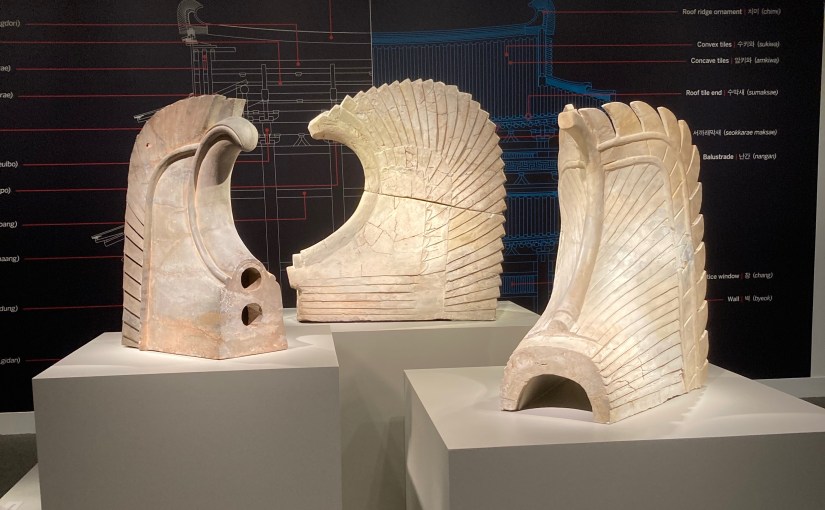
The centerpiece of the Once Upon a Roof: Vanished Korean Architecture are three chimi—roof ornaments. They look similar enough that one might, at first glance, assume they come from the same site. After all, they are displayed together. However, they come from three sites across Korea: Iksan, Buyeo, and Gyeongju. Two are from Buddhist temples, the other from a palace complex.
It’s not the museum’s fault I leaped to an erroneous conclusion. Even a cursory examination reveals differences in the three chimi: articulation of the “feathers,” ratio of height to width, and depth of the curl. Clearly, they are not from the same site. Could a map display have helped me not make that mistake? Maybe. Fortunately, I was able to sort out my error and enjoyed getting past my mistake to something more truthful.
On the other side of the Smithsonian National Museum of Asian Art is the exhibit: Falcons: The Art of the Hunt. Two statues of falcons preside over the exhibit, and walking up to them, I thought, “What wonderful Horuses.” Both of the falcons have notched flat spaces atop their heads. Crowns would have rested on each, like this example of a Horus found in the Metropolitan Museum of Art. Except they aren’t representations of Horus. The display card reveals that they “bear the names of two gods, Herakles and Aphrodite, who were worshipped during the Ptolemaic (305-30 BCE) period.” This startled my mind into the thoughts: “How did the Ptolemaic Egyptians graft Greek and Egyptian religion (myth)?” and “Could falcons represent any god in ancient Egypt?”
Lesson one: read the display cards at the museum.
Lesson two: the story already in your mind may not be correct (even if you are wicked smaht). And while I recognize this on my Sunday wander, it happens everywhere else.
Why does the first draft (or first glimpse) of a story impress itself so firmly in our minds? I know that it does. To begin with, our minds are incredibly attuned to how we feel when we take in new information. For instance, the sudden “Aha!” when I realized that the roof ornaments came from three distinct and distant sites or the Greek connection to those stone falcons is a feeling I cherish. I seek that rush of discovery, and experiences that trigger that particular joy stick with me.
The innate fight or flight response does not lend itself to a careful mulling over facts. We jump to conclusions because of a deep-seated survival mechanism. Our minds are attuned to getting a story set as quickly as possible. Add to that the way our brains anticipate or predict every event that occurs in the world, and second thoughts become improbable, if not impossible.
So, it is not a surprise that we punish those who change their stories. “These people cannot keep their stories straight” is a refrain used to denigrate those trying to tell the truth. The minute the story changes, an error message is triggered in our mind, and out of that error, we envision obfuscations that reveal possibly darker machinations. And yes, sometimes that happens. The lesson of Watergate was that the crime of the cover-up can outstrip the original crime. However, even when there are no ulterior motives, we fight against the changes because the initial story carries such weight, even when it is inaccurate.
But how often do facts change because we learn more along the way? How often is the first report ever as accurate as a final thorough reckoning? In Think Again, Adam Grant suggests the power of thinking like a scientist (as opposed to a prosecutor, priest, or politician) can help us embrace “I don’t know”–not just as a starting point, but a possible if provisional endpoint. Did I know that Aphrodite and Herakles could be represented as falcons? No, but I can learn.
It would be too easy to ascribe the rush to judgment to a particular ideological camp; it is a universal proclivity. I have friends on the left whose anger at the changing approaches to the pandemic matches the rage on the right. However, it also points out the rationale behind people trying to manage the first blush of any story. Whether they know by inclination or research, those who manage stories in the public sphere know that once the bone of truth is set, it is hard to break again. And they also know that when the truth breaks, we want it set quickly.
What does allow us to change our minds? Well, let’s go back to feeling. Our feelings create a steady background noise in our minds. Suppose we are driven by a homeostatic impulse (maintaining not just a narrow physical temperature but a steady emotional disposition). In that case, things that interrupt that constant state will be rejected. We will seek out truths that align with our overall frame of mind. For example, if you own guns because you feel the need to protect yourself and your family, you probably feel that a threat already exists in the world. After a mass shooting event, someone may suggest that you (and everyone else) need to give up your guns. But after a shooting, do you feel more or less threatened? And does the request to disarm enhance or alleviate your fear? No matter what facts are bandied about, our feelings take precedence. In a similar vein, do teachers feel more or less threatened after a shooting? And does the thought of more guns in the classroom heighten or lessen their perception of threat? Our thoughts change to fit our feelings. And the same feeling can lead to entirely different thoughts.
The recent season of Michael Lewis’s podcast Against the Rules focused on experts and how, when confronted with a problem, we fail to find the right expert to help solve that problem. One stumbling block (and Lewis documents several) is that real experts will say, “I don’t know,” and “I don’t know” is never satisfying. We gravitate towards people who speak with authority, even when they are wrong. When experts do not clothe themselves in the trappings of authority, when they work in the basement as opposed to the corner office, or when they offer probabilities as opposed to certainties, we reject them and complain. Anyone who cannot provide a single understandable narrative (and the narrative we first decided on) must be wrong. And that wrong must be due to an intellectual and moral failing.
It’s a commonplace to acknowledge that “there are no wrong feelings.” But I wonder whether fear is still as helpful an emotion as when we wandered on the savannah or across the landbridge to the American continent? That’s a false wonder. I believe that fear—manifested in its instinctual form—is, as Roosevelt proclaimed, all we have to fear. As daunting as it may be, the unknown is fertile ground. I don’t know how fear keeps us from discovery, but I know there are discoveries to be made. Some are easy, like revelations I make on my Sunday museum walks. Others will prove challenging, almost intractable, like bridging the gap between equally frightened political camps. A commitment to the unknown, which is a commitment to the future, must be our North Star.






 continuoussearch