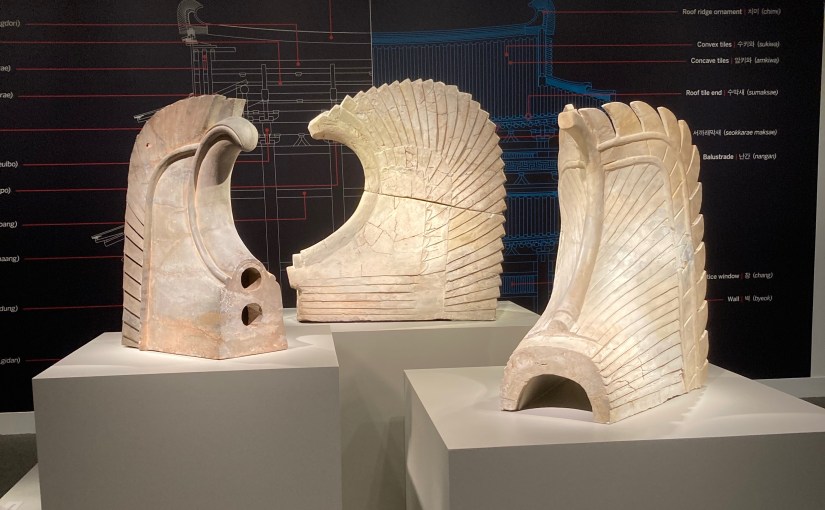


The centerpiece of the Once Upon a Roof: Vanished Korean Architecture are three chimi—roof ornaments. They look similar enough that one might, at first glance, assume they come from the same site. After all, they are displayed together. However, they come from three sites across Korea: Iksan, Buyeo, and Gyeongju. Two are from Buddhist temples, the other from a palace complex.
It’s not the museum’s fault I leaped to an erroneous conclusion. Even a cursory examination reveals differences in the three chimi: articulation of the “feathers,” ratio of height to width, and depth of the curl. Clearly, they are not from the same site. Could a map display have helped me not make that mistake? Maybe. Fortunately, I was able to sort out my error and enjoyed getting past my mistake to something more truthful.

On the other side of the Smithsonian National Museum of Asian Art is the exhibit: Falcons: The Art of the Hunt. Two statues of falcons preside over the exhibit, and walking up to them, I thought, “What wonderful Horuses.” Both of the falcons have notched flat spaces atop their heads. Crowns would have rested on each, like this example of a Horus found in the Metropolitan Museum of Art. Except they aren’t representations of Horus. The display card reveals that they “bear the names of two gods, Herakles and Aphrodite, who were worshipped during the Ptolemaic (305-30 BCE) period.” This startled my mind into the thoughts: “How did the Ptolemaic Egyptians graft Greek and Egyptian religion (myth)?” and “Could falcons represent any god in ancient Egypt?”

Lesson one: read the display cards at the museum.
Lesson two: the story already in your mind may not be correct (even if you are wicked smaht). And while I recognize this on my Sunday wander, it happens everywhere else.
In recent memory, these things happened. The timeline of the shooting in Uvalde, Texas, changed, which led to accusations of incompetence and malfeasance. COVID masking guidelines changed and changed again, which led to allegations of incompetence and malfeasance. History textbooks changed, which… well, you get the picture. I recall an early story that came out after the Benghazi attack that pointed to an anti-Muslim video as a cause, which was later discredited—the story of the Benghazi attack became, at once, more complicated and more straightforward. The fact that the story changed caused outrage.
Why does the first draft (or first glimpse) of a story impress itself so firmly in our minds? I know that it does. To begin with, our minds are incredibly attuned to how we feel when we take in new information. For instance, the sudden “Aha!” when I realized that the roof ornaments came from three distinct and distant sites or the Greek connection to those stone falcons is a feeling I cherish. I seek that rush of discovery, and experiences that trigger that particular joy stick with me.
The innate fight or flight response does not lend itself to a careful mulling over facts. We jump to conclusions because of a deep-seated survival mechanism. Our minds are attuned to getting a story set as quickly as possible. Add to that the way our brains anticipate or predict every event that occurs in the world, and second thoughts become improbable, if not impossible.
So, it is not a surprise that we punish those who change their stories. “These people cannot keep their stories straight” is a refrain used to denigrate those trying to tell the truth. The minute the story changes, an error message is triggered in our mind, and out of that error, we envision obfuscations that reveal possibly darker machinations. And yes, sometimes that happens. The lesson of Watergate was that the crime of the cover-up can outstrip the original crime. However, even when there are no ulterior motives, we fight against the changes because the initial story carries such weight, even when it is inaccurate.

But how often do facts change because we learn more along the way? How often is the first report ever as accurate as a final thorough reckoning? In Think Again, Adam Grant suggests the power of thinking like a scientist (as opposed to a prosecutor, priest, or politician) can help us embrace “I don’t know”–not just as a starting point, but a possible if provisional endpoint. Did I know that Aphrodite and Herakles could be represented as falcons? No, but I can learn.
It would be too easy to ascribe the rush to judgment to a particular ideological camp; it is a universal proclivity. I have friends on the left whose anger at the changing approaches to the pandemic matches the rage on the right. However, it also points out the rationale behind people trying to manage the first blush of any story. Whether they know by inclination or research, those who manage stories in the public sphere know that once the bone of truth is set, it is hard to break again. And they also know that when the truth breaks, we want it set quickly.
What does allow us to change our minds? Well, let’s go back to feeling. Our feelings create a steady background noise in our minds. Suppose we are driven by a homeostatic impulse (maintaining not just a narrow physical temperature but a steady emotional disposition). In that case, things that interrupt that constant state will be rejected. We will seek out truths that align with our overall frame of mind. For example, if you own guns because you feel the need to protect yourself and your family, you probably feel that a threat already exists in the world. After a mass shooting event, someone may suggest that you (and everyone else) need to give up your guns. But after a shooting, do you feel more or less threatened? And does the request to disarm enhance or alleviate your fear? No matter what facts are bandied about, our feelings take precedence. In a similar vein, do teachers feel more or less threatened after a shooting? And does the thought of more guns in the classroom heighten or lessen their perception of threat? Our thoughts change to fit our feelings. And the same feeling can lead to entirely different thoughts.

The recent season of Michael Lewis’s podcast Against the Rules focused on experts and how, when confronted with a problem, we fail to find the right expert to help solve that problem. One stumbling block (and Lewis documents several) is that real experts will say, “I don’t know,” and “I don’t know” is never satisfying. We gravitate towards people who speak with authority, even when they are wrong. When experts do not clothe themselves in the trappings of authority, when they work in the basement as opposed to the corner office, or when they offer probabilities as opposed to certainties, we reject them and complain. Anyone who cannot provide a single understandable narrative (and the narrative we first decided on) must be wrong. And that wrong must be due to an intellectual and moral failing.
It’s a commonplace to acknowledge that “there are no wrong feelings.” But I wonder whether fear is still as helpful an emotion as when we wandered on the savannah or across the landbridge to the American continent? That’s a false wonder. I believe that fear—manifested in its instinctual form—is, as Roosevelt proclaimed, all we have to fear. As daunting as it may be, the unknown is fertile ground. I don’t know how fear keeps us from discovery, but I know there are discoveries to be made. Some are easy, like revelations I make on my Sunday museum walks. Others will prove challenging, almost intractable, like bridging the gap between equally frightened political camps. A commitment to the unknown, which is a commitment to the future, must be our North Star.


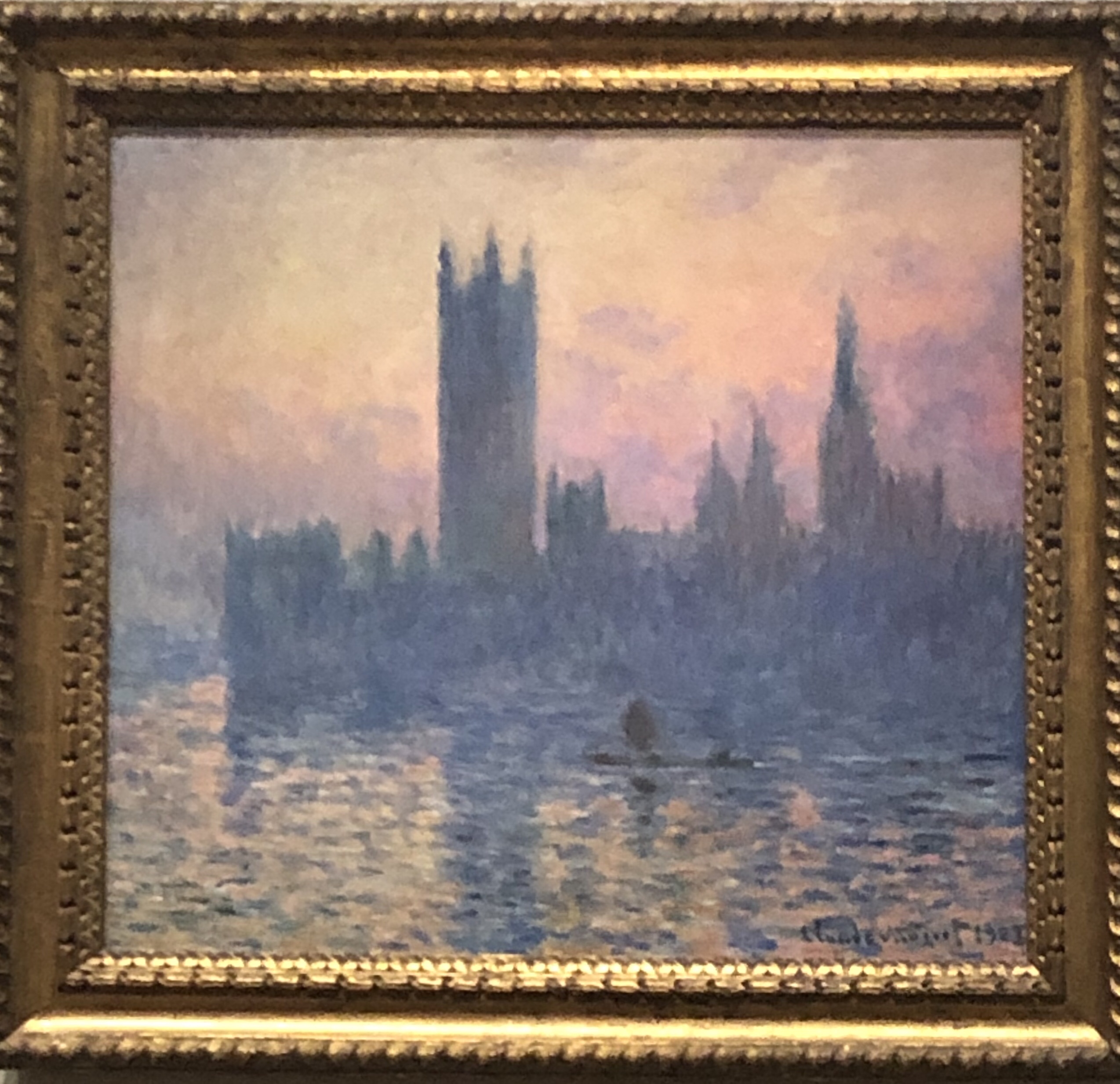 It has been a year and a few months since I was in London. I’m thinking about London while I sit and study Monet’s “Houses of Parliament, Sunset” at the National Gallery of Art. The memory of looking across the Thames at that building, with Big Ben swathed in the latticework of repair, has faded only a little. The memories of walking the streets of the original square mile and beyond remain startlingly vivid. I used them to paint scenes when the characters in my novel walked through London. The memories of the places and the memories of the feelings.
 When I was last in London, I was taking steps into a world where I knew I could live, where I had longed to live. Just like in the dream, writing—flight—was not foreign to me, but something I had traded in for a more certain, more directed existence. While “You are…You should” can feel like shackles, flying—writing—is formless and uncertain. Anywhere is possible. Everywhere is almost a mandate. Just like in the dream, I had written before—had flown—and had lived closer to the limits of my existence. But I had to leave my self-imposed limits. I had to accept that I might fall—and fail—but just as I accepted that in my dream—soaring up the side of a steel and glass edifice, wondering, “What if I forget? What if I fall?—I thought, even as the thrill of fear invigorated me, “You are flying now. Even if you fall, you will remember as you fall, and fly again. Keep flying.”
 Two women look at the Monet—taking seat in the National Gallery beside me. They think it is beautiful, but claim, “It doesn’t look like that.” Of course, the Houses of Parliament look like that, as does the river Thames, as does the sunset. “We didn’t see it,” they claim, “We were tourists, doing touristy things, like thinking about where to have dinner.” I did not think about dinner when I was in London. As much as I love dinner, even food became a secondary thought while I was in London. Even the pubs and ales became little more than way-stations along the bigger task—the journey, the seeing, the walking, and the flying. And the writing.
 Just over a year ago, I went to the LA Bar in Arlington and did karaoke. It was New Year’s Eve, and I had just come from a fairly routine party, where we had counted down the end of the old year and beginning of the new. It wasn’t enough. And so, away I went with my date, and we signed up to sing the Talking Heads’
  continuoussearch