Losing the Path—How a writer can get lost

Along the way, I lost the true path. So many of these past posts have been about finding my way back to the right road—to my purpose, to writing, and to love. Like the Italian poet, I am perhaps a little attuned to an inspiring force—a Beatrice, if you will—and so as writing has come back into my life, I have found inspiration as well. But the path is writing, and I blundered off.

Dante begins The Inferno:

Midway on our life’s journey, I found myself

In dark woods, the right road lost. To tell

About those woods is hard–so tangled and rough

And savage that thinking of it now, I feel

The old fear stirring: death is hardly more bitter.

And yet, to treat the good I found there as well

I’ll tell what I saw, though how I came to enter

I cannot well say, being so full of sleep

Whatever moment it was I began to blunder

Off the true path.

Of course we ask, “Why? How?” For each of us who blundered off, the cause of our blundering was specific. Perhaps there are similarities. Here are mine.

Some of my challenge is surely due to some odd predisposition against the kind of selfish drive that must accompany the purposeful and durable impulse to write—or do anything. I recall when I was twelve or thirteen and we were electing pack leaders in my Boy Scout troop. I was nominated, and I did not vote for myself. I did not do that because I had been taught, always and hard, to think of others first, to not be selfish. I had two younger brothers—and not just younger, smaller—and was expected to make way for them, to not impose myself. Whether the overall message came from my parents, from teachers, or from some other source, I cannot say. When the time came for me to vote for a pack leader, part of being a leader, so I thought, was making the generous and considerate move. It was an early lesson.

My life in the world has set me against those who are primarily selfish. I see selfishness everywhere—the thousand daily infractions of an overarching ethical code. Be strong. Do more than your share. Tell the truth. Be kind. I do not understand behaviors that subvert those rules, and when I have broken them, or come close to breaking them, I have borne that certain weight. At some point on a dating site, there was a question, “Do you know the worst thing you have ever done?” I know the ten worst things. One was yelling at a boy with a physical disability to not block the stairs going into school. It is far from the worst. I work to balance the ledger.

I have framed the writing life, my writing life, as a calling. While that is a powerful vision of writing, a calling has its drawbacks, even dangers (see “The Dangers of a Calling“). It means that our work is not about or for us, but for something outside us, and this can lead those who live within this frame, to sacrifice, even sacrificing what is at the heart of that calling. Somewhere along the line, we must learn to be ferocious, obsessive even, about our purposes. This, and nothing else. No matter what.

Beyond that, there are many other roads, especially when one is in the dark—whether suffering through a bout of creative disconnection (no stories!), or suffering through the slings and arrows of outrageous fortune (the daily bits of life and love)—and a wrong road can seem very much like a right road. There are so many opportunities for success, and routes that promise fulfillment. The greatest dangers to purpose are not dissolution and waste; they are “almost purposeful” fulfillment. How hard to turn away from success (or the road to success) as a leader, as a teacher, as a father, as a spouse. Who would not want all these successes in his life? I am writing about me, so the male pronoun is appropriate here; I imagine that a “she” or a “they” would have the same kind of struggle.

One of the attractions of success across a broad range of fields is the push to be well-rounded. How many times was passion curtailed because it was deemed too obsessional, too blinding to a balanced life. From early on in my life, I was strongly encouraged to be conversant in several fields of study. To understand science, math, history, and, English. To be a scholar athlete. To be well-informed about the news of the day (not just local, parochial news, but in the world as well, and not just news about proto-historical events, but arts, sports, business, everything). To play a number of sports. Always more. The monomania to do the 10,000 hours of practice was seen as ungentlemanly. Me, the last amateur, breezily succeeding, breezily failing, breezily letting life slide past.

Purpose was nearly antithetical to my life. And I have paid for that. Midway on our life’s journey, I reclaim the right road. I leave these markers for you, and for me. Follow.

Manqué—a Writer’s Predicament

Almost thirty years ago, I was eating dinner at a little restaurant on the edges of Johnson City and Binghamton, New York. My mentor and her husband had invited me along. These were heady occasions, full of discussions about writing and literature, and the program in which we all worked. I was a student, but, still, I worked. On this particular occasion, they started talking about writers manqué—although I heard it as writer manqués. It was a new word for me. Manqué: having failed to become what one might have become; unfulfilled. They started listing writers who had been in the program, writers who had published and stopped, and writers who were currently in the program. It was sharp and cruel, and the sobriquet stood out as one to be avoided at all costs. These may not have been eternal footmen, but there was snickering enough to go around.

The muse is a durable construct for the writer, because the muse can go away. Most writers I know have experienced life-crushing bouts of silence. It is the single worst event in the life of a writer: when the inward eye stares and stares and sees nothing, and all the inward voice can do is wait, or write, less vividly, about less, or about the nothing. Think of Wallace Stevens’ poem “The Snowman,” and the listener, who “listens in the snow,/ And, nothing himself, beholds/ Nothing that is not there and the nothing that is.”  A writer who has faced silence has faced the absolute nothing. It makes the writer question her or his ability to evoke a world, to create, to even be. Stevens turns it into a gift—the ability to not see anything but what is, to inhabit a “mind of winter” without preconceptions or preconditions.

The writer carries a slew of preconceptions and preconditions. While most can leave their jobs and go home to become a mother or a husband or something, the writer, like a soldier, is on duty all day. Unlike a soldier, who can remove the uniform, and briefly be, what? human? the writer never becomes anything else. Her or his humanity is bound into this one peculiar characteristic: they make worlds with words. I’m sure this is true of artists of all sorts. A friend recounted an interview with a composer who told how each time when she wrote and felt that the work was wonderful and that she was flying, when she started the next day, she had to learn to fly all over again, that she was rooted to the ground. Success is no bulwark against the feeling of starting all over each and every day.

And so, locating that characteristic in a muse—and those old Greek muses were incredibly flighty—was, is, a safe way to inoculate oneself against the silent times.  It isn’t me! It’s that damn fickle muse!

Some writers simply prescribe habit to overcome the silent times. Stephen King wrote the commonplace advice: “Writing equals ass in chair,” which is a grittier take on Mary Heaton Vorse’s “The art of writing is the art of applying the seat of the pants to the seat of the chair.” Getting used to daily practice removes the onus of waiting for the muse. Sit down and write. Repeat. Of course King provides an example of a diligent sitter in The Shining, when Jack Torrance produced reams of “All work and no play makes Jack a dull boy.” A little more than sitting can be a help.

Nonetheless, the fear of being unfulfilled lurks. In a prose poem called “Ants,” I render it as a mass of ants that eat the speaker, even while success beckons. Having come to writing in stages, and later than many, I was thrilled by the force of words as they seemed to tumble forth. I was also a little suspicious. Was this really what I could do forever? What about money? or success? Hearing my mentor denigrate those poor “manqués”—I imagined little monkey of Isak Dinesen’s tale “The Monkey.” How horrible to lose oneself to that invidious transformation.

Like any great and terrible idea, this one lurked. Even when I was writing every day, and earning the admiration of friends and mentors for my creative and scholarly work, I worried. Perhaps that is exactly because I did come late to the craft, that coming so late, I did not have a firm belief either in it or myself. There are half a dozen other reasons, all of them lying in wait. Monkey. Like the law-seeker in Franz Kafka’s “Before the Law,” I was ready to be stopped at the wall, and wait. I knew better—I even knew the antidote! I did!—but the idea of “manqué,” so formidable, grew out of proportion to all reason.

When the silence came, I was unprepared, or, rather, I was over-prepared. Too ready. I sought and found success outside of my work, and followed those paths for years. However, the muse—or the mind—did not forget. It simmered there, stoking my peripheral vision for years. Characters and stories inhabited the edges of my consciousness, darting away when I turned my inward eye upon them. Chiding me—don’t you know how to see us? I did not. It hurt. I carried half a heart in my chest, wearing an inner funeral black no matter what flags of color banded my body.

And I had success. But what is success to a writer, to an artist, but the work? Teacher, husband, father, religious leader. I had to tear my life apart, reorganize it.

Kafka has another short story, “My Destination” (“Das Ziel”), in which the traveler declares “I need [no provisions], the journey is so long that I must die of hunger if I don’t get anything on the way. No provisions can save me. For it is, fortunately, a truly immense journey.” I knew this long ago, and sang it out to any who asked, but could not hear it, not truly, myself. Physician, heal thyself. I could not. And a silent wound festers until it explodes. Or until the call is heard. Again.

And, as if by magic (and not magic at all, old artificer), seeing that I had given myself back to the craft, that I was writing every day—these blog posts included—the vision began to hold. I wrote, I changed my life, and continue to write, out a sense of surprise and without expectation. I write without a plan—and that is my secret. Without a goal, other than writing, there is no question of staring straight at something, or letting the peripheral vision take precedence. I can move forward by sidelong glances. Into the unknown, ignorant of my former limits—and not, stupid memory—and finding the old useful joy and craft.

My Destination

I had always shrugged off the idea of traveling to the Grand Canyon. I was one of those, “what’s the big deal about a big hole in the ground” skeptics. I was wrong. Of course I was wrong. The Grand Canyon is an amazement—and of course, I was properly amazed when I saw it—looking into two billion years of rock will do that, should do that. I realized that what I had held aside was not the geology or the landscape, but the travel. Why had I discounted my ability to be amazed by travel? I had done it all my life. Going, all kinds of going, even if so much of it has been more local—on this continent, in this country—has been part of me all my life.

When young, my family would take day trips—Sunday drives—through the Amish country in Pennsylvania. We got in the car and headed out Route 30. Or we would go to the West Chester airport and walk among the privately owned single prop planes. In the summer, we headed to Longwood Gardens for fountain shows. There were trips to nearby parks—I remember lakes with small patches of added sand for “beach.” We routinely drove to Long Island—heading up the New Jersey Turnpike past the refineries—to visit family. When I was ten, we headed to Maine, a day long drive with three boys and a dog. Once we began sailing, it did not take long to head to the British Virgin Islands—my first plane rides, and first swimming in warm Caribbean seas.

I loved airplanes and airports. Departures were invitations to new adventures. When I traveled with my family, I usually sat alone—the hazard or benefit of being an odd numbered group. I took my first plane flight alone when I went to Iowa to swim; I was 15. I traveled by train and bus alone all through my early adult life. I usually traveled to visit friends. However, I also went to cities to simply see them, to look at buildings, and camp in museums—visiting and revisiting works of art that held sway over my imagination.
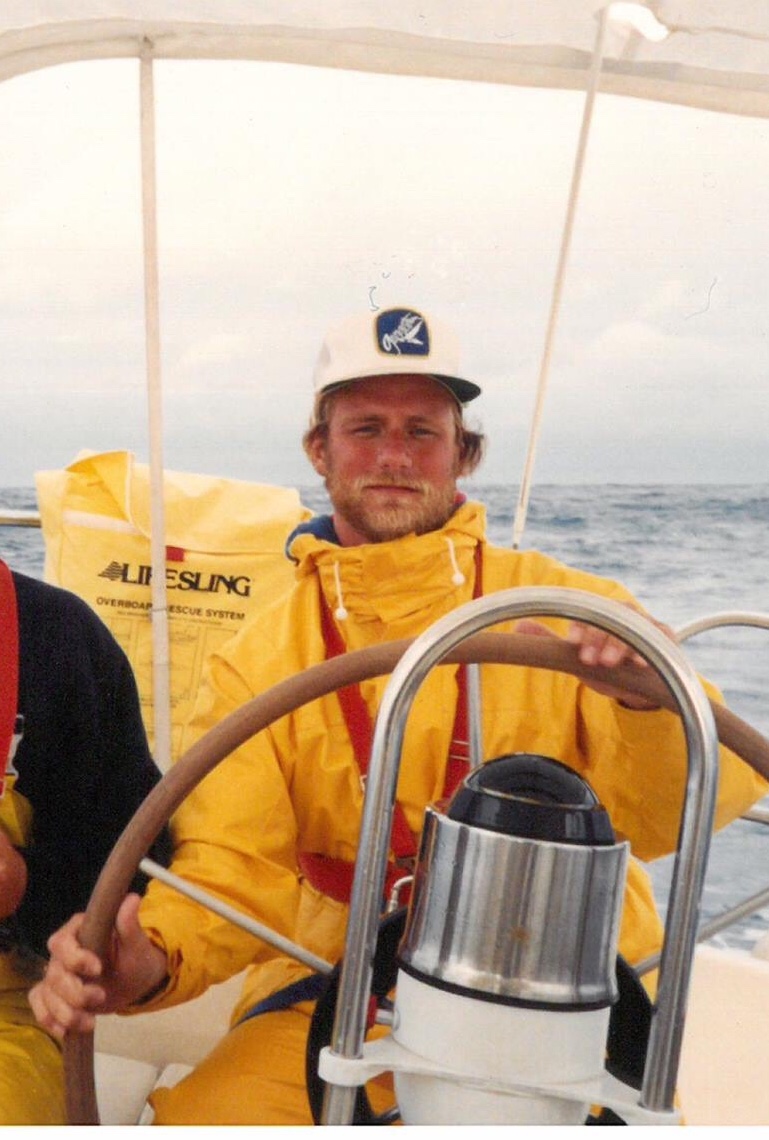
I loved driving, and would sometimes eschew expedience for country roads, foregoing straight, broad, multi-laned ribbons for winding paths along mountain sides and down by river beds. Landscapes called to me as well as vaulted ceilings. Beauty was everywhere.

And, I loved walking. I hiked 500 miles when I was 12. As an adult, when I took myself to Maine, I would walk the beaches in Phippsburg, breaking up my study sojourns with hours long ambles. When I arrived in Bermuda, I walked off my sea legs with long walks and runs around the island, walking into local places, on roads no taxi or rented moped hazarded. Once, on a trip to NYC, I walked, in winter, from Soho to the Met, freezing along the way, but surrounded by shops and towers and people. When I spent a conference week in Portland, Oregon, I took a day off to wander to Portland Museum of Art to see Native American artifacts from the Pacific Northwest, and a painting by Clifford Stijl. Afterwards, I headed onto Powell’s Bookstore, then to the DeSchutes brewpub. All on foot.

There were trips under sail with my father and brothers. These were tests as well as trips. The ocean makes us foreign to ourselves, our bodies not made to be perpetually wet, and perpetually in motion—shaken and stirred. I have never been anywhere larger than surrounded by sky and ocean, never felt as alive, nor as alone.
This blog began with travel some four years ago—a trip to China, to a strange land to bring a stranger into my life. There are so many strange places yet to go—so many friends to visit—people I have not yet met, whose tables have an open seat waiting.

So, walking to the edge of the canyon should not have surprised me. I am sure that some snobbish impulse to avoid what millions of others had done informed my thought. But I am not like millions of others. I forget that sometimes. On purpose—as a bulwark against being a snob, against falling into the easy habit of travelers to simply bring myself wherever I go. I would rather be a stranger—not just to the place, but to myself, and welcome this new person into my already teeming life.

And so, finally, after one long ago missed opportunity, I am traveling to London. It is an easy enough first step to Europe. I wonder what I will find there, what old memories will rise up, what new experiences will awaken. And I wonder, who I will find there in among the histories and wanderings. Who will come home, amazed, this time? And what will happen if the wanderlust takes a firmer hold of me this time? How will that change me–or, rather, change me again. Eyes up, here I go.

Mothering and Nostalgia

A current meme on Facebook compares what Moms used to say to their kids with what they say now. It is held up as a clarion call to the virtues of yesteryear, when Moms—and their kids—knew what was what. Over and over again, stuff (stuff) like this careens around the internet, in casual banter on news shows, in conversations in my workplaces. Those of us who grew up in the mythical “then” look back with nostalgia, and look at this moment with a jocular disdain. I would like to call “bullshit” on the whole enterprise.

I don’t now what your mother was like. If she was anything like mine, there were highs and lows. My mother stayed at home with my brothers and me. She bowled in a league. Went shopping. Had bridge parties. Took tennis lessons. She was a den mother for my Cub Scout troop, and took us to the Devault Meat Packing Plant, among other places. Her sons were a handful. She scurried us out at a reasonable time in the morning, set out lunch when it was time, and made dinner for the family. She made us Batman capes for Easter one year; she sewed. I remember her stitching up an injury to one of our cats.

Was she happy? Her happiness was never an issue for us. Nor was our happiness overly attended to. We all were content, which, to my gimlet eye, is a horse of a different color. It was only later, some 13-14 years after I was born that she began to explore art, and then took on the work of a painter, and artist. If she found genuine and durable happiness, it was in that work—and the work of making art is not about easy delight, or even contentment (so says her son, the writer).

My mother did what she thought and felt was right. She learned her lessons from her mother and family—and what lessons they were. Some things, she changed. She never leashed us to trees in the front yard. Others were more indelible. I am certain that most of us parent in the same way—sifting through the conscious and unconscious lessons that we received from our parents. What we do, we do almost on a kind of autopilot—in the heat of the moment, dumb memory takes over. Change is hard.

I cannot and will not say that my childhood was perfect. I can recall exceptional moments on both sides of the ledger. Making a judgment seems beside the point. Here I am now, and I go on. There’s a ton of privilege built into that statement, and I fully recognize exactly how fortunate I am to be where I am, and to have traveled to this point in my life. The choices I can make now—and the way I make those choices—are predicated on the choices of my mother and father. And so on. For ages.

I guess that any time I hear someone pass judgment on another’s parenting—and mothering especially so—in that gross, if semi-benign “Look at the snowflakes” kind of way, I want to yell, “Really? Cast aspersions carefully, oh paragons of perfection!” All those old lessons about the log in your eye and casting the first stone ring out loudly for me. Those are the lessons I remember. Besides, the old joke about walking five miles to school in the snow, uphill, both ways, gives the proper lie to ill-kept nostalgia.

Life, and mothering, are hard. No one needs anyone to chide them for the daily duties. The significant missteps require a different consideration. No more abuse, please. But keep the quibbling to a minimum. Please.

In general, and in a larger sense, I distrust nostalgia. Yes, remember, always remember, but without the haze of candy floss. At heart, I am more focused on where we are going, adapting, and learning—and in passing those lessons on. Have I failed? Indeed. I keep at it. I will fail again. So what? I keep at it. Where I came from is a starting point, but not my destination. Eyes up! Here comes life.

Confession

I have a confession. I have a terrible time receiving love. I’m sure that this is true of almost everyone, so, I’m reluctant to make any big claim about it.
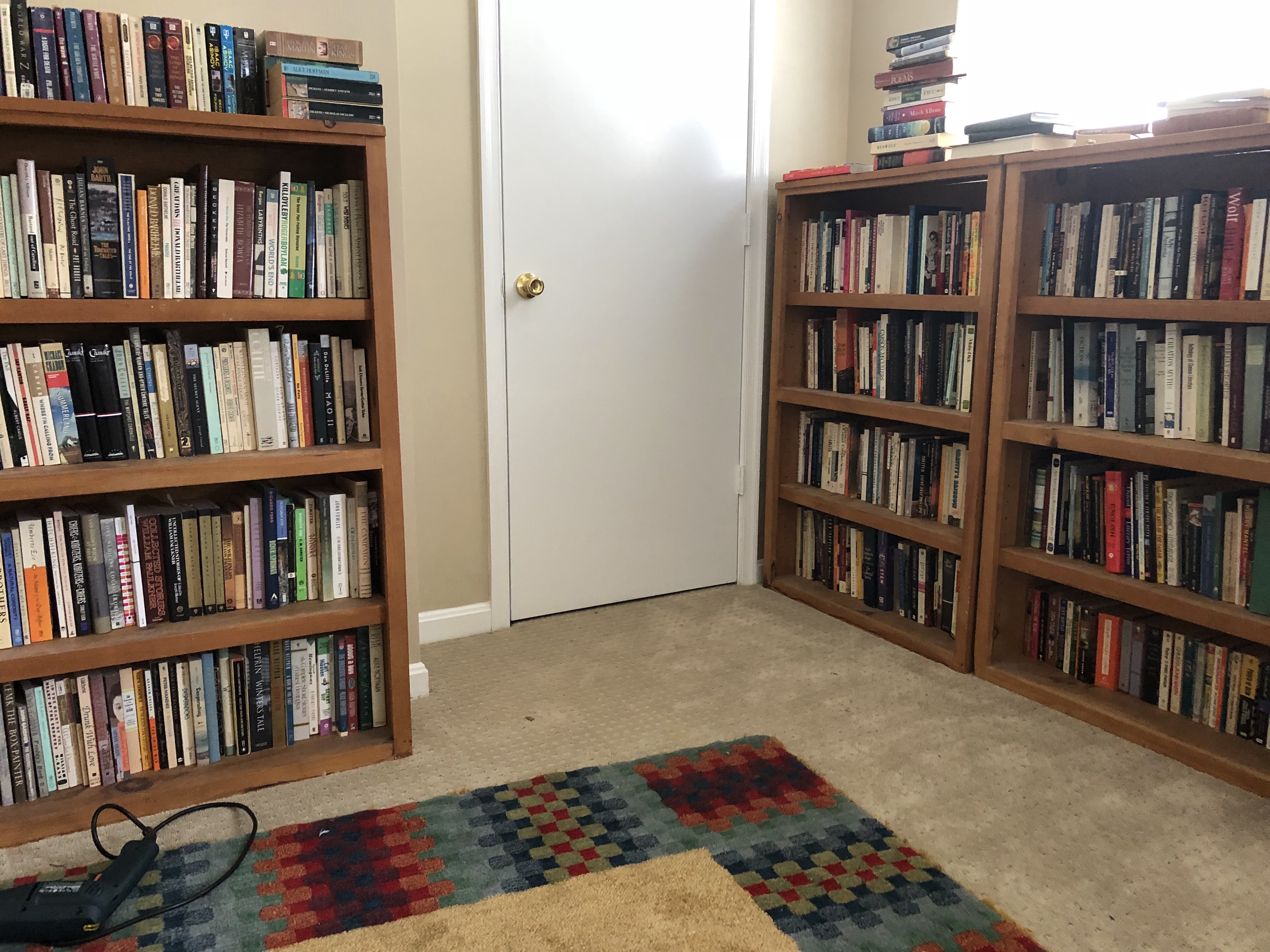
And yet, that too is a strategy I use to avoid the possibility that you, unknown reader, will not love what I have written. “Oh, god, not another carping complaint. It’s all about him, again. Bastard. Why doesn’t he write about me?”

How quickly I hear disparaging criticism. How even more quickly do I anticipate it. There is virtually no critique that I have not already baked into my work.

“How,” you might imagine, “do you manage to write at all?”

Dear reader, I imagine the same thing.

My creative process is a headlong rush between the giddiness of discovery, and the wrenching feeling of anticipated disdain. When I can hold it in balance, the disdain can provide a critical foil that hones the writing; when it runs wild, my work shrinks to a barely whispered voice. Less. Years have passed.

Harder yet, is when this dynamic creeps into my other parts of my life. Wait, it does not creep. It storms in—jack-booted, kicking down doors, taking the me hostage.

You would think, after 58 years, after a modicum of personal and professional successes, that this would not trouble me. I can be an interminable optimist. The bright red balloon of my heart can soar into possibilities. There is a court jester’s sensibility that makes for easy humor, tinged with sarcasm, but also with an abiding love for the queen (you!) that seeks only to please.

However, I harbor a vision of disconnection and interpersonal doubt that would make Henry David Thoreau or Holden Caulfield seem sunny by comparison. Call it cynicism, or realism (GAH!). When I am at my best, I recognize this darker vision for what it is—a diversion from the bright path that waits. Just. Over. There. And when you are at your best, my heart gladly joins in the song you sing. But when the two of us (or more, and more) sink into dissension and doubt, then I am challenged to rise to my festive best. Then the Hobbesian vision kicks in, and the only reason we find any accord is to put off the never ending war of all against all.

I write, and love, to assert a vision of life that encompasses all the bright possibilities. And that acknowledges the deeper disconnections—not simply disagreements or differences—that drive us apart. I know that there are such divisions, but I believe in the power of writing and love to bind up the old wounds, to forge a new path, and to discover new hope.

Sometimes, all it takes is writing. And that is what I have forgotten too easily over the years. The writing will carry me back to the world of connection, possibility, and yes, love. And so I write, the cloud lifts. The lesson is learned.

Daily (writing, and maybe dating advice)

One of the questions—there are thousands of questions—on the OK Cupid dating website is:

Ideally, how often would you have sex?

• Every day

• 3 to 4 times per week

• 1 to 2 times per week

• less than once per week

Secretly, this is a writing question.

So, you say that you want to write. I have many friends and acquaintances who make that claim. Maybe they like to read, or maybe they have something to get off their chests, or maybe there is some kind of residual romantic cache to being a writer. I hesitate to ask them, is there anything you like to do every day?

Most people only do a few things every day. We sleep (perchance dream). We eat and drink. Cup of coffee? Glass of wine? My dad had a small dish of ice cream every night. Work? I used to work seven day weeks—which is exhausting and revelatory. Parents parent every day—every single day. Some work out daily. Fortunately, I have no worn meniscus in my brain to keep me out of the mental pool more than every other day, and I am happier when I get my actual wet mile in daily. For some with partners, or even without, some kind of sexual activity happens daily.

How many of those do you do willingly, with a sense of purpose bound to deeper joy? How many are obligations that feel like you need a respite from every five—or less!—days? If you are the kind of person who rankles at the daily grind, maybe skip the writing, unless the rankle gets you going. I know plenty of cranky writers. Plenty—Jeremiah has many brothers and sisters.

One of the early discussions in grad school was the tricks writers used to trigger their daily duty. Sharpening pencils. Cleaning house. Eating M&Ms. Waking up.

Antonio Machado writes (translated here):

After living and dreaming

comes what matters most:

waking up.

Writing is like waking up—and it happens every day. It may be fueled—strike the “may”—it is fueled by our lives and dreams, but it is more than either. The same way our bodies move through the day—chopping onions, carrying bags from the car, wheeling our mothers into the doctor’s office—they come awake when we make love (I hope, for your sake that this is so). Writing is like that—an intentional and yet mysterious waking up. A discovery.

I almost always write with a plan. I have a first sentence and last sentence. And then I wake up. The middle—every other part—is a surprise. I start grabbing books off shelves, looking up physics formulas, checking the weather data from fifty years ago, calling a friend. I almost always end up with that last sentence, but the route shifts as fast as a glimpse—the meaning of the last sentence changing as all the shifting words transport me to a city whose streets are unfamiliar and entirely welcome, and whose secret is revealed in a way I had only dreamed.

Every day. If you want to write. Dream, live, write, wake up. Every day.

A little advice

I hate giving advice, or being in a position to even begin to seem like an authority. This is due, in large part, to the fact that every vestige of what little wisdom I may have is either so narrowly circumscribed by my experience as to be entirely personal and inapplicable to anyone else, or it is bound into volumes or displayed on walls or growing in plain sight, that it all could just as easily be read or seen or visited by anyone, and therefore I am just repeating what already exists. I mean, really, I can’t tell you anything about the Grand Canyon, or Jackson Pollock’s Number One, or Virginia Woolf’s The Waves that you couldn’t get on your own. And all the business about sailing, or my divorce, or the way my heart was broken or buoyed by human contact, well, that’s all extravagant navel gazing. Or, if it’s any good, it’s good because it praises the world I have experienced.

A friend of mine once told me (and granted, we were in the middle of a disagreement that threatened to end our friendship, so like all things spoken in heat, I try (and fail) to take it in that light) that I needed people to agree with me. The truth is that 90% of the time when I make what seems like a definitive statement about anything, my shock-proof shit detector blares a secret (oh, I hope it’s secret) claxon. It’s going off right now. Whenever I write, I write through the deafening din. I already know that what I say, or what I write is so riddled with exceptions that each word would take a page, or a tome of footnotes and commentary.

I reread David Foster Wallace’s 2005 “This Is Water” commencement address from Kenyon, and what I notice most is his reluctance to declare.  It’s not this platitude, or this story, or that cliché, which is what all advice feels like it about to disintegrate into—just another fragment of bullshit masquerading as wisdom.  Welcome to the world of Polonious, sending Laertes off with the skin and no pith. Go ahead and utter, “To thy own self be true” without knowing the source and the final awful result. Say good bye to Denmark. Say good bye to the best and brightest.  Here comes history.

I once told my friend, Brian Clements, that the only point of criticism—and what, after all is criticism than a kind of advice, either to the artist (do this, don’t do that), or to the audience (see this, avoid seeing that)—was to praise, that everything else was ego masquerading as wit. Did I really say that? Maybe.  I still believe this. (Quick, check the reams of footnotes). The only art that I ever feel called on to lambaste, is art that fails to find some piece of life and hold it up for glory. And I will go to stunning lengths to find that one moment in any work of art that meets Rilke’s charge: “Praise this world.”  And when I say “art,” I’ll admit it, I mean the intentional product of a life lived with purpose to produce something that praises the world.  And that could be a poem, a sculpture, a taco, a roadbed, a length of  rope. A free throw. A beautifully struck return in tennis. An incisively spoken line in a play. A carefully chosen word to comfort a child, or anyone.  Anything done with intention to praise this world and raise it up.

And if anything, these little slices of my mind, are not so much advice, as reminders, and I think we need reminding, to pay attention to all that is praiseworthy and to hold it high. “Pay attention” is what DFW told the graduates at Kenyon in 2005, and I wish that someone had reminded him every day about the impossible and sometimes ineffable worthiness of praise. Pay attention to that too, big fella. And I know when I write these, I am, in fact, reminding myself as well as you, because it is not easy.  It’s just worth it.