What I Watched About Love—Dr. Strangelove

Dr. Strangelove (1964)

Directed by Stanley Kubrick

Starring

Peter Sellers as President Merkin Muffley, Group Captain Lionel Mandrake, and Dr. Strangelove

George C. Scott as General “Buck” Turgidson

Slim Pickens as Major “King” Kong

Sterling Hayden as General Jack D. Ripper

I did not see this as a Sunday night ABC Movie of the Week. This had to be a Friday night movie, starting at 11:30 or 12:00. I watched it by myself. It is a black and white movie, but I was well used to that. Almost all the horror movies of my youth were the black and white movies of Universal, or American… Besides, the first television I remember was a black and white set, which made the Wizard of Oz only a little less magical.

Why does this movie make it onto a list of movies about love? There is only one woman in the cast, Tracy Reed as General Turgidon’s “secretary,” and her part reveals more about the men than it does her. And at the end of the film, Vera Lynn sings “We’ll Meet Again” over a montage of hydrogen bomb explosions. What I didn’t know when I first saw this movie was that “We’ll Meet Again” was a soldier’s anthem in World War II; it marked the hope for those (don’t know where, don’t know when) sunny days. To me it was just dark irony.

I grew up in the company of boys. I had two younger brothers. I was in the Cub Scouts and Boy Scouts. Almost all my playmates were boys. We played “tank” on the school playground, draping our arms over each other’s shoulders and marching pointedly across the field. I went to an all boys private boarding school from 9th-12th grade. Boys playing at being men was what I knew.

Already, by my teenage years, I could see the pitfalls. I was aware of the passionate intensity that could overwhelm sensibility—just as Buck Turgidson demonstrates the the guile of a B-52 pilot screaming over the countryside to deliver his payload. I had experienced the misbegotten “fairness” doctrine—just as President Muffley tries to be fair with his Russian counterpart over the hotline. I had witnessed the driven madness of conspiracy that illuminates General Ripper, and the dedication to duty that Colonel Guano defends. Dr. Strangelove’s and Major Kong’s maniacal genius and drive was often held out as a, more sanely but only just barely, goal. Only Mandrake’s befuddled competence stands out as a lone vision of something like sanity—and he is a stranger in a strange land.
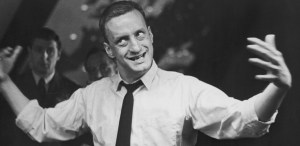
Where is the place for love—strange or otherwise—in a world that totters toward Armageddon? Romantic love is the counterpoint to the well-meaning incompetence, or belligerent dedication of the world of men. Without it: self-destruction.

Thoreau wrote in Walden that “the mass of men lead lives of quiet desperation.” In the late sixties and through the seventies, I didn’t know Thoreau at all, but I was naggingly aware of another desperation: one borne of the recent history of perpetual war and nuclear weapons. Those bombs waited like an exclamation point at the end of every thought about war, from World War Two, through Korea, the Cuban Missile Crisis, and then the Vietnam War. I often wondered who the men who bore responsibility for the weapons were, and if they were anything like the all too human men in my life. There came a point—it had passed to my way of thinking—when our weapons outstripped our ability to know how to use them. Desperation—existential anxiety—was a low thrum beneath all the humor, all the politics, and all the intensity of my teen age years.

And love? Could love stand against destruction? Imagine that. Only some equally powerful, equally misbegotten, equally passionate, dedicated, driven, and genius form of love, which is to say a love that was truly strange. How long would I try to fly that banner? Years.

What I Watched About Love–Two For the Road

What Marriage Means

Two for the Road (1967)

Directed by Stanley Donen

Starring Audrey Hepburn as Joanna Wallace and Albert Finney as Mark Wallace

I remember seeing Two for the Road before I was 12, and that cannot be right. I was probably 15. I was delighted by the editing—how it jumped back and forth between the five different time periods, from scene to scene and back again. It was like nothing I had seen before, and it made perfect sense to me. And the dialogue was witty to the point of casual cruelty. It was familiar to me because there was a premium on sharp elbows at dinner table conversation in my family. As the boys became old enough to be no longer seen and not heard, we entered conversations by jousting our way in. Later on in life, a woman I was dating asked how we could be so mean to each other. We had learned it early, and it stuck.

More than anything else this one struck deep because of Audrey Hepburn’s performance. She was 37 when this movie came out, an she played a character who ages from about 20 to 30. Finney is meant to be older than her and was 7 years her junior. Besides the simple matter of years, her transformation is the more amazing of the two. She is both more hopeful and more sad over the course of her character’s aging. Finney remains more static, which is one facet of his masculine character.
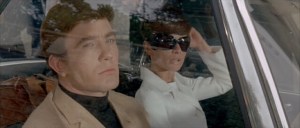
A note here: I had crushes on a number of actresses when I was younger. I was unable to distinguish between the characters and the people playing the characters. And I only knew the actresses from a limited number of roles. I had no idea that Catherine Deneuve starred in a number of French films, many of which were far from chaste. I had seen none of Audrey Hepburn’s early work (Roman Holiday, Sabrina). There was simply no way to track down the movies. And besides small notices in Time Magazine, I knew nothing of their lives. I watched according to what was on television, and developed infatuations at the whims of unseen programmers.

At the beginning of Two for the Road the Wallaces, now ten years into their marriage, drive past a bride and groom in a car after their wedding ceremony. “They don’t look very happy,” Joanna remarks. “Why should they? They just got married,” Mark answers. The movie dances through their relationship, specifically tracing a series of five car trips through the French countryside as they travel from the north to the south of France. Their banter is breezy, charming, sarcastic, and bitter, building to crescendos of “I love you” before tumbling back into doubt and resentment. Marriage seems like an unresolvable puzzle, especially to Mark, and toward the end of the movie he asks Joanna, “What can’t I accept?” She answers, “That we’re a fixture. That we’re married.”

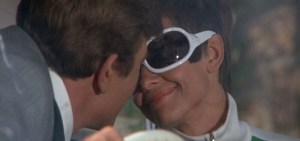
Hepburn glows when she looks lovingly at Finney. This must be the look every man wishes to receive from the woman he loves. She captures the look at several stages of the development of Joanna’s feelings toward Mark: from naive hopefulness through the first trembling of doubt, to disdainful resignation, and finally to generous acceptance. Did I understand the complexity of her feelings? Not at all, but I recognized the continuity, and as much as the look, how could a man not want to be loved through all his difficulty.
Growing up, I had no idea how relationships worked. My parents’ marriage was simply a fact and a mystery to me. I learned little about love and romance watching them. Nor were we close to my aunts and uncles and their families or the families in our neighborhood. I could not gauge how families were happy or unhappy. And this was never discussed at home. The only thing I knew was me, and I knew, and was told, that I was difficult. I may not have possessed Mark’s arrogance, but I understood early on that men in particular acted one way and felt another, and that to display doubt was nearly unforgivable. Or so I felt taught, and so I acted. I knew I harbored secret flaws—or not such secret flaws—and there was only one person who was going to love me in spite of them, and maybe even because of them.

At the end of the movie, Joanna tells Mark, “But at least you’re not a bad tempered, disorganized, conceited failure any more. You’re a bad tempered, disorganized, conceited success.” He isn’t angry or upset by her comment. He knows it, and ten years into their relationship, he is happy not to keep his secret from her. She is willing, even happy, to keep it with him.

I wonder now how the movie would play if the roles were reversed, if Joanna had been the arrogant architect, and Mark had been the more steady presence. I wonder what less traditional role I may have played had I seen that possibility earlier in life. But as Joanna tells Mark as he asks her his “What if” questions, she answers “I don’t know.” She has learned to live with the uncertainty. I know I have to accept what I am, which is something I struggled with as a teenager, then as an adult. I have begun to accept the uncertainty. And some of the flaws. And I have stopped expecting one person, even one person like Audrey Hepburn, to keep that secret.

Thanksgiving Dinners

The holiday season is upon us, and it is a time we gather with people. Well, to be honest, I gather with people year round. For me, holidays are more a way point, a place to aim for during the journey, and a time to take stock and reflect. When I look backward, I can see the faces of friends who have gathered at my table, at all my tables, and not just at the end of the year festivities. There have been Bastille Day dinners, and Friday night dinners, lobster feasts, and barbecues, as well as Thanksgiving meals. I don’t know that I ever really expected all those people I have cooked for to remain at the table year after year, but in reflection there they go, drifting off into new arrangements, seated around distant tables.

When I think about the holiday dinners I have made and attended, while the courses have remained the same, the people at the table have changed nearly every single year. Of course there is the family—my brothers, my mother, and while he was still alive, my father. My own family, the family of choice, has shifted over the years. Both my brothers are at or just past twenty year marriages and their wives, and then their children have held stable seats at our gatherings, but I have brought four or five different friends or partners or, in one case, wife to holiday meals. I’m not sure what my family thinks of this. I’m sure they were reasonably pleased that the revolving door had stopped spinning when I married, but then that relationship ended as well.

And before this all seems too mawkish and wistful, the holiday table has never been a place of “what was,” or “what if,” but almost always “what is.” And maybe because nostalgia, or its future looking younger cousin, desire, have provided no overwhelming gravity to either pull me back or towards some land other than the one in which I reside, holidays have not had for me that tinge of regret or loss. Still, I am cognizant of the changing faces, and I wonder where they have gone, and also wonder who might be at the table this year, or the next, or the next.

The only twinge I feel is that I do not think that this is what other people feel. Do other people have the weight of memory and expectation to draw them somewhere? What must that be like? What must it be like to spend twenty or more years gathered with the same people? I feel sometimes as if I am missing out on something, that I lack some key that will unlock a door to this experience.

And yet. And yet there is a simple untaintable joy in seeing new faces, even in imaging where the old ones may now be seated. I picture tables in rooms that I have never seen, with gatherings peopled by a mix of friends and strangers, and in some inexplicable way, I am there too.

Exit 7A


I have traveled along the New Jersey Turnpike many times. When I was a kid, my parents would take us to New York to visit their parents. When I was in high school I would travel to swim meets with my school. In college, I went to Great Adventure with a collection of friends. After college, I had a girlfriend who lived in Freehold, and drove there and back  to visit her in my first car. I later took dates to Great Adventure. Most recently, I headed north with my (now ex-) wife and family to visit her family in Ocean Grove, NJ. Today, I took the familiar exit 7A to attend a workshop on the Jersey Shore. I can recall all or parts of all the trips I made along this highway, but I didn’t make it so often that it became rote. I remember leaving from Steve’s home out toward Exton, along with Chris, Darius, and Julie. I remember driving to, and then from Ginny’s home in Freehold. I remember the warm spring air across snow plowed into mounds in the Lawrenceville gym parking lot. I remember riding the Ferris wheel with Marie. I remember missing the turn onto Rte 18. I remember the radio signal fading out from WIP close to where the NJ State Police building was along the turnpike. I can remember feeling happy, sad, angry, jealous, confused, frustrated, thrilled, elated, confident–all along this same stretch of road.

As I drive along this road, I feel as if I am accompanied by several versions of myself, each one traveling the same path to different destinations, either alone or in the company of friends. I wonder what habits have shaped my travel, and me, and how the habits formed over time. I wonder what it would be like to wander over this path–and a dozen, a thousand other paths–for the first time. “You’ve analyzed this enough for both of us,” someone once told me. Of all my habits, analyzing–what I will call wondering or remembering or reveling or pondering or considering or questioning or figuring or honoring or respecting or holding or living–is perhaps my most ingrained habit. It isn’t second nature; it is first nature. What would it be like to just do–either guided by feelings or by someone else’s direction–without thinking?

I once used the metaphor of a path in the brain to demonstrate how memories are made and habits formed. I told students to imagine someone walking through woods over and over until a dirt path had been worn into the underbrush. walk along that path enough and it becomes more like a rut. As soon as the path takes hold, it begins to seem like there is only one way through the woods. I said that once a neural pathway had forms in the brain, it becomes a little like that deep hewn path, and that will power and determination alone are insufficient to the task of changing it. I was trying to disabuse my students of the notion that addictions or mental illnesses like depression could be combatted by force of will alone–that there is no shame in seeking help. I was also trying to show how deeply ingrained habits and patterns in our lives could become.

Maybe this kind of thought is simply a habit for me. Maybe others simply do not need to reflect and wonder. I don’t know what that would be like. I am reading William Finnegan’s Barbarian Days, and he writes about being a young surfer and learning to surf a particular break, and how surfers–the epitome of “go with the flow”–patiently learn the dynamics of each place they surf. They intimately learn the combinations of wind, tide, and depth. And then make surfing seem effortless. Thinking is effortless for me–not easy, to be sure–but something that comes as naturally as breathing or eating. I barely need to daydream, because the visions, the thoughts, the fleeting glimpses and sometimes lengthy gazes into the breaks of the day come involuntarily.


Something about memory

Once you can imagine how images and sounds get turned into bits of binary code, which you can then play back on a cell phone, you can begin to conceive of memory. Brains experience the world as a pattern of firing neurons—small chemical explosions in our heads that can be reignited over and over again. When Yeats writes, “I went out to the hazel wood because a fire was in my head”—it’s memory that inspires him on the journey that ends with him picking the “silver apples of the moon… [and] the golden apples of the sun. Memory of what? Who knows.

Memories aren’t just about things—they are about all the thoughts and feelings we had when we encountered those things. I talk to my students about making memories “sticky”: giving them more purchase in their brains. A memory will take greater hold if there is a feeling associated with it. For instance, my emotions (happiness, sadness, everything else) run close to the surface and deeply too—they are whales and not minnows—and when I see a new thing, or learn a new thing, I attach, without even intending to do so, an emotion to the thing. Go figure. I was happy about learning the constitution when I was in high school, or the great chain of being when I was in junior high school (or, or, or), and those emotions made those things more “sticky.” At the very least, learning has made me feel happy, and I am blessed with plenty of sticky happiness.

For Yeats, the odd transformative associations: a hazel wand that becomes a fishing pole; a little silver trout that becomes and glimmering girl; the moth-like stars; the hollow lands and hilly lands; are ways back to memory and to inspiration.  We tend to think of inspiration as a vision of something yet to be made, something that exists primarily in the future, but our future vision relies on what we already have seen.  The inspired poet turns the past into future with protean grace.

When memories fade, it isn’t so much that the patterns dull, so much as the ways back to those patterns fade. Maybe think about it like this… Imagine that you have a room in your house in which you have a beautiful painting. The door to the room has a lock. You lose the key to the locked door. The painting is still in the room, but you cannot see it. You haven’t lost the painting, just the key to the door in which the painting waits for you, still bright and beautiful, still reminding you (but no longer) of the day on which you first saw it, the weather, the person you were with, and what you had done all morning on that day. If only you had the key!

The mnemonic device called the “memory palace” is a means of making memories “sticky” and organizing where and how they are stuck. The stickiness is not simply an emotion, which can be an incredibly random and unpredictable placemarker (we don’t tend to organize our emotions in a clearly coherent pattern so much as ride on them like waves), but a familiar place, in fact some place which we are already memorized, whose dimensions, smells, colors, and secrets are so deeply ingrained that we can call them back instantly and without effort.  Yes, we bind new memories to older established ones.  We put them on coffee tables and window ledges, in drawers of dressers, at the bottoms of garment bags in our parents’ bedroom closet (where they sometimes hid Christmas presents).

I will admit that I like the idea of this device more than the one I use.  My memories are bound to map like structures, to roads and routes, airport terminals and the backs of buses. Sometimes they lead to places, even palaces, but mainly they are blue lines on yellowing maps. “Why do you need to know where we are going?” a friend once asked, “I can tell you where to go.” “Because,” I wish I had answered, “Every road leads to a new memory, and if I don’t know them, not only will I be lost, so will these memories.”  The trick for me is that since the atlas of my memory is fairly large, adding a few new maps, even if they are revisions of older ones, is not particularly onerous or difficult.  Of course, the trick is to revisit those maps, to crack the binding of my memory, head down old roads, and re-visit places.  And new places?  The placement of puddles, the spread of trees across streets, and colors of cars in driveways—all these inscribe themselves on a map, illustrate a chart, and add themselves to me.


The Flags of Memory

Facebook politely reminds me that I have memories.  On April 28th last year I posted #FUCO, inspired by the Daily Show’s effort to get the Democrats and Republicans to F#$%ing Cooperate. Two years ago I celebrated being a scant three days from traveling to China to meet my daughter. Three years ago I posted Tom Waits’ cover of “Somewhere.”  Four years ago, two articles from the New York Times’ caught enough of my eye that I reposted them. Day after day, another batch of the past is just a click away. But all I have to do is turn my head, and I can glimpse the shades of things past.

I am surrounded by memories.  Even the most ordinary thing in my household triggers one or a dozen memories.  The computer speakers on my desk top are the speakers that I had in my attic office, are the speakers that I had in my apartment by the beach, are the speakers that were in my apartment in Roland Park, are the speakers I bought when I lived on Fair Oaks Avenue.  I can see them on a desk in each place, and around that desk old rooms organize themselves, and around those rooms entire buildings take shape, and around those buildings, streets spread out into cities populated by people whose faces are just a turn to the left or right from the chair in which I sit. I feel as if I could start a conversation with these memories just as easily as I begin one with the people who walk just outside my office window just this very moment.

I am not sure if other people experience memories in this same way.  It’s not as if I have an excellent memory; the rules of German grammar eluded me when I was in high school.  But I knew the Constitution by Section and Article almost at first glance.  And I drove all over the suburbs of Philadelphia without getting lost as soon as I had a driver’s license—all based on my childhood memories of being in cars. Years later, when I traveled to Maine after a twenty year absence, I did the same there.  I cannot dredge a memory up, but feel wrapped in a thousand wispy scarves each one peeling away to reveal some past me surrounded by a past world, which is also the present me surrounded by the present world.

Some people must be able to store their memories in boxes in an attic, and that out of sight and out of mind, their memories don’t regularly come crashing down off the shelves.  Or they put one or two—or more—on the mantle in the living room, or on a hidden altar in their homes. And those memories take precedence over the ones in the attic. Maybe I am unable to select, maybe I need them all, maybe I do not know which memory will hold the key to some unforeseen puzzle.

I guess that someone who felt more melancholic would feel ensnared by all these connections. I have moments when I would like to be cut free from them, when the sadness of a particular skein feels overwhelming, and the sadness overpowers all the other threads. At different times of my life I have combated those feelings either by playing a simple solitaire game that I learned from a college friend, or by getting in my car and driving until the roads became strange, or by playing a video game for the seventh or eighth time.

Repetition dulls the brightness of the connections, and I have simple repeated rituals (peanut butter and jelly for lunch nearly every day) that offer some respite from the densely colored warp and weave of the past.  Just this, for now, before the return. And then the glorious return of how many days—twenty thousand?—and how many moments?  This, writing, also limits the connections—the focus required to write narrows my vision to this word, this letter, this comma.  And yet the inspirations to write are all the peripheral visions that are always just a distracted head turn away.

I also turn to the new.  I remember those late night drives—in a brown Volkswagen Rabbit with the stereo turned up beyond reason, listening to John Adams’ Shaker Loops, or Laurie Anderson’s United States, or the Talking Heads’ Remain in Light—which became longer and later in my twenties as I drove farther and farther west, traveling on back roads from Philadelphia all the way to Harrisburg.  I came home, because as far as I went I never forgot my cat.  I returned home to my apartment on City Line Avenue more to tend him than to prepare for a job.  Now, with four cats and a daughter, the journeys away must be curtailed.  I must drive in.

And so in I go, trailing a billowing cloud of memories like flags from countries that I have not claimed, but have claimed me. Turn this way, they insist.  This is where to go.  This is the key.