 When I am out walking with my daughter I have one, simple repeated lesson: pay attention. Crossing a street? Pay attention. Walking past a flower bed? Pay attention. Meeting people? Pay attention. It is the cornerstone. I point out when I fail, as she does: Pay attention, daddy. Did you look? Did you see me? Two eyes seem like slim equipment for the work of days.
As a teacher, the central lesson is a finely tuned attention. The study of literature is a proving grounds for giving attention its fullest due. Words, images, sound. The unpacking of one of Shakespeare’s sonnets, or Joyce Carol Oates’s stories, or a passage from Joyce’s impossible novel relies on the attention one gives and the knowledge one brings. All the knowledge in the world is wasted if one does not look outward and pay attention.
When I write, I also pay attention—it is a balance between inward and outward attention—letting the still, strong voice inside reflect on the outward world. I try to write about what I see, what I learn, what surprises me—almost all outside of me. When I venture within, I hope to turn the same sharp vision within—seeing myself as if on a journey, as if I was foreign and strange—as I must be, even to myself.
But those are only three roles I play in life: father, teacher, writer. I am also a friend, and enjoy paying attention to my friends’ likes and dislikes, their peculiar fascinations and passions. We tend to have similar interests—we are, after all, friends. And I know that my friends pay attention to me—that they appreciate my odd vision.
There is one other role—and it is at once the easiest and most difficult. I love paying attention to the person I love. I love learning the stories that comprise a life, listening to the dreams of possible futures, and discovering the intricacies of another’s heart. All this is so easy—I could listen and learn for a lifetime—I feel like all else is practice for this.
The hard part is having someone pay attention to me. First, allowing someone to see me, all my flaws and strengths. That is, almost, easily assuaged by repeated kindnesses—I have learned to accept being loved.
Harder is accepting when someone misses something. When my daughter stumbles into a crosswalk, head tilted toward phone, there is a quick check—pay attention. When a student misses the meaning of the image: “star to every wandering bark,” I can quickly point out that Shakespeare is punnier and more ribald than serious young students give credit. When I make a mistake in an early draft, I can edit. And I can accept my friends “misses” easily—chalking it up to our simple flawed and generous humanity.
But, with love. Perhaps because it is only then—when I love romantically—that I feel most vulnerable. I sometimes become all but selfless—loving most and desiring least, as if true love could enable a perfect kind of detachment. So much for flawed and generous humanity—I must be perfect. Jeff Tweedy sings, “No loves as random as God’s love”—this random indiscriminate, impossibly generous love. Shakespeare calls it “lascivious grace”—unimaginable to those who walk upon the ground, and yet, the only ideal.
And yet, the hope, beyond hope, that someone is paying attention. One of the great joys of love—and of life—is feeling recognized, not simply on someone else’s terms (This is how you are like me! This is how you complete me!), but on your own terms (You showed me… You taught me… You amazed me… You surprised me… You changed me…). Isn’t this how we feel love, when we are at our best? Isn’t this how we want to be loved?
I share little details, bits and pieces, and listen and wait. What is she paying attention to? Through what screen does she see me? I expect hesitantly, trying not to overburden possibility with my hair-shirted set of (non-)expectations. And then, after sharing a story, a glimpse, a piece by Dinesen, some recollection of a journey, she travels away and returns with a small blue jar filled with water from two seas. I know there will be misses, but I also know I have been seen. And this makes all the difference. This is how.
 An occupational hazard of a career of reading English Literature is an almost fiendish doubt in the power of love. Just think of all the novels—serious literary novels—that you have read, and multiply the effect by a thousand. Sure, Jane Austen has something to offer, but seriously, Pride and Prejudice without Darcy’s fortune waiting to bail out Elizabeth Bennet is a tragedy.
 What preoccupies me is less what is beneath some other surface, than what is beneath mine. I can hardly utter the first word, “I,” without replaying every other time I finished the phrase. No matter how many versions of love I have seen others act out, or that I have seen portrayed, my single clearest—or least clear—vision of love comes from my own experiences. I am sure this is true for everyone. Who, in the final moment before she or he declares her or his love, trusts anything other than the one set of experiences that illuminates only one heart?
 It wasn’t until I started teaching—when I actively had to think about how what I said and did would further the progress of my students—that I began to have a serious idea about love. Teachers never think about themselves. Okay, that’s clearly not true. Great teachers think about their students, even when they think about themselves. I don’t know how I learned that—probably from the examples that great teachers gave me. I do know that the first serious relationship I had in graduate school was made more potent, and ended more peacefully—if not less painfully—than any romantic relationship I had up to that point.
 I don’t believe in fate—providence, if you will. If there is a plan, it does not proscribe outcomes. Rather we wander in and out of circumstances bumping into two sets of patterns—those we make out of our lives, and those that are beyond our immediate control. Life goes out of balance when we cannot get the two patterns to jibe—when we cannot reconcile ourselves to the patterns that exist. Out of balance we can neither accept what has happened in our lives or we cannot break those patterns and create new ones that are made from familiar pieces but reflect possibilities that we had not imagined. Out of balance we fight against the patterns that life provides, missing obvious signs (rising temperatures, repeated cruelties, even the tender messages of love) and careening against the walls of a maze that we cannot perceive and causing damage to ourselves and those around us.
 I recently swapped the nicknames that we give our kids with a friend. We had both, surprisingly and strangely, settled on “Bug.” I’m not sure that our daughters will appreciate that longer into their lives, but for now, it will do.
 And I do know the other side. I know how easy it is to let upset slide into hate. And I know that once uttered—by an adult, not by a child, because children must experiment with all words and all emotions—it breaks the bonds in a nearly irrevocable way. I have said it, out loud—either in the perpetual external conversation I have with the world or directly the object of scorn—and the immediate thrill is followed by a deep remorse as the tendrils that connected me to another person wither immediately into dried spiked vines, like the hedges of multiflora rosa that grew brown and foreboding in winter. All that was planted must be uprooted. Maybe something can be saved, some sprig, somewhere.
 I have been thinking about feelings. Which means, of course, that I have been having them, or rather, overwhelmed by them of late. I wouldn’t bother to write about them if they were good feelings. When I am in love, I tend to write less about that feeling, in part because my need to communicate to the world is being so generously satisfied by the person I love. The feeling of being so thoroughly understood (she gets me!) is like putty in the gaps through which the words drift out (or in). The feeling of being misunderstood blows all the putty out.
 Dr. Strangelove (1964)
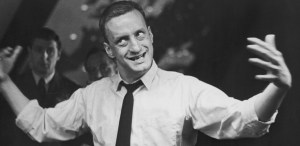 pilot screaming over the countryside to deliver his payload. I had experienced the misbegotten “fairness” doctrine—just as President Muffley tries to be fair with his Russian counterpart over the hotline. I had witnessed the driven madness of conspiracy that illuminates General Ripper, and the dedication to duty that Colonel Guano defends. Dr. Strangelove’s and Major Kong’s maniacal genius and drive was often held out as a, more sanely but only just barely, goal. Only Mandrake’s befuddled competence stands out as a lone vision of something like sanity—and he is a stranger in a strange land.
 Thoreau wrote in Walden that “the mass of men lead lives of quiet desperation.” In the late sixties and through the seventies, I didn’t know Thoreau at all, but I was naggingly aware of another desperation: one borne of the recent history of perpetual war and nuclear weapons. Those bombs waited like an exclamation point at the end of every thought about war, from World War Two, through Korea, the Cuban Missile Crisis, and then the Vietnam War. I often wondered who the men who bore responsibility for the weapons were, and if they were anything like the all too human men in my life. There came a point—it had passed to my way of thinking—when our weapons outstripped our ability to know how to use them. Desperation—existential anxiety—was a low thrum beneath all the humor, all the politics, and all the intensity of my teen age years.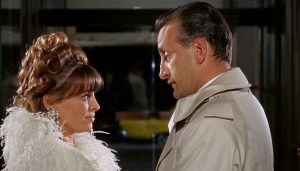
 This is at once a fanciful and a grim movie. The pace is jaunty, and the editing jumps the viewer forward, back, and side to side. Janis Joplin and The Grateful Dead perform in the film. Lester creates momentary tableaux that are discordant and arresting. A happy person, well ensconced in a healthy relationship would dismiss it as an over-intellectualized and cynical film. Since, at 17, I was neither particularly happy, and never had a relationship, it struck me as a warning about what waited in adulthood, and what a horrible warning it was.
 perpetual theater of feelings and opinions (and by the gruesome broadcasts of news from Vietnam). Lester’s film frames these performances as shallow, even callous. When asking for help speaking with a Spanish speaking man, one cool answers, “I only know Polish.” That’s how it is: the joke’s on you.
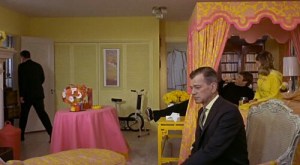 Petulia has a secret. She is fighting for her life. She witnessed Archie perform surgery on a small boy she and her husband became tangled up with—fixing the mess she and her husband made. Her husband abuses her. Archie is the solid, generous, and cool alternative to the privileged, abusive, and secretly volatile world she inhabits. She shows up at Archie’s bachelor apartment, bearing a tuba. Romance of a sort follows. And ends. Archie is perplexed, and then angry that Petulia stays with a man who beats her. And then knows there is nothing he can do.
 Two for the Road (1967)
 out, an she played a character who ages from about 20 to 30. Finney is meant to be older than her and was 7 years her junior. Besides the simple matter of years, her transformation is the more amazing of the two. She is both more hopeful and more sad over the course of her character’s aging. Finney remains more static, which is one facet of his masculine character.
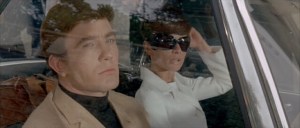 At the beginning of Two for the Road the Wallaces, now ten years into their marriage, drive past a bride and groom in a car after their wedding ceremony. “They don’t look very happy,” Joanna remarks. “Why should they? They just got married,” Mark answers. The movie dances through their relationship, specifically tracing a series of five car trips through the French countryside as they travel from the north to the south of France. Their banter is breezy, charming, sarcastic, and bitter, building to crescendos of “I love you” before tumbling back into doubt and resentment. Marriage seems like an unresolvable puzzle, especially to Mark, and toward the end of the movie he asks Joanna, “What can’t I accept?” She answers, “That we’re a fixture. That we’re married.”
 She captures the look at several stages of the development of Joanna’s feelings toward Mark: from naive hopefulness through the first trembling of doubt, to disdainful resignation, and finally to generous acceptance. Did I understand the complexity of her feelings? Not at all, but I recognized the continuity, and as much as the look, how could a man not want to be loved through all his difficulty.
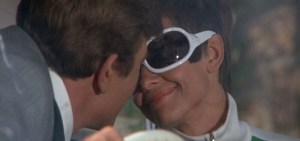 At the end of the movie, Joanna tells Mark, “But at least you’re not a bad tempered, disorganized, conceited failure any more. You’re a bad tempered, disorganized, conceited success.” He isn’t angry or upset by her comment. He knows it, and ten years into their relationship, he is happy not to keep his secret from her. She is willing, even happy, to keep it with him.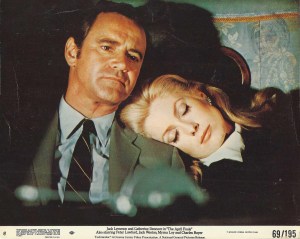
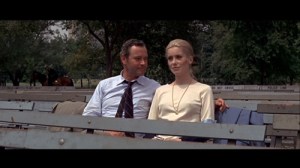 Deneuve’s character, named Catherine Gunther (the boss’s wife), is sad and no longer fits in a society built on attraction and platitude. Brubaker catches her eye because he is unpolished. Even though he can be inept, he is genuine. She is convinced to give him a try when they spend a night in the company of a quirky couple, the Greenlaws, played by Myrna Loy and Charles Boyer, who live in a castle located somewhere in New York City. She tells fortunes. He practices fencing. They inspire Catherine to seek out a more enduring love. She chooses Brubaker.
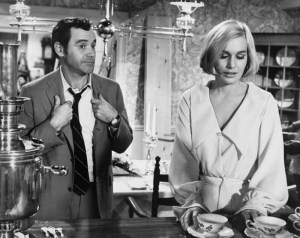 It should be noted that both Brubaker and Catherine are married. They leave their spouses, and the rest of their world’s behind. Ted Gunther is a smoothie who hits on other women and depends on his wife’s willingness to ignore his behavior. Sally Kellerman (an early heartthrob because of her part in a Star Trek episode) plays Brubaker’s wife Phyllis as distant and focused on her own projects. She talks at, not with, her husband and rushes off the phone to whatever actually holds her interest.
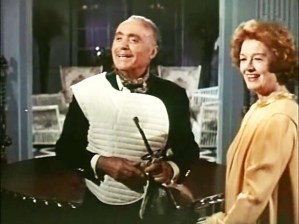 All except for the magical Loy and Boyer, whose wealth does not stigmatize them so much as separate them from the herd. They spend the days asleep, because of all the bad things that happen in the sun. There is no explanation given for their presence, the same way that fairy godmothers have no explanation in fairy tales. I longed for quirky friends, even as a youth. My classmates talked about Happy Days and the Pittsburgh Pirates. I had other, more shadowy interests, and no one to share them with.
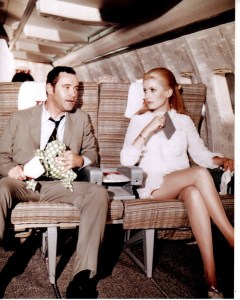 The April Fools implies that happiness derived from love is so rare that it will require a rule-breaking intercession to achieve it. What a strange foundation on which to build an idea of love, and at 14, that is what I was doing. And to think that a kiss ought to lead to a trip to Paris and a new life. How many kisses would come that did not bear that freight, that betrayed that wish?
 continuoussearch