
The Planet of Memory

IMG_6913Every time I reach a particular traffic light in Norfolk, I can hear, clear as a bell, the not so gentle prodding that “You can turn right on red from the middle lane. There are people behind us.”  Heading west out of Norfolk through the Downtown Tunnel causes a surge of ineffable joy, even when it’s just a trip into Portsmouth. The long drive across the Bay Bridge Tunnel reminds me of the day I took my daughter to drop flowers in the bay to commemorate the day my father fell into the water.

BigRed9There is hardly a street corner, a stop sign, or a stretch of highway that does not bring back flashes of memory. I stood on that plot of grass, took photos of the flooding at my church, and then sent them to a friend. I walked past the giant number “9” at West 57th in New York City with another friend, on our way to the Hard Rock Café. There is a house on the back way into the Paoli Shopping Center that my father told us belonged to Chester Gould, the illustrator and writer of the Dick Tracy comic strip. This seems as dubious a claim as that Dr. Seuss lived in a house visible on the hill above Yellow Springs Road—my father had a predilection for harmless invention.

Before I learned the names of streets (which are still all but meaningless to me), I carried vast mental maps of all the places I had been. Even now, some fifty years later, those old memory maps are vivid.  When I travel to places where I lived or visited as a child, I see two (or more) places at once—the heights of trees and plants, the placement of curbs, buildings, or playground equipment, and sometimes even the sunshine or snow shimmer against each other.  I know which one is real now, but the other waking dream of a place asserts itself.

IMG_8216I have read that places become memorable when significant emotional events have taken place there. Memory formation is my hobby horse. What constitutes a significant emotional event? What allows the creation of two, three, four, more memories to occupy a single green exit sign on the Route One into Bath, Maine?

I am moving from a place that I have lived for fourteen years and heading to a place that is entirely new. I try to venture forward without insisting on emotions—instead of North, South, East, and West the cardinal emotions of Joy, Anxiety, Hope, and Despair each create on some new direction, some new map point. And yet, I have taken my daughter, and watched as she skipped down Main Street in Warrenton, or happily ate blackberry ice cream at Moo Thru in Remington. A place takes shape and becomes part of the memory planet on which I walk.

Two Sides: Ambivalence Part 2

When we are young, we change.  The hurtling forward into growth exhilarates us. We learn at full gallop, disastrously adding new ideas before old ones have taken shape. We are gluttons, and the table is richly laid out and endless. Our Apollonian and Dionysian sides eat together—the only rule is More, and more we do have. We learn and learn, good gods I hope we do, like gods.

rr-apollo-quiz-apollo-lyre_23f7551cSome people, most people, grow up, and cast their lot on one side or the other. Apollonian selves dream into an idea of logic and order—think a sonnet by Shakespeare, glorious in its arrangement of rhythm, rhyme, and idea. This is Apollo brought to earth, walking firmly on the ground. Dionysian selves trumpet feelings and instinct: Ginsberg’s “first thought, best thought” is as much a dictum as can be borne.


180px-Dionisio3

Rule three thousand one hundred and sixty-two: if you are one, do not marry the other. And do not ask about the other five million rules.

And recognize that just because one is Dionysian, do not think there is a lack of rules about how to go wild. A little Apollonian memory slips in.  You need to party like this, or you aren’t really partying, dude.  On the flip side there may be a wild inconsistency built into that Apollonian logic—call it hypocrisy if you feel like it but know that wildness finds a way.

A few people never settle into one side or the other.  The two halves bristle within like ions in a storm cloud. Ambi-valent: charged in two directions, fire in both hands.  We don’t grow up, but out, finding hidden paths through the forest, wanting one last opinion, and reassessing as we charge into conflict. Yelling at our superiors and demanding a reckoning.  Being schooled by our students and admitting our blindness. and always, always learning.

I bemoan my ambivalence; I cherish my ambivalence. It’s a dirty little secret about my life. I hate being fenced in, and I love the elegant symmetry of a well written novel. You point out chaos, and I will chart the forcelines that create paisley swirls. I want to love someone and build a life with them and I want them to dance right out of the picture on their own. I want to lead the way, and I am happy to chase comets.

Oh, it’s the worst. And the best. Or the other way around. And the other way around.

Some folks tell me that I’m too strict, or not enough of an adult, or that I have too many rules, or that I don’t follow their rules. Dude, this is how we party. How am I a teacher? How could I be anything else? How can I not shake up my life and take my daughter along for the ride: reassuring her, giving her the foundation she needs, and teaching her that when the earth shakes, the ground still loves her. And that everywhere I am, I will love her.

coin_flipping_by_uroskrunic-d36x79rMy youngest brother has told me many times that I am too serious. And of all the boys, I am. And not. My wildness is serious, and my seriousness is wild. Flip a coin, and watch the light glint off side after side after side as it tumbles through the air. Heads or tails, the glinting wins.
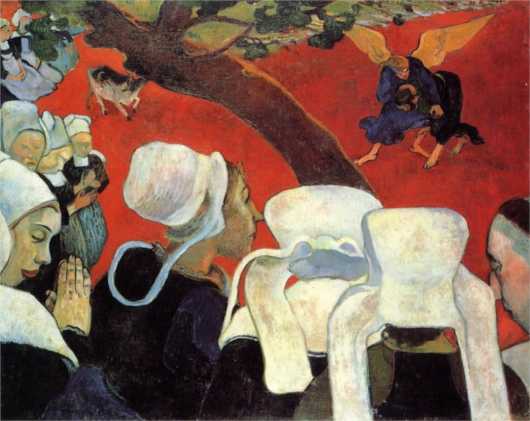
Wrestling with ambivalence

jacob-wrestling-with-the-angel

My younger daughter randomly pronounces “I’ll miss you, papa,” or “I’ll miss you, daddy.” We could be doing anything: folding laundry, driving to the store, watching a video about geysers. It tears me apart every time.

My daughter stays with me three nights a week, which has been the arrangement with my ex-wife for the three years we have lived apart. We live blocks from each other, so I have seen my daughter between times as well. In a few weeks, I will move three hours away, and our comfortable schedule will change. We will spend weeks and months together throughout the year, and manage weekends, but I will not be the nearly daily presence I am now.

So why move? Why tear the central chamber of my heart to shreds? I don’t see myself as a horribly selfish man, which kind of negates the entire, “I’m doing this to be happy” argument—or belies it. Maybe I am a selfish man.  Wear that feather in your cap for a bit, and feel how heavy the crown really gets.

“You can’t let yourself think that way,” I will be, have been, told. And that’s fine, but when Socrates trots out “The unexamined life is not worth living,” this is the kind of thing one is meant to examine—not every sandy beach in the Caribbean or every dive bar in Baltimore.  Saddle up for self-examination, or get off the trail.  And yeah, keep your eye on the trail, greenhorn. See them rocks over there?  That’s ambivalence, and we’re here to fill your packs with it.  Get digging!

So many things—too many things? –pull in opposite directions.  Half of life seems a paradox, and the other half I just can’t make my mind up about which direction it’s headed. And I don’t simply throw my hands up and say, “Oh well.” I wrestle, intently, with the angel of ambivalence.  In “The Waking” Theodore Roethke states, “This shaking keeps me steady.” Damn right.

I don’t hold with those who don’t engage ambivalence—being of two minds about things.  People who insist “you’re either with me or you’re against me” give me a serious pain. People who say such things and then claim, “It’s okay if we disagree,” help me find my way to the exit tout suite. You cannot claim an absolute and then say it doesn’t matter—or vice versa. Be afraid of those who claim an open mind while harboring a stone heart.

I cannot claim that this is an easy path. I think a reasonable amount of comfort and privilege makes it possible. I have walked away from the comfortable certainty of doctrine, in large part, because I felt that a life without doctrine would be neither dark nor disastrous.  I knew that the monsters hidden in the chaos were as deeply entrenched within the staunchly defended halls. Beowulf never had to go far beyond the mead hall to find adversaries as deadly as Grendel.

While I understood what Obama was getting at when he talked about economic insecurity driving people to cling, I knew that there were plenty of secure people who traffic in certainties and verities.  Maybe that’s what helped make them secure. Or maybe there’s something else at work—a digression for another time.

As for me, now, this decision, to leave my secure and certain life, has immediate repercussions. I may have reasons, and good ones, to move.  But I know that I am unwinding the steadiest relationship in my life for uncertainty.  Of course, it is not as uncertain—my daughter and I have a firm bond.  And a happier father will, in the end, be a better father. Or so I hope. Nonetheless I make this move with a serving of ambivalence, and perhaps, that will be enough to keep us steady.

The Center of the Universe—words from a Graduation

I tell my students lots of things. There is the teaching, of course, but there are certain phrases that have become, well, worn. I repeated a story with my ninth graders just a couple of weeks ago. I think that’s a sign.

One of my sayings, usually delivered in class, when a student has interrupted everyone else to declare something like, “There are clouds in the sky,” or “I have a cat”—something that has floated in over the transom of their mind—is this:

“If you have lost the center of the universe, I think I have found it.”

Except, I haven’t told you, there is a secret, and the secret: you are the center of the universe.

Science backs that up—in an infinite universe, everywhere is the center. It’s one of those paradoxes that makes teaching science so much fun. Or like this one from math: which is longer, a ray, which starts at a fixed point and goes on for infinity, or a line, which is infinite in both directions? Something cannot be half as infinite.

That’s why I stick to teaching English.

Take Shakespeare’s universe. In his plays, there is almost—and I’m going to say almost, because unlike math, in English there are always exceptions—almost never anyone more important than the King. The King is always the center of the secular universe.

And you might think, “I’m the king? Cool! I’m the center! I have arrived!” I also tell my students how my daughter thinks that being principal is the best because I get to give out detentions. This is the worst part of the job, and not just because I get to sit on detentions. An authority that gleefully metes out punishments, is truly limited vision of authority. Henry wants—no, needs—his band of brothers to thrive, and they do, because he elevates them. He may be the center, but he is also the first peer, the first equal.

And here’s the trick, In Shakespeare there are only a few truly happy and successful kings. I think he leaves high school principals out altogether. He doesn’t leave students out. And that’s because students can learn. Kings, for the most part, do not. They are, as Caesar claims, as constant than the Northern Star. Once the have become the king they are who they will be. They will not change. And who would wish for an inconstant king? Shakespeare’s tragedies are littered with them: Macbeth, Richard III, even Henry’s father, who mutters, “Uneasy rests the head that wears a crown.” Be a king, indeed.

But, what does it mean to be a center? My juniors and seniors have seen the list of king-becoming graces that Malcolm provides to Macduff: justice, verity, temperance, stableness, bounty, perseverance, mercy, lowliness, devotion, patience, courage, fortitude. It’s quite a list, and like any list we would quibble over each term a bit too much. My students can quibble.

Perhaps it is better to remember that in an infinite universe, if you are the center, so is the person sitting next to you, and so is some person sitting on the other side of the world. We are all centers, and must learn to live and live well with each other. And what better way to live than to live as brothers. Because if we are as brothers, then we shall share a cause—perhaps not so clear as that as faced by Henry at Agincourt, but a cause nonetheless.

And because today is father’s day, again, I am reminded by this:

This story shall the good man teach his son;

And Crispin Crispian shall ne’er go by,

From this day to the ending of the world,

But we in it shall be rememberèd—

We few, we happy few, we band of brothers

And so, today, find your cause, but be sure to make it large enough so that you can be brothers with each other, and with all the other centers that are spinning around you.

And now, I have some diplomas to bestow…

Echoes of Suicide

Here there be triggers…

The suicides of Kate Spade and Anthony Bourdain set off klaxons across all media. People—friends, family, and experts— shared memories, formulated reasons, and dispensed advice. And in my little corner of the world, I quietly melted down as I revisited the suicide that upended my life.

I drove my friend, Jennifer, home on the night she committed suicide. She was more than my friend, she was also my supervisor, colleague, and minister at the church where I work. After her death, I went into crisis mode, helping my congregation as best I could through what was, for some, a challenging year. Because of the timing, no minister could serve our congregation for the year (a neighboring congregation lent us their minister on a once a week basis, and she checked in on us). I talked with a counselor about the events. Friends checked in to make sure I was in reasonable shape. I was.

In a moment of anger, one of my friends suggested that she must must have known it would have been him or me who would have discovered her. I knew then, as I know now, that such calculations or considerations are never present in any meaningful way in the mind of someone who suffers from a mental illness strong enough to cause death. However, that never stopped me from playing and replaying the conversation we had on the night I picked her up from dinner (her car was in the shop) and drove her home.

My rational mind has assured me, and continues to assure me, that nothing I said could have caused her to do anything—or for that matter caused her not to do what she did. I was in the company of a person whose decision—insofar as any decision was actually possible—was already made. And yet over the past few days expert after expert says, “Reach out. Talk. You could save a life.” So my imaginative mind scurries relentlessly into every corner of possibility. “What ifs” pile up like bread crumbs in a tower to rival Babel. And while my rational mind wins the day, I realize this conflict has been with me for years.

The hardest thing I grapple with is the knowledge—certain and horrible—that either there was nothing I could do for my friend, or that I missed an opportunity to do something. The second choice leads to a horror show of self-recrimination. On most days I avoid that. The first choice leads to other struggles, primarily, what difference can I ever make with anyone?

Surely, this is not true. I am reassured repeatedly by the evidence of my experience that I do make differences. Routinely, daily, in the lives of those I teach, of those with whom I work, and of those I love. And yet I daily face unilateral behaviors and actions from people surrounding my life about which I can do nothing. And every time, there is a little (or not so little) twinge. Driver heading two blocks the wrong way down a one way street? Twinge. Student refusing to do work? Twinge. Congregant refusing to meet volunteer obligations? Twinge. I am leaving out the big ones. They are there too.

This happened during the summer after my family had traveled to China to bring home our second daughter. My friend had been at her birthday party in May, and had joined us at my birthday party in June. Jennifer died in July. By November my wife and I began separating. I moved into my own place in April. It was a full year. I am aware now how tangled each and every interaction I had that year, and in the years since, have been with those feelings of guilt and powerlessness–a raw and indefatigable impotence and ineffectiveness.

One of the members of my congregation recently asked how my move was going. I am leaving the congregation I have served for eleven years, and the school where I have taught for nine, and heading to a new school, and no new church, at least not right away. We conferred briefly on the feeling of being in control of the process, and how that was appealing to me. He said that he understood. I too knew it was important, and knew I had felt out of control for some time. My church, by the way, has had six ministerial teams over the eleven years I have served them, with the immediate prospect of two more in the next three years. And we are moving to a new building—a good thing. Still, that twinge, what some might call a trigger, is so wrapped in my in church life, and my life here in Norfolk, that is is nearly impossible to continue.

I know people will tell me, in the most anodyne fashion, that control is an illusion, and that I need to let it go, practice a little Buddhist non-attachment, and set myself free. Or that I need to get tough and face my feelings with Spartan fortitude. And for god’s sake don’t talk about them. But I do not seek detachment, even when the consequence is suffering. Suffering is fine. And I can try not to feel too attached to my feelings, but really, who thinks saltpeter in the milk is a solution? I would rather deal with the struggle. Even four years later. Even forty. In the end, the struggle makes me stronger.

As for sharing? What the hell. I write. This isn’t a cry for help. And it is no “J’accuse!” unless I am accusing myself. I usually wait to write until I have teased out the germs of an idea or feeling until it has grown into words. I admit that here on the blog, I let some unpercolated thoughts trickle in. This one has been in my head for days. Or years. With any luck, the words will be a bridge between us, and not a wall. And with even more luck, perhaps these words will help someone build a bridge in themselves to something they haven’t imagined yet.

Westworld Season Two Reflections

Westworld-S2-2-1070x598Although it has maintained a broad appeal, telling a beautifully depicted story and asking questions about artificial intelligence and the nature of humanity in a comfortable and technologically advanced world, the second season of Westworld has been shackled by narrative devices that give it little room to move or grow.  First, a signal climactic event is visited and revisited in the initial episode of the season, from which there has been no narrative space to move into. The deeper issues of how we use stories to perceive and create reality (or consciousness) have been discarded in advance of a plot driven by revenge and violence.
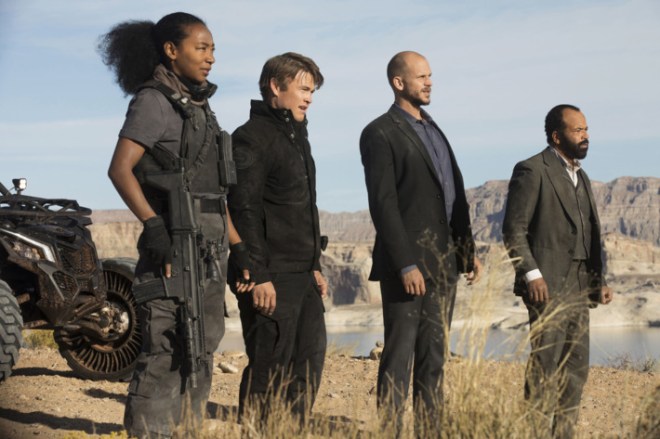
 

The first season of Westworld displayed ample amounts of violence and sex, but seemed to be making comments on the baser human instincts that the park revealed.  The characters with whom we sided—the robot hosts—were fighting to escape their loops: the repetitive cycles of abuse perpetrated on them to delight the human guests. When the first season culminated in a host revolution, the viewer could cheer, because the robots were breaking free of their loops. As the second season began, the hosts descend to violence against the humans and each other that rivals anything that occurred in the first season.


23-westworld.w710.h473The war begins in the first episode and is shown in two closely linked timelines: one immediately following the uprising that ended season one, the other taking place a few weeks later.  In the first timeline the hosts decimate the guests, in the second nearly all the hosts are found “dead” in an artificial lake.  The season has been spent linking these two timelines and filling in some backstory to explain the “true” rationale for the park.  We see waves of humans face the hosts, each one being dispatched with swift and stylized violence. We also watch as the hosts turn on each other. Set free from their controlled loops they repeat and amplify the excesses they had suffered as vehicles for the guests “bloody delights.”
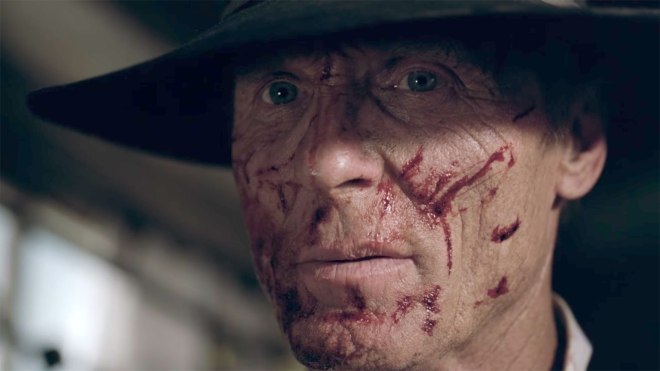
 

westworld-season-2-trailerWhile the first season was unabashedly bloody it also had four major narrative strands of awakening: Dolores gained consciousness and free will; William became the “Man in Black”; Maeve gained a kind of consciousness, but on a separate and less certain course than Dolores; and Bernard had his humanity stripped from him. Each of these plots had a cumulative development: each episode moved these stories forward, and there was a distinct pleasure as we discovered the stories for ourselves.  That discovery was shared by the characters as well, some with pleasure, and some without. The climax of each story—personal revelation for good or bad—mirrored the overall plot.  There was simple structural pleasure to be had.


lead_960_540In the second season these four characters have remained the main focus.  But now, because the climax preceded all the events to follow, the action is more repetitive.  Where else is there to go after mass slaughter? The characters do not grow so much as have secrets revealed to them or new powers added to them.  They are at the mercy of plot needs.  When Shogun World and Raj World, or the named but unseen Pleasure Palaces are introduced they are just grim mirrors of what goes on in Westworld.  When the Cradle and the deeper purpose of the park is revealed, the viewer may have been able to anticipate their existence, but both feel like sleight of hand adjuncts to a story about characters. “Look over here! Isn’t this fancy? Don’t pay attention to the repetitiveness of the story.”


Maybe Westworld will pull out of this narrative funk—there are three episodes left in the season.  How cool would it be to discover that after revenge is piled on top of revenge that some kind of peace breaks out.  Imagine that: peace as a climax. Maybe it will build on the theme of the power of story that underpinned the first season, and subvert narrative expectations by inverting rising action, and we can be as surprised as William was at the end of the first season. Or maybe the next slaughter will just be bigger, more choreographed, more beautiful, and meaningless. Here’s hoping for a quick turn.

03westworld-recap-articleLarge


The Greyhound

“You got any stories, friend?”

And so begins Episode Five, “Contrapasso,” of Westworld. Each of the other nine episodes begins with a host, one of the robots at the heart of the story, waking up or coming on line.  This one begins with a host, Old Bill, making a request of Ford, the creator of the robots and all the park that is Westworld. Ford answers, “Yeah, suppose I do,” and goes on to tell the story of “the saddest thing [he] ever saw.” A pet greyhound kills a cat when it is let loose from its leash. An event that is wholly anticipated (“our father warned us”), ends in horror (“to the horror of everyone, he killed that little cat, tore it to pieces.”), which is also entirely predictable. Who wouldn’t feel horror at a “little cat” being torn to pieces? Because this exchange between Ford and Old Bill breaks the pattern of the opening sequences, it is, as much as anything might be, the key to Westworld’s first season.

Westworld, for all its science fiction underpinnings, timeline switches, sex and violence, is a show about the power of story.  The hosts repeat their stories, which are called loops by the park employees. The guests participate in narratives, taking either white or black hat roles, and act out fantasies of sex and violence that are forbidden in the real world.  Ford and the park employees create and manage the narratives and the hosts to meet the guests’ expectations. Only one guest, The Man in Black, sees these stories as part of a game, and wants in on the bigger game, the more meaningful story, the maze.

Ford’s exchange with Bill hints at all this.  To begin with, Old Bill, is programmed to listen–that is his loop. But, because he is an old host, he isn’t very good at it. When Ford asks, “Never seen a greyhound have you, Bill?” Bill doesn’t recognize “greyhound” and reinterprets it to fit his understanding; he answers that he has seen a few showdowns. This shows one of the fundamental challenges of stories.  The teller and listener need to have a shared language and culture. At the end of the story, Bill responds, “That is one humdinger of a story, partner. Shall we drink to the lady with the white shoes?” Ford looks at him sadly. His secret is safe in Bill’s hands.

The secret Ford shares is the secret of loops.  The greyhound “spends its life running in circles, chasing a bit of felt made up like a rabbit.” Whether by instinct or routine, its life becomes automatic, robotic.  The greyhound running in circles is like the hosts on their loops.  But the dog chases a fake rabbit—just as the hosts are fake humans. While the hosts are on perpetual loops, the guests come to Westworld to break from their loops of their daily lives, to experience a simulacrum of authenticity. The hosts and guests share this. In the park the guests fall into loops that are just as predictable (if more extreme) as the ones they left behind at home, and just as predictable as those that dominate the hosts.

The viewers of the show are invited to sympathize with the hosts.  The guests are portrayed as crude and cruel, the hosts are doe-eyed and wistful. However, the hosts are machines—sophisticated machines, but more like supercharged go-karts. They are not “little cats.”  And yet, because the story of the show plays on the viewers emotions, our attention is refocused, and our expectations shift to hopes that the hosts will be set free from their loops—much in the same way that a father would bring a rescued greyhound into a home to give it some respite from years of cruel running in circles.

The Man in Black shares this hope.  He sees the park as too controlled, and therefore as inconsequential. Even when he gets a glimpse of the maze, he rejects it, because his expectations (“You know what I wanted,” he tells Ford in Episode Ten, “The Bicameral Mind”) were not met. His idea of the story he wants to see prevent him from seeing anything else. He, like Old Bill (and the Man in Black’s name is William), cannot understand the story he is being told.

One of the fun parts of watching the show when it first came out in 2016, was listening to the discussions about the stories in the show.  People wondered who each character was, what timeline each one occupied, and what the big secret would be. They were viewer stand-ins for the Man in Black, or Old Bill, listening and not understanding, letting their expectations or programming get in the way of what was told.

The secret to art of reading is in large part dependent on being able to see the structure of a story as one reads it. We know that if an event happens in chapter one, the rule of plot (rising action) will lead to an amplification of that event later in the story.  If a stranger dies in chapter one, then a friend will die later.  If a distant friend dies early, a dear friend will die later. Stories follow familiar patterns, and when those patterns are broken the reader or viewer may revolt. This is one reason why Campbell’s Hero’s Journey holds such sway over popular screenwriting: familiarity is the writer’s friend.

However, life is not a screenplay or a story. Unexpected, if predictable things happen.  Dogs chase down little cats and the results horrify us.  “I got the cat. Now what?” wonders the dog.  The reason that Ford’s story is “the saddest thing [he] ever saw,” is not because of the little cat, it’s because there’s nothing else for the dog to do.  Its life is defined by chase and kill, and once it has succeeded that’s all there is. Growth, or meaning, does not come from meeting expectations, but from the realization, and it can be a sad realization, that life, as opposed to a story, does not follow an order.  Life is chaotic and random. It dashes our expectations and makes us strip our stories bare and try (and perhaps fail) to revise.

The overall story in Westworld points us to this, if gently.

Persuasion (get over it)

I have been thinking about feelings. Which means, of course, that I have been having them, or rather, overwhelmed by them of late. I wouldn’t bother to write about them if they were good feelings. When I am in love, I tend to write less about that feeling, in part because my need to communicate to the world is being so generously satisfied by the person I love.  The feeling of being so thoroughly understood (she gets me!) is like putty in the gaps through which the words drift out (or in). The feeling of being misunderstood blows all the putty out.
I wonder what it would be like to write about love. I should try.

When there is anger, which almost always proceeds from misunderstanding, I don’t know how to speak to anyone I love. One former lover suggested that I should just “let her be” when she was angry.  I should know to do that, or something like that.  Active listening is an approach I have been trained to use by countless leadership and communications trainings. Yet, it is hard to apply my professional approaches to my personal life, because my personal life is so much more consequential than my professional life, and because my personal life is so, forgive me, personal.

When a congregant, a colleague, or a student is angry, it matters, but not in any kind of existential way. I can pull aside a student several days later, ask what was going on, and suggest what their angry display had the possibility of doing (how it might impact the relationship he has with adults or classmates). Because students are young and impulsive, most do not hold onto their impulsive anger in a lasting way, and most can offer a genuine “My bad” after the fact. They do it days later, and sometimes hours later. Adults hold their feelings longer. With adults, some formulation of “I hear you” and “I hear that you feel strongly about that” is my trained response. And is usually answered with “You’re damn right I feel strongly about that” followed by a lengthy restatement of what the person just said. In my professional capacity I have listened to many explanations. Accords follow later, if they follow at all.

I wonder why adults hold their feelings more dearly.  I think, and I could be wrong, that we live in an age in which the truth of our feelings is valorized. We pick facts that confirm our feelings and change the facts when needed. We organize the world to suit our feelings, and when the two don’t jibe, we seek to change the world and not to change our feelings. I don’t know why this is.  I hold with Rilke, who advises the young poet not to focus on his feelings, but to pay attention to things.  I think today we take our feelings to be as immutable as chairs, or oceans, or stars.

In Rhetoric Aristotle argues that “modes of persuasion are the only true constituents of the art [of rhetoric]: everything else is merely accessory.” (He also states, “things that are true and things that are just have a natural tendency to prevail over their opposites.” Oh, for that simple time.)  Aristotle divides the approach into three: the character of the speaker, the state of mind of the audience, and the proof of “a truth or an apparent truth by means of the persuasive arguments suitable to the case in question.” These days it seems that the state of minds of the audience has taken precedence over truth or character.  I think this is true in our political rhetoric, but it is also true in our professional and personal lives. What matters most is neither your character, nor the validity of your argument; it is how the people or person you are speaking to feels.

However, the feeling of being misunderstood, especially by a person I love most (most intimately, most personally, most romantically), completely upends me.  And so, I try to persuade or explain, which is a fool’s errand, mainly because I am angry at being misunderstood: “How can you NOT understand me, oh person I love?” All that person can hear is the anger, and all I can hear back is more misunderstanding. So, like the tourist who cannot make himself understood in a foreign land, I increase the volume, either the number of proofs (See?) or the protestations with regards to my character (I am a good person). And I fail.

Anger over being misunderstood is my Achilles heel, and should immediately disqualify me from being a teacher, a writer, or a lover because misunderstanding is the common currency of an expressive life. I could say “Yanni” and someone will hear “Laurel” or something else that no one has imagined as a possibility yet: “Bluebird,” “Sarsaparilla,” “I hate you,” or even “I love you.” And yet, here I go, plunging into another teaching job, trying to write this down, and remaining open to the possibility of being misunderstood by someone I love. A cynic would tell me that therapy can help break this cycle, but really, all a therapist will do is help me make peace with the fact that this is my cycle.  I better learn to love it.

The Captain’s Way

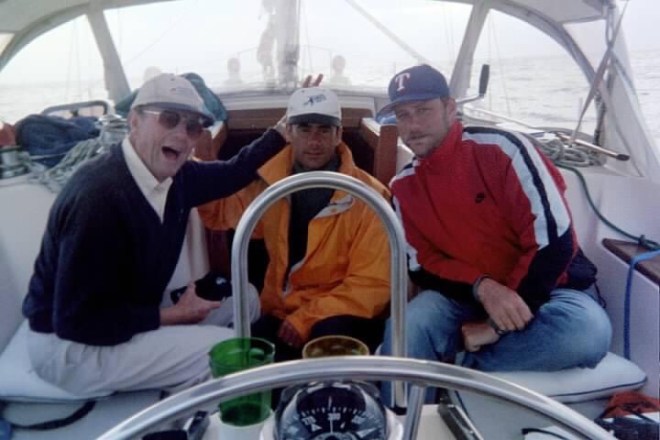
Over twenty-five years ago I started sailing on the ocean with my father. We would leave the Chesapeake Bay in the last week of May and spend five or six days out of sight of land on the way to Bermuda. Some days the weather was lovely. I read The Pickwick Papers on deck during my first trip, lying on the cabin roof in generous sun and a steady breeze. Some days the rain found every gap in the foul weather gear, and every inch of skin wrinkled to a puckered wet mess. There were days when no wind blew, and the foul diesel exhaust clung to the boat like regret, and days when the wind blew too hard to unfurl the smallest triangle of sail.

On every trip save three I got seasick—a miserable thirty-six hours of retching that began during my first 2 am watch on the ocean and ended when the store of yellow bile in my guts was exhausted and my inner ears adjusted to the six-way surprises of pitch, roll, and yaw. If I think hard enough about it, I can churn my stomach while standing on dry land. I chewed ginger, which was tarry and vile. I applied scopolamine patches, which gave me marvelous hallucinations that I used to unlock characters in stories. I went without, which guaranteed predictable suffering. Finally, I settled on an anti-vertigo drug that wrapped my head in gauze but staved off illness.  Only once, when we sailed out onto the ocean in a full gale, and the seas peaked into a landscape of rolling hills, did I avoid either remedy or illness.

I miss sailing.  I miss fighting through unpredictability. I miss sailing upwards of seven knots. I miss storm clouds lit by the night sky. I miss encounters with thousand strong pods of dolphins.  I miss standing watches with my father.

My father rarely complained about anything when we were on the ocean.  He called the weather “shitty” on a few occasions. He swore at the crew once, which has lived down in family lore; “Blanket the fucking jib” has outlived him. He knew that the greatest frustrations on the ocean were not weather, or even illness. He suffered with Parkinson’s Disease when I sailed with him, and except for the times he sent me forward to tie down a loose sail or hold the helm through a storm, he did not express regret about his condition, about what he could no longer do.

He knew that the hardest part of sailing was the proximity of four men on board. It was after I complained about some dreary antics of one of our crew mates that he told me how important variety was.  “If everyone was an orange, life would be boring,” he advised.  He brought his sons to the ocean with him because he knew we would not misbehave.  We laughed. We passed over contretemps with humor; he was the only one who would swear at anyone. He was the captain. But even after swearing, there was time for a scotch and laughter. We may not have all been oranges, but we shared an approach that kept us on course.

I know the world is bigger than a thirty-six-foot sailboat, and so the need to behave well does not always assert itself. People say and do things that would raise the captain’s voice. I realize, as my father must have years ago, that not all families abide with humor, that many live by other means. Years of working with people in school and church have taught me that people bring a variety of approaches to challenge, and that my father’s way is rare. I have also learned that for some, humor is not a balm as it was for us. For some contention and control provide the well-worn ground that makes the world, if not safe, then predictable. And for some, there is safety in that.

I think I gave up on safety a long time ago.  Sailing will do that to you.  You learn to prepare for the unimaginable, and to gird yourself with an attitude that can adapt. In the last weeks of May, I feel the old tug, and miss my father. I long to sail in his affable company again.

What I Watched About Love—Dr. Strangelove

Dr. Strangelove (1964)

Directed by Stanley Kubrick

Starring

Peter Sellers as President Merkin Muffley, Group Captain Lionel Mandrake, and Dr. Strangelove

George C. Scott as General “Buck” Turgidson

Slim Pickens as Major “King” Kong

Sterling Hayden as General Jack D. Ripper

I did not see this as a Sunday night ABC Movie of the Week. This had to be a Friday night movie, starting at 11:30 or 12:00. I watched it by myself. It is a black and white movie, but I was well used to that. Almost all the horror movies of my youth were the black and white movies of Universal, or American… Besides, the first television I remember was a black and white set, which made the Wizard of Oz only a little less magical.

Why does this movie make it onto a list of movies about love? There is only one woman in the cast, Tracy Reed as General Turgidon’s “secretary,” and her part reveals more about the men than it does her. And at the end of the film, Vera Lynn sings “We’ll Meet Again” over a montage of hydrogen bomb explosions. What I didn’t know when I first saw this movie was that “We’ll Meet Again” was a soldier’s anthem in World War II; it marked the hope for those (don’t know where, don’t know when) sunny days. To me it was just dark irony.

I grew up in the company of boys. I had two younger brothers. I was in the Cub Scouts and Boy Scouts. Almost all my playmates were boys. We played “tank” on the school playground, draping our arms over each other’s shoulders and marching pointedly across the field. I went to an all boys private boarding school from 9th-12th grade. Boys playing at being men was what I knew.

Already, by my teenage years, I could see the pitfalls. I was aware of the passionate intensity that could overwhelm sensibility—just as Buck Turgidson demonstrates the the guile of a B-52 pilot screaming over the countryside to deliver his payload. I had experienced the misbegotten “fairness” doctrine—just as President Muffley tries to be fair with his Russian counterpart over the hotline. I had witnessed the driven madness of conspiracy that illuminates General Ripper, and the dedication to duty that Colonel Guano defends. Dr. Strangelove’s and Major Kong’s maniacal genius and drive was often held out as a, more sanely but only just barely, goal. Only Mandrake’s befuddled competence stands out as a lone vision of something like sanity—and he is a stranger in a strange land.

Where is the place for love—strange or otherwise—in a world that totters toward Armageddon? Romantic love is the counterpoint to the well-meaning incompetence, or belligerent dedication of the world of men. Without it: self-destruction.

Thoreau wrote in Walden that “the mass of men lead lives of quiet desperation.” In the late sixties and through the seventies, I didn’t know Thoreau at all, but I was naggingly aware of another desperation: one borne of the recent history of perpetual war and nuclear weapons. Those bombs waited like an exclamation point at the end of every thought about war, from World War Two, through Korea, the Cuban Missile Crisis, and then the Vietnam War. I often wondered who the men who bore responsibility for the weapons were, and if they were anything like the all too human men in my life. There came a point—it had passed to my way of thinking—when our weapons outstripped our ability to know how to use them. Desperation—existential anxiety—was a low thrum beneath all the humor, all the politics, and all the intensity of my teen age years.

And love? Could love stand against destruction? Imagine that. Only some equally powerful, equally misbegotten, equally passionate, dedicated, driven, and genius form of love, which is to say a love that was truly strange. How long would I try to fly that banner? Years.