 I have been thinking about feelings. Which means, of course, that I have been having them, or rather, overwhelmed by them of late. I wouldn’t bother to write about them if they were good feelings. When I am in love, I tend to write less about that feeling, in part because my need to communicate to the world is being so generously satisfied by the person I love. The feeling of being so thoroughly understood (she gets me!) is like putty in the gaps through which the words drift out (or in). The feeling of being misunderstood blows all the putty out.
I wonder what it would be like to write about love. I should try.
When there is anger, which almost always proceeds from misunderstanding, I don’t know how to speak to anyone I love. One former lover suggested that I should just “let her be” when she was angry. I should know to do that, or something like that. Active listening is an approach I have been trained to use by countless leadership and communications trainings. Yet, it is hard to apply my professional approaches to my personal life, because my personal life is so much more consequential than my professional life, and because my personal life is so, forgive me, personal.
When a congregant, a colleague, or a student is angry, it matters, but not in any kind of existential way. I can pull aside a student several days later, ask what was going on, and suggest what their angry display had the possibility of doing (how it might impact the relationship he has with adults or classmates). Because students are young and impulsive, most do not hold onto their impulsive anger in a lasting way, and most can offer a genuine “My bad” after the fact. They do it days later, and sometimes hours later. Adults hold their feelings longer. With adults, some formulation of “I hear you” and “I hear that you feel strongly about that” is my trained response. And is usually answered with “You’re damn right I feel strongly about that” followed by a lengthy restatement of what the person just said. In my professional capacity I have listened to many explanations. Accords follow later, if they follow at all.
I wonder why adults hold their feelings more dearly. I think, and I could be wrong, that we live in an age in which the truth of our feelings is valorized. We pick facts that confirm our feelings and change the facts when needed. We organize the world to suit our feelings, and when the two don’t jibe, we seek to change the world and not to change our feelings. I don’t know why this is. I hold with Rilke, who advises the young poet not to focus on his feelings, but to pay attention to things. I think today we take our feelings to be as immutable as chairs, or oceans, or stars.
In Rhetoric Aristotle argues that “modes of persuasion are the only true constituents of the art [of rhetoric]: everything else is merely accessory.” (He also states, “things that are true and things that are just have a natural tendency to prevail over their opposites.” Oh, for that simple time.) Aristotle divides the approach into three: the character of the speaker, the state of mind of the audience, and the proof of “a truth or an apparent truth by means of the persuasive arguments suitable to the case in question.” These days it seems that the state of minds of the audience has taken precedence over truth or character. I think this is true in our political rhetoric, but it is also true in our professional and personal lives. What matters most is neither your character, nor the validity of your argument; it is how the people or person you are speaking to feels.
However, the feeling of being misunderstood, especially by a person I love most (most intimately, most personally, most romantically), completely upends me. And so, I try to persuade or explain, which is a fool’s errand, mainly because I am angry at being misunderstood: “How can you NOT understand me, oh person I love?” All that person can hear is the anger, and all I can hear back is more misunderstanding. So, like the tourist who cannot make himself understood in a foreign land, I increase the volume, either the number of proofs (See?) or the protestations with regards to my character (I am a good person). And I fail.
Anger over being misunderstood is my Achilles heel, and should immediately disqualify me from being a teacher, a writer, or a lover because misunderstanding is the common currency of an expressive life. I could say “Yanni” and someone will hear “Laurel” or something else that no one has imagined as a possibility yet: “Bluebird,” “Sarsaparilla,” “I hate you,” or even “I love you.” And yet, here I go, plunging into another teaching job, trying to write this down, and remaining open to the possibility of being misunderstood by someone I love. A cynic would tell me that therapy can help break this cycle, but really, all a therapist will do is help me make peace with the fact that this is my cycle. I better learn to love it.

 This is at once a fanciful and a grim movie. The pace is jaunty, and the editing jumps the viewer forward, back, and side to side. Janis Joplin and The Grateful Dead perform in the film. Lester creates momentary tableaux that are discordant and arresting. A happy person, well ensconced in a healthy relationship would dismiss it as an over-intellectualized and cynical film. Since, at 17, I was neither particularly happy, and never had a relationship, it struck me as a warning about what waited in adulthood, and what a horrible warning it was.
 perpetual theater of feelings and opinions (and by the gruesome broadcasts of news from Vietnam). Lester’s film frames these performances as shallow, even callous. When asking for help speaking with a Spanish speaking man, one cool answers, “I only know Polish.” That’s how it is: the joke’s on you.
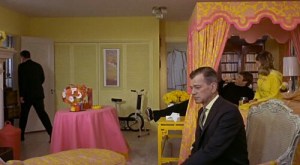 Petulia has a secret. She is fighting for her life. She witnessed Archie perform surgery on a small boy she and her husband became tangled up with—fixing the mess she and her husband made. Her husband abuses her. Archie is the solid, generous, and cool alternative to the privileged, abusive, and secretly volatile world she inhabits. She shows up at Archie’s bachelor apartment, bearing a tuba. Romance of a sort follows. And ends. Archie is perplexed, and then angry that Petulia stays with a man who beats her. And then knows there is nothing he can do.
 Is there anything worse than being mis-known? Than someone making a claim about how you feel or think that has almost nothing to do with your actual thoughts or feelings? I remember an occasion after one of our Thursday night poker games in Binghamton when some poor soul ventured that no matter what I said, he knew that what I felt in my heart was different. I don’t even remember what we were discussing—maybe Moby Dick. My friend Brian looked at me at that moment, acknowledging the serious breach that had been made.
 continuoussearch